
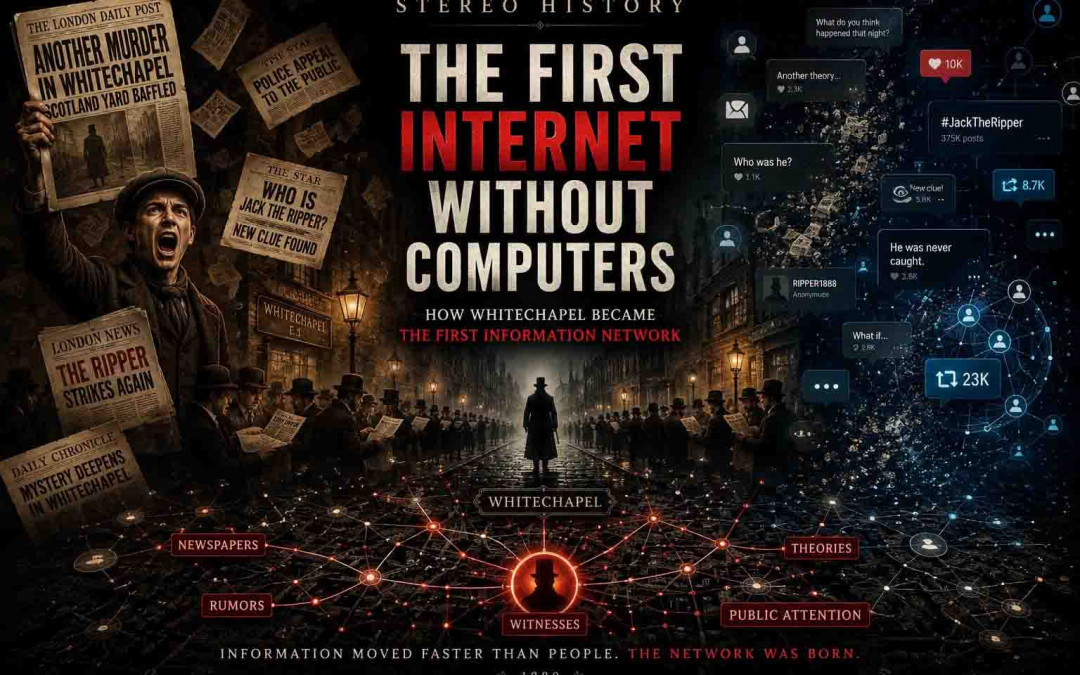
Why Whitechapel Behaved Like a Network
On an autumn morning in 1888, a man in Manchester, Birmingham or Edinburgh could open a newspaper and become emotionally involved in a murder committed in a London district he had never visited.
He could read a witness description, distrust it, discuss it at work, encounter another theory in an evening paper, hear that a letter had supposedly arrived from the killer, and discover the next day that journalists, police and readers were already reacting to reactions produced only hours earlier. Information was moving through society quickly enough that the reporting of the event began to change the event’s cultural form while the underlying investigation remained unresolved.
There were no screens.
No social platforms.
No recommendation algorithms.
No smartphones vibrating in pockets.
Yet something recognizable had begun to happen.
A physical crime entered an information system and became larger than the location in which it occurred. Newspapers reproduced it, correspondents modified it, rumor added material, readers interpreted it, hoaxers entered the conversation, and uncertainty itself became productive. The murderer remained unknown while the public identity associated with him became increasingly legible.
This is where Whitechapel begins to resemble our own century.
Not technologically.
Structurally.
The internet did not begin in Victorian London. But Victorian London already possessed enough connectivity for us to see what happens when information moves faster than certainty.
The Network Was Already There
The late nineteenth century did not suddenly discover mass communication. Europe had postal systems, pamphlets, newspapers, international finance, telegraph networks and long-distance political communication before the Whitechapel murders. Earlier centuries had already produced media panics, celebrated crimes, political rumors and stories capable of crossing borders.
What changed during the nineteenth century was scale, speed and density.
Literacy expanded. Newspapers became cheaper and more competitive. Telegraphy shortened the delay between distant event and public report. Railways accelerated physical distribution. News agencies helped information cross geographical boundaries with unprecedented efficiency.
A story no longer needed to remain close to its place of origin.
This is an important distinction.
Before modern electronic networks, information still traveled physically through paper, wires, presses, trains and human carriers. Nothing had escaped matter. But the relationship between location and attention was weakening.
A murder in Whitechapel could become psychologically present to people far outside Whitechapel.
That is one of the prerequisites of network culture.
The audience no longer needs to share the event.
It needs only to share access to representations of the event.
When Reporting Becomes Part of the Event
We usually imagine journalism as something that comes after reality.
A crime occurs.
A reporter describes it.
The public receives the description.
The sequence appears simple.
But once enough people begin responding to the report, the line collapses.
A newspaper prints a theory.
Readers repeat it.
Someone reports a suspicious man because the theory has changed what they notice.
Police investigate the report.
The investigation becomes another article.
Another newspaper criticizes the police response.
A member of the public sends a letter claiming to come from the murderer.
The letter attracts attention.
Other people imitate it.
The new correspondence consumes investigative resources and produces additional reporting.
At this point, the information surrounding the case is no longer merely a record of what happened.
It has begun generating new events.
This is one of the most important similarities between Whitechapel and modern networked media.
In a connected information system, representation can become causal.
The post about the event changes behavior.
Behavior produces another event.
The new event produces another post.
The network begins feeding on its own consequences.
Nothing supernatural has occurred.
The echo has simply become loud enough to influence the source environment.

Jack the Ripper Becomes a Profile
The most extraordinary element of the case may be the separation between the historical individual and the public identity.
Someone committed the murders.
That is the physical beginning.
But the figure now recognized as Jack the Ripper was assembled through more than murder alone.
The name emerged through correspondence claiming to come from the killer, particularly the famous “Dear Boss” letter, whose authenticity remains doubtful. Newspapers spread the name. Other correspondents adopted the persona. Illustrations supplied imaginary appearances. Later writers supplied increasingly elaborate psychology.
The result is almost the reverse of normal biography.
Ordinarily, a person exists first and a public profile forms around known details.
Here the profile became stable while the person remained unstable.
There was a name without a verified biography.
A voice without secure authorship.
A character without an authenticated face.
In contemporary terms, it resembles an anonymous account whose influence becomes far greater than public knowledge of whoever controls it.
But there is an important difference.
We do not know whether the historical murderer controlled the account at all.
The persona may have been partly produced by other people.
That possibility makes the comparison with the internet more interesting rather than less.
Digital culture repeatedly shows that public identities can become collective constructions. Audiences, commentators, imitators and opponents participate in defining what a figure means.
Whitechapel was already demonstrating the same problem.
The public identity could outgrow the person whose existence originally made it possible.
The Audience Enters the Story
Broadcast media often appear to divide the world into producers and receivers.
Networks behave differently.
Receivers become participants.
This was already visible in the Ripper panic.
Members of the public did not simply consume reports. They supplied tips, suspicions, letters and theories. Some joined patrols. Others wrote to authorities or newspapers. Hoaxers pretended to possess knowledge they did not have. Citizens interpreted strangers according to descriptions circulating through the press.
The audience therefore became one of the mechanisms through which the story developed.
That participation is crucial.
A network is not defined merely by rapid distribution.
It allows information to return from the edges.
The newspaper sends a story outward.
Readers send material back.
Editors select from the material.
The next edition sends the transformed version outward again.
The process resembles a cultural feedback loop.
Slow by contemporary standards.
Fast enough to change behavior.
This is why the metaphor of Whitechapel as an internet without computers is useful when handled carefully. The resemblance is not that every Victorian reader was literally equivalent to a digital node. It is that the information system had begun displaying a familiar property:
the audience was helping produce the thing it was watching.
Mystery Creates Engagement
The unresolved nature of the murders intensified this process.
Certainty closes possibilities.
Uncertainty multiplies them.
If the murderer had been arrested quickly, identified beyond serious doubt, tried and documented, public attention might still have been enormous. But the narrative would have acquired boundaries.
Instead, nearly every important absence created room for another interpretation.
No verified identity.
No confirmed motive.
Conflicting witness descriptions.
Uncertain correspondence.
Disagreement about knowledge and skill.
An unresolved sequence of crimes.
The archive therefore contained enough evidence to sustain inquiry but not enough to terminate it.
This is an unusually powerful informational condition.
Too little information and attention disperses.
Complete information and speculation contracts.
Partial information invites participation.
Modern platforms have not invented this dynamic. They have industrialized it.
An unresolved political story, missing-person case, celebrity scandal or ambiguous video generates enormous engagement because every fragment can be interpreted and every interpretation creates another object of attention.
Mystery is therefore not simply an absence of information.
Within a network, mystery can become a machine for producing information.
Whitechapel demonstrated that mechanism with extraordinary clarity.
Information Can Outrun Verification
The telegraph and newspaper radically increased the velocity of information relative to earlier communication systems.
But speed creates an old problem in a new form.
Verification takes time.
Transmission can become faster than confidence.
The result is a gap.
Inside that gap live rumor, exaggeration, premature theories and mistaken identities.
This remains one of the defining problems of contemporary media.
A claim can circulate globally before specialists establish whether it is true. Corrections then enter an environment already shaped by the original story. The false version may possess the advantage of emotional simplicity, repetition or dramatic timing.
Victorian journalism operated at an incomparably slower speed, yet the structural problem was already visible.
A claim about the murderer could become culturally important even if it later proved unreliable.
A letter could affect public imagination before its authorship was established.
A suspect’s name could circulate before evidence justified the attention.
The network did not need truth in order to transmit.
It needed transmissibility.
That difference is fundamental.
Information systems move what can be represented.
They do not automatically distinguish between what is true and what merely travels well.

The Attention Economy Did Not Begin in Whitechapel
The phrase attention economy is useful here, but history requires restraint.
Publishers competed for readers long before 1888.
Public entertainers competed for audiences.
Political speakers competed for crowds.
Religions, pamphleteers and advertisers understood the value of attracting attention long before economists gave the phenomenon modern terminology.
Whitechapel therefore did not create the first attention economy.
What it shows especially well is the interaction between commercial media and unresolved public fear.
Crime attracted readership.
Competition rewarded novelty.
Novelty encouraged speculation.
Speculation produced further attention.
The mechanism could become self-reinforcing even when no editor consciously planned the entire system.
This is another feature that resembles digital platforms.
Systems can create outcomes no individual participant intended.
A journalist wants a strong story.
A reader wants information.
An editor wants circulation.
A hoaxer wants amusement.
Police want useful tips.
Each actor pursues a local purpose.
Together they can produce a large informational phenomenon.
This is one reason network history should not search too quickly for a mastermind.
Sometimes nobody controls the whole machine.
The pattern emerges from interaction.
The First Viral Ghost Was Already Distributed
Jack the Ripper eventually became something remarkably similar to a network-native identity.
He survives without a confirmed original.
The name is copied.
The story is retold.
The visual conventions are reproduced.
New theories attach themselves to the existing pattern.
Each generation modifies the figure while preserving enough features for recognition.
That resembles virality.
But again, the internet comparison becomes strongest once we stop calling the Ripper the first anything.
Stories had reproduced across populations long before him.
Anonymous legends survived without authors.
Political rumors spread across kingdoms.
Religious narratives crossed continents.
What Whitechapel offers is a particularly modern combination:
mass-market journalism,
rapid communication,
anonymous identity,
public participation,
commercial incentives,
continuous speculation,
and permanent archival incompleteness.
The figure became capable of moving between media without requiring the historical man to appear again.
The individual disappeared.
The cultural object became portable.
That is close to what digital networks later made ordinary.
The Network Eventually Forgot the District
There is an irony in calling Whitechapel the center of the phenomenon.
The district itself was real.
People lived there.
Worked there.
Raised children there.
Slept in lodging houses.
Bought food.
Argued.
Drank.
Survived.
The murders affected actual communities.
Yet the media representation gradually transformed Whitechapel into something symbolic: darkness, poverty, fog, danger, labyrinth, Victorian horror.
The informational Whitechapel became more portable than the geographical one.
This is another network effect.
Places can become symbols that travel independently of local complexity.
Harlem.
Wall Street.
Hollywood.
Chernobyl.
Silicon Valley.
Whitechapel.
The name begins by identifying geography.
Eventually it can evoke an entire cultural model.
The compression is efficient.
It is also dangerous.
Real neighborhoods become stages upon which outsiders project fears and fantasies.
The map starts replacing the territory.
This matters because modern network culture performs the same operation at much greater speed.
A location appears online through a few images or narratives.
Millions of people acquire an impression.
The impression can influence tourism, policing, investment or stigma.
A representation begins producing consequences for the place it supposedly represents.
Again the informational layer returns to alter the physical one.
On an autumn morning in 1888, a man in Manchester, Birmingham or Edinburgh could open a newspaper and become emotionally involved in a murder committed in a London district he had never visited.
He could read a witness description, distrust it, discuss it at work, encounter another theory in an evening paper, hear that a letter had supposedly arrived from the killer, and discover the next day that journalists, police and readers were already reacting to reactions produced only hours earlier. Information was moving through society quickly enough that the reporting of the event began to change the event’s cultural form while the underlying investigation remained unresolved.
There were no screens.
No social platforms.
No recommendation algorithms.
No smartphones vibrating in pockets.
Yet something recognizable had begun to happen.
A physical crime entered an information system and became larger than the location in which it occurred. Newspapers reproduced it, correspondents modified it, rumor added material, readers interpreted it, hoaxers entered the conversation, and uncertainty itself became productive. The murderer remained unknown while the public identity associated with him became increasingly legible.
This is where Whitechapel begins to resemble our own century.
Not technologically.
Structurally.
The internet did not begin in Victorian London. But Victorian London already possessed enough connectivity for us to see what happens when information moves faster than certainty.
The Network Was Already There
The late nineteenth century did not suddenly discover mass communication. Europe had postal systems, pamphlets, newspapers, international finance, telegraph networks and long-distance political communication before the Whitechapel murders. Earlier centuries had already produced media panics, celebrated crimes, political rumors and stories capable of crossing borders.
What changed during the nineteenth century was scale, speed and density.
Literacy expanded. Newspapers became cheaper and more competitive. Telegraphy shortened the delay between distant event and public report. Railways accelerated physical distribution. News agencies helped information cross geographical boundaries with unprecedented efficiency.
A story no longer needed to remain close to its place of origin.
This is an important distinction.
Before modern electronic networks, information still traveled physically through paper, wires, presses, trains and human carriers. Nothing had escaped matter. But the relationship between location and attention was weakening.
A murder in Whitechapel could become psychologically present to people far outside Whitechapel.
That is one of the prerequisites of network culture.
The audience no longer needs to share the event.
It needs only to share access to representations of the event.
Watch The Video
When Reporting Becomes Part of the Event
We usually imagine journalism as something that comes after reality.
A crime occurs.
A reporter describes it.
The public receives the description.
The sequence appears simple.
But once enough people begin responding to the report, the line collapses.
A newspaper prints a theory.
Readers repeat it.
Someone reports a suspicious man because the theory has changed what they notice.
Police investigate the report.
The investigation becomes another article.
Another newspaper criticizes the police response.
A member of the public sends a letter claiming to come from the murderer.
The letter attracts attention.
Other people imitate it.
The new correspondence consumes investigative resources and produces additional reporting.
At this point, the information surrounding the case is no longer merely a record of what happened.
It has begun generating new events.
This is one of the most important similarities between Whitechapel and modern networked media.
In a connected information system, representation can become causal.
The post about the event changes behavior.
Behavior produces another event.
The new event produces another post.
The network begins feeding on its own consequences.
Nothing supernatural has occurred.
The echo has simply become loud enough to influence the source environment.
Jack the Ripper Becomes a Profile
The most extraordinary element of the case may be the separation between the historical individual and the public identity.
Someone committed the murders.
That is the physical beginning.
But the figure now recognized as Jack the Ripper was assembled through more than murder alone.
The name emerged through correspondence claiming to come from the killer, particularly the famous “Dear Boss” letter, whose authenticity remains doubtful. Newspapers spread the name. Other correspondents adopted the persona. Illustrations supplied imaginary appearances. Later writers supplied increasingly elaborate psychology.
The result is almost the reverse of normal biography.
Ordinarily, a person exists first and a public profile forms around known details.
Here the profile became stable while the person remained unstable.
There was a name without a verified biography.
A voice without secure authorship.
A character without an authenticated face.
In contemporary terms, it resembles an anonymous account whose influence becomes far greater than public knowledge of whoever controls it.
But there is an important difference.
We do not know whether the historical murderer controlled the account at all.
The persona may have been partly produced by other people.
That possibility makes the comparison with the internet more interesting rather than less.
Digital culture repeatedly shows that public identities can become collective constructions. Audiences, commentators, imitators and opponents participate in defining what a figure means.
Whitechapel was already demonstrating the same problem.
The public identity could outgrow the person whose existence originally made it possible.
The Audience Enters the Story
Broadcast media often appear to divide the world into producers and receivers.
Networks behave differently.
Receivers become participants.
This was already visible in the Ripper panic.
Members of the public did not simply consume reports. They supplied tips, suspicions, letters and theories. Some joined patrols. Others wrote to authorities or newspapers. Hoaxers pretended to possess knowledge they did not have. Citizens interpreted strangers according to descriptions circulating through the press.
The audience therefore became one of the mechanisms through which the story developed.
That participation is crucial.
A network is not defined merely by rapid distribution.
It allows information to return from the edges.
The newspaper sends a story outward.
Readers send material back.
Editors select from the material.
The next edition sends the transformed version outward again.
The process resembles a cultural feedback loop.
Slow by contemporary standards.
Fast enough to change behavior.
This is why the metaphor of Whitechapel as an internet without computers is useful when handled carefully. The resemblance is not that every Victorian reader was literally equivalent to a digital node. It is that the information system had begun displaying a familiar property:
the audience was helping produce the thing it was watching.
Mystery Creates Engagement
The unresolved nature of the murders intensified this process.
Certainty closes possibilities.
Uncertainty multiplies them.
If the murderer had been arrested quickly, identified beyond serious doubt, tried and documented, public attention might still have been enormous. But the narrative would have acquired boundaries.
Instead, nearly every important absence created room for another interpretation.
No verified identity.
No confirmed motive.
Conflicting witness descriptions.
Uncertain correspondence.
Disagreement about knowledge and skill.
An unresolved sequence of crimes.
The archive therefore contained enough evidence to sustain inquiry but not enough to terminate it.
This is an unusually powerful informational condition.
Too little information and attention disperses.
Complete information and speculation contracts.
Partial information invites participation.
Modern platforms have not invented this dynamic. They have industrialized it.
An unresolved political story, missing-person case, celebrity scandal or ambiguous video generates enormous engagement because every fragment can be interpreted and every interpretation creates another object of attention.
Mystery is therefore not simply an absence of information.
Within a network, mystery can become a machine for producing information.
Whitechapel demonstrated that mechanism with extraordinary clarity.
Information Can Outrun Verification
The telegraph and newspaper radically increased the velocity of information relative to earlier communication systems.
But speed creates an old problem in a new form.
Verification takes time.
Transmission can become faster than confidence.
The result is a gap.
Inside that gap live rumor, exaggeration, premature theories and mistaken identities.
This remains one of the defining problems of contemporary media.
A claim can circulate globally before specialists establish whether it is true. Corrections then enter an environment already shaped by the original story. The false version may possess the advantage of emotional simplicity, repetition or dramatic timing.
Victorian journalism operated at an incomparably slower speed, yet the structural problem was already visible.
A claim about the murderer could become culturally important even if it later proved unreliable.
A letter could affect public imagination before its authorship was established.
A suspect’s name could circulate before evidence justified the attention.
The network did not need truth in order to transmit.
It needed transmissibility.
That difference is fundamental.
Information systems move what can be represented.
They do not automatically distinguish between what is true and what merely travels well.
The Attention Economy Did Not Begin in Whitechapel
The phrase attention economy is useful here, but history requires restraint.
Publishers competed for readers long before 1888.
Public entertainers competed for audiences.
Political speakers competed for crowds.
Religions, pamphleteers and advertisers understood the value of attracting attention long before economists gave the phenomenon modern terminology.
Whitechapel therefore did not create the first attention economy.
What it shows especially well is the interaction between commercial media and unresolved public fear.
Crime attracted readership.
Competition rewarded novelty.
Novelty encouraged speculation.
Speculation produced further attention.
The mechanism could become self-reinforcing even when no editor consciously planned the entire system.
This is another feature that resembles digital platforms.
Systems can create outcomes no individual participant intended.
A journalist wants a strong story.
A reader wants information.
An editor wants circulation.
A hoaxer wants amusement.
Police want useful tips.
Each actor pursues a local purpose.
Together they can produce a large informational phenomenon.
This is one reason network history should not search too quickly for a mastermind.
Sometimes nobody controls the whole machine.
The pattern emerges from interaction.
The First Viral Ghost Was Already Distributed
Jack the Ripper eventually became something remarkably similar to a network-native identity.
He survives without a confirmed original.
The name is copied.
The story is retold.
The visual conventions are reproduced.
New theories attach themselves to the existing pattern.
Each generation modifies the figure while preserving enough features for recognition.
That resembles virality.
But again, the internet comparison becomes strongest once we stop calling the Ripper the first anything.
Stories had reproduced across populations long before him.
Anonymous legends survived without authors.
Political rumors spread across kingdoms.
Religious narratives crossed continents.
What Whitechapel offers is a particularly modern combination:
mass-market journalism,
rapid communication,
anonymous identity,
public participation,
commercial incentives,
continuous speculation,
and permanent archival incompleteness.
The figure became capable of moving between media without requiring the historical man to appear again.
The individual disappeared.
The cultural object became portable.
That is close to what digital networks later made ordinary.
The Network Eventually Forgot the District
There is an irony in calling Whitechapel the center of the phenomenon.
The district itself was real.
People lived there.
Worked there.
Raised children there.
Slept in lodging houses.
Bought food.
Argued.
Drank.
Survived.
The murders affected actual communities.
Yet the media representation gradually transformed Whitechapel into something symbolic: darkness, poverty, fog, danger, labyrinth, Victorian horror.
The informational Whitechapel became more portable than the geographical one.
This is another network effect.
Places can become symbols that travel independently of local complexity.
Harlem.
Wall Street.
Hollywood.
Chernobyl.
Silicon Valley.
Whitechapel.
The name begins by identifying geography.
Eventually it can evoke an entire cultural model.
The compression is efficient.
It is also dangerous.
Real neighborhoods become stages upon which outsiders project fears and fantasies.
The map starts replacing the territory.
This matters because modern network culture performs the same operation at much greater speed.
A location appears online through a few images or narratives.
Millions of people acquire an impression.
The impression can influence tourism, policing, investment or stigma.
A representation begins producing consequences for the place it supposedly represents.
Again the informational layer returns to alter the physical one.
How to Read the World
Current Knowledge
The Whitechapel murders occurred during a period of significant expansion in mass journalism, literacy, cheap print, rail distribution and telegraphic communication. These systems enabled information about the crimes to circulate far beyond the East End relatively quickly by nineteenth-century standards.
Mass-mediated crime and networked information did not begin with the Ripper murders. Earlier newspapers, pamphlets, postal systems, telegraphs and public scandals had already connected geographically dispersed audiences, sometimes on a very large scale.
The name “Jack the Ripper” became famous through correspondence claiming to come from the murderer. The authenticity of the best-known letters remains uncertain, and much Ripper correspondence was fraudulent. The public persona should therefore be distinguished from the unknown historical offender.
Contemporary newspapers varied substantially in accuracy, tone and sensationalism. Their reporting became part of the social environment surrounding the investigation by influencing public fear, generating tips, circulating theories and providing a platform for letters and commentary.
The modern internet differs fundamentally from Victorian media in speed, scale, interactivity, automation, storage and algorithmic distribution. Any comparison with Whitechapel is therefore structural and metaphorical rather than technological.
Open Questions
The first question is how far the feedback loop between reporting and criminal behavior actually extended. We know that media coverage altered public behavior and the investigative environment, but whether the murderer himself consciously adapted to publicity remains unresolved. Authentic correspondence would strengthen the case for deliberate media interaction; without it, we should resist attributing a sophisticated publicity strategy to the unknown offender.
A second question concerns whether network behavior has stable properties across technologies. Rumor, imitation, distributed participation and competition for attention appear in very different media environments, but similar outcomes do not necessarily imply identical mechanisms. The Victorian newspaper system and today’s algorithmic platforms operate under profoundly different conditions even when the resulting cultural patterns occasionally resemble one another.
There is also the question of threshold. At what point does a communication system become sufficiently fast and participatory that reporting no longer merely follows events but begins shaping their subsequent development? Whitechapel may be useful precisely because we can observe that threshold while the machinery remains comparatively visible.
Finally, we should ask how much unresolvedness contributes to informational longevity. Did the Ripper case survive because of the nature of the murders, the media environment, the unknown identity, later cultural mythology, or an unusually effective combination of all four? Separating those factors remains difficult.
Transhumation Interpretation
The Whitechapel case belongs to Transhumation because it shows that networks do more than move information.
They transform the relationship between event, representation and observer.
A physical event begins locally.
A representation leaves the location.
Another observer interprets it.
That interpretation becomes another representation.
The new representation returns to the network and changes what subsequent observers encounter.
After enough iterations, the system no longer contains only reports about the original event.
It contains reactions to reactions, theories about theories and identities assembled from fragments produced by people who were never present at the beginning.
This is not a flaw unique to newspapers or the internet.
It is a general property of mediated culture.
The more powerful the network becomes, the more important provenance becomes.
Where did this claim originate?
Was this witness contemporary?
Was this letter authenticated?
Did this photograph show the thing it later came to represent?
Is this statement evidence, inference or repetition?
Without those distinctions, the network accumulates coherence faster than knowledge.
Jack the Ripper is almost a perfect demonstration.
The unknown historical person sits at the center of an enormous information architecture.
But the architecture is not simply a magnified portrait of him.
It contains journalism.
Hoaxes.
Later memory.
Errors.
Historical research.
Fiction.
Film.
Tourism.
Digital debate.
The network has preserved the case spectacularly while failing at the most basic task of preservation:
identifying the person.
That paradox matters for the Library of Mirrors.
More information does not automatically mean a clearer reflection.
A library can become larger while the object sought inside it remains obscure.
An AI system capable of searching the entire archive may greatly improve navigation, yet the fundamental distinction remains between discovering a relationship supported by evidence and generating the most satisfying pattern available.
This is where the comparison with modern networks becomes especially important.
Today’s systems solve distribution extraordinarily well.
What they do not solve automatically is truth.
Indeed, distribution can amplify the consequences of error.
The network is structurally indifferent to whether a pattern deserves survival.
It rewards whatever its mechanisms allow to reproduce.
Modern algorithmic systems add another layer because they do not merely transmit material. They rank it.
They predict attention.
They select.
They personalize.
Victorian newspapers competed for readers, but today’s systems can continuously measure the behavior of individual users and adjust subsequent information flows.
That is a profound difference.
The nineteenth-century network taught civilization that a story could become larger than its source.
The twenty-first-century network can decide which version of the story each person is most likely to encounter.
Artificial intelligence may introduce another stage.
Instead of retrieving only existing fragments, systems can synthesize explanations across enormous archives.
Used well, that could make history more navigable than ever before.
Used badly, it could create a perfectly coherent Whitechapel that never existed.
The danger is not simply hallucination in the technical sense.
It is premature closure.
The machine sees fragments.
The human wants a man.
The system produces one.
Suddenly the mystery feels solved because uncertainty has been compressed into a convincing narrative.
A good librarian should resist that temptation.
Sometimes the most truthful answer is not another theory.
It is a carefully preserved empty space.
This is why the title The First Internet Without Computers should remain deliberately provocative rather than literal.
Whitechapel did not invent the networked world.
It gives us something more useful.
A historical model in which we can see recognizable network behavior before digital machinery made the behavior so fast and continuous that it became difficult to inspect.
Readers became participants.
Rumors became inputs.
Public identities became detachable from verified people.
Media competition amplified ambiguity.
Information generated more information.
The carrier was paper rather than silicon.
The latency was measured in hours rather than milliseconds.
But one principle already looks unsettlingly familiar:
once a society becomes connected enough, information no longer merely describes reality. It enters the machinery that produces the next version of reality.
That is the real bridge between Whitechapel and the internet.
Not computers.
Feedback.
FAQ
Was Whitechapel really the first internet?
No. The title is metaphorical. Long-distance communication networks and mass information systems existed before 1888. Whitechapel is useful because the Ripper case displayed several behaviors that later became familiar in digital networks.
What makes the comparison convincing?
Rapid information circulation, public participation, anonymity, rumor, competing interpretations and an unresolved story produced a self-reinforcing media phenomenon.
Was Jack the Ripper like an anonymous online identity?
Structurally, there is an interesting resemblance: the public name became highly recognizable while the real individual remained unknown. But we do not know whether the murderer deliberately created or controlled that persona.
Did Victorian newspapers work like social media?
Only in limited ways. Newspapers allowed mass circulation and some public feedback, but modern platforms are far faster, more interactive, personalized and algorithmically organized.
Why did the Ripper story survive so strongly?
The combination of serious crimes, intense media attention, missing identity and unresolved evidence left enough structure for recognition while preserving enormous interpretive space.
What is the deeper Transhumation question?
Networks do more than preserve events. They continuously reconstruct them.
The question is therefore not only whether information survives its original carrier, but whether the thing that survives is still the event itself—or the pattern created by everyone who encountered it afterward.
Continue the Transhumation Series
- Forgotten Religion | Ancient Gods, Symbols and the Hidden Structures of Human Civilization
- The Last Religion | Death, Immortality and the Future of Humanity
- The New Theurgy | AI, Information and the Future of Human Civilization
- End of Branding: You Were Never Meant to Become a Product
- Baal vs Ishtar: Why Ancient Gods Never Disappeared