
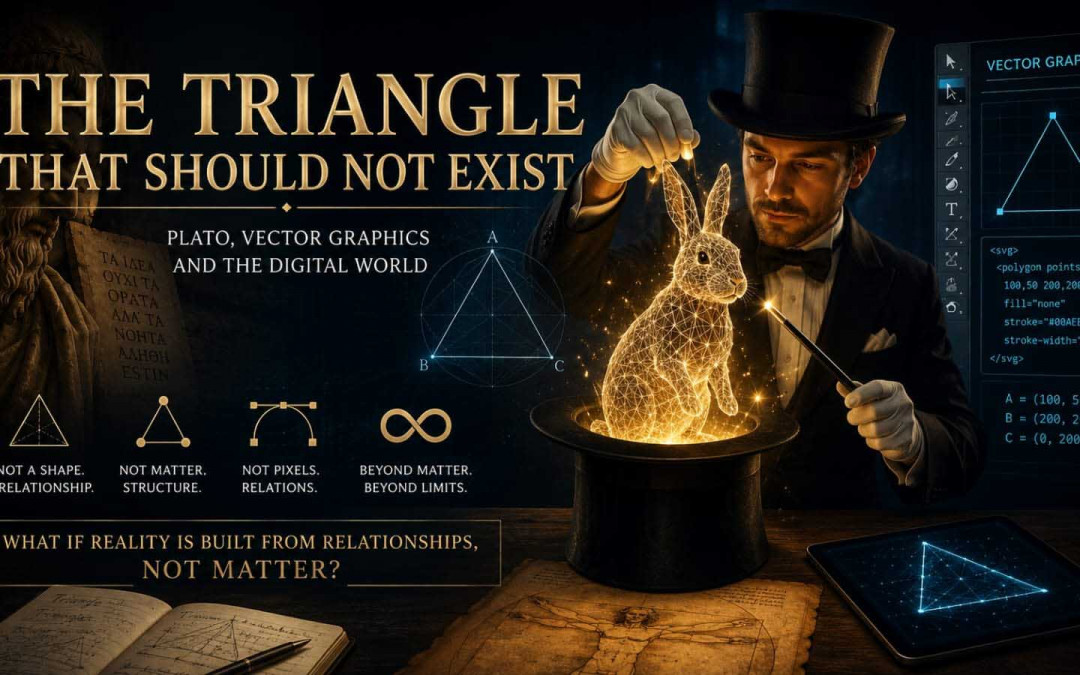
Strange Independence of Structure
Draw a triangle on a piece of paper and immediately something has gone wrong. The line has thickness. The graphite spreads unevenly into the fibers. The corners that appear sharp to the naked eye become rough landscapes under magnification. Even a machinist working with extraordinary precision cannot manufacture three lines without width meeting at mathematically dimensionless points. The physical world gives us objects that are triangular, but the triangle used by geometry seems to demand something no physical object can quite provide.
This is one of those philosophical problems that sounds trivial until it refuses to disappear. Children understand triangles before they understand why the question is difficult. Architects calculate them. Engineers trust them. Surveyors use them to reconstruct distances. Computer graphics depend upon them in quantities so enormous that modern visual culture would be difficult to imagine without them. Yet the geometrical object itself is not identical with any triangle that has ever been drawn.
Plato would have recognized the discomfort immediately. His philosophy treated the relation between changing particulars and stable intelligible structures as one of the central problems of knowledge. The popular version says that Plato believed perfect triangles existed in a separate invisible world while physical triangles were merely imperfect copies. That is useful as a first approximation, but his theory of Forms is larger and more complicated than a story about perfect geometric shapes floating somewhere beyond the sky. Still, geometry remains one of the clearest ways of feeling the Platonic problem.
The drawn triangle changes.
The relation we reason about does not seem to change with the drawing.
More than two thousand years later, computers have not solved the metaphysics. They have done something almost as interesting: they have made the distinction technologically useful.
The Triangle Before the Picture
A raster image stores an image through a grid of pixels. A diagonal edge therefore becomes a particular arrangement of colored cells. Enlarge the image far enough and the smooth line begins to reveal the grid from which it was built.
Vector graphics work differently. A shape can be represented through mathematical descriptions: coordinates, curves, paths, transformations and relationships among points. The system does not need to begin from a fixed photograph of a triangle at one particular size. It can store enough information to generate the triangle again at many different scales.
That distinction sounds technical until one notices what has happened philosophically.
The visible triangle is no longer the primary object being preserved.
The relationship capable of producing triangles becomes primary.
Change the display. Change the resolution. Print it. Project it onto a wall. Render it on a screen that did not exist when the file was created. The material implementation changes repeatedly while enough of the mathematical description remains stable for us to recognize the same geometric construction.
Of course, the process is not literally infinite or perfectly exact. Real computers use finite memory and finite numerical precision. Displays contain finite pixels. Printers have physical tolerances. At sufficiently extreme scales, implementation details matter.
But those limitations do not erase the deeper distinction.
A raster picture says, roughly, preserve these visible samples.
A vector description says, preserve these relations and draw the visible object again.
That is a profound change in what counts as continuity.
Plato Did Not Predict Adobe Illustrator
There is always a temptation, especially when ancient philosophy meets modern technology, to turn resemblance into prophecy. Plato imagined Forms; computers manipulate mathematical structures; therefore Plato somehow anticipated the digital world.
That would be a mistake.
Plato did not predict vector graphics, CAD systems or computational geometry. His metaphysical questions emerged from an intellectual world radically different from ours. Modern mathematics and computer science developed through histories that cannot be collapsed into ancient philosophy.
What technology gives us is not proof of Plato.
It gives us a new environment in which an old question becomes unusually visible.
Suppose a triangle is represented on one machine, transmitted as data, interpreted by another machine and rendered at a different size. Which of those physical images is the triangle?
The obvious answer is that none has exclusive ownership of it.
They are instances.
What persists is something closer to a rule, relation or mathematical structure that can be instantiated repeatedly in different physical conditions.
This does not establish an independent realm of Platonic Forms. A nominalist, structuralist, formalist and Platonist can interpret the same technological fact differently.
But everyone must explain the same curious success: one organized relation can remain recognizable while its particular physical realization changes.
That is the part Transhumation should care about.
A Shape That Survives Its Carrier
This becomes clearer if the triangle moves through several media.
Draw it in chalk.
Represent it in an SVG file.
Cut it from steel.
Project it with light.
Describe it using coordinates.
Build it from wooden rods.
None of these objects is materially identical with the others. They differ in mass, color, scale, texture and physical composition. Yet under the right criteria we call all of them triangles because a particular relation has survived the change of carrier.
This is almost embarrassingly simple.
It is also one of the foundations of civilization.
A melody can survive a change of instrument because certain musical relationships remain recognizable even when timbre changes. A text can survive movement from manuscript to print to digital display because the relevant linguistic order persists. Software can run on different compatible machines because the logical organization is not tied to one original block of silicon, although it always requires some physical implementation.
The lesson is not that matter has become irrelevant.
The lesson is that identity can sometimes depend upon which properties we choose to preserve.
For the triangle, we care primarily about geometric relations.
For a medieval manuscript, the wording may survive digitization while the historical object does not.
For a painting, a perfect digital scan may preserve visual appearance without becoming the original painting.
The carrier-and-pattern distinction therefore works beautifully until someone asks the dangerous question:
What kind of object is a person?
The Digital World Is Built From Re-instantiation
Modern computing makes carrier independence feel normal because software constantly moves between physical implementations.
A document created on one machine can be opened on another. A 3D model can be displayed on a laptop, manufactured by a machine tool or rendered inside a simulation. A mathematical object described abstractly can become a diagram, an animation or part of an engineering calculation.
Again, the physical world never disappears.
The server is material.
The processor is material.
The electrical states are material.
The screen is material.
But the useful structure can be re-instantiated in different material systems.
This may be one of the most important conceptual habits digital civilization has taught billions of people without ever presenting it as philosophy.
We routinely distinguish the file from the laptop.
The song from the speaker.
The document from the screen.
The game from the console.
The model from the printer that happens to manufacture it today.
We have become culturally comfortable with objects whose continuity is defined partly by organization rather than by preservation of one original piece of matter.
That would have been philosophically familiar to Plato even if the machines would have been incomprehensible.
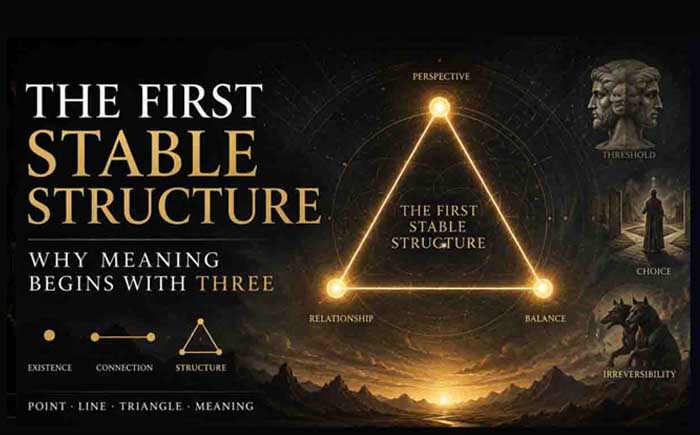
The Dangerous Jump From Geometry to Identity
Once the triangle survives its screen, an obvious temptation appears.
Perhaps everything important works this way.
Memory.
Personality.
Identity.
Consciousness.
Perhaps the body is merely another carrier and the human being is the pattern.
This is exactly where the argument must slow down.
A triangle has no point of view.
Copy a triangle and nothing philosophically disturbing occurs. Two perfect representations do not compete for the right to be the “real continuing triangle” in the way two copies of a person would.
Software can be duplicated because duplication is often part of what software is designed to permit. A song can exist in ten thousand copies without creating ten thousand rival continuities of one experiencing subject.
Personal identity introduces a different problem.
Suppose a future technology reproduced a person’s memories, dispositions, neural organization and behavioral patterns with extraordinary accuracy. The copy wakes and says, “I am the same person.”
Now suppose the original remains alive.
Both remember the same childhood.
Both recognize the same family.
Both sincerely claim continuity with the same past.
The pattern may have been copied successfully.
The observer appears to have branched.
This is why the triangle is valuable not because it proves that people are transferable patterns, but because it tells us precisely where that analogy begins—and where it stops being easy.
Mathematics Without Metaphysics
There is another reason the triangle remains interesting.
Modern civilization depends intensely upon abstract mathematics whether or not society agrees about what mathematical objects ultimately are.
Aircraft are designed using mathematics.
Bridges are modeled mathematically.
Digital graphics use coordinate geometry.
Physics describes regularities through equations.
Navigation relies on mathematical relationships.
Machine learning depends upon high-dimensional numerical structures that no human being experiences directly as physical shapes.
We therefore inhabit a civilization whose practical success relies on abstractions whose philosophical status remains disputed.
That is a remarkable situation.
We can disagree about whether mathematical structures are discovered or invented while using them to land spacecraft.
The metaphysics remains open.
The engineering works.
Perhaps this is why the triangle should not be turned into an argument for one philosophical camp. Its real value is that it demonstrates something narrower and harder to deny: relationships can possess operational continuity across changes in representation.
That fact does not solve Plato.
It explains why Plato remains difficult to dismiss.
Watch The Video
How to Read the World

Current Knowledge
A physically drawn triangle can only approximate the idealized geometric triangle used in mathematics. Real lines have thickness, measurements have tolerances and physical objects contain irregularities. Mathematics nevertheless allows exact relations to be defined within formal systems without requiring a physically perfect drawing.
Plato’s theory of Forms concerns the relationship between changing particulars and stable intelligible objects or properties, although its interpretation varies across dialogues and among scholars. Reducing the theory entirely to “perfect shapes existing somewhere else” oversimplifies Plato’s broader metaphysics.
Vector graphics describe shapes using mathematical parameters such as points, paths and curves rather than storing only a fixed grid of pixel values. This allows the image to be rendered at different sizes without the same resolution-dependent pixelation characteristic of raster enlargement. Actual computer implementations still rely on finite precision and physical hardware.
Modern science and engineering make extensive use of abstract mathematical models, but this practical success does not settle the philosophical dispute over whether mathematical entities exist independently of human minds.
There is currently no scientific demonstration that the carrier independence visible in mathematical descriptions or software automatically extends to personal consciousness.
Open Questions
The oldest question remains surprisingly alive: are mathematical structures invented by minds, discovered by minds or best understood without forcing that binary at all? The technological usefulness of mathematics intensifies the question without settling it.
There is also a question about identity across representation. When a vector object moves between machines and file formats, we usually know which properties must remain invariant. For more complicated entities, the criterion becomes less obvious. How much alteration can a melody, institution or language undergo before continuity becomes only metaphorical?
The human case is harder still. If biological consciousness depends on dynamic organization, embodiment and causal continuity, would reproducing the organization elsewhere preserve the observer or merely reproduce the pattern? No current experiment answers this.
And finally there is a question that returns directly to Plato: why is abstract mathematics so effective in describing physical reality at all? Whether that effectiveness reflects deep structure in nature, the selective construction of human models or some relationship between the two remains a philosophical problem of unusual durability.
Transhumation Interpretation
The triangle gives Transhumation one of its cleanest examples of a carrier-independent structure.
Not carrier-free.
Carrier-independent.
That distinction matters enormously.
The mathematical relation does not need one particular chalkboard. It does not need one screen, one sheet of paper or one arrangement of pixels. It requires some representation when humans or machines work with it, but the representation can change while the relevant structure remains recoverable.
This is a modest claim.
It is also revolutionary.
It means that at least some things possess continuity that cannot be identified simply with persistence of their original material.
Civilization already depends on this principle everywhere.
Texts survive manuscripts.
Software survives individual computers.
Mathematical descriptions survive notation.
Songs survive instruments.
Institutional rules survive officeholders.
The pattern migrates because another carrier can instantiate enough of the same relations.
This is why the triangle belongs beside the Carrier and the Pattern, the LEGO Principle and the Julian Experiment.
Together they form a sequence.
First, we discover that a recognizable structure can survive changing matter.
Then we ask which properties actually have to survive.
Finally, we ask whether copying those properties preserves the thing—or merely creates another instance of it.
For geometry, that final problem is easy.
For consciousness, it may be everything.
The triangle therefore does not tell us that a human being is downloadable.
It teaches us the intellectual discipline required before we can even ask the question properly.
Do not ask only what something is made of.
Ask which relationships define it.
Then ask whether those relationships are sufficient.
Then ask what happens if they are instantiated twice.
That third step is where many fantasies of digital immortality begin to break.
Plato’s triangle remains beautifully indifferent to the problem. Reproduce it on a thousand screens and nothing has been lost. There is no privileged first triangle demanding continuity with itself.
A person is different because there appears to be a first-person perspective involved.
The structure may be copied.
The question is whether the perspective crosses.
That is the boundary Transhumation should refuse to hide behind elegant metaphors.
And perhaps this is why the triangle is more interesting now than it was when it was only scratched into dust. Digital civilization has given us daily experience of patterns migrating between carriers. It has made structural continuity ordinary.
We know the trick works for some things.
The next century may be defined by discovering where it stops.
FAQ
Does a perfect physical triangle exist?
Probably not in the strict mathematical sense. Every physical triangle has finite thickness, measurement limits and material imperfections. Mathematical geometry deals with idealized relations rather than perfect manufactured objects.
What does Plato have to do with triangles?
Geometry provides a useful illustration of Plato’s wider concern with stable intelligible structures and imperfect changing particulars, although his theory of Forms is much broader than geometry alone.
Why are vector graphics important here?
Because they show how a visible shape can be generated from mathematical relations rather than preserved only as one fixed grid of pixels. The same description can produce recognizable instances on different physical systems.
Does vector graphics prove Plato was right?
No. It demonstrates the practical power of abstract mathematical representation, not the existence of a separate metaphysical realm of Forms.
Does the triangle prove identity can survive a change of body?
No. It proves only that some structures can survive changes of carrier. Consciousness and personal identity introduce additional problems involving embodiment, causal continuity and first-person experience.
What is the deeper Transhumation question?
The fascinating question is no longer whether patterns can survive different carriers. Some clearly can.
The question is which things remain the same when their carrier changes.
For the triangle, we know what must survive.
For ourselves, we still do not.
Continue the Transhumation Series
- Forgotten Religion | Ancient Gods, Symbols and the Hidden Structures of Human Civilization
- The Last Religion | Death, Immortality and the Future of Humanity
- The New Theurgy | AI, Information and the Future of Human Civilization
- End of Branding: You Were Never Meant to Become a Product
- Baal vs Ishtar: Why Ancient Gods Never Disappeared