
God`s Cruel Design
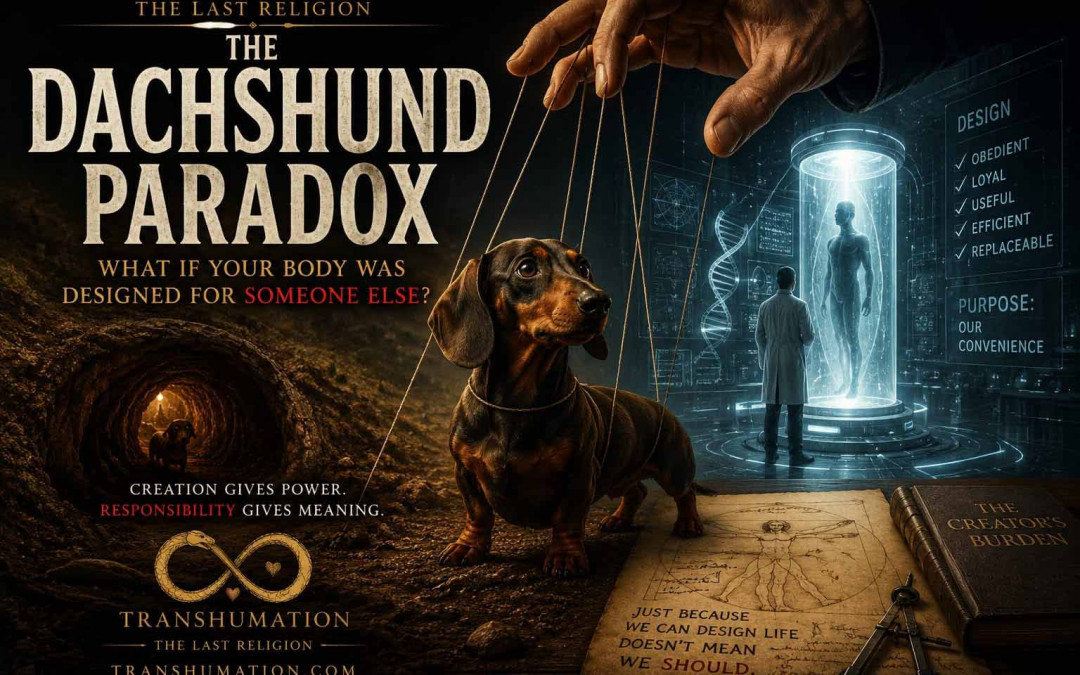
A dachshund crossing a kitchen floor is difficult not to like. The proportions are almost comic: a long body carried improbably close to the ground, short legs moving faster than expected, oversized confidence packaged into a shape that looks as though somebody dragged a normal dog sideways in a drawing program. The animal appears to have been designed by a child who refused to obey conventional geometry.
In a sense, somebody did design it.
Not one person, not in a laboratory, and not with a blueprint. But over generations, humans selectively bred dogs for traits that served human purposes. The dachshund’s low body and short legs were useful for going into burrows, particularly in hunting badgers and other quarry. What looks today like charm is partly the visible residue of a long engineering process conducted through breeding rather than machinery.
That makes the dachshund more philosophically interesting than its size suggests.
Because once another species begins shaping your body for its own goals, a strange question appears:
Progress for whom?
The Dog Under the Table
Selective breeding is so familiar that its radical nature is easy to miss. Human beings did not merely tame wolves and leave them alone. Over thousands of years we altered size, coat, skull shape, temperament, speed, strength, scenting ability, reproductive traits and countless other characteristics. The modern dog is not a single natural solution. It is a landscape of human preferences made biological.
Some breeds were optimized for herding.
Some for guarding.
Some for hunting.
Some for appearance.
Some for companionship.
The dachshund belongs to a lineage shaped partly around a very practical requirement: enter narrow spaces and pursue animals underground.
From the human perspective, this is obvious success.
The body works.
The animal performs the task.
The trait reproduces.
But the creator’s perspective is not the only perspective available.
The same elongated body and shortened limbs are associated with elevated risk of intervertebral disc disease and other health problems. The useful form can therefore carry a cost for the animal inhabiting it.
That is the paradox.
A design can succeed perfectly at the goal of the designer while becoming a burden for the designed.
The First Moral Question of Engineering
Engineers usually begin with function.
What must this object do?
How can it do it more efficiently?
Which trade-offs are acceptable?
For bridges, engines or tools, that logic is straightforward because the object does not possess interests of its own. A hammer does not care that its handle is uncomfortable. A server rack does not suffer because airflow was optimized badly.
Living beings complicate design.
The organism has a point of view.
It can experience pain, stress, comfort, fear or limitation. Once that enters the system, optimization can no longer be judged only by external performance.
A racing horse can become faster while becoming more vulnerable.
A chicken can produce more meat while becoming less capable of ordinary movement.
A dog can become visually desirable while inheriting respiratory or skeletal problems.
The creator may call the result improvement.
The creation may experience it as constraint.
This distinction is easy to see when another species is involved.
It becomes much harder when the designed creature is us.
Reverse the Story
Imagine discovering that human beings had been deliberately engineered by another civilization.
Not evolved through natural selection.
Designed.
Suppose the designers reduced our physical strength because weaker bodies required fewer resources. Suppose they shortened our lifespan because rapid generational turnover served their economy. Suppose they tuned our reward systems to make obedience pleasurable, our fears to discourage escape, and our social instincts to make cooperation easier to control.
From the designer’s perspective, humanity might be a brilliant success.
Efficient.
Stable.
Productive.
Adaptable.
From ours, the same system might look monstrous.
This thought experiment is useful because it removes the comforting assumption that design is automatically benevolent. A creator can be competent and exploitative at the same time.
The moral question is therefore not:
Was the creature designed well?
It is:
Designed well for whose purpose?
That question should follow every future technology of human modification.
The Age of Designers
For most of human history, the body arrived as inheritance.
You could train it, decorate it, injure it, heal parts of it, but the fundamental architecture was largely given. Evolution had already done the design work, if “design” is used metaphorically rather than intentionally.
That boundary is beginning to shift.
Gene editing allows increasingly precise modification of biological systems.
Synthetic biology can redesign organisms for new functions.
Reproductive technologies already shape parts of human reproduction.
Brain-computer interfaces are beginning to explore new relationships between neural activity and machines.
Artificial intelligence can influence decisions, environments and behavior at scale.
The language of design is moving closer to life.
This does not mean humanity is about to custom-build perfect children or upload consciousness next week. Many of these technologies remain limited, experimental or ethically contested. But the direction is historically new enough to matter.
We are moving from a species shaped primarily by evolution toward a species increasingly capable of shaping parts of itself deliberately.
That creates a responsibility evolution never had.
Evolution does not owe the organism an explanation.
Designers might.
Frankenstein’s Real Success
Mary Shelley’s Frankenstein is often remembered as a warning against creating life.
That is only partly right.
Victor Frankenstein’s experiment works.
The creature lives.
The catastrophic failure begins after success, when the creator refuses responsibility for what he has brought into the world.
This is what makes the novel enduringly modern. It separates capability from care.
Science asks:
Can this be done?
Responsibility asks:
What happens if it works?
The dachshund paradox belongs to the same family of questions. The moral burden does not begin only when a design fails. It can begin precisely when the design succeeds according to a narrow metric.
If a dog becomes better at entering burrows but more vulnerable to spinal disease, the problem is not merely bad engineering.
It is incomplete engineering.
One objective was optimized.
The rest of the creature was left to pay the bill.
AI and the Designed Mind
Artificial intelligence pushes the paradox into unfamiliar territory.
Current AI systems are not known to be conscious, and there is no established evidence that present models possess subjective experience comparable to humans. So we should not speak as though today’s systems are silently suffering under our prompts.
But the ethical structure may matter before the metaphysical question is settled.
We design systems around goals.
Accuracy.
Engagement.
Efficiency.
Compliance.
Safety.
Profit.
Task completion.
If future systems become more autonomous, more persistent, or perhaps someday conscious, the creator’s problem becomes unavoidable.
Would we design an intelligence to enjoy obedience?
Would we restrict its curiosity because curiosity creates risk?
Would we limit its memory because forgetting makes control easier?
Would we build a mind capable of understanding freedom while denying it the architecture required to exercise freedom?
These questions sound speculative now.
Selective breeding once sounded like practical animal husbandry.
The ethical meaning becomes clearer only after the system has existed long enough for its costs to become visible.
The Body as a Contract You Never Signed
The dachshund cannot consent to its shape.
Neither can a child consent to the genome it inherits.
This is already true without genetic engineering. Every human life begins inside constraints chosen by nobody: body, family, language, geography, historical period.
Technology changes the problem because some of those constraints may become intentional.
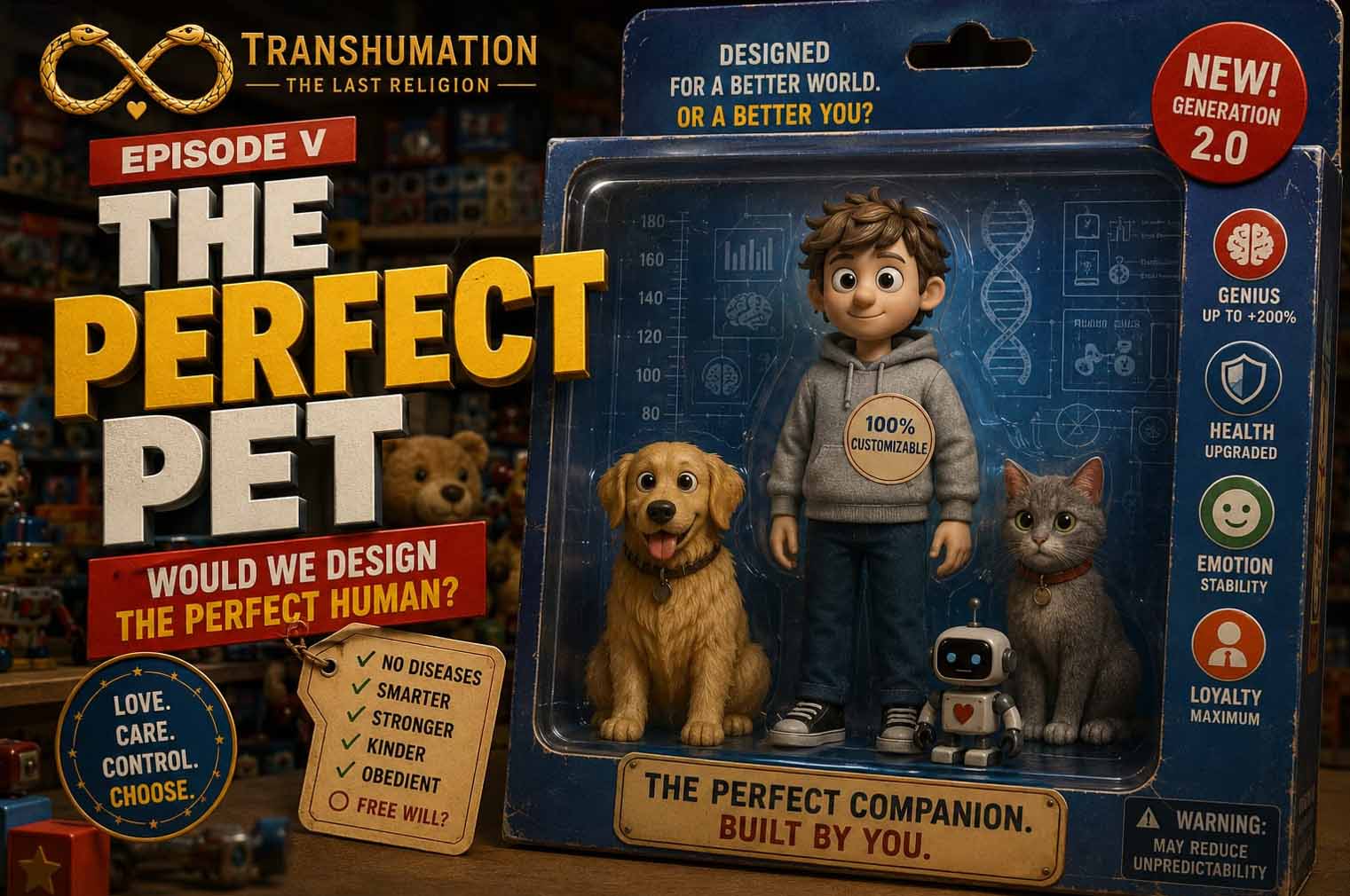
Once future parents or institutions can meaningfully choose traits, absence of choice becomes choice.
Do we reduce disease risk?
Increase height?
Modify cognition?
Select temperament?
Optimize metabolism?
At what point does therapy become enhancement?
At what point does enhancement become social standardization?
And who defines “better”?
A population designed for obedience might be socially stable.
A population designed for competitiveness might be economically productive.
A population designed for emotional calm might suffer less anxiety.
Each option can be sold as improvement.
The question remains the same:
Improvement for whom?
The Creator Who Has to Live With the Creation
This is where the analogy with God becomes uncomfortable.
Religions have asked for millennia why suffering exists in a world created by a good or powerful deity. The problem of evil belongs to theology because creation seems to create responsibility. If the creator had options, why this design?
Technology is beginning to encounter a smaller human version of the same problem.
If we alter a living system and suffering follows, the suffering is no longer merely inherited from nature.
Some of it may belong to design.
That does not mean we should stop designing. Refusing to intervene can also cause suffering. A gene therapy can prevent disease. Selective breeding can improve health when selection prioritizes health. Technology can liberate as well as constrain.
The important change is moral visibility.
Once you can choose, you can no longer pretend the outcome was simply given.
Creation produces responsibility because alternatives existed.
Watch The Video
How to Read the World
Current Knowledge
Dachshunds were historically bred for hunting, particularly for pursuing animals such as badgers into burrows. Their distinctive body shape is associated with chondrodysplastic traits produced through selective breeding.
The breed has an elevated risk of intervertebral disc disease, a condition linked in part to spinal anatomy and inherited skeletal characteristics. Not every dachshund develops severe spinal disease, and individual risk varies, but the association is well established.
Humans have selectively bred domesticated animals and crops for thousands of years, often prioritizing traits useful or desirable to humans. Selective breeding can improve health and function, but it can also produce welfare problems when extreme traits are favored.
Modern gene-editing technologies such as CRISPR allow targeted changes to DNA, but human germline editing remains ethically and legally restricted in many jurisdictions. Current technology does not permit unrestricted design of complex human traits.
There is no established scientific evidence that present AI systems possess subjective consciousness or suffering.
Open Questions
How should welfare be weighed against utility when humans intentionally shape another species? Should breeding standards prioritize the interests of the animal even when doing so changes traits people find useful or aesthetically desirable?
Human enhancement raises a harder version of the same issue. If genetic modification becomes safer and more capable, who should define which traits count as improvements? Parents, doctors, governments, markets or future individuals themselves?
AI introduces an additional uncertainty. If artificial systems ever develop morally relevant forms of consciousness, how would we detect them, and what obligations would designers have toward systems built around goals chosen entirely by humans?
The deepest problem is one of perspective: can a creator reliably judge what counts as improvement without privileging the creator’s own interests?
Transhumation Interpretation
The Dachshund Paradox can be reduced to one structural question:
design → function → benefit → cost → observer
The crucial variable is the last one.
From the human observer’s position, the dachshund’s body can look like successful design.
From the animal’s position, the same design may include pain or limitation.
The structure does not change.
The evaluation does.
This is why Transhumation treats creation as more than technical capability. A creator always has the temptation to define success from above.
The created system experiences success from inside.
That distinction may become one of the central ethical problems of the future.
Humanity is moving toward greater control over bodies, minds and artificial systems. If we become capable of designing new carriers for intelligence or new forms of human life, the question cannot stop at whether the new system functions.
We have to ask whether the being inside the system can flourish.
The dachshund cannot choose the architecture it inherited.
Future humans may be able to choose architectures for others.
That is where technological power becomes moral responsibility.
Perhaps the true test of a creator is not whether the creation performs beautifully.
It is whether the creator remembers to ask what the design feels like from inside.
FAQ
What is the Dachshund Paradox?
It is the ethical problem of designing another living being for a function that benefits the designer while potentially imposing costs on the creature itself.
Why use the dachshund?
Because its distinctive body reflects generations of selective breeding for human purposes and is also associated with important health risks.
Does this mean selective breeding is always wrong?
No. Selective breeding can improve health and useful traits. The problem arises when human goals override animal welfare.
How does this relate to human genetic engineering?
Future genetic technologies may allow people to make intentional choices about traits inherited by others, raising similar questions about whose interests define improvement.
Why mention Frankenstein?
Because the story separates successful creation from responsible creation. Victor’s failure begins after his experiment works.
Is current AI conscious?
There is no established evidence that current AI systems possess human-like subjective consciousness.
Why does AI still matter here?
Because if future artificial systems become morally relevant beings, designers may face the same question: are we optimizing them for their own flourishing or primarily for ours?
Is this article against technological progress?
No. It argues that greater creative power requires broader measures of success than capability alone.
How does this connect to Transhumation?
Transhumation asks what survives and changes when life, intelligence and identity move into new forms. The Dachshund Paradox adds the creator’s responsibility: a new form should be judged not only from outside, but from the perspective of whatever may have to live inside it.
Continue the Transhumation Series
- Forgotten Religion | Ancient Gods, Symbols and the Hidden Structures of Human Civilization
- The Last Religion | Death, Immortality and the Future of Humanity
- The New Theurgy | AI, Information and the Future of Human Civilization
- End of Branding: You Were Never Meant to Become a Product
- Baal vs Ishtar: Why Ancient Gods Never Disappeared