
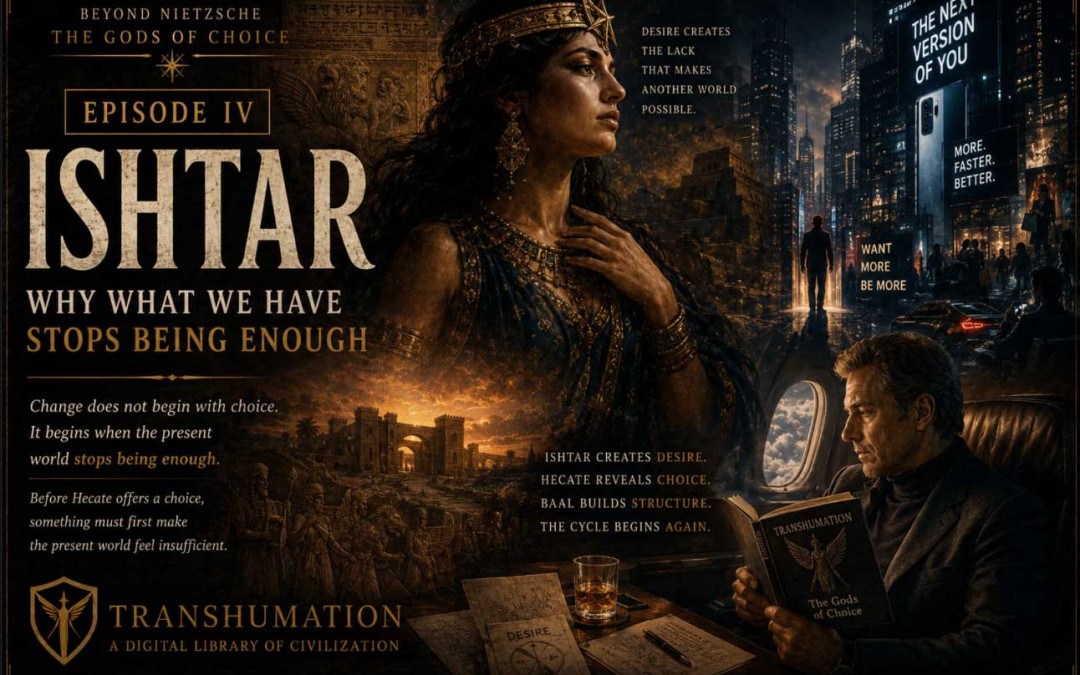
The Appetie for Life
Nothing has happened to the phone in your hand. It still makes calls, takes photographs and performs every task for which, perhaps only two years ago, you were willing to pay a considerable amount of money. Yesterday you may even have thought it was a very good phone. Then someone places a newer model beside it. The screen is brighter, the camera catches details yours misses, and some small function you had never previously needed suddenly appears difficult to live without. When you pick up your old phone again, something peculiar has happened. The machine has not changed at all, yet your experience of owning it has.
There is a surprisingly large part of civilization hidden inside that trivial moment. A horse was not painfully slow until another machine altered our understanding of distance. A handwritten letter was not absurdly inefficient until communication could cross continents almost instantly. A library did not seem impossibly difficult to search until a few words typed into a box could retrieve information in seconds. Again and again, the new invention does something stranger than merely improve the future: it travels backwards and changes our judgment of the world that existed before it.
We usually tell the story of change from the crossroads onward. A person has several possibilities and chooses one; a society confronts competing futures; an inventor selects one solution from several available designs. This is the territory I have associated elsewhere in Transhumation with Hecate. But there is a problem with beginning at the crossroads. Why did anyone walk there in the first place?
A man entirely satisfied with his road has little reason to search for another one. Something must happen before choice becomes interesting.
The world must first stop being enough.
The Crack in the Present
It rarely begins dramatically. A secure career still pays well but starts feeling strangely like somebody else’s life. A relationship continues, yet a previously invisible absence becomes difficult to ignore. A political order functions much as it did yesterday, while increasing numbers of people cease to believe that it should. A scientific theory explains almost everything except one irritating observation that refuses to disappear.
Nothing has necessarily collapsed. There may be no crisis at all. The present has simply developed a crack through which another world can be seen.
This is where Ishtar becomes interesting.
Historically, the Mesopotamian goddess was associated with love, sexuality, fertility, political power and war. She was not a tidy personification of modern consumer desire, and pretending otherwise would turn ancient religion into a convenient collection of contemporary metaphors. But her strange combination of attraction, appetite, power and disruption makes her useful for another purpose. She gives a face to something that remains remarkably difficult to describe: the force by which what we do not possess begins reorganizing our relationship with what we already have.
Desire is usually described as a response to absence. We lack something, therefore we want it. But the phone suggests something subtler. Sometimes the absence did not exist until the possibility appeared. You did not spend yesterday mourning a feature you had never imagined. Only after seeing it did your old device acquire a deficiency.
The same thing happens on a larger scale. Before flight, the inability of human beings to cross an ocean in a few hours was not normally experienced as a technological failure. Before antibiotics, diseases we now regard as treatable belonged to the ordinary brutality of existence. Before photography, nobody complained that a painter required days to accomplish what a machine might someday do in a fraction of a second.
The future does not merely give us new things. Sometimes it teaches us what was missing from the past.
In the language of Transhumation, that moment belongs to Ishtar. Hecate may eventually offer the roads, but Ishtar makes us look up from the road we are already travelling.
What Do You Actually Want?
Walk through an expensive shopping district and almost nothing in the windows is being sold for its literal function. A watch tells time, but so does the phone already in your pocket. A sports car transports its owner from one address to another, although a far cheaper car could perform the same task. Clothes keep the body warm, houses provide shelter, restaurants provide calories. Described this way, much of civilization sounds faintly ridiculous.
Yet nobody really experiences these things only through function. The watch can contain ancestry, taste, achievement or membership in an imagined world. The house can become proof that a difficult part of life has ended. The car may contain youth, danger or independence. Even a university degree can become less a document proving education than a mirror showing the person one hoped to become.
Advertising understands this exceptionally well because it rarely sells an object alone. It sells the distance between two versions of you.
That distance explains something peculiar about possession. The dream house eventually becomes the place where the boiler fails. The extraordinary car becomes the car that needs servicing. The promotion becomes Monday morning. The new phone becomes, with astonishing speed, simply your phone. Possession has not necessarily disappointed us; something quieter has happened. The object has crossed from imagination into ordinary life, and ordinary life has removed the distance that made it glow.
Desire then moves elsewhere.
This mechanism can look shallow when applied to consumer goods, but it becomes harder to dismiss when we notice that civilization itself appears to depend upon it. Human beings do not merely seek what is necessary. If they did, cathedrals would be difficult to explain. So would haute couture, symphonies, private gardens, theoretical physics, voyages to the Moon and the decision to spend years painting a ceiling when an undecorated ceiling already performs its architectural function perfectly well.
Michelangelo did not make the Sistine Chapel more waterproof.
Some of the most extraordinary things humans have created exist precisely because enough was not enough.
That should make us cautious about treating dissatisfaction as a defect. The same restless excess that can sell somebody a handbag they do not need can also persuade someone that crossing an ocean, curing a disease or understanding the movement of the planets is worth a lifetime.
Ishtar has never promised to be sensible.

The Machine That Must Keep You Hungry
There is, however, an important difference between discovering that something is missing and living inside a system that benefits from making sure something always feels missing.
The modern attention economy has become remarkably skilled at this distinction. A social platform offers connection, but its ideal user cannot become permanently satisfied with connection. There must always be another message, another reaction, another video, another person, another possibility waiting just beyond the edge of the screen. The next item has to remain potentially more interesting than the one currently being viewed.
The mechanism is elegant because it rarely needs coercion. Nobody has to force the user to continue. The system merely keeps a small door open in the imagination: perhaps the next thing will be the thing.
This is where an older problem of desire meets a new technological structure. A tool created to answer a human appetite can discover that reproducing the appetite is more profitable than satisfying it. The desire for recognition becomes a notification system. Curiosity becomes an infinite feed. Social contact becomes engagement. What began as a human impulse is translated into architecture.
Something curious has happened to Ishtar.
She has entered Baal.
In the symbolic vocabulary of Transhumation, Baal is not simply a demon or an ancient deity dragged carelessly into modern life. He represents the moment when a structure acquires enough continuity to begin shaping the people who created it. The institution, technology or habit ceases to be merely an expression of human choices and becomes part of the environment in which future choices are made.
A system does not have to order us to desire.
It can simply learn what keeps desire unfinished.
And yet blaming technology would be too easy, because the same instability is also the engine of invention. Every important technology begins with somebody refusing to accept a limitation that everyone else has learned to live with. Communication is too slow. Light is too expensive. Calculation takes too long. The machine is too large. The disease is incurable. The journey is impossible.
At first, the limitation belongs to reality.
Then somebody experiences it as intolerable.
That difference may be where invention begins.
The Crossroads Appears Later
This brings us back to Hecate, because dissatisfaction alone changes very little.
A person can hate his profession for twenty years. He can dream of another country every evening without ever buying a ticket. He can imagine leaving a relationship, starting a company, writing a book or changing his life while preserving every element of the old one. Desire feels like movement because the mind has already travelled somewhere else. Reality, inconveniently, may not have moved at all.
Perhaps this is why possibility can become intoxicating. The life not lived possesses remarkable advantages over the life we actually inhabit. The restaurant we did not choose has no bad service. The company we never started has never lost money. The person we did not marry has never disappointed us. The city we dream about contains no traffic jams, taxes or leaking roofs. Possibility remains perfect because consequence has not yet been allowed inside.
Ishtar can therefore keep a person moving without allowing them to arrive anywhere.
Only at this point does Hecate become necessary. The crossroads is not the place where imagination expands but where it becomes expensive. One road must be taken seriously enough for the others to begin disappearing. The fantasy of another life must encounter rent, loyalty, time, responsibility and the irreversible fact that a day spent building one world cannot also be spent building every other one.
This changes the sequence.
We often say that freedom creates change. But freedom may arrive surprisingly late. First something disturbs satisfaction. Then another world becomes imaginable. Only then does a genuine choice appear.
Ishtar says that this cannot continue.
Hecate asks what comes next.
And the distinction matters because strong desire is easily mistaken for transformation. Wanting another life is not yet living one. Recognizing a prison is not the same as leaving it. Imagining a better technology does not build it.
The adventure begins when possibility acquires a price.
What Happens After We Get What We Wanted?
There is another reason the sequence matters. The thing we choose eventually becomes the thing we live inside.
A revolutionary movement becomes a government. A startup becomes a corporation. A romantic commitment becomes a household with obligations, routines and shared property. A technological breakthrough becomes infrastructure. Yesterday’s escape route becomes today’s road.
This is not necessarily corruption. It is how continuity works. Nothing durable can remain permanently in the ecstatic condition of beginning. Eventually somebody has to maintain the railway, write the rules, repair the building, pay the salaries and decide what happens on Tuesday morning.
But every structure also creates new limitations. The automobile liberates people from one geography and creates another organized around roads and parking. Instant communication liberates information from distance and creates a culture in which being unreachable becomes unusual. Search engines make knowledge accessible while making attention harder to defend. Artificial intelligence may reduce the scarcity of answers while increasing the value of knowing which questions deserve to be asked.
The solution changes the environment. The changed environment reveals a new problem.
And Ishtar returns.
Seen this way, civilization begins to resemble less a staircase toward satisfaction than a machine that continually changes the location of dissatisfaction. Each generation inherits structures built to solve problems that once seemed urgent, then discovers costs that were invisible to the people who built them.
This may explain why progress can be real without ever producing arrival.
We solve genuine problems.
The solutions create genuinely new worlds.
And the new worlds contain problems that could not have existed before the solutions.
The pattern is not a circle, because history does not return us to the same place. It is closer to a spiral: desire makes another world visible; choice gives it direction; structure gives it duration; structure creates new limitations; desire returns under changed conditions.
Ishtar. Hecate. Baal. Ishtar again.
Not gods controlling history, but names placed on recurring positions inside transformation.
The Last Luxury
Now imagine pushing the mechanism much further.
Suppose artificial intelligence makes competent intellectual production abundant. Images, music, films and virtual environments can be generated almost instantly. Manufacturing becomes cheaper. Biological engineering makes the body increasingly modifiable. Simulations provide experiences once limited by geography, money or physical possibility.
What happens to desire in a world capable of producing almost anything?
The obvious answer is that humanity finally becomes satisfied. History gives us little reason to expect it.
Scarcity is more likely to move.
When photographs were difficult to make, the photograph itself possessed value. When billions can be produced, attention becomes valuable. When digital images can be flawless, imperfection may acquire prestige. When anything can be copied, provenance matters. When experience can be simulated safely, genuine risk may become luxurious. When machines can provide endless conversation, the freely given attention of another human being may become more precious rather than less.
Perhaps one day the most expensive object in the room will be the thing nobody can manufacture.
A scar.
A mistake.
A handwritten note.
An afternoon that cannot be replayed.
Someone who could have left but chose to stay.
This possibility reveals something about Ishtar that the smartphone concealed at the beginning. Perhaps desire was never fundamentally attached to objects. Objects merely gave desire somewhere to land. What we wanted through them was difference: between now and later, here and there, who we are and who we might become.
If technology begins collapsing those distances, desire may not disappear.
It may search for distances technology cannot easily close.
And that leads to a stranger question than whether future civilization will possess enough.
What will remain desirable when almost everything is possible?
Watch the Video
How to Read the World

Current Knowledge
Ishtar was one of the major deities of ancient Mesopotamia, closely related to the Sumerian Inanna and associated across different periods with sexuality, love, fertility, warfare and political power. Her historical meanings were complex and changed across cultures and periods; there is no scholarly basis for claiming that ancient Mesopotamians understood Ishtar as a theory of technological or consumer desire in the sense developed here.
Modern research gives no single explanation for human desire. Biological drives, reward systems, learning, social comparison, cultural expectations, identity and environmental cues all influence what people want. Psychology and consumer research also show that people adapt to improvements and that comparison can alter how previously acceptable circumstances are evaluated. Behavioural economics and research into digital systems further demonstrate that the architecture in which options are presented can influence attention and behaviour without removing formal choice.
The Ishtar–Hecate–Baal sequence in this essay is therefore not presented as ancient theology. It is a Transhumation model imposed deliberately on different historical and contemporary phenomena to ask whether a recurring structure can be recognized beneath changing carriers.
Open Questions
The difficult question is not whether dissatisfaction can produce change; history gives us ample reason to think that it can. The harder problem is distinguishing the dissatisfaction that reveals a genuine limitation from the dissatisfaction produced by comparison, manipulation or an inability to inhabit any achieved reality.
If innovation repeatedly solves one scarcity while creating another, does technological progress have any natural destination? Can a civilization remain inventive without continuously persuading its inhabitants that their present lives are inadequate? And if future abundance makes objects, information and simulated experience almost unlimited, will desire weaken—or migrate toward authenticity, consequence, risk and things that cannot be copied?
Perhaps there is also a more personal test. When another life suddenly appears brighter than our own, how can we know whether we have discovered a road worth taking or merely another beautiful road that has never yet had to become real?
The Transhumation Interpretation
Transhumation begins this sequence one step before choice.
Before Hecate can stand at the crossroads, Ishtar must make the current road feel incomplete. She introduces difference between the world that exists and the world that can suddenly be imagined. Hecate converts that difference into alternatives and demands a choice. The chosen path, repeated long enough, becomes habit, technology, institution and identity. Eventually Baal appears: the structure gains sufficient weight to begin shaping the people who once created it.
Then, sooner or later, somebody notices the crack.
This is why transformation may have no final form. Every successful answer changes the conditions under which the next question will be asked. The structure that liberates one generation can constrain another; the technology that satisfies one desire can reveal an absence nobody previously knew how to feel.
Ishtar therefore represents something more dangerous than wanting what we do not have. She represents the instant in which reality loses its monopoly over us because another reality has become imaginable.
She does not tell us that the other world will be better.
She does not tell us to choose it.
She merely performs the first and perhaps most consequential act in every transformation.
She makes us look again at what we already possess—and, for the first time, notice what is missing.
FAQ
Who was Ishtar?
Ishtar was an ancient Mesopotamian goddess associated with love, sexuality, fertility, power, war and political authority. She was a complex figure representing both attraction and destructive intensity.
What does Ishtar represent in Transformation?
Ishtar represents desire, lack and the moment when the present condition stops being satisfying. She creates the tension that makes change imaginable.
Why does desire come before choice?
People usually approach a crossroads because something in the present has become insufficient. Desire makes alternatives emotionally and intellectually visible before a decision is made.
Is desire the same as need?
No. Need is usually connected to survival or basic functioning. Desire exceeds necessity and often concerns identity, meaning, beauty, recognition or possibility.
How does desire drive innovation?
Innovation often begins when someone notices a limitation others have accepted. Desire imagines a world in which the limitation no longer exists.
Can advertising create desire?
Yes. Advertising often links products to identity, status or fulfilment, making the current situation appear inadequate by comparison.
Why does a new product make an old product feel worse?
The new possibility changes the standard of comparison. The old object may function exactly as before, but its limitations become more visible.
Why does possession often fail to end desire?
Once an object is acquired, it becomes part of ordinary life. The distance and anticipation that gave it symbolic power disappear, and desire often moves elsewhere.
Is dissatisfaction always harmful?
No. Dissatisfaction can reveal injustice, falsehood, stagnation or a genuine need for transformation. It can be the beginning of liberation.
Can desire become a form of unfreedom?
Yes. A person may become trapped in endless anticipation, consumption or comparison, always seeking the next possibility without committing to a real path.
How are Ishtar and Hecate connected?
Ishtar creates the feeling that the present is insufficient. Hecate represents the crossroads where possible responses become real choices.
How are Ishtar and Baal connected?
Desire leads to choices that create habits, technologies and institutions. These structures may later organise life and become Baal, the system that begins to rule its creator.
Does love belong to Ishtar’s domain?
Yes. Love disrupts self-sufficiency and creates desire for connection, presence and a shared future. It can lead to mutual transformation or to possession, depending on whether the other person’s freedom is respected.
Can desire be spiritual?
Yes. The desire for salvation, transcendence, enlightenment or union with the divine is still a form of desire, even when earthly desires are rejected.
Would abundance eliminate desire?
Probably not. Desire may shift from material goods towards identity, authenticity, attention, uniqueness or experiences that remain limited.
What is the difference between dissatisfaction and direction?
Dissatisfaction reveals that something is wrong or incomplete. It does not automatically reveal the correct solution. Hecate’s choice is still required.
What is the main argument of the article?
Human transformation begins when satisfaction breaks. Ishtar represents the desire that makes another world imaginable, but desire must still be interpreted and turned into responsible choice.
Continue the Transhumation Series
- Forgotten Religion | Ancient Gods, Symbols and the Hidden Structures of Human Civilization
- The Last Religion | Death, Immortality and the Future of Humanity
- The New Theurgy | AI, Information and the Future of Human Civilization
- End of Branding: You Were Never Meant to Become a Product
- Baal vs Ishtar: Why Ancient Gods Never Disappeared