
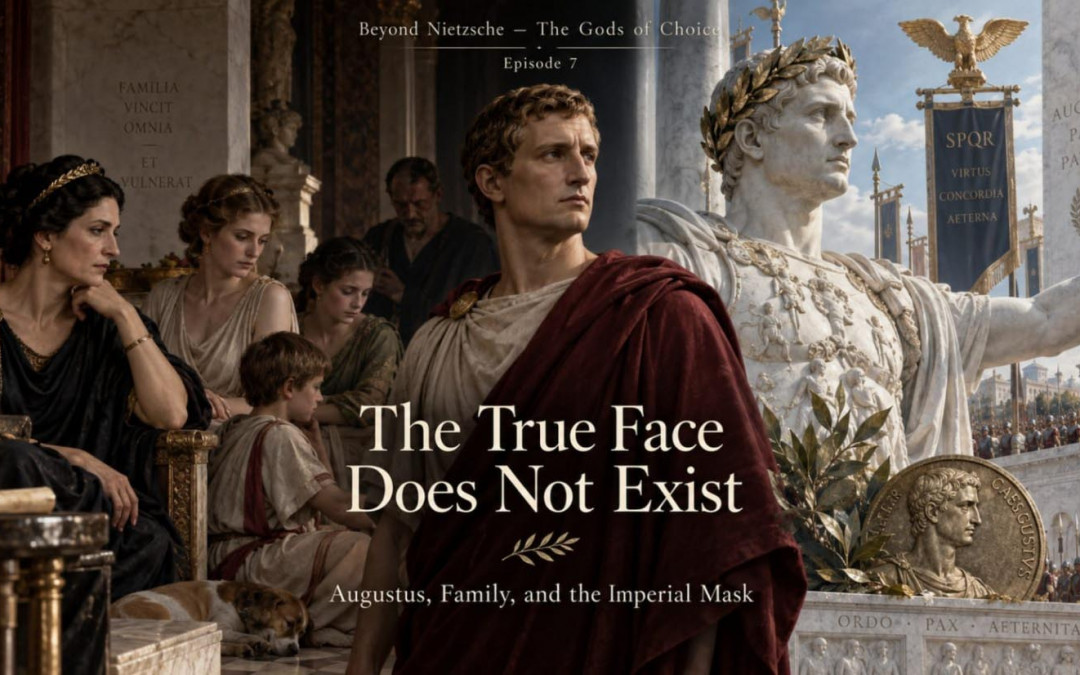
Caius – The Nephew
Augustus was eighteen when Julius Caesar was murdered. Caesar’s will named the young Octavius as his adopted son and heir. It was an extraordinary inheritance, but not an obviously fortunate one. Caesar had left him money, a name and access to power. He had also left him enemies. Octavius could accept both or walk away from both. We know what he chose, and that knowledge makes it difficult to understand how uncertain the choice once was.
History does this constantly. It turns choices into roads after somebody has already walked them. We draw a line from Caesar’s murder to Actium, from Actium to Augustus and from Augustus to the empire. The line looks obvious because we draw it backward. Octavius could not see it. At eighteen he saw only the next decision.
That may be the first thing worth remembering about him. Augustus did not begin his life knowing that he was Augustus.
Neither do we.
The Road Appears Behind You
A biography is a dangerous object. It gives a life a shape that the person living it never possessed. Dates become milestones. Mistakes become warnings. Meetings become turning points. An event that lasted ten minutes may receive twenty pages because the historian knows what happened afterward.
The person inside the life has no such advantage. Tomorrow has not yet been edited.
When Octavius accepted Caesar’s inheritance, he could not know that Antony would become his enemy, that Cleopatra would enter the story, or that a naval battle near Actium would help decide the political future of Rome. He could not know that statues of his face would stand two thousand years later in museums belonging to countries Rome had never imagined. He knew that Caesar was dead. He knew that accepting Caesar’s name carried danger. Then he chose.
We like to believe that important people possess some unusual ability to see the road ahead. Usually they do not. They may calculate better. They may have better information. They may also be luckier. But the future remains stubbornly unavailable.
This makes the past look very different. The great road of Augustus was not waiting for him like a Roman highway. It appeared behind him as he walked. The same is true of much smaller lives.
A job accepted at twenty-six can determine the city in which someone meets a wife. A loan can create a company or destroy one. A conversation postponed for six months can quietly become the most important decision in a relationship. We rarely recognize these moments while they are happening. They arrive disguised as Tuesday. Only later do we draw the line.
Before the Choice, You Have a Theory
Most people have a detailed opinion of their own character. They are loyal. They are brave. They are independent. They would never remain silent in the presence of injustice. They would never betray a friend for money. They would leave if somebody treated them badly. They would protect their family regardless of the cost.
Perhaps.
There is nothing dishonest about believing these things. The problem is simpler. Until a belief has acquired a price, it has not been tested.
A man with no opportunity to steal may be honest. He may also be waiting for an opportunity worth taking. A person who has never been seriously frightened may indeed be courageous. There is simply little evidence yet. The loyal friend who has never had to choose between friendship and ambition is in the same position. This is why we say that pressure reveals the true face.
The phrase is attractive because it suggests that character already exists somewhere inside us. Crisis removes the covering. The hidden person steps into the light. But that is too simple.
A choice does not merely reveal information. It creates information. Before the decision, you have a theory about yourself. Afterward, something has happened.
You stayed. You left.
You told the truth. You lied.
You took the money. You refused it.
That event does not define you forever. The next crossroads may produce different evidence. But the record is no longer empty.
You now know something you did not know before.

Octavian at War
War should have shown the true Octavian, if the usual theory is correct.
He lived through one of the most violent political collapses in Roman history. He joined Antony and Lepidus in the Second Triumvirate. The proscriptions followed. Enemies were killed and property was confiscated. Cicero became the most famous victim, but he was hardly the only one. Octavian then passed through further wars until Antony and Cleopatra were defeated and no rival remained capable of challenging him.
It is easy to look at that period and decide that we have found the man beneath the marble.
This was the real Octavian. The later Augustus was the mask.
There is a problem with that conclusion. War is not a neutral laboratory.
War changes incentives. It changes acceptable behavior. It changes the cost of hesitation. It changes the people around you. A man who survives twenty years of political violence has not merely demonstrated his character. He has lived inside a machine capable of altering it.
Peace is a machine too.
After Actium, Octavian faced a problem that Antony could no longer solve for him. A visible enemy is useful. He gives people direction. Defeat him. Survive him. Win.
Victory removes that simplicity.
Octavian had learned how to win power. Augustus had to discover what to do when there was nobody left to defeat.
That was another crossroads.
The Man Beside the Fishpond
Years later, Augustus was dining with Vedius Pollio. Pollio was enormously wealthy and had a reputation for cruelty. During the meal, a slave broke a valuable crystal cup. Pollio ordered that the man be thrown into a pool containing lampreys. The slave appealed to Augustus. Ancient accounts differ in details, but the central episode is consistent: Augustus intervened and the slave was spared.
Cassius Dio gives the story a particularly satisfying ending. Augustus ordered Pollio’s valuable drinking vessels to be brought out and smashed. The objects had been allowed to become more important than a human life. Augustus removed the objects from the equation.
It is tempting to stop here and perform the same trick again.
Perhaps this was the true Augustus.
The young Octavian had been forced into brutality by civil war. The mature ruler was humane. Time had removed the violence and revealed the decent man underneath.
But why should this portrait receive privileges denied to the first one?
The slave at Pollio’s table does not erase the proscriptions. The proscriptions do not erase the slave.
Both events belong to the road.
The more interesting question is what happened between them.
A Man Can Practice Being Himself
We distrust masks because we associate them with deception. A mask hides something. Remove it and the truth appears.
Human behavior rarely works so neatly.
A young doctor can be terrified and still speak calmly to a patient. A father can feel rage and deliberately lower his voice before speaking to his child. A soldier can learn procedures that continue functioning when instinct tells him to panic. A shy person can practice speaking in public until the performance becomes ordinary.
At first, the behavior may feel artificial.
Then it becomes easier.
Eventually somebody says, “You are naturally calm.”
He may not be.
He may simply have practiced calm for twenty years.
This is where the distinction between mask and face begins to fail. The performance changes the performer.
Augustus understood public image extraordinarily well. His official portraits presented a controlled and idealized ruler. He aged, but the public Augustus remained remarkably young. The same face travelled through statues, coins and copies across the Roman world.
We can call this propaganda and be correct. We will also miss the more interesting possibility.
Imagine spending decades being represented as the man who restored order.
People expect stability from you. Officials act in your name. Buildings repeat your political message. Your family is incorporated into the image. Your previous decisions become precedents for your next ones.
At first you create the role.
Then the role begins to create expectations.
Eventually those expectations arrive back at your door.
When the Structure Answers Back
Human beings create structures because structures make the world easier to navigate.
We create laws, offices, families, companies, traditions, religions and reputations. We give them names. We establish rules. We behave as though the process ends there.
It does not.
The structure begins producing consequences of its own.
A company founded by one person can eventually tell its founder what he is allowed to do. A law can restrain the politician who wrote it. A family tradition can determine the behavior of descendants who never met the person who began it. A reputation can force a man to defend an image he once created for convenience.
Identity can do the same thing.
A man says that he is brave. Perhaps he has evidence. He repeats the claim often enough that other people begin expecting bravery from him. One day retreat becomes the sensible choice.
Now his old choices are standing in the room with him.
You are not the kind of man who retreats.
The sentence may save him from cowardice.
It may also get him killed.
This is why the mask can educate the face and imprison it at the same time.
There is no formula that tells us which one is happening.
There is another crossroads.
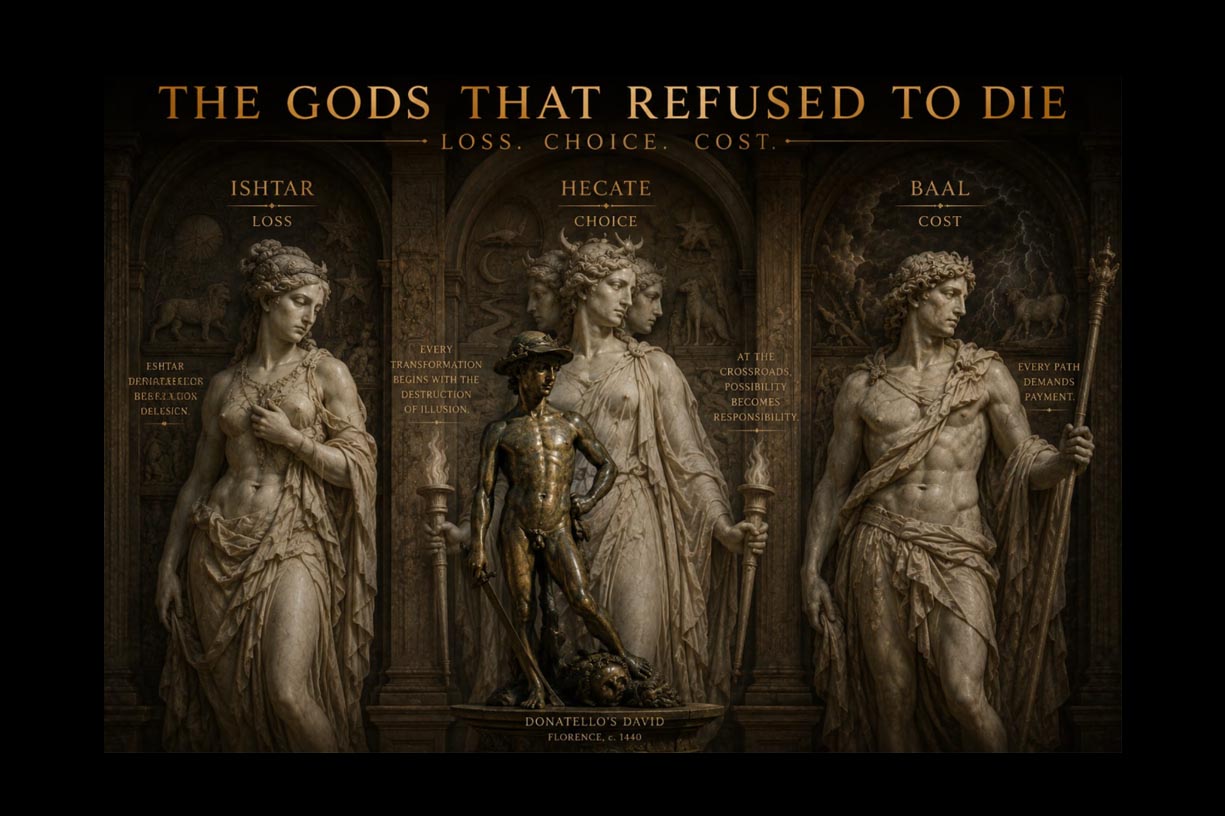
Hekate at the Threshold
Hekate belongs at the crossroads because a crossroads contains an uncomfortable fact.
More than one road remains possible.
If there were only one, there would be no reason for a goddess to stand there.
You arrive carrying your history. Previous choices matter. Habit matters. Fear matters. Training matters. The promises you have made matter. So do the people watching you and the person you have told yourself you are.
They change the probability of the next decision.
They do not necessarily make it inevitable.
This is why the modern fear of consequential choices deserves examination.
We spend much of life being warned about them. Do not sign too quickly. Do not borrow too much. Do not commit before you are certain. Do not make a decision you cannot reverse. Keep your options open.
Most of this is sensible advice.
But it can quietly become a philosophy.
Avoid the situation in which you might lose something. Avoid responsibility if somebody else can carry it. Delay the decision until certainty arrives. Preserve as many exits as possible.
There is one difficulty.
Certainty rarely arrives.
A person can therefore spend years protecting himself from the very situations capable of telling him something important about himself.
He can remain brave in theory.
Loyal in theory.
Generous in theory.
Independent in theory.
His character remains immaculate because it has never been asked to work.
Do Not Be Afraid of the Choice
This is not an argument for impulsiveness.
Consequences exist.
A bad loan remains a bad loan. A foolish marriage does not become wise because it taught you something. A business can fail. A friendship can be destroyed. People can make decisions whose cost follows them for decades.
The lesson is not that choices are harmless.
It is that consequences are not only external.
Something also happens to the person choosing.
Sometimes the discovery is unpleasant. A man who believed himself courageous discovers that he runs. Someone who spoke endlessly about loyalty accepts the better offer. A person who thought money was unimportant discovers the exact sum at which it becomes important.
Good.
Now there is information.
The discovery need not become a sentence.
A cowardly decision can be followed by a courageous one. A selfish person can learn generosity. Someone who remained silent once may speak the next time.
The road does not disappear because one step was bad.
It continues.
That is precisely why the idea of the true face is misleading. It asks us to choose one frame and declare the investigation finished.
Human beings are not finished that easily.
Future Has Long Passed
We possess one advantage Augustus never had.
For us, his future has already happened.
We can place the eighteen-year-old Octavius beside the old Augustus. We can connect Caesar’s will to Actium. We can place the proscriptions beside the story of Pollio’s slave. We can look at the idealized marble face while knowing that the flesh beneath it aged.
The whole road fits on a page.
This creates an illusion.
It makes structure look like destiny.
Octavius becomes Augustus because the line between them has already been drawn. We forget that the line exists only because a man walked it.
The distinction matters far beyond Roman history.
We do the same thing to ourselves.
Looking backward, we say that we were always going to marry that person. We were always going to choose that career. We always knew we would leave. We were always that kind of person.
Memory is an excellent cartographer.
It draws roads across terrain that once contained only possibilities.
This is one reason the future has long passed matters. From the observer’s position, the structure is visible. From inside the life, it is not.
You do not experience your trajectory.
You experience the next step.
The Old Man at Nola
Augustus died at Nola in AD 14. He was seventy-five years old and only weeks from his seventy-sixth birthday. His health had deteriorated during a journey through Campania. The young man who had accepted Caesar’s inheritance was now separated from that first decision by more than half a century.
Suetonius gives us a final scene that is almost too appropriate.
Augustus asks for a mirror. He has his hair arranged and his appearance put in order. Then he asks his friends whether he has played the comedy of life well. If so, he says, give the performance its applause.
We should be careful with perfect endings supplied by ancient biographers. History has always liked a good final line. But suppose we allow Suetonius his scene. The mirror is there.
So is the mask.
So is the actor.
After more than fifty years, however, the old question has become difficult to ask.
Which one is the true Augustus?
The young man who accepted Caesar’s name? The triumvir? The victor of Actium? The ruler who spared Pollio’s slave?
The face on the coins? The old man looking into the mirror? We can choose one and call the others masks. Or we can stop looking for the face.
A life may be better understood as a trajectory. Every consequential choice adds a point. Habit connects some of them. Memory rearranges others. Roles and structures bend the line. Occasionally a person reverses direction.
Only from a distance does a shape appear. That is what Augustus never saw and what history allows us to see. It is also what we cannot yet see about ourselves. There will be another crossroads. You may not recognize it when it arrives. It may look like a contract, a telephone call, a resignation letter, a hospital corridor or an ordinary conversation at a kitchen table. You will want to know the correct road before choosing.
Sometimes you will know.
Often you will not. Do not fear that fact more than necessary. Before the choice, you possess predictions about yourself. Some may be accurate. Some may be flattering stories you have never been forced to test. Then you choose. The future moves one step into the past. And for the first time, there is evidence.
The true face does not exist. The road does.
Watch the Video
How to Read the World
Current Knowledge
Augustus did not begin as the finished figure preserved in Roman marble. Born Gaius Octavius, he entered the struggle for Caesar’s inheritance after the dictator’s assassination in 44 BC. His rise included civil war, the Second Triumvirate, the proscriptions and the final conflict with Antony and Cleopatra. After victory, he presided over a political order that presented itself very differently from the violence through which it had emerged.
The surviving evidence also shows that Augustan identity was carefully represented. Official portraiture maintained an idealized and youthful image even as Augustus aged. Ancient writers preserve episodes that complicate any simple portrait of his character, including his intervention when Vedius Pollio wanted a slave brutally punished. These sources cannot give us direct access to Augustus’s private mind. They give us actions, representations and stories produced at different points along his life.
Modern psychology likewise gives little reason to treat personality as either completely fixed or infinitely flexible. Temperament, previous experience, social roles, environment and repeated behavior can all affect later choices. A decision can therefore reveal something about a person while also participating in what that person becomes.
Open Questions
If character changes through experience, how much of a decision belongs to the person who arrived at the crossroads and how much belongs to the road already travelled? Can repeated performance genuinely create a new disposition, or does it only make a particular behavior easier to reproduce? At what point does reputation stop describing a person and begin controlling one?
There is also a harder question. If different circumstances produce different versions of us, by what right do we select one moment and call it authentic? Is the frightened person more real than the calm one? Is the young Octavian more authentic than Augustus because violence came first? Or does the search for a privileged version of the self begin with a false assumption?
Perhaps the largest unanswered question is whether identity exists independently of trajectory at all. If every answer we give about ourselves can be modified by the next consequential choice, the final description may never arrive while we are alive.
Transhumation Interpretation
Transhumation treats the problem differently. The important object is not the face but the information produced along the road.
Before a consequential choice, a person contains possibilities. He may have memories, habits, principles and a strong image of himself. These matter, but they do not completely describe what will happen next. The crossroads converts part of that uncertainty into information. Something that existed as I think I would becomes I did.
That information then enters the system. A choice becomes memory. Repeated choices become habit. Habit contributes to reputation. Reputation creates expectations. Those expectations can influence the next choice. The person creates the structure, and eventually the structure begins speaking back to the person.
This is why Augustus matters to Transhumation. We possess something he never possessed: his completed past. The future has long passed. From our position, scattered decisions form a trajectory. From his position, there was never a trajectory ahead of him. There was only the next threshold.
The same asymmetry exists in every human life. We want to know who we are before choosing because knowledge feels safer than responsibility. But some information about ourselves cannot exist before the choice that produces it.
The crossroads is therefore not merely a danger.
It is an instrument of knowledge.
Before it, you have a story about yourself. After it, you have evidence.
FAQ
Did Augustus have a “true personality” behind his public image?
We cannot recover a single private Augustus hidden behind the statues, coins and ancient accounts. The surviving evidence shows different behavior in different periods and circumstances. The young Octavian of the civil wars operated in a very different environment from the ruler of later decades. Treating one period as the “real” man and every other period as a mask assumes exactly what the article questions.
Did Augustus deliberately create his public image?
Yes. Augustan portraiture, monuments, coinage and public language formed a remarkably consistent political image. The ruler was presented as controlled, stable and often idealized rather than simply recorded as he physically aged. Yet a public image does more than influence an audience. Once established, it can create expectations that the person represented must continue to satisfy.
What happened between Augustus and Vedius Pollio?
Ancient sources describe an incident in which Pollio wanted a slave severely punished after the slave broke a valuable drinking vessel. The slave appealed to Augustus, who intervened. In Cassius Dio’s version, Augustus ordered Pollio’s valuable vessels smashed and the slave was spared. The episode does not prove that Augustus was secretly merciful all along. It gives us another piece of evidence from another point in his life.
Does pressure reveal a person’s true character?
Sometimes pressure reveals qualities that ordinary life has never tested. But pressure also changes the conditions under which people act. War, fear, wealth, responsibility and power can shape behavior rather than merely expose something already complete. A crisis therefore produces evidence about character, but it does not necessarily reveal a permanent person hidden underneath.
Can a role or “mask” actually change personality?
It can influence it. Repeated behavior becomes habit, while reputation creates expectations from other people. Someone who repeatedly performs calm, discipline or courage may eventually find those responses easier. The reverse can also happen. A role can become restrictive when maintaining it matters more than responding honestly to new circumstances.
Why is the crossroads important in this article?
Because a crossroads separates possibility from evidence. Before a consequential decision, we can predict what we would do. Afterward, something has actually happened. The choice does not reveal an eternal identity, but it adds information to the trajectory of a life.
Continue the Transhumation Series
- Forgotten Religion | Ancient Gods, Symbols and the Hidden Structures of Human Civilization
- The Last Religion | Death, Immortality and the Future of Humanity
- The New Theurgy | AI, Information and the Future of Human Civilization
- End of Branding: You Were Never Meant to Become a Product
- Baal vs Ishtar: Why Ancient Gods Never Disappeared