
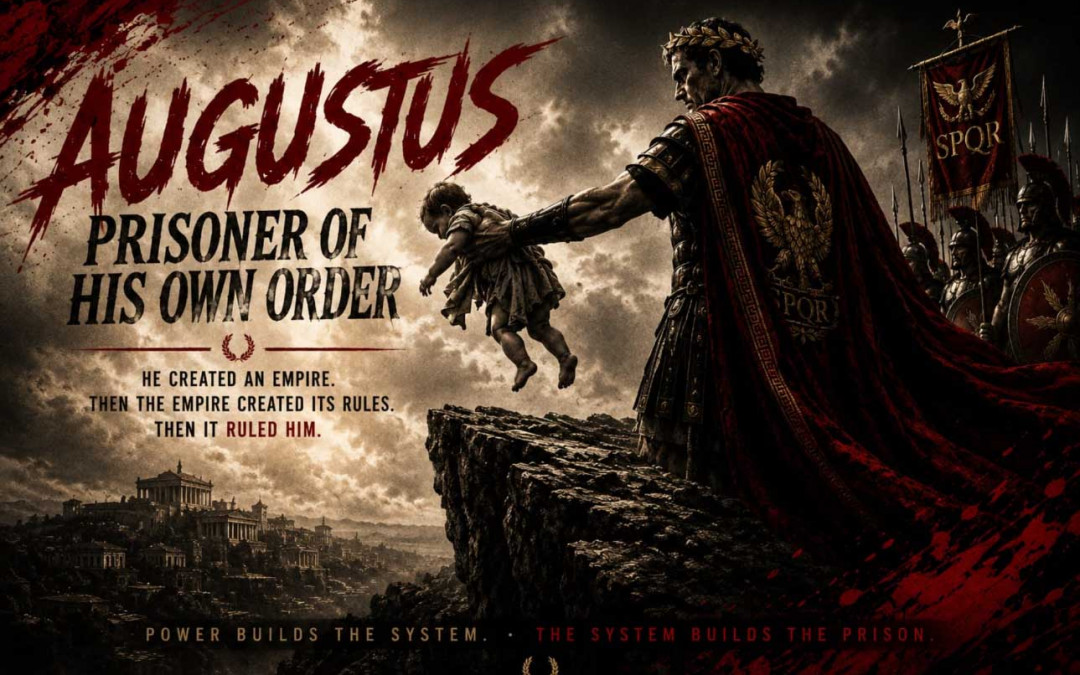
Caius Octavius the Prisoner of Augustus
Rome began with two abandoned children. At least that is how Rome chose to remember itself. Romulus and Remus were condemned before either had committed a crime, because their danger came from birth rather than action. They were descendants of Numitor, the displaced king of Alba Longa, and therefore inconvenient to the man who had taken his throne. The infants were carried away and left beside the Tiber. A she-wolf found them.
Eight centuries later, another child was born into the family that ruled Rome. We do not know its name, and we know almost nothing about its brief existence. Its mother was Julia the Younger, granddaughter of Augustus, who had been condemned and sent into exile. Suetonius tells us that Augustus would not allow the child born after her condemnation to be acknowledged or reared. The child had broken no law and betrayed no marriage. This time no she-wolf came.
The obvious response is to call Augustus cruel and close the case. Frederick Kindt prefers contradictions, and there is a large one here. Augustus had spent much of his reign encouraging marriage, legitimate descent and the production of children. He had also spent decades arranging marriages and adoptions because the political order he created needed someone to survive him. By the end of his life, succession had become one of his greatest problems. Yet when another descendant appeared, Augustus himself refused to accept it.
The useful question is therefore not whether Augustus was cruel. It is what an innocent child can inherit from an offence it did not commit. The answer cannot simply be guilt, because the child was guilty of nothing. Yet consequences can travel much farther than guilt, and Augustus knew this unusually well. Roughly four decades earlier he had faced another young person whose danger also came largely from birth. His name was Caesarion.
The Emperor Who Needed Children
Augustus had only one biological child, Julia the Elder. His long marriage to Livia produced no surviving children. This meant that the future had to be constructed from the family available to him. Marriage became political architecture, while adoption became a way of manufacturing continuity. Augustus was creating a political system that claimed not to be a monarchy, but the problem waiting at its centre was familiar to every monarchy: what happens when the man at the top dies?
Julia became part of the answer. She first married Marcellus and, after his death, Marcus Agrippa. Augustus later adopted her sons Gaius and Lucius, and both were advanced toward public life. Their future importance was hardly concealed. They were young, visible and attached to the continuation of the Augustan order.
Then both died young. Agrippa Postumus remained, but he was eventually exiled. Tiberius had already been pulled into the family design through marriage to Julia, which required him to divorce Vipsania. Eventually Augustus adopted Tiberius as his son. The family increasingly resembles a machine whose components were moved whenever the problem of succession demanded it.
This sounds cold only if we insist on treating an imperial family as an ordinary household. Dynastic marriages have rarely been purely private affairs. Centuries later, European royal houses would still regulate marriages because a marriage could produce alliances, claims and future sovereigns. The private decision of two people could alter the politics of several states. Augustus was dealing with an earlier version of the same problem.
A child inside such a family is therefore two things at once. It is a human being, but it is also information about the future. Its father matters. Its mother matters. The legal relationship between them matters. Its place in a family tree can matter to people who will never hold the child in their arms.
That distinction is where this case begins to become uncomfortable.

When the Law Came Home
Augustus did not invent Roman marriage or Roman concern with sexual morality. He did, however, give marriage, adultery and reproduction unusual public importance. His legislation encouraged marriage and childbearing among parts of Roman society, while adultery became a public offence subject to legal treatment. The state was entering territory that could once be understood more readily as belonging to household discipline, custom and family honour.
Then the legislation met Augustus’s own family.
Julia the Elder was accused of adultery and exiled. Years later her daughter, Julia the Younger, was also condemned and sent away. Whatever mixture of morality, politics and family anger lay behind these cases, Augustus now faced a problem created partly by his own public position. The imperial household had been presented as part of Roman order. Its failures could not easily remain private.
The easiest word to use here is hypocrisy. It is also one of the least interesting. Augustus’s own marital history was complicated. Livia was pregnant by her previous husband when she married Octavian, and ancient observers were perfectly capable of noticing awkward differences between the private history of the ruler and the standards later associated with his regime.
But hypocrisy describes a man who demands a rule from others while quietly exempting himself. Augustus eventually faced something stranger. The standards he had helped strengthen became expensive even when applied to his own family. The system was no longer useful only when it restrained somebody else. It had reached the people Augustus most needed.
That is the moment when a rule becomes real.
The Child Without a Name
Julia the Younger was exiled in AD 8. After her condemnation she gave birth. Suetonius records that Augustus refused to allow the child to be acknowledged or reared. He gives us the decision but very little of the reasoning behind it. We do not know the conversation in which it was made, and we should not pretend to know Augustus’s private motive.
Perhaps anger mattered. Perhaps legitimacy mattered more. Perhaps Augustus believed that recognizing the child would weaken the moral order he had spent years defending. Perhaps the answer contained all of these things at once. The surviving evidence is too thin to turn one explanation into certainty.
One fact, however, does not depend on speculation. The child itself had done nothing.
Our instinct is to answer that problem with individual responsibility. Julia committed the offence. Julia received the punishment. Her child should therefore stand outside the case. Modern law has good reasons for trying to place that boundary around guilt.
The difficulty is that guilt and consequence are not the same thing.
A child can inherit consequences without inheriting responsibility. A parent can lose a fortune and leave the next generation poor. A family can lose political status and change the opportunities available to descendants not yet born. A marriage can alter succession rights belonging to future children. No theory of inherited guilt is required for any of this to happen.
The child does not inherit the offence. It enters the world the offence has already changed.
Augustus had encountered that distinction before.
Caesar Had Two Sons
Julius Caesar had no surviving legitimate son. Cleopatra, however, had a son called Ptolemy Caesar, better known as Caesarion. The claim that Caesar was his biological father was already controversial in antiquity. Suetonius reports both the assertion that Caesar acknowledged the boy and an attempt by Caesar’s associate Gaius Oppius to deny the paternity. The dispute itself tells us something important. People cared because the answer had consequences.
Caesar also created another son by a method that did not require biology. His will adopted Gaius Octavius. Roman adoption created legal family, and Octavius inherited Caesar’s name as well as much of the political capital attached to it. The young man who would become Augustus could now describe himself not merely as Caesar’s supporter or heir, but as Caesar’s son.
There were therefore two different claims attached to the same dead man. Caesarion represented blood, assuming the paternity claim was true. Octavian represented legal adoption backed by Caesar’s will. One relationship came from the body. The other came from a legal structure.
Neither was imaginary.
That is what made the combination dangerous.
For a time, geography kept the two claims apart. Caesarion remained in Egypt. Octavian fought for Caesar’s inheritance in the Roman world and gradually turned the name into the foundation of his own political identity.
Then he arrived in Alexandria.
The Other Child
After the defeat of Antony and Cleopatra, Caesarion was sent away. Plutarch says Cleopatra dispatched him through Ethiopia toward India with a large amount of treasure. His tutor Rhodon persuaded him to return after telling him that Octavian intended to give him the kingdom. The source does not allow us to establish whether Rhodon deliberately betrayed the young man or genuinely believed that returning was safe.
Caesarion returned, and Octavian had to decide what to do with him. Plutarch attaches a famous remark to the decision. The philosopher Areius advised that having too many Caesars was not a good thing. Caesarion was killed.
The line survived because it was clever. Its cleverness hides something ugly. Areius was not really counting people. He was counting political meanings.
That becomes clearer when we compare Caesarion with the other children of Antony and Cleopatra. Octavian did not simply slaughter the children of his defeated enemies. The others survived. Caesarion was the exceptional case because he carried information they did not.
He could be presented as the biological son of Julius Caesar.
Octavian was Caesar’s adopted son.
There was room in the Mediterranean for many children. There was much less room for two politically useful answers to the question of who Caesar’s son was.
What Had Caesarion Done?
Almost nothing that explains his fate.
Caesarion had not killed Caesar. He had not written Caesar’s will. He had not adopted Octavian or created the rivalry between Antony and Octavian. He had not chosen Cleopatra as his mother, and he certainly had not chosen Julius Caesar as his alleged father. The facts that made him dangerous had been assembled around him by adults.
This is the point at which a person begins to resemble a carrier of information. Biologically, Caesarion was a young man. Genealogically, he was presented as Caesar’s son. Dynastically, he was a Ptolemaic ruler. Politically, he could embody an alternative interpretation of Caesar’s legacy. His body remained the same while the information attached to it changed everything.
Remove the name Caesar and much of the problem disappears. Remove Cleopatra and the Ptolemaic throne and more disappears. Remove Antony’s public use of Caesarion’s parentage and another layer disappears. The young man himself has not changed, yet his political danger has almost vanished.
This is one of the less comfortable properties of information. It can alter what a person is permitted to be without altering the person.
Octavian understood this perfectly.
He would later discover that the same mechanism did not belong only to his enemies.

Pompey’s Head
There is an older story from Alexandria that makes Caesarion’s death more interesting. Julius Caesar arrived in Egypt after defeating Pompey, who had once been his ally and son-in-law before becoming his principal rival in civil war. Pompey’s removal was useful to Caesar. The Egyptian court solved that problem by murdering Pompey before Caesar arrived.
Ancient accounts preserve Caesar reacting badly to the result. We should be careful not to turn this into a modern morality play. Caesar had pursued Pompey in war and was hardly opposed to political violence. His response also reflected Roman ideas about rank, dignity and who possessed the authority to deal with a Roman of Pompey’s standing.
That distinction matters. Pompey was Caesar’s enemy, but he was also a Roman statesman, former consul and commander. The Egyptian court had treated a Roman civil conflict as an opportunity to purchase the winner’s favour. It had solved somebody else’s political problem by cutting off a Roman head.
Plutarch later observed the irony in another context: Pompey’s murder allowed Caesar to escape the stain of his blood. The problem had been solved for him, but not in a manner that he needed to celebrate.
Eighteen years later Caesar’s adopted son stood in Egypt with another inconvenient human being before him. This time the danger did not come from armies already commanded or offices already held. Much of it came from a name and a possible biological relationship.
Caesarion died.
The contrast should not be pushed too far. Pompey and Caesarion occupied radically different political and legal positions. Yet the two episodes show how much Rome had changed during one generation of civil war. They also show how easily the boundary between a human being and a political problem can disappear.
The Problem Returns Home
About four decades after Caesarion’s death, the unnamed child of Julia the Younger entered the same life.
The cases were not legally identical. Caesarion was a young king associated with a defeated foreign dynasty and a politically potent claim to Caesar’s paternity. Julia’s child was an infant born into the imperial family after its mother’s condemnation. One was deliberately executed. In the second case, our source tells us that Augustus would not permit the child to be acknowledged or reared.
But underneath those differences lies a similar structure.
Neither child created the information that made it troublesome.
Caesarion carried Caesar, Cleopatra and the possibility of a competing dynastic meaning. Julia’s child carried its mother’s disgrace, questions of legitimacy and the contradictions of a ruling family whose private relationships had acquired public consequences.
The young Octavian had already learned that innocence did not erase political meaning. He had acted on that principle in Egypt.
Now the same principle had reached his own bloodline.
That is where the story stops being primarily about cruelty and becomes a story about structure.
The Prison Augustus Built
Augustus spent his adult life converting uncertainty into order. He inherited Caesar’s name and made it politically dominant. He defeated competitors, arranged marriages, adopted heirs and created expectations about the imperial family. He also supported laws that gave marriage, reproduction and sexual conduct greater public significance.
Each solution reduced uncertainty.
Each solution also removed a little freedom from the future.
This is the bargain hidden inside every durable structure. A rule is valuable because it continues to operate when somebody would prefer to ignore it. An institution is useful because it does not have to be reinvented each morning. A reputation has power because people expect tomorrow to resemble yesterday.
The cost appears when the creator wants an exception.
Augustus remained extraordinarily powerful. We should not pretend that his laws physically forced his hand when Julia’s child was born. He made decisions and remained responsible for them.
But an exception would also have been a decision, and it would have communicated something. If adultery was a public concern, why should the imperial family receive private treatment? If legitimate descent mattered, why should the circumstances of this particular birth suddenly cease to matter? If the ruler’s family was supposed to embody order, what happened when the ruler declared that disorder inside his own house did not count?
Augustus had not become powerless.
He had become expensive to contradict.
The public Augustus had accumulated too much information.
The Exception Is the Real Test
Rules are easy when they hurt strangers.
The difficult case begins when the rule reaches somebody you love, somebody you need or somebody whose exemption would solve a practical problem. That is when we discover whether the rule was a principle or merely a weapon.
Augustus encountered this problem in unusually concentrated form because his family occupied two positions at once. They were his relatives, but they were also part of the political architecture. Their marriages could not be merely marriages. Their children could not be merely children. Their scandals could not be merely embarrassing evenings that a wealthy family kept behind closed doors.
The system had made them symbols.
That is why calling Augustus a hypocrite may actually let him off too easily. The darker possibility is that he believed enough in the order to accept damage when it returned to his own household. Consistency is not automatically virtue. A cruel principle applied consistently remains cruel.
But consistency can create a prison.
The ruler who makes every exception for himself has no real rules. The ruler who refuses every exception may eventually discover that his rules are stronger than his private wishes.
Augustus spent decades building an order capable of surviving individuals.
Eventually he became one of the individuals it constrained.
The Boundary of Roman Law
This brings us back to the original child and to a question larger than Augustus.
Where does responsibility end?
Modern legal instinct draws the boundary around the person who committed the act. This is one of the foundations of individual responsibility. The child of a criminal is not a criminal. A son does not inherit his father’s prison sentence.
But law cannot prevent all consequences from crossing that boundary.
Property crosses generations. Citizenship crosses generations. Family status crosses generations. Political claims cross generations. Wealth and poverty do the same. A child can inherit a language, a border, an enemy, a title or a ruined estate before it is capable of making a meaningful choice.
Dynastic politics makes the mechanism unusually visible because birth itself becomes politically legible. The identity of the parents can determine whether an infant is irrelevant, legitimate, royal or dangerous. Nothing about the infant’s moral agency has changed.
This is not inherited guilt.
It is inherited position.
That difference is essential.
It is also why Caesarion and Julia’s child belong in the same investigation even though their cases were very different. Both show a political structure responding not only to what a person had done, but to what that person’s existence meant.
The Children of Rome
Now return to the beginning.
Romulus and Remus were dangerous for the same basic reason. They had done nothing. Their ancestry had. They were descendants of a displaced ruler and therefore represented a future possibility that the current ruler wanted removed.
The Roman foundation myth understood this problem before Rome had laws sophisticated enough to describe it.
The children were innocent.
Their genealogy was not neutral.
Someone therefore carried them away to die.
The miracle in the story is not merely that a wolf fed two infants. The miracle is that the political meaning assigned to their birth failed to kill them. They survived long enough to acquire actions of their own. One of them eventually became the man from whom Rome claimed its name.
Centuries later Caesarion entered the same pattern. His alleged father mattered before his own actions did. Octavian saw the political information attached to him and removed the person carrying it.
Then, near the end of Augustus’s life, another child appeared. It too arrived carrying information created before its birth. This time the information came from Augustus’s own family and from an order he himself had helped construct.
No wolf came for Caesarion.
No wolf came for Julia’s child.
Rome remembered the two abandoned children who survived long enough to found its greatest story. It remembered rather less about the children whose inherited position made survival inconvenient.
Perhaps that is why the old myth is the right place to begin this case. It reminds us that innocence and consequence have never been opposites. A person can enter the world completely innocent and still enter a structure that has already made decisions about what that person means.
The child does not inherit the crime.
It inherits the world the crime has changed.
Watch the Video
How to Read the World
by
Current Knowledge
Ancient sources give us several firm points while leaving important gaps. Julia the Younger, granddaughter of Augustus, was condemned and exiled in AD 8. Suetonius states that when she gave birth after her condemnation, Augustus refused permission for the child to be acknowledged or reared. The source does not preserve the child’s name or provide a detailed explanation of Augustus’s decision.
Caesarion, formally Ptolemy XV Caesar, was the son of Cleopatra VII and was publicly associated with Julius Caesar. Ancient sources disagree over Caesar’s biological paternity, but the claim was politically significant during Caesarion’s lifetime. Julius Caesar’s testamentary heir was Octavian, whom Caesar adopted in his will. After the defeat of Antony and Cleopatra, Caesarion was killed on Octavian’s orders, while other children of Antony and Cleopatra survived.
Roman tradition also placed endangered children at the beginning of Rome itself. Romulus and Remus were threatened because of their descent from the displaced royal line of Numitor. The story is legendary rather than documentary history, but its structure matters for how Romans imagined their own origins: the future founders of Rome were endangered before they had done anything because their ancestry already carried political meaning.
The three cases are not legally or historically identical. Their value lies in the question they share. In each case, a young human being acquires political significance through information created before that person can meaningfully act: ancestry, paternity, legitimacy, dynasty or succession.
Open Questions
The greatest uncertainty concerns the unnamed child of Julia the Younger. We know Augustus’s decision but not the complete reasoning behind it. We cannot reconstruct with confidence the discussions surrounding the birth, determine how Augustus ranked questions of legitimacy against personal anger or political consistency, or know what alternatives were seriously considered.
Caesarion presents a different uncertainty. Julius Caesar’s biological paternity cannot be demonstrated beyond dispute from the surviving evidence. Yet the political importance of the claim does not require us to settle the biological question. If contemporaries believed the claim, promoted it or feared its consequences, the information could operate politically whether or not modern historians can prove it genetically.
A larger question remains unresolved because it extends beyond Rome. When does a consequence become a punishment? If a person loses status because of circumstances created by parents, has the system punished that person, or merely applied rules concerning status and succession? Legal categories can distinguish guilt from consequence. Human experience may find the boundary considerably less comfortable.
The final question belongs to Augustus himself. How much freedom does the creator of an order retain once other people begin to believe in it? We can identify his formal power more easily than we can measure the invisible cost of contradicting the standards on which that power partly rested.
Transhumation Interpretation
The body of a newborn child contains remarkably little political information by itself. It breathes, cries, sleeps and requires care. Then human systems begin adding descriptions.
Daughter of Julia. Descendant of Augustus. Son of Cleopatra. Son of Caesar. Legitimate. Illegitimate. Heir. Foreigner. Prince. Threat.
Nothing in the physical body needs to change for these descriptions to change the future of the person carrying them.
This is an Information Ladder problem. At one level there is a biological organism. Above it sits genealogy. Above genealogy sits legal status. Above legal status can sit dynastic legitimacy, inheritance and political expectation. Eventually the physical person becomes the carrier of a structure that exists largely outside the body but can determine what happens to it.
Caesarion makes the mechanism unusually visible. Remove the information attached to him and much of his danger disappears. The same body without Caesar, Cleopatra, Egypt and the Ptolemaic throne would have been politically unremarkable. His danger therefore existed partly in relationships, records, names and beliefs distributed among other minds.
Julia’s child presents the mechanism from the opposite direction. Augustus had spent decades strengthening an order in which marriage, descent, legitimacy and the conduct of his household carried public meaning. When the child appeared, Augustus could not erase that accumulated information simply because the consequences had become personally inconvenient. The structure remembered what its creator had taught it to mean.
This is why the article is ultimately not about Roman sexual morality or even Augustus. It is about one of the strangest properties of human systems: consequences can travel without guilt. Information produced by one generation can reorganize the possibilities available to the next.
That is also why the she-wolf belongs at the beginning.
Romulus and Remus enter the Roman imagination already carrying information they did not create. Their ancestry makes them dangerous before their actions can make them anything at all. The miracle of the myth is that they survive long enough to acquire their own history.
Caesarion was not given that opportunity.
Perhaps Julia’s child was not either.
A person enters the world physically new, but never enters a new world. The names, borders, laws, debts, reputations, alliances and stories are already waiting.
We inherit more than the past. We inherit the consequences of what the past has already made possible.
FAQ
Why did Augustus refuse to recognize Julia the Younger’s child?
Suetonius reports that after Julia the Younger had been condemned and exiled, Augustus would not allow the child she subsequently bore to be acknowledged or reared. The surviving account does not give us enough evidence to establish Augustus’s exact private reasoning. Questions of legitimacy, family scandal, political reputation and the moral program associated with his reign may all have mattered. What makes the episode important is that the child itself had committed no offence.
Was Caesarion really the son of Julius Caesar?
Cleopatra presented Caesarion, Ptolemy XV Caesar, as the son of Julius Caesar, but his paternity was disputed even in antiquity. Suetonius reports that Mark Antony claimed Caesar had acknowledged the boy, while Caesar’s associate Gaius Oppius argued that Caesarion was not Caesar’s son. The uncertainty is important because Caesarion’s political significance depended partly on what people believed his relationship to Caesar meant.
Why was Caesarion dangerous to Octavian?
Caesarion represented a potentially competing connection to Julius Caesar. Octavian was Caesar’s adopted son and testamentary heir, while Caesarion was presented as his biological son. After the defeat of Antony and Cleopatra, Octavian spared other children of the defeated couple but Caesarion was killed. Ancient tradition preserves the remark attributed to the philosopher Areius that having too many Caesars was not a good thing.
Did Caesarion commit a crime against Octavian?
There is no evidence that Caesarion’s fate resulted from a personal crime against Octavian. His political importance came primarily from his parentage, royal position and the claim that Julius Caesar was his father. In this sense, his case illustrates one of the article’s central problems: a person can become politically dangerous because of what their existence represents rather than because of something they have done.
What do Romulus and Remus have to do with Augustus?
In Rome’s foundation myth, Romulus and Remus were endangered as infants because of their ancestry rather than their actions. As descendants of the displaced Numitor, their existence represented a potential threat to the existing ruler. The comparison does not make their story historically equivalent to the cases of Caesarion or Julia’s child. It reveals a recurring structural question: what happens when political meaning is assigned to a child before the child can make any choices of its own?
Was Augustus forced by Roman law to reject Julia’s child?
The surviving evidence does not justify saying that Augustus had no choice. He remained an extraordinarily powerful ruler and should not be presented as a passive victim of his own legislation. The stronger argument is structural. The public importance Augustus had attached to marriage, legitimacy, family conduct and succession made certain private exceptions increasingly costly and politically contradictory.
Why call Augustus a “prisoner of his own order”?
Augustus spent decades creating rules, expectations and institutions intended to survive individual circumstances. That made his political order durable, but durability has a price. Once the imperial family itself became a symbol of Roman order, Augustus could no longer treat every family problem as purely private without weakening the meanings he had helped establish. His power remained enormous, but the structure narrowed the choices he could make without contradicting it.
Continue the Transhumation Series
- Forgotten Religion | Ancient Gods, Symbols and the Hidden Structures of Human Civilization
- The Last Religion | Death, Immortality and the Future of Humanity
- The New Theurgy | AI, Information and the Future of Human Civilization
- End of Branding: You Were Never Meant to Become a Product
- Baal vs Ishtar: Why Ancient Gods Never Disappeared