
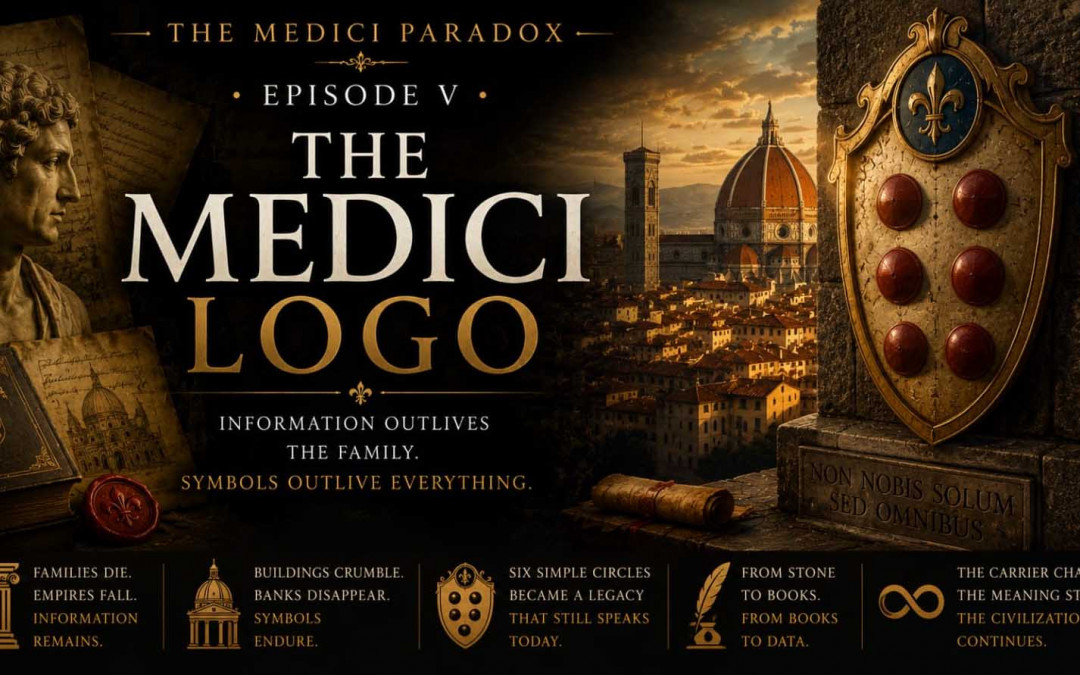
What Would You Put on Your Shield?
Every person carries a logo. Most of us are simply never asked to design it. Death occasionally does the job for us. Walk through an old cemetery and you will see human lives compressed into objects: a ship, a hammer, a book, a flower, an anchor, a cross. A person who required eighty years to become himself is reduced to something a stranger can recognize in three seconds. Companies perform the same compression earlier. A fruit. A shell. Three stripes. Two arches. A star. The interesting part is not that symbols simplify us. It is what happens when we are forced to choose one. Imagine that tomorrow you had to design a mark for yourself — not a company you own, not a product you sell, but you. You might choose a lion because you admire courage, a crown because you value independence, an eagle because it suggests height, a rose because it belonged to someone you loved. And then, if you took the exercise seriously enough, something unexpected would happen. You would begin discovering rules. The lion has been used before. The crown is not merely a crown: its form can imply rank. A flower may belong to a dynasty. A helmet can sit differently according to a heraldic tradition. Suddenly the innocent act of choosing a picture has opened a trapdoor beneath your feet. Under the picture is a system. Under the system are permissions, hierarchies, inheritances and claims, some of them older than the countries in which we now live. A coat of arms is therefore a dangerous object to dismiss as decoration. Pull at one element and an entire vanished structure may come out with it. You thought you were looking at a picture. You were looking at rules.
Six Red Balls
This is why I became interested in six balls. Five red ones arranged on a field of gold and a sixth, blue one above them, carrying three golden fleurs-de-lis. Today they mean Medici with the efficiency of a corporate trademark. Florence does not need to be written underneath. Neither does bank, pope, Renaissance, Lorenzo, Cosimo or Tuscany. The image has already swallowed the words. Yet once I began looking backwards, the apparent simplicity became unstable. Earlier versions of the Medici arms contained more palle: seven, eight, sometimes eleven. Their original meaning is uncertain. The famous explanations are wonderfully convenient. They have been called pills, suggesting doctors and the family name; coins, suggesting bankers; oranges; even dents supposedly made in an ancestral shield by the mace of a giant named Mugello. The last version has everything a successful dynasty deserves: courage, violence, antiquity and a giant. Unfortunately, reality offers something less cinematic. The Medici were established in Florence long before Giovanni di Bicci, and some heraldic scholarship has connected their early arms with the visual world of the Arte del Cambio, the guild of bankers and money changers, whose own emblem used a field of golden bezants. The relationship is suggestive, not proven. That distinction matters. But something else matters more. The earliest Medici shield does not need to contain a prophecy. It did not have to know that popes, queens and grand dukes were coming. It only had to belong to a family living in the world in which it was made. Perhaps our first mistake is always the same: once we know how a story ends, we demand a beginning grand enough to deserve it.

The Man Who Did Not Inherit the Ending
Giovanni di Bicci de’ Medici is particularly vulnerable to this kind of improvement. Born in Florence in 1360, he lost his father at about three and eventually received one fifth of what Treccani describes as a modest paternal estate — nowhere near enough, by itself, to support serious social advancement. But he was not a destitute boy wandering into Florence with a coin in his shoe. The Medici name already existed. Other branches of the family had money and connections. A wealthier relative, Vieri di Cambio de’ Medici, operated an international banking business, and Giovanni worked for him. Giovanni also married Piccarda Bueri; her dowry of 1,500 florins became capital in the banking enterprise in which he was advancing. By 1397 the centre of the business that became the great Medici Bank had moved to Florence. The mechanism is almost annoyingly human. A name. A relative. A marriage. Capital. Apprenticeship. Opportunity. Trust. Work. Timing. None is sufficient alone. Together they can change the starting position of the next generation. That is more interesting than the modern founder myth because Giovanni himself never became what we now imagine when we hear the word Medici. He died in 1429 as a banker and citizen, not a prince. His descendants would inhabit a different category of society. Giovanni’s achievement was therefore not simply that he became richer than his father. He altered the distance his children had to travel. This is the part of social mobility we routinely misunderstand. We look for the spectacular individual leap. Families often move differently: one generation reaches a door; the next begins on the other side of it. Giovanni did not inherit a dynasty. He inherited a position and left a better one.
The Doors Money Cannot Open
Money is wonderfully effective until it encounters a rule written in a different currency. A rich man can buy a larger house than a poor nobleman. He can employ him, lend to him, perhaps rescue him from bankruptcy. Yet in societies organized around inherited status, none of those transactions necessarily answers the question: Who are you? Wealth and rank overlap, but they are not identical. This becomes almost alien to us because modern commercial culture encourages the opposite intuition. If you can afford the room, why shouldn’t you enter it? Earlier Europe contained rooms in which that was precisely the problem. Access might depend upon birth, office, presentation, recognized nobility or documented descent. The paperwork could matter because the paperwork represented something money could imitate but not automatically create: legitimate position inside a structure. A witty man might delight a king — provided he first reached the room in which the king could hear the joke. Talent operates after access. Wealth operates inside rules. Even identity may require witnesses. That is why heraldry becomes more interesting the longer one looks at it. A shield can preserve traces of doors that no longer exist. A quartering may record a marriage. An addition may record an office or favour. A crown may indicate a claim to rank. The image is not merely telling us what its owner liked. It can tell us what a social system had agreed to recognize. And the Medici shield contains one extraordinary example. One of its balls eventually stopped being red. It became blue. Then three golden lilies appeared inside it. The Medici had reached another door.
The Flower They Could Not Draw
In 1465 Louis XI of France granted Piero de’ Medici and his legitimate descendants the right to incorporate the royal fleurs-de-lis into their arms. Hence the blue upper palla decorated with golden lilies. It is a tiny modification. Physically, almost nothing has happened. Blue pigment. Three flowers. A competent Florentine painter could have produced them before breakfast. But that would have missed the point, because the valuable object was never the paint. The valuable object was permission. The surviving grant praises the Medici and records royal favour; it does not justify reducing the episode to a simple purchase of lilies from a king. Something more interesting is visible anyway. By this stage the family had considerable financial power. What they could not manufacture by financial power alone was the fact that the king of France had authorized them to place part of his heraldic language inside theirs. The blue ball therefore contains almost no material value and enormous informational value. Anyone could copy its geometry. Not everyone could copy what it said. That distinction survives around us today. A university seal can be printed for pennies; the degree behind it cannot. A passport can be photographed; the border does not therefore recognize the photograph. A verified mark is merely pixels until a system agrees that the pixels confer something. We have become so accustomed to these interfaces that we forget what they are doing. The Medici fleur-de-lis exposes the machinery because it is old enough for us to see the gears. They could draw the lilies. They could not draw Louis XI saying yes.
When the Logo Started Carrying the Family
Something peculiar happens to a successful symbol. At first, people have to explain it. Later, it explains them. Giovanni and his predecessors carried the Medici name and the palle through a world in which their position still had to be constructed. His son Cosimo accumulated political influence on a different scale. Later generations produced popes, rulers and royal marriages; eventually Cosimo I became Duke of Florence and then Grand Duke of Tuscany. The balls had crossed an invisible boundary. They were no longer merely attached to people whose actions gave them value. They had accumulated enough value to change how a person carrying them was perceived. The strangest demonstration came from outside the Florentine line. Giovan Angelo Medici, elected Pope Pius IV in 1559, belonged to a Milanese Medici family. Treccani notes that there is no evidence establishing kinship between that family and the Florentine dynasty. Yet the possibility of a connection was politically useful enough for Florentine Medici to allude to one, and the Milanese family was probably allowed to use the famous six-ball arms around the time Giovan Angelo became a cardinal. That is an astonishing reversal. At the beginning of our investigation, we were asking what the balls meant because of the people who carried them. Now people could gain meaning by carrying the balls. The symbol had become a store of accumulated reputation. This is what great logos eventually do. The swoosh does not require the shoe to explain it. The apple does not require a computer. And by the sixteenth century, six balls could arrive before the man beneath them. The family had carried the logo until the logo became capable of carrying a family.
The Magnificent Illusion
This is also the point at which history becomes dangerous, because accumulated reputation travels backwards. Lorenzo de’ Medici is remembered as Il Magnifico, and five centuries of repetition have made the words sound less like a form of address and more like civilization’s final verdict on the man. Lorenzo becomes the Renaissance; the Renaissance becomes Florence; Florence becomes Medici; and suddenly the family appears to have been travelling toward magnificence from the beginning. The finished logo alters our memory of the unfinished people. We do this constantly. Once a company becomes enormous, its first garage acquires prophetic significance. Once a dynasty becomes royal, an obscure ancestor becomes the first chapter of royalty. Once a revolution succeeds, every earlier event becomes a sign that it was coming. The Medici are particularly good at exposing the trick because their ascent was neither straight nor guaranteed. Cosimo the Elder was exiled before returning to dominate Florentine politics. Lorenzo’s extraordinary cultural and political reputation coexisted with serious deterioration inside the banking organization inherited from earlier generations. The family produced brilliant operators and poor ones, good decisions and disastrous ones. Yet the six balls flatten all of that into Medici. A logo is therefore a peculiar machine for compressing time. It removes the abandoned drafts. It hides the failed branches. It forgets the doors that did not open. We see the final six balls and unconsciously send their later prestige backwards into the eleven. Success does not merely change the future. Given enough time, it edits the beginning.
The Man Beneath the Shield
By the end of the dynasty, the problem reverses again. If a great symbol can make an ordinary beginning look inevitable, it can also make a complicated ending look like a morality play. Cosimo III, Grand Duke of Tuscany from 1670 to 1723, cultivated intense religious devotion. His government increased the presence of religious orders, strengthened clerical influence in parts of public life and conceded important ground to ecclesiastical jurisdiction; Treccani also records restrictive moral and religious measures. It would be crude to say that piety destroyed Tuscany, but equally crude to assume that personal respectability guaranteed effective government. His son Gian Gastone provides the uncomfortable counter-image. The last Medici grand duke acquired a terrible private reputation: drinking, favourites, scandal, indifference and a court that later writers found irresistible. Yet the administrative record does not arrange itself neatly around the moral portrait. Under Gian Gastone, interest on public debt was reduced, certain levies were abolished, some fiscal burdens inherited from his father’s period disappeared, and restrictions on intellectual life were loosened. Treccani’s older account even describes aspects of his reign as a restoration after his father’s damaging government, while also emphasizing Gian Gastone’s apathy and the limits of what was achieved. That contradiction is exactly what matters. A shield can tell us that a man inherited the Medici position. It cannot tell us whether he was wise, kind, competent, happy or good. The structure survives inside the symbol; the human being stubbornly refuses to fit inside it.
The Medici Without the Medici
Gian Gastone died in 1737 without children, and the ruling Medici dynasty ended. The six balls did not. That may be the most revealing event in their entire history. Strip away the giant, the supposed prophecy, the temptation to make Giovanni poorer than he was, the desire to make Lorenzo magnificent at everything and Gian Gastone disgraceful at everything, and something far stranger remains. A family inherited a sign whose ultimate origin we cannot state with certainty. Generation after generation placed things behind it: transactions, relationships, marriages, mistakes, buildings, patronage, political victories, defeats, royal recognition, papal elections and eventually sovereign rank. The image itself became simpler while the structure behind it became larger. Eleven balls could become six because the sign needed to say less once the world knew more. Then the people disappeared and the information remained. This is why a coat of arms is more than decoration and why a logo is more than graphic design. Both can become interfaces to structures that cannot be seen directly. A few shapes can contain a bank, a marriage, a king’s permission, a social hierarchy, several centuries of accumulated access and the memory of doors through which one generation passed so that another would never know they had once been closed. We began by asking what you would put on your own shield. Perhaps the better question is what would have to happen before your descendants no longer needed to explain it. The Medici did not inherit a symbol of power. They inherited a symbol and spent generations making it powerful. And that is why the final six balls are not a prophecy of what the family would become. They are something more human. They are a receipt for the distance travelled.
Watch the Video
How to Read the World
by
Current Knowledge
The Medici were established in Florence before Giovanni di Bicci de’ Medici. Members of the wider family appear in Florentine public life by the thirteenth century, and different branches occupied very different economic and social positions. Giovanni therefore did not create the Medici name, nor did he begin from absolute poverty. What he did was transform the prospects of his particular branch through banking, relationships, marriage, political judgment and the expansion of a financial network that became the Medici Bank.
The famous Medici arms also predate Giovanni. Their most recognizable form is a gold field bearing six palle, five red and one blue. Earlier examples, however, used different numbers of balls, including considerably more than six. The precise original meaning of the palle is unknown. Explanations involving medicinal pills, coins, oranges and the blows of a giant’s mace belong to a mixture of hypotheses, word association and later legend rather than securely demonstrated origin. A proposed relationship with the imagery of Florence’s money-changing world, including the Arte del Cambio, is historically interesting but should not be presented as proven derivation.
One major alteration is documented. In 1465 Louis XI of France granted Piero de’ Medici and his legitimate descendants the privilege of incorporating the French royal fleurs-de-lis into their arms. The upper palla consequently became blue and bore golden fleurs-de-lis. Whatever financial and diplomatic relationships surrounded the Medici and the French crown, the surviving grant should not be simplified into an established transaction in which a debt was literally exchanged for the heraldic privilege.
Over subsequent generations the social meaning attached to the arms changed dramatically. Descendants of Giovanni’s branch became dominant political figures in Florence, popes, dukes and grand dukes, while women of the family entered European royal dynasties. By the sixteenth century, the palle no longer identified merely a Florentine banking family. They had become a recognizable symbol of dynastic and sovereign power.
Open Questions
The most basic question remains unanswered: what did the Medici balls originally mean? Their resemblance to coins or bezants makes a connection with commerce attractive, while the family’s name encouraged later medical interpretations. The resemblance between early Medici heraldry and the visual vocabulary of the Arte del Cambio deserves attention, but resemblance is not proof of direct borrowing. The surviving evidence does not allow us to identify a single moment when an ancestor selected the balls and explained why.
There is also a larger question that documents cannot answer so easily. When did the symbol begin to work in the opposite direction? At first, Medici individuals must have supplied reputation to their name and arms. Eventually the name and arms themselves supplied reputation to the individual carrying them. There is unlikely to be a date on which this reversal occurred.
And an even harder question survives the dynasty itself: when a symbol outlives the people who created its meaning, who owns that meaning? The ruling Medici line ended in 1737. The palle remain instantly recognizable centuries later. They now communicate ideas — Florence, Renaissance culture, banking, patronage, power, ascent — to people with no genealogical relationship to the family.
That is not a heraldic question anymore.
It is a question about information.
Transhumation Interpretation
The Medici arms can be read as an example of a structure accumulating information without becoming physically more complicated.
A red circle contains almost nothing.
Six circles contain little more.
Yet centuries of human action can make those circles carry enormous informational weight. Money was earned and lost beneath them. Relationships were formed. Political access was negotiated. Buildings were commissioned. Marriages joined families. A king authorized his lilies to appear inside the design. Popes and rulers subsequently carried it. Eventually the people disappeared while the pattern remained.
This is the distinction between carrier and information.
The physical carrier may be pigment on a wall, stone above a doorway, ink on paper or pixels on a screen. None contains the Medici story materially. What survives is the relationship between the pattern and the information human beings have learned to associate with it.
Heraldry exposes another layer as well. Symbols can reveal structures that are otherwise invisible. A crown may encode rank. A quartered shield may preserve inheritance or marriage. A royal augmentation may record recognition granted by another authority. What appears to be decoration can therefore function as an interface to a system of permissions, relationships and status.
The blue Medici palla makes this unusually clear.
The Medici could reproduce the shape of the French lilies themselves.
They could not reproduce what made those lilies valuable.
Permission existed outside the pigment.
That distinction has not disappeared. Modern civilization remains full of symbols whose physical reproduction is trivial while their recognized meaning depends upon an external structure: passports, university seals, signatures, trademarks, currencies, certificates and digital credentials.
The technology changes.
The underlying problem does not.
A symbol is cheap.
Recognition is expensive.
FAQ
What do the balls on the Medici coat of arms mean?
No definitive explanation survives. The palle have been interpreted as coins or bezants, medicinal pills, oranges and other objects, while later family legend connected them to dents made by a giant’s mace. A relationship with the commercial and money-changing world of medieval Florence has also been proposed. None of these explanations has been conclusively established, which is part of what makes the emblem so interesting.
Why are there six balls on the Medici coat of arms?
Six became the best-known form of the Medici arms, but earlier versions contained different numbers of palle, including seven, eight and even eleven. The arms evolved over time and across branches of the family. The familiar six-ball version should therefore not be mistaken for an unchanged design that existed from the beginning.
What does the blue ball with the fleurs-de-lis represent?
It records a royal privilege. In 1465, King Louis XI of France granted Piero de’ Medici and his legitimate descendants the right to incorporate the French royal fleurs-de-lis into their arms. The upper palla consequently became blue and carried golden fleurs-de-lis. Its importance was not the difficulty of drawing the flowers, but the royal authorization behind them.
Were the Medici originally nobles?
The Medici were an established Florentine family long before they became rulers, but the branch descended from Giovanni di Bicci did not begin as a princely dynasty. Their rise came through commerce and banking, civic influence, relationships, marriage, political power and eventually sovereign status. Later generations became dukes and grand dukes, while members of the wider dynasty became popes and royal consorts.
Did Giovanni di Bicci de’ Medici start from nothing?
No. Giovanni inherited a modest share of his father’s estate and belonged to an already established family. He also benefited from connections to the wealthier banker Vieri di Cambio de’ Medici and from the substantial dowry of his wife, Piccarda Bueri. His achievement was not creating something literally from nothing, but transforming the opportunities available to him into a radically stronger position for his descendants.
Was the Medici symbol connected to banking?
Possibly, but this remains an interpretation rather than a proven origin. The circular palle can resemble coins or heraldic bezants, and comparisons have been made with the imagery of Florence’s Arte del Cambio, the guild associated with bankers and money changers. There is not enough evidence, however, to state that the Medici simply copied the guild’s emblem or deliberately designed their arms as a banking logo.
Why call the Medici coat of arms a “logo”?
Because the comparison reveals something that the word heraldry can obscure. Like a modern logo, the Medici arms accumulated meaning through repeated association with people, institutions and events. The shapes themselves were simple. What became valuable was everything people learned to recognize when they saw them. The analogy is not meant to claim that medieval heraldry and modern corporate branding were identical systems.
Could anyone simply copy a noble or royal symbol?
A person could physically reproduce almost any image. That did not mean society recognized the claim represented by it. Heraldry operated within traditions, legal practices and systems of rank, inheritance and authorization that varied across place and period. The Medici fleurs-de-lis illustrate the distinction perfectly: anyone could paint lilies, but only royal authorization gave the Medici augmentation its particular status.
Did the Medici coat of arms change as the family became more powerful?
Yes, although its development should not be treated as a neat modern corporate redesign sequence. Different periods and branches used variants. Nevertheless, the surviving arms show that the number and arrangement of the palle changed, while the 1465 French augmentation added an unmistakable new layer of dynastic information.
Why is the Medici coat of arms still recognizable today?
Because the symbol survived the political dynasty that gave it its extraordinary reputation. Centuries of banking, political power, patronage, architecture, papal history and rule in Tuscany became associated with a relatively simple visual pattern. The ruling Medici line ended in the eighteenth century, but the information attached to its emblem remained culturally transmissible.
What does the Medici logo tell us beyond the history of one family?
It demonstrates how a simple symbol can become an interface to an invisible structure. Behind the palle we find money, family, inheritance, political access, royal recognition and social rank. The image itself is simple; the network of rules behind it is not.
That leads to the central question of the article:
How much history can a symbol carry after the people who gave it meaning are gone?
Continue the Transhumation Series
- Forgotten Religion | Ancient Gods, Symbols and the Hidden Structures of Human Civilization
- The Last Religion | Death, Immortality and the Future of Humanity
- The New Theurgy | AI, Information and the Future of Human Civilization
- End of Branding: You Were Never Meant to Become a Product
- Baal vs Ishtar: Why Ancient Gods Never Disappeared