
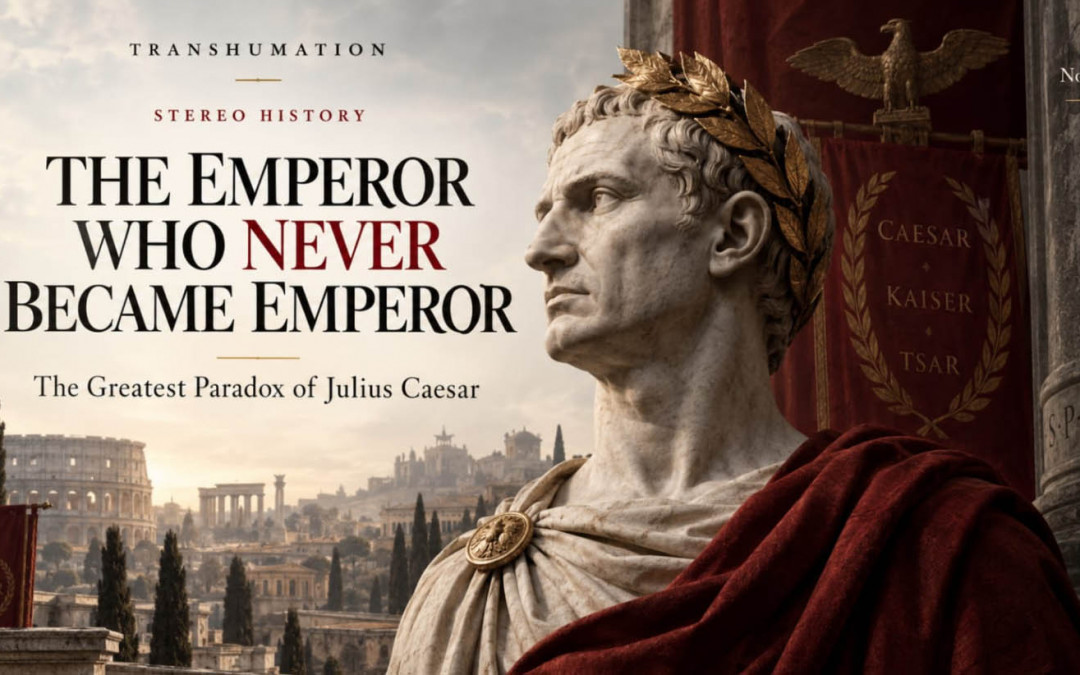
The Greatest Title Julius Caesar Never Held
There is something almost comical about the way history remembers Julius Caesar. Ask for the first Roman emperor and his name will often arrive before Augustus. Caesar appears on cinema screens surrounded by imperial marble, speaks with the authority of a monarch and has become so inseparable from the idea of Roman emperorship that correcting the mistake can feel pedantic. Yet the correction matters, because behind it is a much stranger story than the familiar one.
Julius Caesar was never Roman emperor in the institutional sense in which Augustus and his successors would rule. In the final weeks of his life he held extraordinary powers, most famously the dictatorship in perpetuo, and the Roman Republic had already been transformed almost beyond recognition by civil war, personal armies and political concentration. But there was no imperial office called “Emperor Caesar” waiting for him to occupy. The political form we associate with the Roman Principate emerged after his assassination, through another period of civil war and through the settlement constructed by his adopted heir, Octavian, later Augustus.
Caesar never sat on that throne.
The more interesting fact is that, centuries later, men who sat on very different thrones would still be using his name.
That is the paradox.
He did not become emperor.
Caesar became something emperors could become.
Was Julius Caesar Actually an Emperor?
The simplest answer is no, although the longer answer explains why the misunderstanding is so persistent. Rome had possessed an enormous territorial empire long before Augustus, but its state still formally operated through republican magistracies, assemblies and the Senate. Caesar accumulated powers inside that political vocabulary rather than announcing a new constitutional office corresponding exactly to what later generations would call a Roman emperor. He was consul, dictator, pontifex maximus and eventually dictator perpetuo. His honors became increasingly monarchical in appearance, which contributed to the atmosphere of suspicion surrounding him, but the precise constitutional future he intended remains disputed.
That uncertainty matters. Caesar’s assassins claimed to be acting against tyranny and in defense of republican liberty, but it would be too neat to turn the Ides of March into a simple collision between a man openly attempting to become emperor and republican heroes trying to prevent it. Roman politics by 44 BCE had already been badly destabilized by decades of elite competition, political violence, military patronage and civil war. Caesar was simultaneously the product of that crisis and one of its most powerful accelerants.
His murder therefore did not restore an earlier Republic waiting patiently underneath him. Instead, another sequence of wars followed. Caesar’s adopted son and principal heir, Octavian, inherited not simply property but a name of extraordinary political value: Gaius Julius Caesar. Together with Mark Antony and Lepidus, he participated in the Second Triumvirate; later he defeated Antony and Cleopatra, became the dominant power in the Roman world and constructed a political settlement that presented monarchical reality through carefully republican forms.
The first man we normally call a Roman emperor was therefore not Julius Caesar.
It was Augustus.
And Augustus had begun his ascent by becoming Caesar.

The Name That Escaped the Man
Most names die slowly.
For a while they remain attached to memories, houses, signatures and descendants. Eventually, unless institutions continue carrying them, they retreat into archives. Caesar’s name did something very different. It detached itself from the limits of one biography and entered the machinery of power.
At first this happened within the Roman world itself. Octavian’s adoption made Caesar part of his legal and political identity. The murdered dictator was subsequently deified as Divus Julius, and the young Octavian could present himself as the son of a god. Over succeeding generations, Caesar ceased to function merely as the family name of one extraordinary Roman and became woven into imperial nomenclature. In the later Empire, it could operate as an imperial designation, including for junior or designated rulers beneath an Augustus.
The transformation did not end with Rome.
The German Kaiser and the Slavic Tsar/Czar ultimately derive from Caesar. Their histories are not identical, and one should not imagine a perfectly continuous institution running from Caesar’s house to modern European monarchies. What survived was something more peculiar: a name had accumulated such a dense association with supreme political authority that other languages could inherit and repurpose it.
This is not ordinary remembrance.
Alexander remained Alexander. Napoleon remained Napoleon. Charlemagne’s name also produced extraordinary linguistic and political afterlives in parts of Europe, but Caesar offers one of history’s clearest examples of a person-name becoming a reusable political sign.
A Roman aristocrat had turned into vocabulary.
How Does a Person Become a Title?
The process tells us something about the peculiar economy of political memory. A name becomes more than a name when repetition connects it to institutions, ceremonies, victories, succession and public expectation. It is not enough for a person to be famous. Fame remembers the individual; a title must become usable by someone else.
That difference is crucial.
Caesar’s biological body could not be transferred. His precise personality could not be transferred. His private memories, voice, gestures and subjective experience disappeared with him. Even his political programme cannot be reconstructed with complete certainty. Yet the name could be separated from almost all of those things and attached to another man while still carrying tremendous force.
In this sense, political succession is a form of controlled compression.
It discards almost everything.
A successor need not resemble the founder physically. He need not think as the founder thought. He may even change much of the founder’s system. What matters is that enough recognizable structure remains for other people to accept the continuation.
Dynasties have always understood this instinctively. Crowns, coats of arms, titles, regnal names and ceremonies are technologies for making authority survive the replacement of the person carrying it. Institutions perform the same operation more quietly. The king dies; kingship remains. A president leaves office; the presidency remains. A pope dies; the papacy continues.
The carrier changes.
But here one must resist the temptation to move too quickly from politics to metaphysics. An office surviving its officeholder does not show that a conscious person could survive the replacement of a biological carrier. Political continuity is continuity recognized by institutions and observers. First-person continuity is an entirely different problem.
Caesar survived extraordinarily well as a political pattern.
That does not mean Julius Caesar survived.

The Empty Throne
There is another irony buried inside the story. Caesar is remembered as the archetype of personal power, yet the most durable part of his legacy may have been something profoundly impersonal.
The man disappears.
The position becomes repeatable.
This is one of the thresholds at which power stops belonging entirely to the person exercising it and begins belonging to the structure surrounding him. A founder may create conditions that later rulers inherit, but once the system becomes durable enough, it begins filtering who can occupy it and how they must behave. Augustus understood this better than Caesar’s popular image would suggest. His political achievement was not simply possessing more power than everyone else. It was embedding enormous personal authority inside forms capable of appearing continuous, legitimate and renewable.
The difference between Caesar and Augustus is therefore instructive. Caesar’s final supremacy was inseparable from Caesar. Augustus spent decades producing a political order that could survive Augustus.
It did, although never unchanged.
And once an office becomes more durable than its occupant, a strange reversal occurs. We normally imagine that the ruler owns the throne. Increasingly, the throne also defines the ruler.
The structure begins choosing the kinds of people it can contain.
Did Caesar Win After His Death?
There is a seductive version of this story in which Caesar is assassinated, the Republic collapses, Augustus creates the Empire and therefore Caesar ultimately triumphs over his murderers.
It makes excellent cinema.
History is less obedient.
The conspirators did fail to restore a stable version of the old republican order, and Caesar’s death was followed by further civil wars that ended with Octavian’s supremacy. But this does not prove that the Augustan Principate was precisely the system Caesar intended to create. Augustus learned from Caesar’s career, inherited his name and exploited his memory, yet he also constructed his own political language with extraordinary care. He avoided many of the symbolic dangers associated with naked monarchy and fashioned a regime that could claim to be restoring the Republic while permanently altering its distribution of power.
Caesar therefore did not simply “win.”
Something produced by the crisis around Caesar survived him and evolved.
That distinction may seem less dramatic, but it is far more interesting. History rarely preserves a person’s project exactly. It selects, combines, mutates and reinterprets. What travels forward is often not intention but structure.
The dead lose control of what their lives will mean.
Caesar could not supervise Caesarism.
Watch the Video
How to Read the World

Current Knowledge:
What Actually Survived Julius Caesar?
Historically, several different kinds of survival need to be separated. Julius Caesar himself was assassinated on 15 March 44 BCE. His political offices and personal rule ended with his death, and the settlement that followed was not a simple continuation of his dictatorship. His adopted heir Octavian inherited his estate and name, and Caesar’s posthumous deification gave Octavian a powerful additional claim to legitimacy as divi filius, the son of the deified Julius.
The word Caesar then underwent a long transformation. From a Roman family name it became embedded in imperial titulature and eventually developed political descendants beyond the Roman Empire, including Kaiser and Tsar. This linguistic survival was neither perfect nor unchanged. Different societies used the inherited term within different political structures, and one should not mistake the survival of a word for the survival of one continuous Roman institution.
That distinction gives Caesar’s afterlife its real significance. What survived was not the whole man and not even one immutable political programme. A comparatively small piece of him—his name—became capable of carrying an enormously expanded historical meaning because later institutions continued loading that name with authority.
The physical carrier vanished.
The cultural carrier multiplied.
Why Did “Caesar” Survive When So Many Other Names Did Not?
History has no fair mechanism for choosing what becomes immortal. Durability is not proof of merit, wisdom or moral superiority. Some names survive because later regimes need them. Others survive because literature preserves them, religions sanctify them, institutions repeat them or accidents of archival transmission keep them visible.
Caesar possessed almost every advantage a name could have. His career occurred at one of the greatest transitions in Mediterranean political history. His assassination became an extraordinarily memorable political event. His heir became the architect of the next order and deliberately carried his name. Roman imperial power then lasted long enough to give that name centuries of repeated institutional exposure.
The result illustrates a principle larger than Caesar.
Repetition alone does not create significance.
Repetition plus consequence does.
A word spoken millions of times because the institutions behind it continue changing people’s lives accumulates historical density. Eventually the name stops functioning merely as a reference to its original owner. It becomes an address pointing toward an entire field of political meaning.
That is when memory becomes structure.
Open Questions:
What Did Caesar Actually Want?
We still cannot answer with certainty what precise constitutional future Julius Caesar imagined for Rome. Ancient sources report royal anxieties, extraordinary honors, the famous diadem episode involving Mark Antony and widespread suspicion that Caesar’s accumulation of power threatened republican liberty. Yet those sources were written within political traditions of their own, and reconstructing Caesar’s ultimate intention from them remains difficult.
It is therefore safer to say that Caesar had accumulated unprecedented personal dominance than to declare that he had a finished blueprint for the Roman Empire later established under Augustus. Had he lived another twenty years, Rome might have developed differently. His Parthian campaign, succession arrangements, reforms and personal authority could have altered the path dramatically. Counterfactual history cannot recover that missing future.
A second open question is more general. When does a person’s legacy cease to belong meaningfully to that person? Caesar could never have anticipated every later use of his name. At some point Caesar became something produced jointly by Augustus, Roman institutions, later emperors, medieval political traditions and the languages that inherited it.
Is that Julius Caesar’s immortality?
Or is it civilization using a fragment of Julius Caesar for its own purposes?
The difference becomes important whenever we speak loosely about surviving through information.
Transhumation Interpretation: When the Name Survives the Man
Caesar offers Transhumation a particularly clean example of the difference between something of a person surviving and the person surviving. His biological continuity ended in 44 BCE. His first-person experience did not migrate into Augustus, into the imperial title or into the word Kaiser. Yet a compressed structure associated with him proved astonishingly portable.
A name became detached from one carrier and attached to others. With every transfer, much was lost and something was retained: authority, legitimacy, imperial association, historical memory. The pattern changed while remaining recognizable enough to continue functioning.
That is not immortality in the literal sense.
It is something perhaps more historically common and more interesting:
a human being becoming a reusable structure inside civilization.
Caesar did not conquer death.
His name discovered new carriers.
And once it did, he no longer controlled what it would become.
The Greatest Title He Never Held
There is a temptation to end Caesar’s story with the Ides of March: the Senate chamber, the knives, the collapse beneath Pompey’s statue. It provides history with the kind of ending history rarely provides itself.
But Caesar’s strangest history begins after the body disappears.
His murderers could kill the individual.
They could not determine what later generations would make from him.
Augustus took the name. Roman emperorship absorbed it. Other political languages inherited versions of it. Eventually men ruling societies Caesar could never have imagined would describe their sovereignty using a sound descended from the name of a Roman assassinated before the Roman imperial system had fully taken shape.
Perhaps this is why the error that calls Caesar “the first emperor” remains so persistent. It is historically wrong, but culturally revealing. Caesar became so thoroughly attached to the idea of emperor that our memory has moved him backward into an office he never actually held.
History performed the final transformation for him.
The man never became emperor.
The emperor became Caesar.
FAQ
Was Julius Caesar actually the first Roman emperor?
No. Julius Caesar exercised extraordinary and increasingly concentrated power, but he died while Rome still formally operated within the republican constitutional framework. Augustus is conventionally regarded as the first Roman emperor.
What title did Julius Caesar actually hold?
Among several major offices, Caesar became dictator perpetuo—dictator in perpetuity—in 44 BCE. This was an extraordinary concentration of power, but it was not identical to the later office and political system of the Roman emperor.
Why did Caesar become a title?
Caesar’s adopted heir Octavian inherited his name, and the name subsequently became embedded in Roman imperial nomenclature. Over centuries it acquired such a strong association with imperial authority that linguistic descendants including Kaiser and Tsar emerged in other political traditions.
Did Caesar intend to abolish the Republic and become a king or emperor?
We cannot know his final intentions with certainty. His extraordinary concentration of power and monarchical honors generated intense suspicion, but the precise constitutional system he would have created had he survived remains an open historical question.
Did Julius Caesar achieve immortality through his name?
Only metaphorically. His name and political associations survived him spectacularly, but survival of a cultural pattern is not survival of the conscious person. Caesar gives us a powerful example of something from a person continuing long after the person is gone—which is precisely why his afterlife is more interesting than simply calling it immortality.
Continue the Transhumation Series
- Forgotten Religion | Ancient Gods, Symbols and the Hidden Structures of Human Civilization
- The Last Religion | Death, Immortality and the Future of Humanity
- The New Theurgy | AI, Information and the Future of Human Civilization
- End of Branding: You Were Never Meant to Become a Product
- Baal vs Ishtar: Why Ancient Gods Never Disappeared