
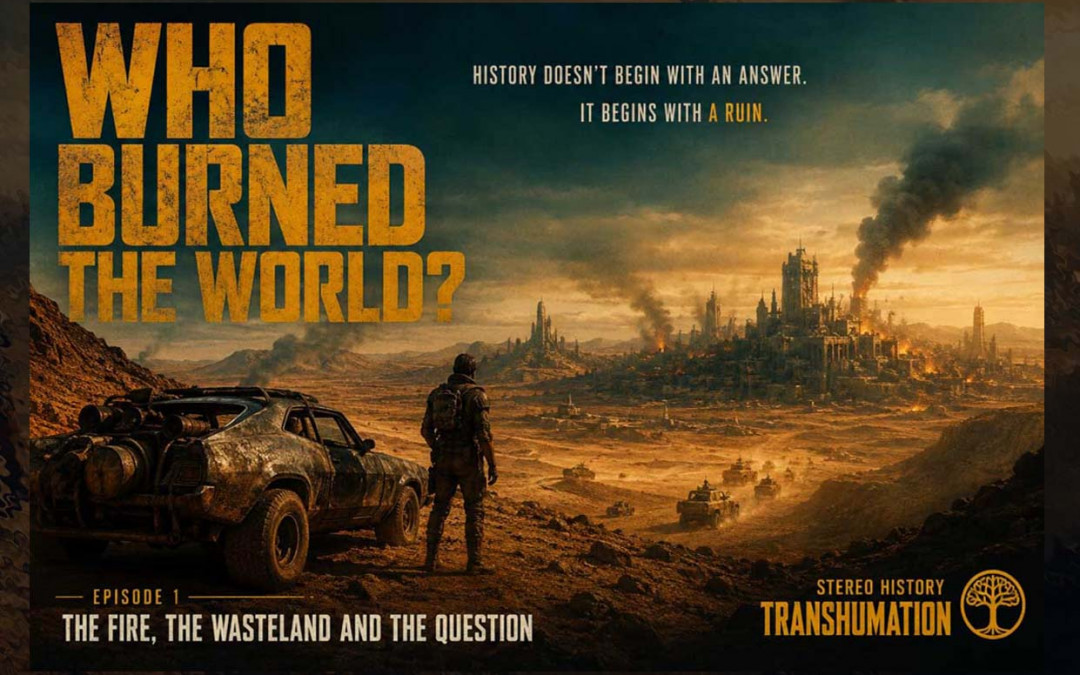
The Steering Wheel
There is a moment in Mad Max: Fury Road when a steering wheel stops being a steering wheel. A sick young man raises one above his head while engines roar around him, chrome shines on his mouth and V8 has acquired the weight of an invocation. Another human being has been strapped to the front of a machine because his blood is useful. We know enough to find all of this grotesque. We remember traffic lights, petrol stations and people driving to supermarkets without considering the spiritual significance of eight cylinders. The War Boy does not. He has inherited the machines but not the world that once made them ordinary. Try explaining that world to him and you immediately have a problem: everything around him confirms his version. Immortan Joe, the Citadel, the other boys, the desert, the engines, the scarcity. He has an entire world on his side. You have only the memory of one.
There is a wonderful joke in The Last Man on Earth built around almost the opposite problem. Civilization has ended, yet Carol objects when Phil parks in a disabled space outside an abandoned store. His reasoning is impeccable: there are virtually no people left, much less a disabled driver circling the car park. The police are gone. The store manager is gone. The practical purpose of the blue rectangle has vanished. Carol refuses to park there anyway. I used to think the joke was that she had failed to notice the apocalypse. Now I wonder whether she was the only person who had understood it. Civilization may survive the disappearance of the policeman for quite a long time. The more interesting moment comes when the last person who knows there will be no fine still leaves the space empty.
Keep Doing It
Julian would have understood Carol. By the time he became emperor in 361, Christianity had acquired imperial power and the old religious world was losing the institutional certainty it had once possessed. Julian tried to restore it with sacrifices and temples, but also with organization: priests were to behave like priests, care for strangers, help the poor and live in ways worthy of the gods. In one surviving letter he complains that Christian charity has helped Christianity prosper and instructs pagan priests to do better. There is something strangely moving about the effort even if one believes none of Julian’s gods existed. His answer to a civilization beginning to doubt its own structures was not necessarily believe harder. It was closer to: keep doing it. Keep the temple a temple. Keep the priest a priest. Leave the blue space empty. A structure can remain worth preserving even after certainty about the story that created it has begun to disappear.
There is an old bumper-sticker joke that turns the mechanism inside out: Jesus is coming. Look busy. The joke works because looking busy is not the same thing as working. Julian’s problem was almost the reverse. The gesture mattered even when certainty weakened, because abandoning the gesture could help destroy the structure that carried it. Somewhere between those two ideas lies the strange fragility of every civilization. A law is only marks on paper until people continue behaving as though it binds them. Money is decorated material until strangers continue accepting it. A sacred boundary survives because somebody who could cross it chooses not to. And a forum remains a forum only while enough people remember that it is something more than conveniently open ground. Centuries later, the Roman Forum was so thoroughly associated with grazing that it became known as the Campo Vaccino, the cow pasture. The cow was not making an argument about Rome. There was grass.

What Fire Teaches
Fire had come before. Rome burned spectacularly in AD 64, and whatever one makes of Nero, the city that followed did something very characteristic of a functioning civilization: it learned. Tacitus describes broader streets, restrictions on building height, open spaces, fire-resistant stone, protected water supplies and requirements for firefighting equipment. Fire destroyed buildings and produced information. That distinction matters. A civilization is not a civilization because nothing burns; everything burns eventually. It is one because enough knowledge, confidence and coordination survive the flames to ask why it burned and how the next thing should be built. There are other fires after which the question itself becomes harder to ask. A statue can be broken, its marble reused, its face lost; a building can surrender its stones to another building. At some point the world that knew how to reproduce the original object may be less available than the object itself. The frightening question is therefore not simply who lit the fire. It is what the fire taught the people who remained.
Now move the camera again. Imagine Fury Road a thousand years after Fury Road. The young man suspended above the front of the machine is one of the masterpieces of Western sculpture. The unknown artist has captured the instant between terror and surrender: the tension of the abdomen, the weight falling through one shoulder, the mouth open but not quite screaming. A narrow tube enters his arm. Beneath him rests the Great Wheel; behind him rise eight cylinders arranged with such impossible balance that generations of commentators have found meanings in their number — completion, rebirth, the Eight Roads, the passage from mortal suffering into the world beyond. Children are brought to see him. Copies stand in provincial sanctuaries. The stone beneath the figure has been polished by centuries of hands. Scholars argue over whether the tube represents mortality or communion. Nobody knows the sculptor’s name. Everyone knows the work. Whoever made it understood suffering, and whoever carved the face loved the man terribly.
The Blood Bag
Nothing in the original scene has changed. The tube is still a tube. The blood is still blood. The terrified man is still attached to a machine because somebody else needs what is inside his body. We have seen him before. It is Max, strapped to the front of Nux’s car. I changed only the century from which we were looking at him, and barbarism acquired marble, commentary, pilgrims and light. Perhaps the War Boys seemed ridiculous only because we arrived too early. Give almost any system a thousand years and it will acquire poets, reformers, hypocrites, saints, scholars, architecture, children who inherit its vocabulary and artists capable of finding genuine beauty inside it. None of that proves the original story true or false. It does something more troublesome: it makes the story difficult to see from outside. I wondered what Michelangelo might have carved had he been born a thousand years after Immortan Joe. Then I wondered how much of what I call civilization is simply Fury Road after the sculptors arrived.
Outside the Movie
For most of this essay I had been using a film about an imaginary ruined civilization to look at a real one. Then I remembered Agora. Cinema has already tried to take us into Alexandria while the ancient world was changing, and at its centre placed Hypatia: philosopher, mathematician, teacher, a woman belonging unmistakably to the intellectual culture of late antiquity. In the film, when the mob comes for her, Davus gives her a final mercy. He suffocates her before the crowd can carry out the death awaiting her. History, as far as our surviving account tells us, provided no such director. In 415 a Christian crowd seized Hypatia during the violent political and religious conflict surrounding Alexandria. Socrates Scholasticus, himself a Christian historian, describes her being dragged away, stripped and killed; her body was then dismembered and the remains burned. The precise responsibility of Bishop Cyril remains disputed, and the evidence does not establish that he personally ordered the murder. What does not require invention is what happened to Hypatia. Even cinema made it easier to watch.
Perhaps no film can really show the end of a world, because the moment we put a camera there we have already given destruction something it did not possess: a frame. We choose the ruins that matter. We restore the missing columns. We know which books will later be mourned and which beliefs will survive. We add music where the people standing in the street heard only noise. Fury Road makes catastrophe beautiful enough to watch. Agora gave Hypatia a mercy that our surviving historical account does not. The people living through the real thing had neither privilege. They could not know which god would become a museum label, which temple would become a quarry, which forum would become a pasture, or which shattered object would one day sit behind glass and be called civilization. Perhaps that is why the end of a world is so difficult to recognize from inside it. Reality has no director to shout cut.
Watch the Video
How to Read the World
by
Current Knowledge
The Western Roman Empire did not disappear in a single event. The conventional date of AD 476 marks the deposition of Romulus Augustulus, but Roman law, Christianity, cities, languages, institutions, infrastructure and political identities survived and transformed in different ways. The Eastern Roman Empire continued for almost another millennium. “The fall of Rome” is therefore useful shorthand for a long and geographically uneven transformation rather than a single historical moment.
Material destruction was nevertheless real. Wars, fires, abandonment, deliberate religious violence, quarrying and ordinary recycling all altered the physical inheritance of antiquity. Statues were damaged and reused, temples changed function or disappeared, marble became building material or lime, and monumental public spaces could lose the institutions that had originally given them purpose. Preservation was equally selective: survival does not necessarily tell us what was most important to the people who originally inhabited that world.
The Great Fire of AD 64 demonstrates that destruction by itself is not equivalent to civilizational collapse. Tacitus records substantial changes to Roman construction and urban planning during the rebuilding, including wider streets, height restrictions, independent walls, fire-resistant stone, protected water access and firefighting provisions. A functioning system could therefore convert catastrophe into information and regulation.
Julian’s religious restoration demonstrates another kind of response to institutional change. His writings show an emperor consciously attempting to strengthen traditional cults by reorganizing priesthoods and adopting forms of charity and social provision that he believed had helped Christianity expand. The article’s “keep doing it” formulation is Jose Fidel’s interpretation of this effort: Julian did not literally leave us that slogan.
The later history of the Roman Forum provides an unusually visible example of functional transformation. By the early modern period the once monumental civic centre was partially buried and used for grazing, earning the name Campo Vaccino. Nothing about cattle grazing there proves why Rome declined. It demonstrates something simpler: a physical place can survive long after the network of institutions and meanings that once made its earlier use seem inevitable has disappeared.
Hypatia’s murder in AD 415 belongs to the documented violence of late-antique Alexandria. It should not be treated as the moment classical learning “ended”; Greek philosophy, mathematics and scientific scholarship continued after her death. Nor does the evidence establish a personal murder order from Cyril. Her death does, however, provide a stark example of intellectual, political and religious conflict during a period in which the cultural balance of the Mediterranean world was changing.
Open Questions
If a law continues to be obeyed after enforcement disappears, is the institution still alive? At what point does Carol’s empty disabled parking space cease to be a rule and become merely blue paint?
How much of civilization consists not in belief, but in continuing to perform inherited structures despite uncertainty about the stories that originally justified them? Was Julian trying to resurrect gods, institutions, habits — or all three?
When does reuse become destruction? If a temple becomes a church, a statue becomes lime or a forum becomes pasture, which part of the previous civilization has actually disappeared: the material, the function, the meaning, or the community capable of reproducing it?
Why can one catastrophe generate better building codes while another contributes to irreversible loss? What determines whether destruction becomes knowledge or darkness?
If the world of Fury Road survived for another thousand years, which of its grotesque practices would become tradition, which would disappear, and which would eventually produce genuine works of beauty?
And if a future civilization reconstructed us only from what happened to survive, how much of the world it described would actually be ours?
Transhumation Interpretation
Who Burned the World? proposes that the survival of a civilization cannot be measured only by the survival of its objects. A steering wheel can survive the automobile industry. A temple can survive its god. A law can survive its enforcement. A word can survive the world that gave it meaning. Conversely, an object can be physically destroyed while some of the structure it carried continues elsewhere.
The decisive variable may therefore be reconstructability.
A civilization remains unusually resilient while enough of its distributed information survives for people to reproduce what has been lost: knowledge, institutions, techniques, habits, categories, trust and the social agreements that make cooperation possible. Fire can destroy a building without destroying the architecture capable of rebuilding it. More serious loss occurs when the carriers remain but the relationships between them can no longer be reconstructed.
This is why Fury Road functions as a mirror rather than a prediction. Its inhabitants possess fragments of an earlier technological civilization without possessing the entire structure that once made those fragments ordinary. The machine survives. The factory does not. The steering wheel survives. Its meaning mutates. Scarcity, memory and power supply another interpretation.
Time can then perform a second transformation. Once a new interpretation survives long enough, it acquires its own artists, institutions, moral vocabulary and inherited beauty. A Blood Bag can eventually be carved in marble. The resulting artwork may be genuinely magnificent without telling us whether the world that first produced the ritual was true, humane or wise.
That distinction matters because history reaches us through the same process. We inherit what survived, together with interpretations produced by people who survived after it. Neither ruins nor traditions come with neutral instruction manuals.
Author therefore moves the camera rather than delivering a verdict. Carol preserves a rule after its practical necessity has disappeared. Julian attempts to preserve a structure whose cultural dominance is disappearing. The Forum becomes pasture. Fire sometimes produces better architecture. Hypatia enters a film in which fiction ultimately gives her a mercy that the surviving historical account does not.
The objects change.
The camera moves.
And eventually the uncomfortable question is no longer who burned their world?
It is whether we would recognize the moment when the meanings holding our own world together began to burn.
FAQ
Did Christianity cause the fall of the Roman Empire?
There is no single accepted cause of the fall of the Western Roman Empire. Political fragmentation, warfare, fiscal pressures, demographic change, disease, migration, institutional transformation and the changing military system all belong to the discussion. Christianity became increasingly powerful during the same centuries, changing institutions, religious practices and the interpretation of the classical past, but chronological overlap is not proof of a single cause. Who Burned the World? is interested in a narrower question: what happens when one civilization begins to describe the surviving objects, places and practices of another?
Did Christians destroy pagan temples and statues?
There were documented episodes of destruction, confiscation, desecration and conversion of pagan religious sites and images, particularly as Christianity acquired imperial and local institutional power. There were also temples and artworks that survived, were reused, protected, reinterpreted or simply abandoned. The process differed greatly by place and period. Ancient marble was also recycled for practical reasons, including construction and lime production, sometimes centuries later. The historical record therefore supports neither the claim that nothing was deliberately destroyed nor the claim that every surviving ruin resulted from a single coordinated campaign.
Was the Roman Forum really used as a cow pasture?
Yes. By the early modern period much of the Forum was buried, and the area was commonly known as the Campo Vaccino — the Cow Field or Cow Pasture — because cattle and other animals grazed among the ruins. The article uses that later image not as evidence for one specific cause of Rome’s decline, but as an illustration of how radically the function and perceived meaning of a place can change.
Did Nero burn Rome?
The Great Fire of Rome occurred in AD 64, but the familiar image of Nero deliberately setting Rome ablaze is not established historical fact. What is well attested is that the reconstruction produced significant changes in urban planning and fire protection. Tacitus describes wider and more regular streets, limits on building height, open spaces, less combustible construction materials, improved access to water and requirements for firefighting equipment. This is why the fire matters to the essay: destruction can sometimes generate institutional learning rather than civilizational collapse.
What was Julian the Apostate trying to restore?
Emperor Julian, who ruled from 361 to 363, attempted to revive and reorganize traditional Greco-Roman religion after decades of growing Christian imperial influence. His surviving letters show that he wanted pagan priests to meet moral standards, support the poor, provide hospitality and strengthen religious institutions. He explicitly complained that Christian care for strangers and the poor had contributed to Christianity’s success and instructed pagan institutions to respond. The essay’s idea of Julian as someone insisting that inherited structures continue to be performed is an interpretation of this broader historical project, not a quotation from Julian.
Was Hypatia murdered by Christians?
Hypatia was murdered in Alexandria in AD 415 by a Christian mob during an intense political and religious conflict in the city. The near-contemporary Christian historian Socrates Scholasticus describes her seizure and killing and condemns the event. Bishop Cyril’s exact responsibility remains disputed; surviving evidence does not establish that he personally ordered her murder. The essay therefore distinguishes the documented identity and context of the attackers from claims about who commanded them.
Is Hypatia’s death in Agora historically accurate?
The film preserves the historical setting but changes her final moments. In Agora, Davus kills Hypatia before the mob can inflict the death intended for her, effectively giving her a fictional act of mercy. The surviving ancient account is more brutal. That difference is central to Jose Fidel’s final reversal: the essay begins by using violent fiction to imagine history and ends with a case in which cinema made history easier to watch.
Is Mad Max: Fury Road being presented as a historical analogy?
Not literally. The film is used as a thought experiment. Its world allows us to observe familiar objects after their original social context has disappeared: engines acquire ritual significance, steering wheels become symbols and inherited technology enters a new narrative. The essay then asks what happens when the same camera is moved backward or forward through real history. Similar mechanisms do not make the societies themselves equivalent.
Continue the Transhumation Series
- Forgotten Religion | Ancient Gods, Symbols and the Hidden Structures of Human Civilization
- The Last Religion | Death, Immortality and the Future of Humanity
- The New Theurgy | AI, Information and the Future of Human Civilization
- End of Branding: You Were Never Meant to Become a Product
- Baal vs Ishtar: Why Ancient Gods Never Disappeared