
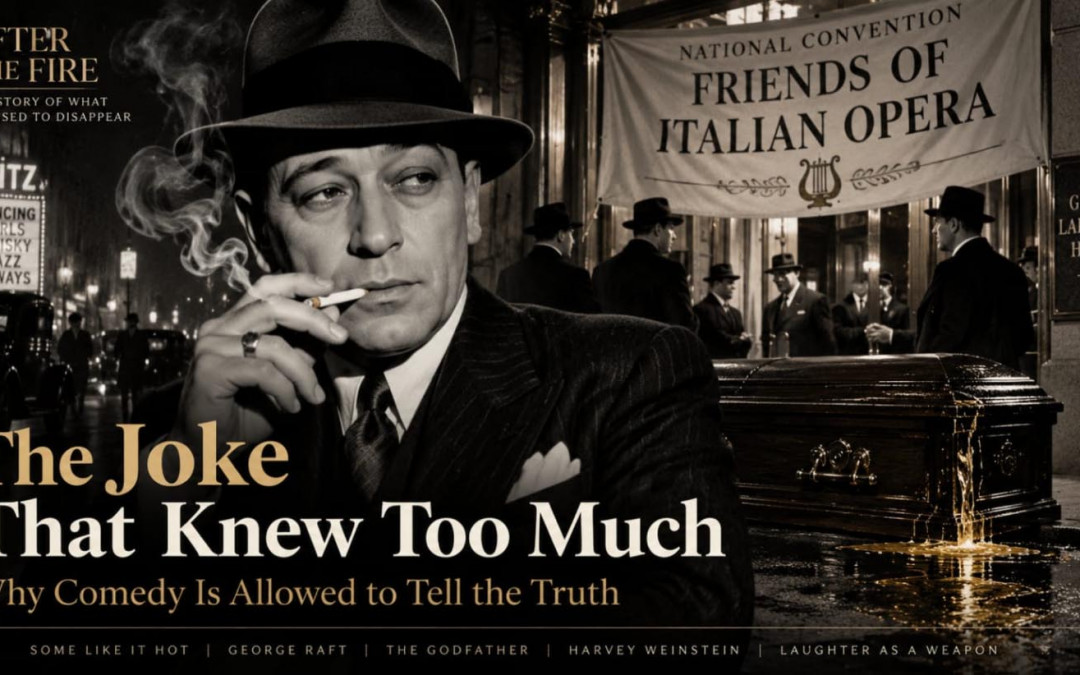
The Joke That Knew Too Much
A hearse moves through Chicago on a winter night. The men inside are dressed for mourning and the coffin appears to contain somebody beyond explanation. Then the police arrive. Bullets enter the hearse, one reaches the coffin, and whisky begins leaking onto the street. The corpse is alcohol. The funeral is a delivery service. Before Some Like It Hot has properly introduced its heroes, Billy Wilder has established the rule of the film: one thing can travel through the world wearing the appearance of another.
It is 1929, reconstructed in 1959. Two musicians will become Josephine and Daphne. Joe will become a millionaire who does not exist. Gangsters will become respectable delegates of the Friends of Italian Opera. The disguises are funny, but what drives them is not. People are hiding from murder, chasing money, seeking sex, buying status and trying to become desirable to somebody else.
Comedy does something peculiar to this material. It does not remove the information. It changes the conditions under which the information is received. Murder can enter wearing a punchline. Desire can arrive in a dress. An accusation can cross a stage under cover of laughter.
Seriousness has not disappeared. It has changed temperature.
When Reality Gets Into Costume
Frederick Kint is interested in the leak. Not the obvious moment when fiction copies reality, but the messier exchange in which reality enters a representation, the representation changes how reality is recognized, and eventually nobody can say with confidence which side taught the other the gesture.
Some Like It Hot is unusually good at this because disguise is not decoration. Jerry does not become Daphne merely because a man in a dress can produce a joke. Remaining Jerry may get him killed. Joe does not invent a wealthy heir simply because lying is amusing. He has identified what Sugar desires and manufactures a person capable of entering that desire.
The film therefore keeps asking the same question in different costumes: how much can a representation do once somebody begins treating it as real? Josephine gets on the train. The millionaire gets the girl. The Friends of Italian Opera get a hotel conference. None of the labels is an innocent description, yet each becomes operational because other people respond to it.
A disguise does not need to become true in order to acquire consequences.

The Gangster Who Brought His Own Shadow
Then George Raft enters as Spats Colombo, and the boundary becomes harder to police. Raft had spent decades helping Hollywood establish the visual grammar of the screen gangster: the controlled stare, tailored suit, economical movement and threat that rarely needed to announce itself. His biography also touched the milieu his films represented; Raft openly acknowledged friendships and acquaintances among underworld figures while rejecting the claim that he was himself a gangster.
That distinction matters. It would be easy, and careless, to claim that Spats behaves in a particular way because Raft learned it from a particular criminal. The evidence does not permit that shortcut. What we can see is stranger enough. A man who knew figures from the real underworld became one of the actors through whom millions of people learned what an underworld figure looked like.
Wilder could then cast Raft and parody the image that Raft had helped create. The famous coin-flipping mannerism associated with his earlier gangster roles is turned back on him when Spats sees another man flipping a coin and dismisses the habit as a stupid trick. Reality had entered cinema; cinema had stabilized the symbol; the symbol could now recognize itself and laugh.
Spats therefore seems to know more than a fictional gangster ought to know, but not because tomorrow has leaked backward through time. The leakage runs sideways. The actor carries a history into the character. The audience carries earlier films into the scene. Wilder knows they are carrying it and writes for the cargo.
By the time Spats speaks, part of the information has already arrived.
The Same Suit, a Different Body
This is where representation becomes more than imitation. A screen gangster may begin as a selective copy of real gangsters, but once the image becomes familiar it can influence how later gangsters, audiences, journalists and filmmakers understand the type. Culture does not simply photograph reality. Sometimes it hands reality a wardrobe.
That does not make every resemblance evidence of influence. It does mean that the traffic between world and image can run in both directions. The copy can become a template. The parody can preserve a mannerism after the people who produced its original context are gone.
Wilder’s fictional Friends of Italian Opera works by the same mechanism. The respectable name is absurd because the audience understands what kind of organization is hiding behind it. Nobody needs an organizational chart. The joke depends on a structure being recognized through a false label.

The Sentence That Entered as a Joke
Decades later, Hollywood produced a darker example. In 2013 Seth MacFarlane, announcing Academy Award nominations with Emma Stone, joked that the nominated actresses no longer needed to pretend to be attracted to Harvey Weinstein. After allegations against Weinstein became public years later, the clip was replayed as though the past had suddenly developed subtitles.
It is important not to give the room knowledge it did not demonstrably possess. The audience laughed; that does not establish that everyone present knew of specific allegations. Laughter is not testimony. Hindsight cannot turn a reaction shot into a witness statement.
MacFarlane later said his remark had been motivated by an account from his friend Jessica Barth concerning Weinstein. That changes what can responsibly be said about the joke itself. A serious implication had entered an extraordinarily public ceremony before the later scandal gave millions of viewers the context through which they would reinterpret it.
The recording did not change. The world around the recording did.
This is Kint’s problem in miniature. In 2013 the sentence arrived as comedy and the ceremony continued. Years later, the identical sequence of sounds could be received as evidence that at least some relevant information had already been circulating. The carrier preserved more than one audience knew how to extract from it at the time.
A joke is particularly good at this kind of smuggling because it asks for recognition without necessarily demanding a verdict. A formal accusation creates pressure to believe, reject, investigate or act. A joke permits the listener to understand enough to laugh and then leave through an emergency exit: it was only a joke.
The information has entered the room. Nobody has yet signed a receipt.
Nobody’s Perfect
The final exchange of Some Like It Hot provides a cleaner experiment. Jerry has exhausted his excuses for why he cannot marry Osgood. At last he removes the wig and gives him what Jerry believes to be the reality-restoring fact: he is a man. Osgood receives the information and replies, “Nobody’s perfect.”
The joke works before a viewer knows much about 1959. A child can understand its machinery: Jerry produces what should be the unbeatable objection and Osgood simply refuses to perform the expected operation. An older viewer can return with knowledge of censorship, sexuality, gender conventions and the film’s historical setting and discover additional layers inside the same few seconds.
This does not make the film independent of history. It makes it an unusually durable carrier. The original audience disappears. Projection becomes television, tape, disc, file and stream. Social conventions change. Yet another nervous system can still construct the expectation and experience its defeat.
Something crossed the distance.
We should be careful about naming that something too quickly. Perhaps it is only a durable comic mechanism. Perhaps it is a more general structure of expectation and reversal. Kint does not need the larger metaphysical claim. He only needs to notice that preserving an object and preserving its operation are not quite the same achievement.
The carrier changed. The operation survived.
Watch the Video
How to Read the World
by Frederick Kindt
Current Knowledge
Some Like It Hot was released in 1959 and places Joe and Jerry inside a fictional Prohibition-era gangster world after they witness a killing modeled on the St. Valentine’s Day Massacre. George Raft’s casting added a self-referential layer because his established screen identity was already closely associated with gangster cinema, allowing Wilder to parody conventions Raft himself had helped popularize.
Raft had documented associations and friendships with figures from the criminal underworld, but that does not establish that particular gestures or details in Spats Colombo were copied from particular gangsters. The safer and more interesting claim is that Raft’s real biography, established screen persona and Wilder’s parody overlap inside the performance.
In 2013 Seth MacFarlane publicly made a joke about actresses and Harvey Weinstein while announcing Academy Award nominations. After allegations against Weinstein became public, MacFarlane said the joke had been motivated by what Jessica Barth had told him. The audience’s laughter does not establish collective knowledge of those allegations.
Open Questions
How much can reality enter a representation before the representation begins influencing reality in return? When an actor brings biography, mannerisms and cultural associations into a role, which parts belong to the fictional character and which arrive with the performer?
Comedy raises a second problem. Does laughter help difficult information cross social resistance, or does it anesthetize the information by removing the obligation to respond? Recognition, belief and action are not the same event.
Finally, when the same joke still works after its original audience, technology and social context have changed, what has actually survived: words, timing, convention, a cognitive operation, or some combination of them?
Transhumation Interpretation
Frederick Kint treats representation as a membrane rather than a wall. Reality can leak into fiction through biography, memory, rumor and convention. Fiction can return the favor by giving reality images, gestures and categories through which it is later recognized.
The Joke That Knew Too Much does not claim that jokes possess secret knowledge or that audiences know everything they laugh at. Its narrower proposal is more useful: a representation can carry information whose significance changes as later observers acquire different context.
Preservation keeps the object. Survival keeps enough of the structure for the object to work again. The recording may remain identical while the world around it changes, and a later observer may extract something the earlier observer did not.
The carrier changed. The operation survived.
FAQ
Why is George Raft important to the argument?
Raft connected several layers at once: real underworld acquaintances, an established Hollywood gangster persona and Wilder’s parody of that persona. He makes the traffic between reality and representation unusually visible.
Does the article claim Spats was based on Bugsy Siegel?
No. Raft knew underworld figures, including Siegel, but that does not prove that specific Spats mannerisms came from Siegel. The article deliberately avoids making that unsupported leap.
Did the 2013 Oscar audience know about allegations against Harvey Weinstein?
The audience’s laughter cannot establish that. The relevant documented point is that MacFarlane later said his joke was motivated by an account Jessica Barth had given him. Later context changed how many viewers interpreted the recording.
Why can the same recording mean something different later?
The recorded words and images can remain unchanged while the observer gains new contextual information. What changes is not the carrier but what the later observer can extract from it.
Does comedy always reveal hidden truth?
No. Jokes can mislead, exaggerate or simply be jokes. Comic framing can, however, let uncomfortable information circulate under different social conditions from a formal accusation.
What does “The carrier changed. The operation survived” mean?
A work can move across film, television, tape, disc and digital streaming while retaining enough of its structure to produce a recognizable operation in a new observer. Preserving a carrier and preserving an effect are related but different things.
Continue the Transhumation Series
- Forgotten Religion | Ancient Gods, Symbols and the Hidden Structures of Human Civilization
- The Last Religion | Death, Immortality and the Future of Humanity
- The New Theurgy | AI, Information and the Future of Human Civilization
- End of Branding: You Were Never Meant to Become a Product
- Baal vs Ishtar: Why Ancient Gods Never Disappeared