
A Pearl Begins With a Disturbance
A pearl begins with a problem. Something enters a living system and cannot simply be wished away. The old explanation was a grain of sand; biology is less romantic and more interesting. A parasite, damaged tissue, some intrusion or irritation gives the animal something it must deal with. The oyster does not remove the past. It covers it. Then covers it again. Layer after layer, disturbance acquires a surface. Eventually, somebody opens the shell, holds the result to the light and calls it beautiful. I have always thought this was an extraordinary arrangement. A diamond is admired because it resists. A pearl is admired because something happened to it.
The Medici understood diamonds. They may have understood pearls better.
The Child Before the Pope
On 26 April 1478, Giuliano de’ Medici was murdered during Mass in Florence Cathedral. His attackers stabbed him repeatedly. His brother Lorenzo escaped. A month later, Giuliano’s son Giulio was born. Do not call him Clement VII yet. That comes later. For the moment there is only a fatherless infant entering one of the most dangerous families in Italy. He cannot know about Luther, Charles V, the Sack of Rome, Catherine de’ Medici or the imperial soldiers who will one day surround Florence. He does not know that men will kneel before him or that other men will curse his name after he is dead.
He knows nothing. That is the first courtesy history owes him. Giulio was absorbed into the Medici world and raised alongside the children of Lorenzo the Magnificent, including Giovanni, the future Leo X. Genealogy calls them cousins. Childhood is less tidy. They were educated together; their lives were joined by the household that remained after Giuliano’s murder. This matters, but not because a murdered father explains a future pope. It does not. Childhood is not a confession extracted in advance. Plenty of fatherless boys do not become Clement VII, just as plenty of loved children become terrible adults.
The more interesting question is simpler: what did the family do for the murdered man’s child? It continued. Someone fed him. Someone educated him. Someone gave him a place at the table. Someone told him his name and showed him the people to whom that name belonged. Before the Church, before the Republic, before the dynasty, there was this smaller machine for carrying human beings across catastrophe.
Family.
The Morning the Guard Did Not Come Home
On 6 May 1527, Rome discovered how quickly marble can become scenery. Imperial troops broke into the city. Clement fled through the Passetto to Castel Sant’Angelo. The Swiss Guard stayed behind. Of 189 guards, 42 survived after escorting the pope to safety; their commander, Kaspar Röist, was killed during the violence. History quite properly remembers Röist. Tyler’s question begins one room farther away. What was the widow doing the following morning? And what were the other widows doing? What happened in the households of the men who did not return? Who explained the empty chair? Who found bread? Who collected a dead man’s belongings? What did the children understand?
Where the record does not tell us, we should not manufacture children and give them names. But we may reconstruct the range of ordinary things that catastrophe does not cancel. Somebody still woke hungry. Somebody still needed shoes. Somebody asked where his father was. Rome had entered history. A child had entered Wednesday. That distinction matters.

What the Widow’s Child Did for His Family
Ten days after the Sack began, Florence expelled the Medici again. Clement had lost Rome as a functioning seat of power and his family had lost Florence. His political strategy had ended with the pope effectively imprisoned in Castel Sant’Angelo. Few portraits of political failure come with architecture this convenient. And yet this is where Clement becomes more interesting rather than less. He survived. He negotiated. In 1529 he reached an agreement with Charles V. Among its consequences was imperial support for restoring Medici power in Florence. The city resisted. Imperial and allied forces surrounded it; Florence capitulated in August 1530. Clement then worked to secure Medici rule, and by 1532 the republican order had given way to a hereditary duchy under Alessandro de’ Medici.
There is an easy way to tell this story. Clement was a Medici pope and sacrificed Florence to Medici dynastic interest. There is another easy way. A man formed by family loyalty protected the institution that had once protected him.
Both are too clean.
Look in both mirrors.
The family had carried the fatherless Giulio. The adult Giulio carried the family. And somewhere inside besieged Florence were other families whose lives were being rearranged by that decision. The circle is almost offensively perfect. The widow’s child had grown powerful enough to create other widows. That is not a verdict on Clement VII. It is a measurement of distance. It tells us how far the child had travelled.
Pearls Against the Skin
Three years after Florence fell, Clement accompanied another young Medici into the next stage of the family’s survival. Catherine de’ Medici was fourteen when she married Henry, Duke of Orléans, in Marseille in 1533. The wedding was magnificent. Her dowry and marriage jewels included substantial precious stones and pearls; surviving descriptions associate an important string of pearls with the settlement.
Clement had done it again.
The family was moving.
This time not behind fortifications, but around the neck and across the body of a teenage girl sailing toward France. There is something peculiar about pearls as dynastic objects. Diamonds belong naturally to crowns. They suggest hardness, permanence, geology and possession. They seem designed to outlive the skull beneath them.
Pearls are softer. Organic. They are made by living things. And we wear them against skin.
Often around the neck, one of the most strangely exposed parts of the human body: the narrow place between thought and flesh, close to the voice, the breath and the arteries. A necklace draws attention to vulnerability while pretending to decorate it. A diamond survives by resisting what happens to it. A pearl exists because something happened to it.
When the Object Outlives the Owner
Later tradition carried famous “Medici pearls” from Catherine toward Mary, Queen of Scots, Elizabeth I and later royal collections. This is precisely where a good story can become too good. The movement of important pearls through sixteenth-century European courts is real. The uninterrupted identity of every individual pearl is harder to establish. Objects can be reset, separated, inherited, sold, renamed and absorbed into later collections. A jewel may survive while its documentary identity becomes less certain.
That uncertainty is not a weakness in the story.
It may be the story.
People are easier to identify. They die.
Objects travel.
A pearl can cross a border without understanding that the border moved. It can leave one dynasty, enter another and acquire a new story while remaining materially much the same object. Human beings spend enormous energy building names, titles and governments around such things. The carrier continues while the interpretation changes.

Pearls Before Swine
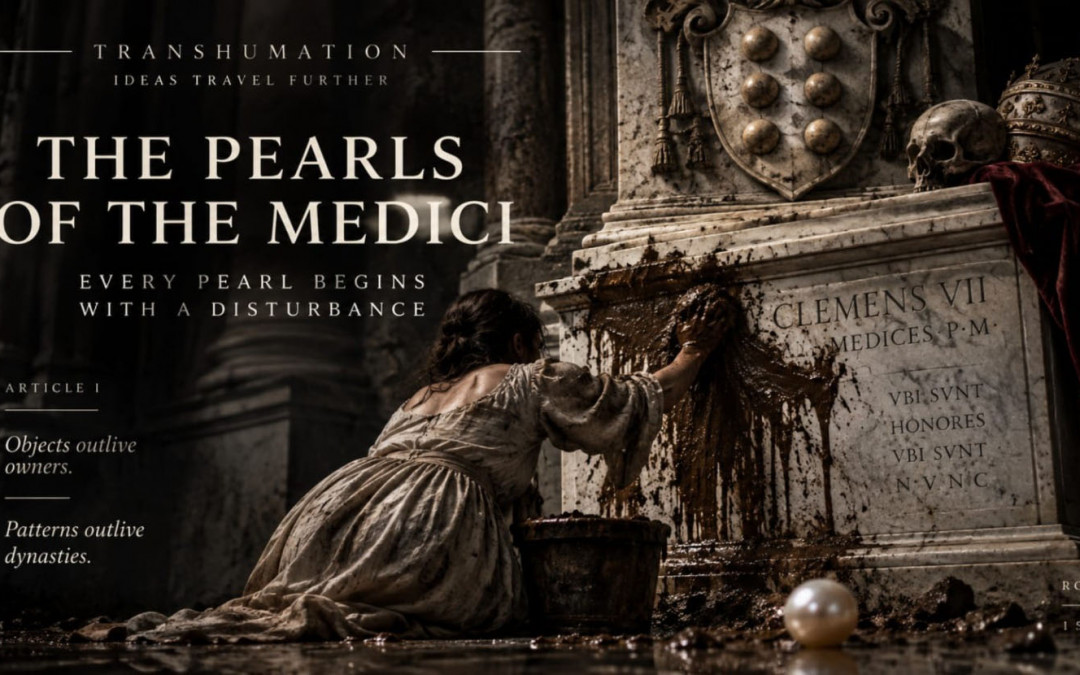
Clement died in 1534. By then he had been the fatherless child of a murdered Medici, the companion of a future Medici pope, a cardinal, a pope himself, a prisoner in his own city, an ally and enemy of emperors, an architect of dynastic restoration, and the man who helped send Catherine toward France carrying the portable wealth of her family. He acquired a magnificent tomb. Rome supplied a footnote. Contemporary hostility toward Clement did not disappear when Clement did. His posthumous reputation included hostile wordplay that turned Clemens into Inclemens — Clement the merciful becoming Clement the unmerciful. Traditions also developed around the physical abuse or defilement of his memorial. This was not a single act of vandalism. For decades, Clement VII’s tomb was reportedly subjected to the same humiliation: hourse excrement was smeared on it again and again. The insult outlived the men who had reasons to hate him. That is a remarkable achievement for a pope. Marble remembers many things. Apparently, so does shit.
But the contrast is worth preserving. Renaissance rulers spoke to eternity in marble. Marble was expensive, pale, durable and obedient. It could carry the coat of arms a man selected, the title he possessed and the face by which he wished to be remembered. Popular contempt answers monuments in cheaper materials. There is an old biblical phrase about casting pearls before swine. Clement’s life presents a stranger arrangement: pearls leaving for the necks of princes while hostility gathered around the monument of the man who had helped send them there. Pearl and filth should have nothing in common. Yet both begin in the body. One is retained, layered, transformed and eventually treasured. The other is expelled.
Civilizations do both with memory.
What Survives the Disturbance
I am reluctant to call the Medici story a curse. A curse is convenient. It turns consequence into magic.
The Medici did not need magic.
They had murder, childbirth, disease, money, loyalty, war, ambition, marriage and time. These are quite sufficient. And running underneath them was something more ordinary: people trying to keep their people alive. That instinct can build extraordinary things. A murdered man’s child is taken in. Cousins become something like brothers. Education is passed on. Property survives. Children inherit names they did not invent. Someone dies and someone else comes for the child.
Civilization probably could not exist without this instinct.
It can also become monstrous.
The desire to protect our people can become nepotism, conquest, exclusion and war. The family that saves one child can eventually possess enough power to endanger somebody else’s. Clement VII contains both possibilities too neatly for us to choose only one. He should not be acquitted because his father was murdered before he was born. He should not be reduced to the failures of his pontificate either.
Don’t smooth the face.
The scars are part of the record.
The Oldest Carrier
A pearl does not remove the disturbance at its beginning. It builds around it until the original injury can become almost impossible to see. Families sometimes do this. Cities do it. Civilizations do it. Perhaps people do too. History has many names for structures designed to survive the individual: church, republic, dynasty, kingdom, empire.
There is an older one.
Family.
That does not make family innocent. It makes it powerful. The same structure that carries a child through catastrophe can carry property, grievance, privilege, obligation, memory and ambition into a century the original participants never saw. Giuliano did not survive the cathedral. Something organized around him did. Giulio entered it before he could choose it. Catherine later carried part of it into France. Pearls, names and alliances moved with her. The interesting question is therefore not whether the disturbance disappears.
It does not.
The question is what learns to carry it.
Watch the Video
How th Read the World

— Alex F. Tyler
Current Knowledge
Giulio de’ Medici was born in 1478 shortly after the murder of his father Giuliano during the Pazzi conspiracy and was raised within the wider Medici household. He later became Pope Clement VII. His pontificate encompassed the Sack of Rome in 1527, his escape to Castel Sant’Angelo under Swiss Guard protection, his later accommodation with Charles V, and the imperial-backed restoration of Medici rule in Florence.
Catherine de’ Medici married Henry, Duke of Orléans, in Marseille in 1533 with Clement VII playing a central dynastic role. Contemporary and near-contemporary descriptions associate her marriage settlement with major jewels, including pearls. Claims about the uninterrupted identity of particular “Medici pearls” across later royal collections require more caution than the broader fact that valuable pearls circulated among European dynasties.
Natural pearls form when a mollusc deposits layers of shell material around affected mantle tissue or another biological disturbance. The familiar schoolroom story that a simple grain of sand is normally the cause is an oversimplification.
Open Questions
The later history of individual jewels is less obedient than dynastic genealogy. Which specific pearls can be followed securely from Catherine’s possession into later collections, and where does documented provenance give way to tradition?
The posthumous treatment of Clement’s memorial also deserves source-by-source scrutiny. Hostile wordplay around his name is part of his reception history, but vivid claims about repeated physical defilement should be stated only as strongly as contemporary evidence allows.
A larger question remains harder to measure: when does loyalty to family function as social resilience, and when does the same mechanism become dynastic capture? Clement’s life places both possibilities unusually close together without allowing biography alone to explain either one.
Transhumation Interpretation
A carrier can disappear while a structure continues.
Giuliano died. Giulio continued. Giulio died. Catherine continued. Dynasties changed, cities changed governments, children became adults and objects crossed borders whose rulers believed themselves permanent.
The pearl provides an unusually precise model. It does not defeat disturbance by returning to what existed before. It incorporates the disturbance into what comes next.
That may be what survival actually means.
FAQ
What are the balls on the Medici coat of arms?
They are known as the palle. Their exact historical origin is uncertain, and several later legends attempt to explain them as coins, pills or marks connected with family history.
Did the Medici dynasty really end in 1737?
The ruling grand-ducal male line ended with the death of Gian Gastone de’ Medici in 1737. His surviving siblings also left no descendants who continued the ruling house.
Did Catherine de’ Medici own famous pearls?
Catherine was associated with major jewellery and pearl traditions, but individual jewels need to be evaluated case by case because later provenance can mix documentation with legend.
Why does provenance change the value of an object?
Because historical ownership adds informational value. An object connected convincingly to a major person or event acquires cultural significance beyond its material composition.
Can a dynasty survive after its bloodline ends?
Biologically, no. Culturally, symbolically and institutionally, parts of a dynasty can survive for centuries through buildings, archives, collections, names and inherited political structures.
What is the deeper Transhumation question?
If a structure can survive the loss of its original biological carrier, then continuity may depend less on preserving the carrier itself than on preserving enough of the pattern for later systems to recognize and transmit it.
A dynasty needs an heir. A pearl only needs another hand.
History adds layers without adding mass.
The Medici did not become immortal. They became transferable.
Continue the Transhumation Series
- Forgotten Religion | Ancient Gods, Symbols and the Hidden Structures of Human Civilization
- The Last Religion | Death, Immortality and the Future of Humanity
- The New Theurgy | AI, Information and the Future of Human Civilization
- End of Branding: You Were Never Meant to Become a Product
- Baal vs Ishtar: Why Ancient Gods Never Disappeared