
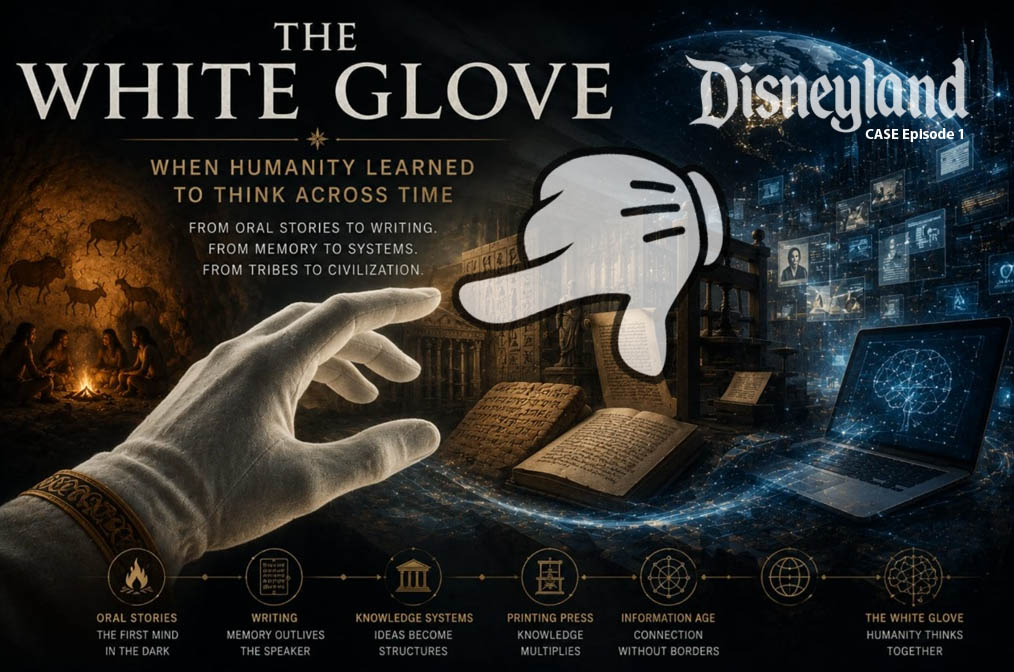
The Mikey`s Gloves
There is a peculiar problem hidden inside one of the most familiar images of the twentieth century. It is so small that almost nobody notices it anymore.
Mickey Mouse is wearing gloves.
Not occasionally, as protection from the cold or as part of a particular costume, but with the persistence of anatomy. The ears belong to the mouse. The tail belongs to the mouse. After nearly a century, the white gloves seem to belong to him too. A child drawing Mickey may forget a button or alter the shape of his shoes, but remove the gloves and something immediately feels wrong. It is difficult to imagine that they were ever absent.
They were. And the reason they appeared was remarkably ordinary.
In the earliest Mickey films, his body was constructed from economical dark forms: circles, tubes, curves, black ink against a pale background. This simplicity was part of the genius of early animation. It also created an irritating practical problem. When Mickey moved his black hands across his black torso, the distinction between them could disappear. The drawings still contained the movement. The audience could no longer read it.
Somewhere inside the enormous adventure of inventing animated cinema, there was therefore a much smaller problem waiting to be solved.
The mouse needed visible hands.
The Treasure Hidden in The Opry House
In the 1929 short The Opry House, Mickey walks onto a stage wearing white gloves. The Walt Disney Family Museum identifies the film as their animated debut. They belonged naturally enough to the theatrical setting, but they also performed a useful visual trick: pale hands remained distinct against Mickey’s dark body. Soon afterward the gloves appeared again and became part of his permanent design.
Walt Disney later offered another explanation. Mickey behaved more like a little person than an ordinary mouse, and Disney did not want him to have realistic paws. Gloves gave him something closer to human hands without requiring the character himself to become human.
There is no reason to force these explanations into competition. Design rarely has the clean genealogy we assign to it afterward. A useful invention can solve several problems simultaneously, and the visual vocabulary available to Disney and his artists did not appear from nowhere. Early American animation inherited conventions from vaudeville and minstrelsy, where exaggerated white gloves were already familiar. That history matters, particularly because some of the theatrical traditions feeding early cartoons have origins that are impossible to treat as culturally innocent.
But something extraordinary happened after the gloves arrived.
They stayed.
The technical conditions changed. Animation acquired color, increasingly sophisticated backgrounds, new methods of production and eventually computers capable of rendering individual hairs. Mickey no longer needed two white patches simply because black ink was disappearing into black ink.
Yet take the gloves away today and Mickey looks strangely naked.
The solution survived the problem.
That is our first piece of treasure.
When an Idea Has Invisible Hands
We tend to imagine that important things fail for important reasons. A company collapses because its strategy was wrong. A book disappears because its ideas were weak. A technology loses because another technology was superior. A philosophy remains obscure because people were not ready for it.
Sometimes this is true. Sometimes the audience simply cannot see the hands.
Imagine the animator looking at his drawings. He knows perfectly well where Mickey’s fingers are. He drew them. He knows what the gesture means and where the movement begins and ends. From inside the act of creation there is no ambiguity at all. Only when the drawing crosses the boundary into another person’s perception does the defect become obvious.
This is a surprisingly brutal property of communication: the creator experiences intentions, while everyone else experiences interfaces.
A website can contain years of serious thought and still leave a visitor wondering where to begin. A scientific argument can be correct and remain culturally invisible because nobody outside the field can see why it matters. A museum can possess extraordinary objects and arrange them so poorly that the visitor walks past them without curiosity. A new technology can perform something astonishing and still feel useless because its first button makes no sense.
The tragedy in such cases is not that nothing valuable exists.
The tragedy is that the valuable thing is already there.
It is moving behind the black shape.
The Strange Life of a Solution
There is another reason the gloves are worth following. They reveal what happens when a practical device remains in circulation long enough to acquire a second life.
At first, the glove helps us see the hand. Then it helps make Mickey human. Then it becomes part of Mickey. Eventually we stop seeing the glove as a solution at all. It has crossed a boundary from engineering into identity.
Civilization is full of objects that have made this journey. The floppy-disk icon survives on screens used by people who have never owned a floppy disk. Architectural ornaments persist after the structural techniques that once required them have disappeared. Ceremonies continue after their original political or religious circumstances have been forgotten. Words carry traces of technologies and customs that no longer exist.
We inherit solutions and call them traditions.
This does not mean that their origins cease to matter. Quite the opposite. The origins tell us something important about how culture is built. We like to imagine symbols descending fully formed from the realm of ideas. More often they arrive carrying a toolbox. They were once answers to awkward, local, embarrassingly practical questions.
Then millions of repetitions polish away the question.
What remains looks inevitable.
The white gloves were never inevitable.
That is precisely why they are interesting.
The Small Door Into the Large Room
Ambitious projects have a dangerous attraction to ambitious solutions. If the idea is large enough, its creator begins searching for a form equally large: a complete philosophy, a revolutionary visual language, a perfect business model, an elaborate explanation capable of containing everything.
The audience does not arrive that way.
It encounters a title. An image. A sentence. A button. A hand.
This is where the hopeless romantic and the radical realist are forced to work together. The romantic is right that enormous ideas are possible. The realist asks whether anyone can find the door.
Reducing an idea until it becomes trivial is not the answer. Mickey’s gloves did not replace Mickey. They did not perform the music, write the jokes or animate the character. Their brilliance was almost the opposite: they preserved the larger performance by introducing one simple distinction.
White against black.
Hand against body.
Gesture against noise.
Good interfaces perform this modest magic constantly. They do not make the world simple. They make complexity enterable. A map does not shrink a country into insignificance; it gives the traveller a way to begin crossing it. A museum label does not replace the artifact; at its best, it creates the small opening through which curiosity can enter. The first sentence of a book cannot contain the book. It can persuade someone to turn the page.
Perhaps this is why the smallest design decisions can become disproportionately valuable. They occupy the border between what exists and what can be perceived.
The White Glove Test
There is a useful test hidden in Mickey’s hands, and it begins with an uncomfortable possibility.
When people fail to understand what we have made, perhaps the first question should not be whether the idea is wrong. Nor should we immediately conclude that the audience is incapable of understanding it.
We should ask:
What is already here that they still cannot see?
That question is harder than it appears because creators suffer from a peculiar form of perfect vision. They know the map before the visitor arrives. They recognize the symbols because they invented them. They understand why one article follows another, why a particular image matters, why a button leads where it leads. They can see Mickey’s black hand perfectly well because they know exactly where it was drawn.
The stranger does not.
Every sufficiently original project will therefore encounter its own disappearing hands. The solution may be a symbol, an opening sentence, a recurring format, a navigation path or an unexpectedly ordinary metaphor. It may look almost insultingly small beside the scale of the thing it reveals.
Good.
Small is not the same as insignificant.
Somewhere in 1929, amid the enormous machinery of an emerging entertainment empire, somebody had to solve the ridiculous problem of a mouse whose hands kept disappearing.
Nearly a century later, the gloves remain.
That should make anyone building something large pay attention to small things.
Watch the Video
How to Read the World
Current Knowledge
Mickey Mouse appeared without his now-standard white gloves in his earliest animated films of 1928. The Walt Disney Family Museum identifies The Opry House (1929) as the first animated appearance of the gloves, where they were part of Mickey’s stage costume and also helped distinguish his hands from his dark body. They became a regular element of the character soon afterward.
Archival accounts also preserve Walt Disney’s explanation that Mickey was conceived as an anthropomorphic character and that gloves made his hands appear more human than realistic mouse paws. The design existed within a wider visual culture influenced by stage entertainment, including vaudeville and minstrelsy. White gloves therefore cannot be attributed with certainty to one isolated technical motivation.
Open Questions
It remains difficult to determine the precise weight of the different influences behind the gloves. How much came from the need for visual contrast? How much from theatrical costume, anthropomorphism, production practice or visual conventions already circulating through American entertainment?
There is also a broader question. At what point does a solution stop being experienced as a solution and become identity? And when an effective cultural symbol inherits elements from troubling historical traditions, how should its later meanings be understood without erasing the conditions from which it emerged?
The design question may be even more useful: when an audience fails to respond to an idea, how can we distinguish rejection of the idea itself from failure of the interface through which it was presented?
Transhumation Interpretation
The white gloves suggest that transmission is not a secondary stage of thought.
It is part of thought’s survival.
A pattern can exist perfectly well for the person who recognizes it and remain effectively nonexistent for everyone else. Between discovery and recognition stands an interface: some distinction that allows one consciousness to reconstruct what another consciousness has already seen.
Disney did not create Mickey’s hands by giving him gloves. The hands were already there. He altered the conditions under which another observer could perceive their movement.
This is a useful model for Transhumation because the project faces precisely the danger that confronts any attempt to describe a large structure. More explanation is not necessarily more visibility. A hundred additional pages cannot rescue a hand that still disappears against the body.
Somewhere inside Transhumation there may therefore be a white glove: a recurring image, a question, a route through the library, a simple gesture whose importance initially appears absurdly small. Its purpose would not be to explain the whole structure.
Only to reveal that something is moving.
The romantic wants to discover another world.
The realist makes sure the door has a handle.
FAQ
Why did Mickey Mouse begin wearing white gloves?
The gloves helped distinguish Mickey’s hands from his dark body in black-and-white animation, making his gestures easier to read. Walt Disney also explained that gloves helped give the anthropomorphic Mickey human-like hands rather than realistic mouse paws.
When did Mickey Mouse’s white gloves first appear?
The Walt Disney Family Museum identifies the 1929 animated short The Opry House as their animated debut. They became a regular part of Mickey’s design soon afterward.
Were Mickey Mouse’s white gloves only a technical solution?
Probably not. Visual contrast was useful, but the gloves also suited Mickey’s anthropomorphic character and belonged to theatrical conventions already familiar from vaudeville and minstrelsy. Their origin is better understood as the intersection of several influences than as a single invention with one cause.
What is the “White Glove Test”?
It is the question: What is already present but still impossible for another person to see? A “white glove” is the small design or interface decision that makes a larger structure perceptible.
Is good design simply simplification?
No. Good design can preserve complexity while providing a clear point of entry. The purpose of an interface is not necessarily to make the underlying idea smaller, but to make access to it possible.
How does this apply outside animation?
The same problem appears in websites, books, institutions, science and technology. Valuable content can remain inaccessible when people cannot understand where to begin, what matters or what an action means.
What is the central Transhumation interpretation?
Discovering a pattern is only half of the problem. For that pattern to cross from one observer to another, it needs a perceptible form. The interface does not replace the structure. It makes the structure visible.
Continue the Transhumation Series
- Forgotten Religion | Ancient Gods, Symbols and the Hidden Structures of Human Civilization
- The Last Religion | Death, Immortality and the Future of Humanity
- The New Theurgy | AI, Information and the Future of Human Civilization
- End of Branding: You Were Never Meant to Become a Product
- Baal vs Ishtar: Why Ancient Gods Never Disappeared