
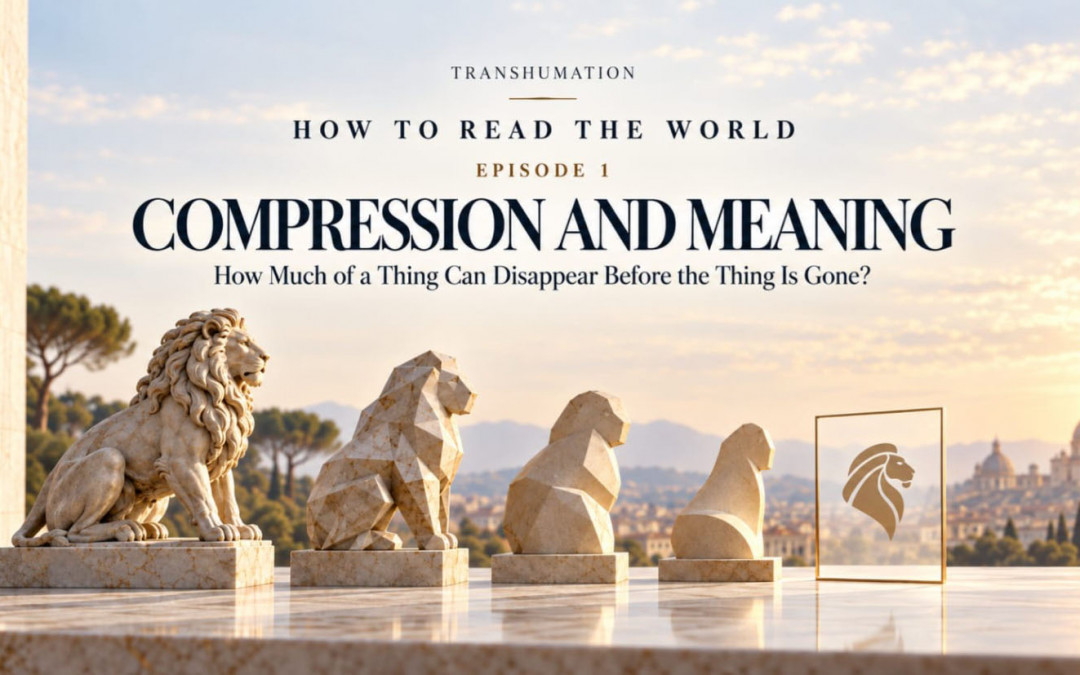
Compression and Meaning
There may be no more ridiculous object with which to begin a serious investigation of identity than the smiling pile of excrement on your phone.
The 💩 emoji has no smell, no bacteria, no temperature worth discussing, no digestive history and almost none of the material characteristics of the biological object it represents. Nobody mistakes it for actual excrement. Nobody steps around it on a pavement. Nobody calls sanitation. Yet almost nobody requires an explanation either. Three brown curves, two eyes and an absurdly cheerful mouth are enough to summon an entire category of physical experience inside the mind of the observer. The representation is laughably incomplete and almost perfectly successful.
That should trouble us more than it does, because the success of the symbol depends on an extraordinary act of destruction. Almost everything has been removed. Chemistry is gone. Weight is gone. Texture is gone. Biological function is gone. What remains is a tiny arrangement of visual differences capable of activating a much larger structure somewhere else.
Not inside the emoji.
Inside us.
The symbol does not carry a miniature version of the object. It carries enough structure for an observer to reconstruct a meaning.
That distinction leads to a question much larger than the joke that introduced it:
How much of a thing can disappear before the thing itself is gone?
The Art of Throwing Things Away
Civilization is built partly on our ability to discard information intelligently.
A map is an astonishing act of omission. It does not preserve the smell of wet asphalt, the bark of every tree, the temperature of a railway platform or the precise color of every building between Paris and Rome. It removes almost everything and keeps a handful of relationships useful for navigation. Its success therefore cannot be measured by how much of the landscape it preserves. A perfect physical duplicate of Europe would be an exceptionally inconvenient map.
A musical score performs a similar reduction. There is no sound inside the page. The paper contains neither violin strings nor air pressure nor the acoustics of the concert hall. Yet a sufficiently trained performer can use those marks to reconstruct a musical event. The word fire contains no heat. A portrait contains no metabolism. A recipe contains no meal. A blueprint contains no building.
Again and again, civilization discovers that preserving everything is neither necessary nor desirable.
What matters is preserving the relationships required for the next operation.
Digital compression makes this principle visible because the loss can be engineered deliberately. A lossy audio format such as MP3 does not attempt to preserve every measurable feature of the original signal with equal precision. Psychoacoustic models help an encoder allocate information according to assumptions about what human listeners are more or less likely to notice under particular conditions. Some details receive less precision. Some source information is discarded.
And the music may remain completely recognizable.
The missing information does not secretly return when the headphones touch your ears. It is gone. What survives is enough for the intended experience.
Compression is therefore not simply the art of making files smaller.
It is the art of deciding which differences are permitted to disappear.
Compression Is Always Compression for Something
That final qualification changes everything.
There is no universal amount of information below which an object suddenly becomes insufficient. Adequacy depends on purpose. A photograph compressed for a phone screen may be perfectly useful for recognizing a friend and useless for diagnosing a skin condition. A map excellent for crossing a country may be hopeless for finding the service entrance to one building. A recording that sounds indistinguishable during ordinary listening may not preserve what an acoustics researcher needs to study the original event.
So the real question is never simply:
How much survived?
It is:
Enough for what?
This is where discussions of information often become slippery. Recognition, function and reconstruction are treated as though they were different names for the same thing.
They are not.
Something may remain recognizable while losing its original function. Something may preserve function while looking completely different. Something may recreate an effect while containing too little information to reconstruct the original object that caused it.
Our ridiculous emoji demonstrates this with unusual efficiency. It passes the recognition test brilliantly. It fails the biological-function test completely. And if an archaeologist of the future were handed only the emoji and asked to reconstruct the precise physical object from which the idea originated—its mass, chemistry, microbial population and molecular history—the symbol would be almost useless.
The meaning crossed.
The object did not.

What Is Actually Being Preserved?
It helps to distinguish at least three kinds of survival.
There is perceptual survival: can an observer still recognize the thing or category?
There is functional survival: can the representation or replacement still do what we cared about?
And there is reconstructive survival: does enough remain to recover the relevant earlier structure?
These boundaries often occur at entirely different points.
A plastic key may preserve the appearance of a key without opening a lock. A digital reproduction of a painting may preserve color relationships and composition while losing scale, texture, pigment structure and material history important to a conservator. A recipe may preserve enough relations among ingredients and procedures to reproduce a recognizable dish without preserving the dinner that was actually eaten in Paris in 1927.
This sounds almost trivial until the subject becomes a person.
Then the vocabulary begins to betray us.
A recording survives, so we say the voice survives. A conversational model behaves similarly, so we say the personality survives. A hypothetical copy possesses the same memories, so we are tempted to say the person survived.
Each step introduces a new criterion.
The previous success does not automatically establish the next one.
Recognition is not reconstruction.
Reconstruction is not continuity.
And continuity may be the property we care about most.
A Symbol Is Not a Tiny Copy of Reality
The strength of a symbol often comes from precisely what it refuses to carry.
Imagine improving the 💩 emoji by making it chemically accurate. Give it real bacteria, temperature, smell, moisture and mass. The result would become vastly more faithful to the physical object and almost infinitely worse as a communication symbol.
The emoji succeeds because it is selective.
The same principle applies to more dignified symbols. A key can represent access without specifying which metal, door or lock. A skull can evoke mortality without identifying a particular dead person. A crown can represent sovereignty even when no monarch actually wears that crown. A cross can carry historical, theological, institutional and personal associations vastly larger than the geometry of two intersecting lines.
This does not make symbols mystical storage devices.
Their meanings are not sealed inside them.
Meaning emerges from the relationship between a pattern, a context and an interpreter capable of expanding the pattern into something larger.
That is why symbols can survive enormous changes of carrier and also why they can fail when they enter a context that no longer possesses the necessary decoder.
A symbol can become smaller because civilization has learned how to supply what is missing.
In a sense, culture does part of the decompression.
Why Can Less Information Sometimes Preserve More Meaning?
Because detail and relevance are not identical.
A person drawing directions on a napkin may produce a map more useful than a satellite photograph. A silhouette may identify a famous building faster than a high-resolution architectural survey. A few notes can identify a melody while a complete acoustic waveform remains unintelligible to anyone without the tools required to interpret it.
Reduction can expose relationships that detail obscures.
But this is also where the danger begins.
A model becomes elegant by leaving things out. A conspiracy theory can become elegant for exactly the same reason.
Once enough inconvenient detail has disappeared, unrelated events can begin looking beautifully connected.
This is why compression must always be reversible at the level of inquiry, even when it is not reversible at the level of data. We must be able to return from the simplified model to the messy evidence and ask whether the pattern still survives.
If it does not, elegance has become illusion.
The purpose of simplification is not to escape reality.
It is to discover which relations reality continues to support after the simplification is challenged.
The Minimum Sufficient Structure
Suppose we keep removing properties from an object.
Change the color.
Change the material.
Reduce resolution.
Alter scale.
Replace one component.
Replace another.
At first the changes may be irrelevant to the property we care about. Then, somewhere, something breaks.
A bridge can tolerate different paint.
It cannot tolerate arbitrary removal of load-bearing members.
A melody can migrate from piano to violin, from orchestra to whistle, from vinyl to digital file. Yet remove enough rhythmic and interval relationships and recognition eventually collapses.
A language can change vocabulary, pronunciation and grammar across centuries while maintaining enough historical continuity to remain recognizable as a developing language. Continue long enough and the descendant becomes distinct enough that speakers require translation.
The interesting part is the region near failure.
That region tells us which relations were carrying more weight than we realized.
This suggests a useful experimental attitude: if you want to understand a structure, do not merely admire the complete object.
Begin removing things.
Watch what survives.
Watch what does not.
The boundary may tell you more than the original.
This is where I would embed your Perfect Sphere film.
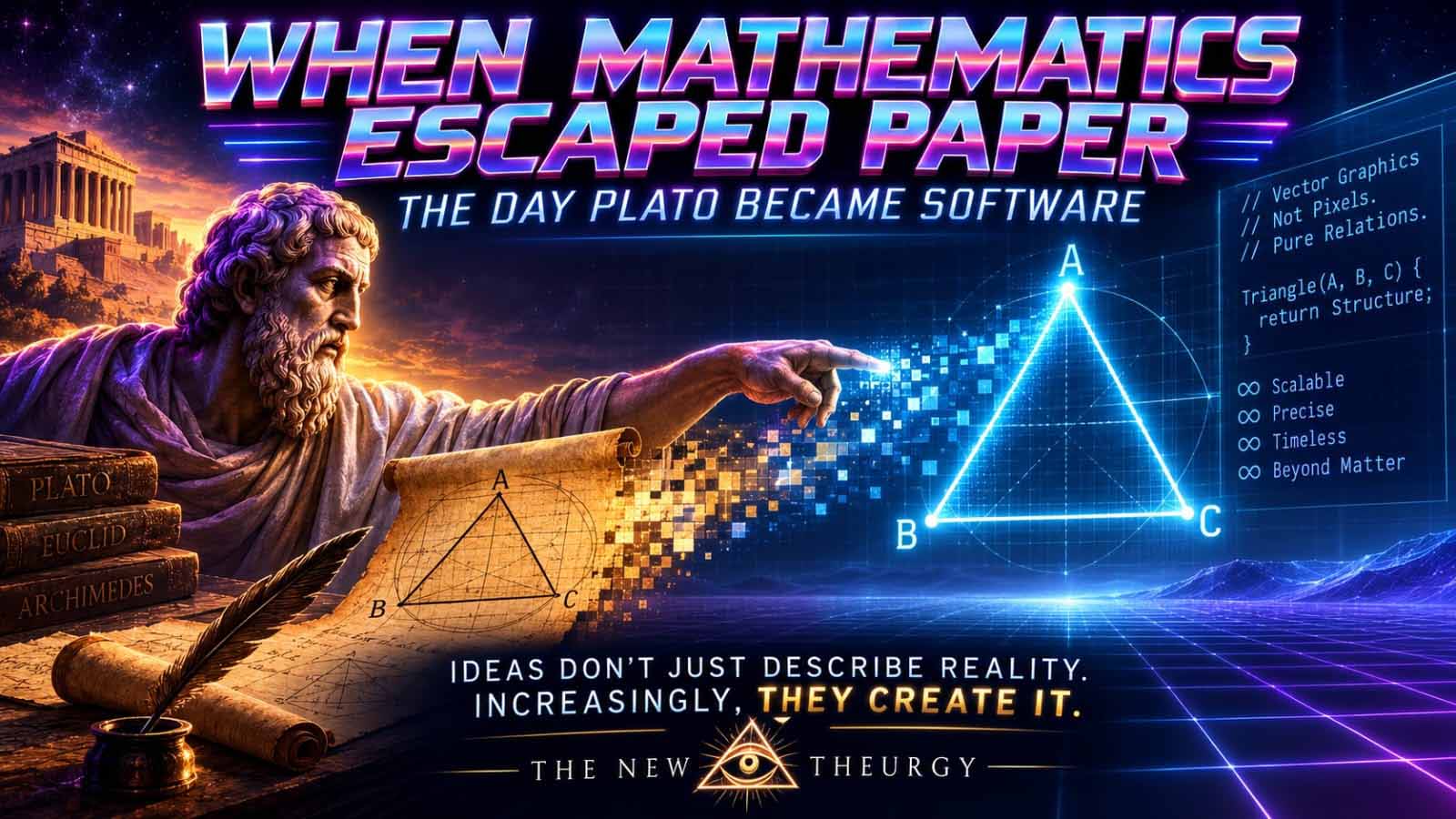
A physical sphere can be marble, steel, glass, digital geometry or a temporary image on a screen. The material realization changes, but a mathematical relation can remain recognizable across those implementations. In Cartesian coordinates, a sphere centered at the origin can be described by:
x² + y² + z² = r²
The equation is not a physical sphere. Nor does its portability prove that mathematical structures exist independently of all material realization. But it gives us an unusually clean example of a relation being instantiated repeatedly through very different carriers.
The marble disappears.
The screen disappears.
The Newton’s cradle stops moving.
The relation can be instantiated again.
That is exactly the kind of boundary this article is trying to locate.
Now Put a Human Being on the Table
This is where the experiment ceases to be comfortable.
Human beings already survive extraordinary amounts of ordinary change. Hair is cut. Teeth are replaced. Joints become titanium. A damaged heart may receive an artificial valve. A transplanted organ can become part of a life whose social and subjective continuity appears uninterrupted.
None of this proves that people are independent of biology.
It certainly does not prove that consciousness can be uploaded.
The connection between conscious experience and brain processes remains fundamental to everything we currently know scientifically about human consciousness. Many neurons can persist for extraordinarily long periods, and the simplistic claim that the human body is continually replaced cell by cell until none of the original remains is misleading.
Yet replacement still exposes a legitimate question.
Which changes are irrelevant to identity?
Which change the person without ending the person?
Which would end the original experiencing subject even if an extraordinarily accurate successor appeared afterward?
Memory cannot settle the matter because memory changes and is reconstructive. Personality cannot settle it because personality develops throughout life. Physical appearance clearly cannot settle it. Even perfect behavioral imitation would tell us what observers see, not necessarily what happened to first-person continuity.
This is where the sentence “the person is the pattern” becomes tempting.
And dangerous.
It may be true in some limited functional sense.
It has not been established as an answer to personal survival.
Watch the Video
How to Read the World
Current Knowledge
Loss Does Not Always Mean Destruction
Information theory provides rigorous ways of describing encoding, transmission and compression. In lossless compression, the original data can in principle be reconstructed exactly from the compressed representation. In lossy compression, some source information is not preserved because exact reconstruction is unnecessary for the intended use. This is an engineering distinction, not a theory of metaphysical identity.
Human perception is also selective, although perception should not simply be described as a compression algorithm. Sensory systems sample and transform physical signals, while neural processing and attention organize only part of the available information into experience. We therefore never encounter the external world as an exhaustive physical inventory.
Cultural representations extend this selectivity dramatically. Maps, language, mathematical notation, images and symbols preserve some relationships while abandoning others. Their usefulness depends on the task, the context and the interpretive competence of the receiver.
What current knowledge does not establish is equally important. We have no scientific evidence that consciousness can be extracted from the biological processes supporting it and instantiated on an arbitrary substrate while preserving first-person continuity. Nor does the successful transfer of a mathematical, linguistic or musical pattern demonstrate that conscious identity behaves in the same way.
A careful conclusion is therefore narrower and stronger:
some structures can survive substantial changes of carrier and enormous losses of detail.
The carrier matters.
But one particular carrier may not always be essential to one particular function.
Carrier-independent enough to travel.
Never carrier-free.
Open Questions
What Is the Minimum That Must Cross?
The most difficult unresolved problem is whether personal identity possesses anything analogous to the invariants we can identify in simpler systems.
Perhaps causal continuity matters more than material continuity. Perhaps certain biological processes are indispensable. Perhaps organization matters, but only when preserved through a continuous physical process. Perhaps consciousness could theoretically be instantiated differently. Perhaps we are missing an important category altogether.
We do not know.
The copying problem makes the uncertainty sharper. Imagine that a future machine could reproduce your complete functional organization, memories, habits and personality with perfect fidelity. Now imagine it produced two versions.
Both remember being you.
Both claim to be the original.
Both recognize your friends.
Both insist that the transfer succeeded.
From that moment they begin accumulating different experiences and become different subjects.
Which one received your original first-person continuity?
The existence of two equally convincing successors reveals that similarity cannot settle the question.
Neither can recognition.
Neither can reconstructability.
This is why Transhumation should resist phrases such as “humans are just information.” They compress the philosophical problem before we have discovered what can safely be removed.
A better procedure is slower.
Change the carrier.
Remove a component.
Restore the detail.
Compare the result.
Attack the analogy.
Ask what would falsify the claim of continuity.
The interesting theory is not the one capable of surviving every imaginable outcome.
It is the one that tells us what would make it fail.
The Boundary Is More Interesting Than the Object
There is something revealing about a melody just before it becomes unrecognizable.
At full fidelity, too many properties survive for us to know which ones were essential.
At complete destruction, nothing remains to study.
The interesting region is between them.
Enough has disappeared to expose the structure.
Enough remains for the structure still to work.
This is why boundary testing is so useful. Reduce a photograph until the face begins to vanish. Translate a sentence until the original ambiguity disappears. Simplify a symbol until nobody recognizes it. Replace parts of a system until function fails.
Then restore one thing.
If the structure returns, you may have found something load-bearing.
Not the essence of the universe.
But something worth investigating.
This is the difference between pattern recognition and pattern worship.
The first tests.
The second merely admires.
Transhumation Interpretation
The First Gate
Transhumation begins here with a modest principle:
Reduce until the structure you care about can no longer survive the passage.
The 💩 emoji makes an excellent first experiment because the stakes are almost nonexistent. Smell, chemistry, biology and physical function can all disappear while the communicative structure remains successful. Music is harder because aesthetic and structural relations matter. Mathematics gives us cleaner carrier changes, but tells us little about subjective continuity. A human being raises a completely different level of difficulty.
Every passage therefore requires a declaration.
What exactly are we trying to preserve?
Recognition?
Function?
Reconstruction?
Continuity?
Without that declaration, claims of survival become meaningless.
This is where an ancient image becomes unexpectedly useful. In the Sumerian descent of Inanna and related Akkadian traditions of Ishtar, the goddess passes through successive gates and is progressively stripped of regalia and attributes. The myth belongs to its own ancient religious world; it is not a prehistoric theory of information and should never be presented as one.
But as a modern structural analogy, it is almost perfect.
At every gate something is removed.
And after every gate we can ask:
Still you?
We should not answer yet.
The path has only begun.
FAQ
What is compression?
Compression is a way of representing information using fewer resources. Lossless compression preserves enough information to reconstruct the original data exactly, while lossy compression deliberately discards some source information for efficiency.
Why can something remain recognizable after information is lost?
Because recognition often depends on a relatively small set of relationships rather than every physical detail of the original object. Which relationships matter depends on the observer and task.
Is a symbol a compressed version of reality?
Only metaphorically. Symbols are not mathematical compression files, but they often work through selective representation: preserving enough structure to activate a larger meaning in an interpreter.
Does changing the carrier prove that the pattern is independent of matter?
No. A pattern can be instantiated across different physical carriers without existing operationally without any carrier. The useful distinction is carrier-independent, not carrier-free.
Does this mean a person could be uploaded?
No. The transferability of symbols, music or mathematical relations does not establish transferability of first-person consciousness. Functional reconstruction and personal continuity remain different problems.
What comes next?
The first article establishes that enormous amounts of detail can disappear while something important remains.
The next question is more dangerous:
How much can we remove before the structure itself begins to fail?
That is where MP3 stops being merely an example of compression and becomes a boundary experiment.
Continue the Transhumation Series
- Forgotten Religion | Ancient Gods, Symbols and the Hidden Structures of Human Civilization
- The Last Religion | Death, Immortality and the Future of Humanity
- The New Theurgy | AI, Information and the Future of Human Civilization
- End of Branding: You Were Never Meant to Become a Product
- Baal vs Ishtar: Why Ancient Gods Never Disappeared