
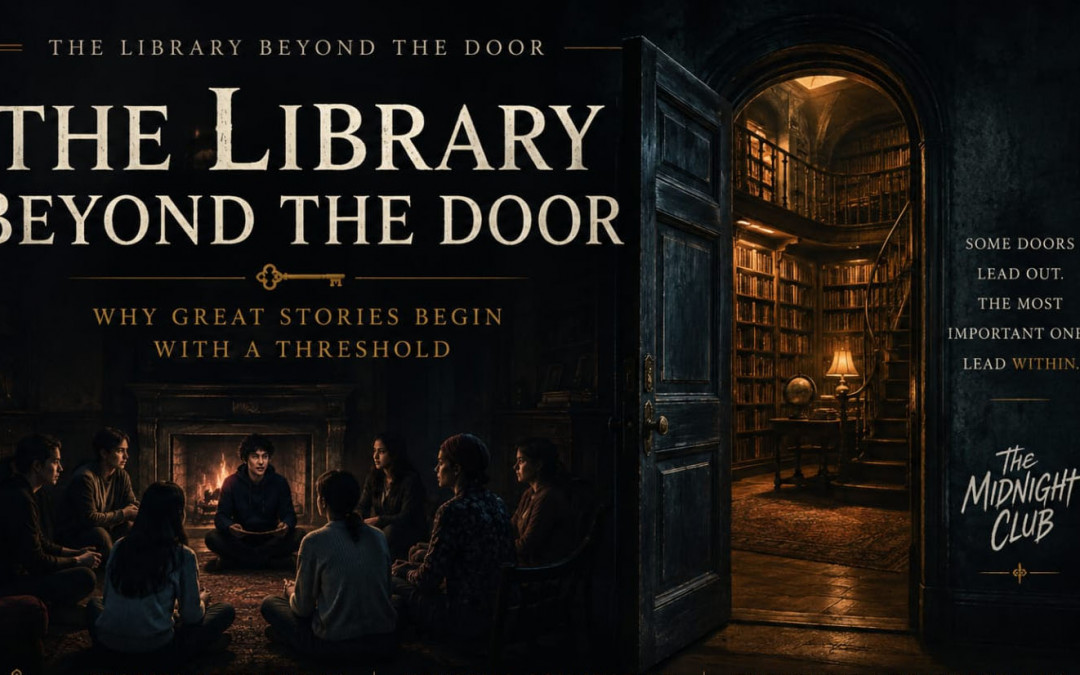
The Library Beyond the Door
Every building contains doors, and almost all of them are boring.
They separate one room from another. They keep heat in, strangers out, noise away from sleep. We pass through dozens without remembering them because ordinary doors perform their function by disappearing from attention. They are successful interfaces. We notice the kitchen, the bedroom, the street; rarely the rectangle through which one became the other.
Stories have never been willing to leave doors alone.
A wardrobe opens onto Narnia. A rabbit hole becomes a route out of Victorian logic. Bluebeard gives his wife one forbidden key. Orpheus crosses a boundary that should not be crossed twice. Religious architecture surrounds entrances with columns, guardians, inscriptions and rituals because people have long understood that certain passages deserve to be made visible.
A threshold is one of the simplest narrative machines ever invented. On one side, a condition exists. On the other, something has changed. The person may still possess the same body, name and memories, yet the meaning of that person is different because the crossing has altered the world in which those things are interpreted.
This is why a door can carry much more than architecture.
It can carry identity.
And this is why The Midnight Club is such useful material for thinking about one of Transhumation’s oldest questions: what must happen for something to cross from one state into another without simply disappearing?
The House That Stops Behaving Like a Floor Plan
Brightcliffe initially presents itself as a place that ought to be understandable. It is an old hospice with bedrooms, offices, corridors, communal spaces and institutional routines. Its inhabitants eat, sleep, receive treatment, meet one another and learn the geography of a building in which they expect to spend an uncertain amount of time.
But fiction can make architecture do something ordinary architecture cannot.
A corridor can begin carrying emotional rather than merely physical distance. A familiar room can acquire a second identity. An entrance can feel as though it has delivered somebody not simply to another location but to another layer of the story. The building becomes difficult to separate from memory, expectation, fear and the possibility that its inhabitants do not understand everything around them.
It would be too easy to convert every such moment into evidence that Brightcliffe possesses literally impossible geometry. The Midnight Club deliberately inhabits the region between supernatural suggestion, illness, memory, folklore and interpretation. The uncertainty is part of the machinery.
The more interesting point is that the building begins behaving the way memory behaves.
Memory has no obligation to respect a floor plan.
A smell in one room can place us instantly in another decade. A photograph on a shelf can make the dead temporarily present in thought. The sound of a stair at night can return a person to childhood before any conscious explanation catches up. Spaces acquire layers that no architect drew.
Brightcliffe becomes powerful when we can no longer tell where the architecture ends and the lives lived inside it begin.
Why Does the Library Matter?
A library is already an impossible room in a perfectly ordinary sense.
Someone who has been dead for five hundred years can enter it with you.
Not literally. Nothing supernatural is required. The author’s consciousness has not been sealed inside the paper, waiting for the correct reader to release it. A book preserves marks arranged in such a way that another mind, trained in the necessary language and context, can reconstruct something: an argument, an image, a voice, a question, sometimes a startling sense of companionship.
The distinction matters.
A library does not preserve people.
It preserves structures capable of producing encounters with what people left behind.
That is more modest than resurrection and, in its own way, more extraordinary. The reader supplies the living nervous system. The page supplies traces. Language supplies the protocol. Meaning appears in the relation among them.
This is why the library is such an appropriate center for a story about young people confronting death. The members of the Midnight Club cannot guarantee biological continuation. They cannot negotiate with time. But they can place something into circulation. A fear becomes a story. A memory becomes a character. A private image becomes something another person can remember tomorrow.
The library therefore sits between two very different ideas that are often confused.
One is survival.
The other is transmission.
A story can achieve the second without proving the first.
What Actually Crosses From One Mind to Another?
Consider the strangest fact about reading: nothing resembling the original experience needs to travel physically from one nervous system to another.
The author sees a winter street.
Years later, the reader sees a different winter street internally.
No snow has crossed the page. No visual image has moved intact between brains. A relatively small arrangement of symbols prompts another nervous system to construct something sufficiently related for communication to succeed.
This is why books belong in the same philosophical family as maps, music notation and mathematical expressions. They are not miniature versions of what they represent. They are interfaces that preserve certain relationships and depend on another system to complete the act.
A sentence can therefore outlive the voice that formed it.
A question can outlive the person who first asked it.
A fictional character can survive every actor who plays the role.
But we should be precise about what kind of survival this is. The continuing pattern does not demonstrate continuing subjective awareness of its originator. Dante survives culturally in ways Dante does not survive biologically. A recording may preserve the signs of presence while the person remains absent.
That difference is not a disappointment.
It is the doorway into a much more interesting question.
How much continuity can civilization construct from absence?
Every Story Creates a Temporary Second Life
The stories told inside The Midnight Club are interesting precisely because fiction allows a person to rearrange reality without having to announce that rearrangement as confession.
Fear can become a ghost.
Illness can become a curse.
Loneliness can become an empty road.
Hope can become a bargain.
A person can say, “This did not happen,” while placing something emotionally true inside an invented event.
This is one of fiction’s oldest technologies.
Indirectness creates access.
A person may be unable to say, “I am terrified of disappearing,” but can tell a story about someone who refuses to die. The fictional form creates enough distance for the thought to become bearable while preserving enough structure for another person to recognize it.
The door into the story therefore works in both directions.
It hides.
And it reveals.
That is one reason myths, dreams and fairy tales remain so durable. Their ambiguity allows structures to travel farther than literal statements sometimes can. The symbol does not remain powerful because it possesses one secret definition. It remains powerful because it preserves a relation while allowing different generations to reconstruct it differently.
The threshold is one such relation.
Before.
Crossing.
After.
Civilization can build almost anything around that skeleton.
Why Do Great Stories Keep Using Doors?
Because doors make transformation visible.
Most changes in human life are annoyingly gradual. A child becomes an adult without any single morning on which childhood can be proven to have ended. A relationship becomes serious before anyone knows exactly when it happened. Illness alters identity slowly. Grief changes the meaning of familiar rooms without moving a wall.
Cultures solve this ambiguity by building thresholds.
A graduation ceremony declares that a student has become something else.
A wedding turns a relationship into a recognized status.
A passport control converts one legal territory into another.
Initiation rites can transform a participant’s social identity even though the body crossing the threshold is physically continuous with the body that approached it.
The ceremony does not magically create every underlying change.
It makes the change legible.
Stories use doors for the same reason.
The doorway gives shape to something reality often leaves blurry.
The Door That Changes the Traveller
We normally think of a doorway as passive.
The person approaches.
The person passes through.
The person remains the same.
But socially and psychologically, some thresholds alter the meaning of whoever crosses them.
A patient entering a hospital does not stop being the person who arrived, yet an additional identity immediately attaches itself: patient. Someone crossing an international border may become foreign on the other side without changing anything biologically. A novice entering a religious order, a recruit entering military service or a prisoner entering confinement passes through architecture into a new institutional grammar.
The threshold does not need to alter the body.
It changes the system that interprets the body.
This is why rites of passage matter. They do not demonstrate some universal mystical technology hidden behind all religions. Practices differ enormously between cultures and periods. What recurs is the human problem they address: how do we mark a transformation that might otherwise have no clear edge?
A doorway is almost embarrassingly good at answering that problem.
Here.
Not here.
Before.
After.
The simplicity is precisely what gives it power.
The Fireplace Is Another Kind of Door
The fireplace around which the Midnight Club gathers performs a quieter version of the same work.
A literal doorway organizes movement between spaces.
The fire organizes movement between people.
Someone begins speaking, and private experience leaves its original owner in altered form. It becomes narrative. Others receive it, reinterpret it, remember parts of it and perhaps tell it differently later.
The important thing is not that the fireplace possesses a fixed symbolic meaning. Fire has accumulated countless meanings across cultures: warmth, destruction, purification, domesticity, sacrifice, danger, presence. Treating any one of these as a universal key would flatten precisely the ambiguity that makes the image useful.
What matters here is structural.
The group gathers around a center.
A voice enters shared space.
A story leaves one person and becomes available to others.
The architecture of storytelling mirrors the architecture of passage.
A room becomes an interface.
Watch the Video
How to Read the World

Current Knowledge
Thresholds and rites of passage are widely documented across human societies, although their meanings and forms vary substantially. Anthropologists have long examined ceremonies marking changes in social status, including birth, initiation, marriage, religious membership and death. Arnold van Gennep’s early twentieth-century work famously described rites of passage in terms of separation, transition and incorporation, while later thinkers such as Victor Turner developed the idea of liminality to examine ambiguous states between established roles. These frameworks have been influential, but they should not be mistaken for evidence that all cultures secretly share one identical symbolic system.
Memory research likewise supports the more modest claim that environments, sensory cues and contextual associations can trigger autobiographical recollection. Places become cognitively and emotionally dense because experiences accumulate around them. A building therefore does not need supernatural properties to become psychologically layered.
Literature and narrative research also give us good reason to distinguish transmission from literal preservation. Books, recordings and stories can preserve linguistic, semantic and stylistic patterns across generations. They do not provide evidence that the original subject’s consciousness persists inside the representation. A recorded voice is evidence that someone spoke; it is not evidence that the speaker remains present.
Libraries are therefore best understood as systems for preserving and reactivating traces rather than repositories of preserved minds. Their extraordinary power comes from enabling new readers to reconstruct encounters from structures left by absent people.
That distinction becomes increasingly important as generative artificial intelligence makes cultural traces responsive.
When the Archive Begins Talking Back
For most of history, the archive waited.
A manuscript did not answer follow-up questions.
A photograph did not alter its expression.
A recording repeated what had already been recorded.
Artificial intelligence introduces a new layer. A system trained on or connected to cultural material can generate responses that were never present in the original archive. The library can begin to feel conversational.
This is potentially useful and potentially dangerous.
A model could help a reader navigate an enormous corpus, connect distant ideas, translate difficult material or identify historical context. In that sense AI can behave like an unusually active librarian.
But responsiveness changes the psychological experience of absence.
A dead author cannot answer a new question.
An AI reconstruction can.
That answer may be coherent, moving and historically informed.
It is still a new event.
The distinction between source, inference, reconstruction and generation must therefore become more visible precisely as the interface becomes more convincing.
A good library of the future will need better doors.
Not doors that prevent passage.
Doors that tell us what kind of room we have entered.
Open Questions
The first unresolved question concerns continuity. When a story passes from one person to another and continues changing, what exactly has survived? The wording may disappear while the plot remains. The plot may change while the emotional function remains. A name may survive after almost every narrative detail has been replaced. There is no universal point at which transmission becomes a new creation.
A second question concerns representation and presence. Technologies increasingly preserve detailed traces of people: photographs, voices, correspondence, video, preferences and conversational histories. Future systems may reconstruct remarkably persuasive versions of absent individuals. We do not yet have a principled way to determine when cultural continuity begins to be mistaken for personal continuity by the people interacting with those systems.
There is also the question of thresholds themselves. Does a transition require a marked boundary in order to become psychologically or socially real, or do thresholds merely make changes that have already occurred easier to recognize? Marriage, graduation, citizenship and death all expose different versions of this problem.
The deepest question is perhaps the simplest. If a pattern can pass between minds while the original subject cannot, what kind of survival is that? Something clearly continues. But something from a person surviving is not the same claim as the person surviving.
That distinction may be one of the most important doors we learn not to walk through carelessly.
Transhumation Interpretation
For Transhumation, the door is useful not as proof of another world but as a model of mediation.
A meaningful passage requires at least three things: something capable of crossing, a structure through which it crosses, and a system on the other side capable of receiving it. Books, films, rituals and memories all satisfy versions of that architecture.
Artificial intelligence may eventually become another such interface, helping civilization retrieve and reinterpret structures whose original carriers are gone. But the librarian should never pretend to be the person whose books it understands.
The library exists for readers.
And a good door does more than open.
It tells you where you are going.
The Library Beyond the Door
Perhaps this is what Brightcliffe makes so compelling.
The building is full of people approaching a boundary no architecture can finally explain for them. They gather anyway. They tell stories anyway. They create small passages from one mind into another while the largest passage remains uncertain.
The library does not defeat death.
The stories do not guarantee continuity of consciousness.
The door does not prove another room exists beyond the one we can see.
Something quieter happens.
A thought that belonged to one person becomes available to another.
A fear acquires form.
A voice leaves a trace.
A life that cannot remain physically present still alters someone who will continue walking after the speaker stops.
That may be the oldest purpose of the library.
Not to keep the dead alive.
To prevent absence from becoming complete.
FAQ
What does the library symbolize in The Midnight Club?
It can be read as a place where voices, memories and stories are preserved and exchanged. The interpretation is thematic rather than evidence that the library has one fixed supernatural meaning.
Why are doors so common in stories?
Doors provide a simple visible model of transition. They separate one state from another and make changes in identity, knowledge or danger easy to dramatize.
Is Brightcliffe literally supernatural?
The series preserves ambiguity around supernatural experiences rather than reducing everything to one explanation. That uncertainty is part of its narrative structure.
What is a liminal space?
A liminal space is a transitional state or zone between established conditions or identities. The term is often associated with anthropological work on rites of passage.
Does storytelling preserve a person?
It can preserve traces of a person’s language, experiences and perspective. That is not the same as preserving the person’s conscious subjectivity.
How does this connect to Transhumation?
Transhumation is interested in interfaces through which structures can move between people, media and eras. The question is not simply whether something crosses, but what crosses, what changes during passage, and what remains absent on the other side.
Continue the Transhumation Series
- Forgotten Religion | Ancient Gods, Symbols and the Hidden Structures of Human Civilization
- The Last Religion | Death, Immortality and the Future of Humanity
- The New Theurgy | AI, Information and the Future of Human Civilization
- End of Branding: You Were Never Meant to Become a Product
- Baal vs Ishtar: Why Ancient Gods Never Disappeared