
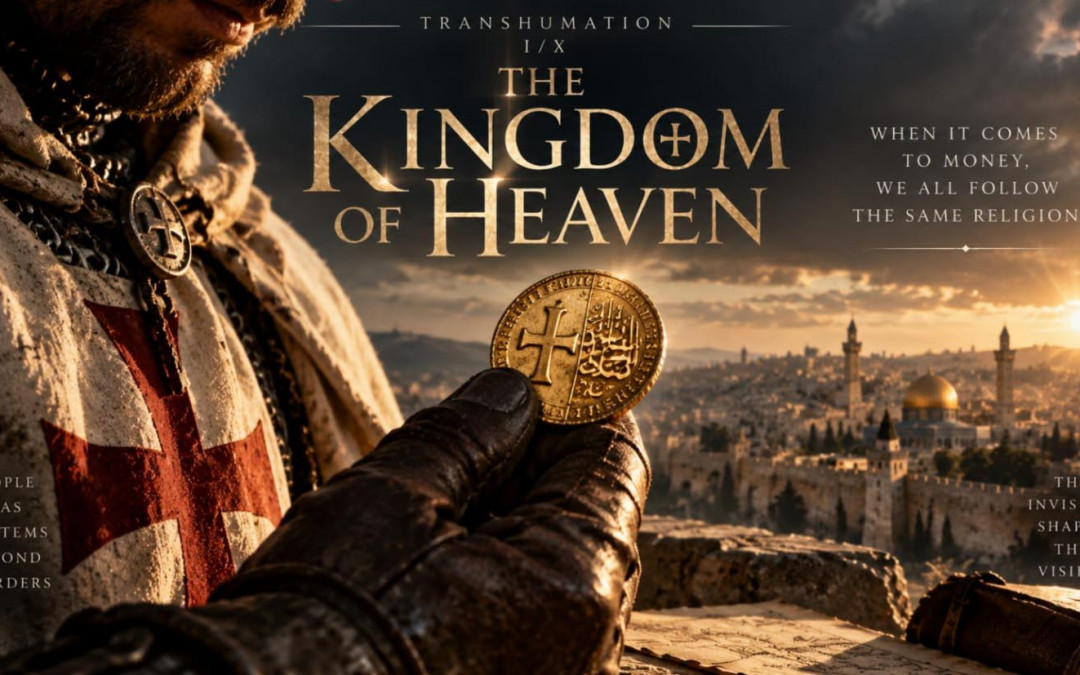
The Kingdom of Heaven
There is a peculiar moment in modern life when you look at a number on a screen and realize that you cannot point to the thing it represents.
Take one thousand dollars.
Not the banknotes. Not gold. Not a stack of coins. The balance in an ordinary bank account. You can spend it, transfer it, lose it, owe it, inherit it, freeze it, divide it or use it to buy something made of steel and concrete. It can decide whether you sleep in a hotel or outside one. It can move a car from a showroom into your name. It can become a flight, a dinner, a month of rent or part of a house.
Yet if someone asks the childish question — where exactly is the thousand dollars? — the answer becomes surprisingly difficult.
There are servers, databases, legal obligations, accounting systems, authentication procedures and institutions. There are cables, buildings, electricity and people. Nothing supernatural has happened. But the thousand dollars is not valuable because a particular hard drive contains a physically precious arrangement of electrons. Replace the machine and the balance can survive. Replicate the database and you have not become twice as rich. Destroy one storage device and, if the system is functioning properly, your claim remains.
The object has become less important than the recognized structure around it.
That is an ordinary fact of modern life.
It is also a very strange one.
For most of human history, the things that governed ordinary existence appeared much closer to their physical carriers. A coin was value you could hold. A letter was information you could burn. A seal was authority impressed into wax. A fortress was power made architectural. A warehouse was wealth with walls around it.
Today the record can move while the matter remains still.
And increasingly, the matter moves because the record changed first.
Why Did Heaven Once Have a Different Physics?
For much of human history, transcendence was imagined through freedom from ordinary restrictions.
Gods could know what happened elsewhere. Messengers crossed impossible distances. Authority could extend beyond physical presence. The dead might survive the destruction of the body. Divine speech could act at a distance. Heaven was not merely a pleasant location above the clouds; it represented another order in which familiar material limits no longer applied in the same way.
This should not be confused with a technological prediction. Ancient religions did not secretly describe databases, cloud computing or electronic banking. Similarity of structure is not evidence of historical descent. The point is narrower and more interesting: human beings spent a very long time imagining realities in which information, identity and authority were less tightly bound to ordinary material limitations.
The physical world they actually inhabited was much less forgiving.
If Caesar wanted instructions delivered to Gaul, something had to travel. A rider, a ship, a piece of writing. Information had a journey because its carrier had a journey. Distance had cost. Delay had consequence. Destroy enough copies of a message and the information disappeared with them.
Wealth also had geography. Grain occupied warehouses. Silver occupied chests. Land could not be carried away. A ruler claiming distant territory required roads, administrators, troops and physical presence somewhere in the chain of command. Power could be conceptual, but its enforcement remained stubbornly material.
This is what makes the modern transformation easy to miss.
We did not abolish matter.
We built a second layer above it.
A layer of claims, permissions, records and rules capable of reorganizing the first.
Where Does Money Exist When the Coin No Longer Travels?
A bank balance is useful precisely because it separates value from one particular physical carrier.
This principle is older than computers. Credit, account money, bills of exchange and banking records long predate the digital era. A merchant did not need to carry all his wealth physically once institutions could recognize claims across distance. What digitization changed was not the existence of abstraction but its speed, scale and intimacy.
The modern user experiences the result as almost frictionless.
A number changes on one screen. Another institution recognizes the change. A seller hands over a physical object. No individual banknote needed to travel from the buyer’s pocket to the seller’s bank. The system preserves the relationship through records.
This is why saying that modern money is “virtual” can be misleading.
Virtual often sounds like imaginary.
A bank balance is not imaginary when unpaid rent can remove someone from an apartment or sufficient credit can finance the construction of one. The information is abstract; its effects are not.
A developer receives financing. A legal claim changes. Orders are placed. Excavators arrive. Steel moves. Concrete is poured. Workers are paid. Months later, where there had been an empty field, there is a building.
The building is physical.
The coordination that made it possible is increasingly informational.
This is one of the central inversions of modern civilization:
the invisible does not replace matter; it increasingly tells matter where to go.

What Else Exists as a Recognized Structure?
Money is merely the easiest example because we interact with it constantly.
Consider ownership.
A house is physical, but ownership is not another brick hidden somewhere inside the wall. Two people can stand in the same kitchen while only one legally owns the building. What distinguishes them is not visible in the plaster. It is a recognized arrangement of records, law and institutional authority.
Consider a company.
A nineteenth-century industrialist might point toward factories, warehouses, machines and rail sidings. Those things mattered. They still do. Yet a modern company can change offices, replace computers, migrate servers and employ an entirely different workforce while retaining legal continuity.
Where, then, is the company?
Not in one chair.
Not in one server.
Not in one employee.
Not even necessarily in one building or country.
Its identity may be distributed among legal registration, contracts, intellectual property, ownership records, software, debts, obligations, trademarks, accounts and institutional recognition.
The same puzzle appears everywhere once you begin looking for it.
Where is a copyright?
Where is a debt?
Where is citizenship?
Where is an airline booking?
Where is a share in a corporation?
Where is an account?
Each depends on physical infrastructure. None floats free of matter. But none can be identified completely with one particular object carrying the record.
This is why the distinction between carrier-independent and carrier-free matters.
These structures are not carrier-free.
They always require some material implementation: paper, people, computers, electricity, institutions, memory.
But they can become independent of any one particular carrier.
Replace the paper.
Replace the server.
Replace the clerk.
Replace the building.
If enough of the recognized structure persists, the claim can survive.
Civilization became remarkably good at doing this long before we acquired the language to notice how strange it was.
When Did Civilization Move Behind the Glass?
There was no single morning when the transition occurred.
No proclamation announced that the invisible layer had become sovereign.
Instead, each step appeared practical.
A safer way to move money.
A better ledger.
A negotiable instrument.
A corporation.
A bank account.
A telephone.
A credit card.
A computer network.
A digital identity.
A cloud service.
A checkbox marked I Agree.
Individually, each solved a local problem. Together, they produced an architecture in which more and more consequential parts of life are organized through structures that are not tied permanently to one visible physical object.
This is why the modern world can feel almost magical while remaining entirely material.
A person can cross a border because a database recognizes a passport.
Fail to board an aircraft because another record does not match.
Own a house because a legal system recognizes a claim.
Lose access to an account because authentication fails.
Control shares in a company without ever touching the company’s physical assets.
The physical world remains underneath every one of these events. Planes still need fuel. Servers need electricity. Houses need foundations. People need food.
But the layer determining who may use what, who owes whom, who can enter, who owns and who is recognized increasingly operates through information.
That is the threshold worth examining.
The world did not become immaterial.
Organization became capable of travelling more easily than matter.
Did We Build a Heaven, or Merely Borrow Its Architecture?
Religious language becomes dangerous here because metaphor can outrun evidence.
A data center is not Heaven.
A digital account is not a soul.
A corporation is not an angel.
An algorithm is not providence.
Nothing about electronic records demonstrates an afterlife or confirms ancient theology.
But metaphors can still reveal structure without claiming identity.
Earlier civilizations repeatedly imagined realms in which presence was not equivalent to physical location, knowledge could cross impossible distance and authority could act without standing beside the thing it affected. Modern civilization has produced mundane, technical versions of some comparable relationships.
A bank balance acts at a distance.
A contract can outlive the person who wrote it.
A company can survive the replacement of almost everyone who once constituted it.
A piece of software can reorganize machines across continents.
A legal record can alter the fate of physical property without changing the property itself.
The resemblance is not theological.
It is architectural.
Human beings once imagined invisible orders governing visible life.
We now live inside one of our own construction.
That may explain why the transition feels less dramatic than it should.
We expected transcendence to arrive with trumpets.
Instead it arrived as paperwork, passwords and accounting.
When Does a Record Become More Real Than the Object?
The deepest change appears when the record no longer merely describes reality but becomes one of the mechanisms producing it.
A deed does not simply describe ownership. Within the relevant legal system, it participates in establishing ownership.
A bank ledger does not merely report that value moved. It is part of the institutional structure through which the transfer becomes recognized.
A corporate register does not merely describe a company from outside. It helps constitute who has authority inside it.
A digital identity can determine whether a system treats the person standing before it as entitled, prohibited, authenticated or absent.
This means information is not always a passive mirror.
Sometimes it is operational.
That is a profound distinction.
A map can describe a city without changing it. But a planning decision encoded in law can determine where the next road is built. A photograph can represent a building; a construction permit can cause one to exist. Two documents may both contain information, but only one participates directly in the machinery that rearranges the physical world.
Modern civilization contains enormous numbers of these performative records.
They do not merely say what the world is.
They help determine what the world may become next.
Which World Is Governing Which?
This is where the title of the series begins to earn its place.
The Kingdom of Heaven imagined an invisible order superior to the visible one.
Our informational civilization has not created that metaphysical kingdom, but it has built an increasingly consequential invisible layer whose rules coordinate material life.
The danger is to overstate the separation.
There is no information without infrastructure.
There is no cloud without data centers.
There is no banking network without institutions, power supplies, law, people and machines.
There is no ownership without a society willing to enforce the relevant claim.
Reality retains veto power.
Yet it is equally misleading to treat the informational layer as a decorative abstraction hovering above the “real” world. A financial record can determine whether steel is purchased. A legal classification can determine whether a building is demolished. A permission can open a border. A change of ownership can redirect the future of an entire company.
Matter constrains information.
Information organizes matter.
Neither is sufficient alone.
The interesting world lies in the loop between them.
And once that loop becomes ordinary, we barely see it anymore.
We simply look at the number on the screen and say:
I have one thousand dollars.
Watch the Video
How to Read the World
Current Knowledge
Human societies have relied on abstract institutional structures for thousands of years. Debt, credit, contracts, titles, accounting and legal identities all predate modern computing. Digital technology did not invent the distinction between a physical object and a recognized claim. What it has done is accelerate, automate and scale the ability of such claims to operate across distance and between institutions.
Modern bank deposits are claims within financial and legal systems rather than individually earmarked piles of cash waiting in a vault for each customer. Corporate ownership likewise depends on records and legal recognition, while intellectual property, securities, debts and many other economic assets derive much of their practical force from institutional rules governing what records mean and how they may be enforced.
None of these structures exists independently of matter. Databases require storage hardware, networks require physical infrastructure, legal systems require institutions and people, and financial claims ultimately operate in economies composed of material resources and human labor. The significant development is therefore not dematerialization in an absolute sense. It is increasing independence from particular material carriers.
This distinction is essential. A record can migrate from paper to one computer and then to another while the recognized claim remains continuous. The structure is carrier-dependent in general but increasingly carrier-independent in particular.
Open Questions
The first question concerns ontology: when does a record stop being merely a description and become part of the thing itself? A paper statement can describe an account, but the recognized ledger entry is operationally closer to the account’s existence within the financial system. Similar problems arise with ownership, corporate identity and legal status, where the informational record does not merely report reality from outside but helps constitute the reality being reported.
A second question concerns institutional trust. If a claim survives changes of carrier because a network of institutions continues recognizing it, then the apparent independence of the information depends on continuity elsewhere. Remove legal enforcement, authentication or shared standards and the same record may lose its practical force. The carrier can change, but the surrounding recognition cannot be ignored.
There is also a question about identity across replacement. If a corporation can survive new employees, offices, computers, shareholders and managers, how much can change before it becomes meaningfully another organization? The same puzzle appears whenever continuity depends on structure rather than on a single enduring object.
Finally, the analogy to religious transcendence has a clear boundary. Similar structures do not establish common origins or metaphysical equivalence. The useful question is therefore not whether digital civilization has literally built Heaven. It is whether ancient intuitions about invisible order become easier to think about once we live inside systems where unseen rules have enormous visible consequences.
Transhumation Interpretation
The Kingdom of Heaven is an investigation into a quiet transition: the growing power of structures that remain effective while their particular carriers are replaced.
The coin once carried value visibly. The letter carried the message. The seal carried authority. Modern systems increasingly separate structure from any single implementation while remaining dependent on material infrastructure somewhere underneath.
That is not transcendence from matter.
It is a new relationship to matter.
The physical world remains the final constraint, but civilization increasingly approaches it through informational layers capable of directing who may use, move, own or transform what is physical.
The old world asked to see the gold.
The new world increasingly asks whether the record is valid.
That may be less spectacular than Heaven.
It may also be one of the strangest things our species has ever built.
FAQ
What is the main idea of The Kingdom of Heaven series?
The series examines how modern civilization increasingly relies on invisible structures such as records, claims, permissions and rules to organize the physical world.
Is the article saying digital money is not real?
No. Digital and account-based money has real economic effects. The point is that its value does not depend on one particular physical token belonging to the owner.
Does this mean society has become immaterial?
No. Every informational system depends on physical infrastructure. Servers, networks, buildings, energy and human institutions remain essential.
Why compare modern information systems with Heaven?
Only as a structural analogy. Older religious traditions often imagined orders in which knowledge, authority or identity were less constrained by ordinary physical limitations. Modern technology has created mundane systems with some superficially comparable properties, but that does not mean religion predicted technology.
What does “carrier-independent” mean here?
It means a structure can survive replacement of a particular physical carrier. A financial record may move between servers while the recognized claim remains continuous. It does not mean the structure can exist without any carrier at all.
What is the deeper Transhumation question?
If records, claims and rules can survive repeated replacement of the matter carrying them while continuing to reorganize the material world, where should we locate the identity of the system: in the matter, in the structure, or in the relationship between them?
The invisible does not replace matter. It increasingly tells matter where to go.
The carrier can change. The claim survives.
We did not abolish the physical world. We built another layer capable of organizing it.
Continue the Transhumation Series
- Forgotten Religion | Ancient Gods, Symbols and the Hidden Structures of Human Civilization
- The Last Religion | Death, Immortality and the Future of Humanity
- The New Theurgy | AI, Information and the Future of Human Civilization
- End of Branding: You Were Never Meant to Become a Product
- Baal vs Ishtar: Why Ancient Gods Never Disappeared