
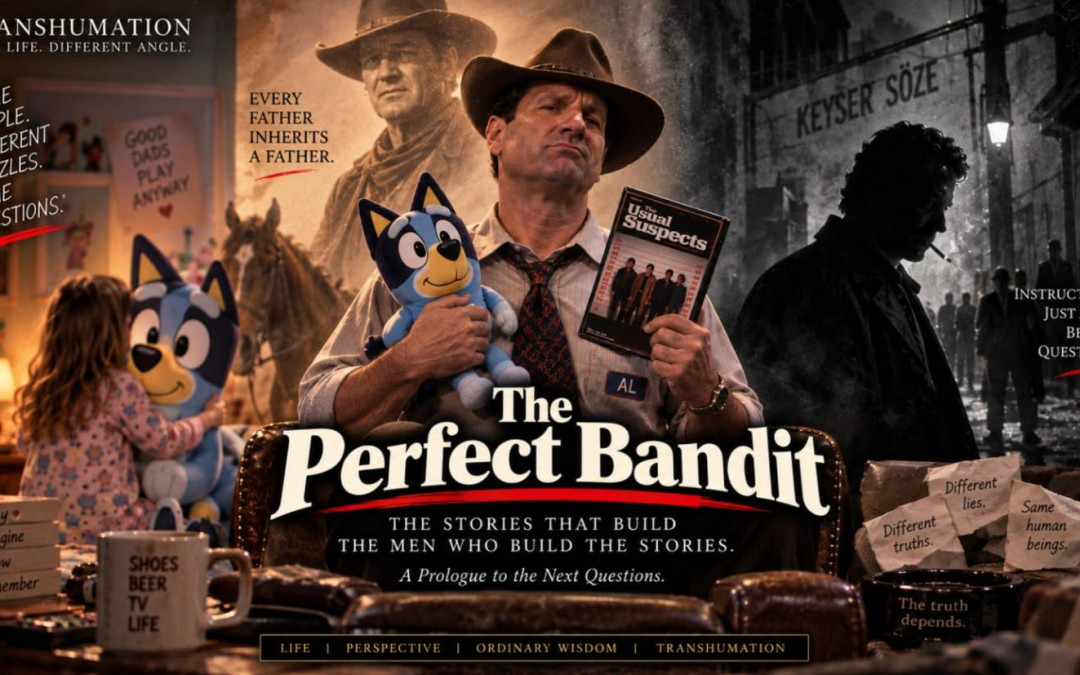
The Perfect Bandit
There is a moment near the end of The Usual Suspects when Detective Kujan looks at the room around him and understands that the story he has been hearing was built from things that were there all along. The shock is not that every piece was false. The shock is that real pieces can be arranged into the wrong person.
That is a more disturbing problem than an ordinary lie. A lie can be corrected. A document can be checked. A witness can be challenged. But give an intelligent observer several convincing fragments and he will often perform the final act himself: he will connect them. Keyser Söze understands not only stories, but the person assembling them.
This is why the perfect bandit does not need to invent an entire world. He needs to understand which world already exists inside the listener, which details the listener will privilege, and which gaps the listener will close without being asked. The detective thinks he is discovering a man. In part, he is manufacturing one.
At the opposite end of this problem is a blue cartoon dog lying on the floor with his children. Bandit Heeler is not trying to deceive anyone. His children simply cannot see all of him. And perhaps they should not.
Who Told You Bandit Was Perfect?
A child receives a peculiar edition of her father. She sees Dad joining the game, carrying her when her legs stop working, cooking breakfast, becoming annoyed, apologising, returning, trying again. She does not see every bill, every private fear, every argument after bedtime or every morning when he had no idea what he was doing and tried to look as though he did.
From those fragments she constructs Dad. Adults are tempted to call this naïve because adults possess more information. But more information does not automatically produce the more useful picture. A six-year-old does not need a nightly briefing on mortality, debt, divorce and the statistical possibility that every embrace may be the last. Total disclosure can be accurate and still be a terrible form of care.
This is the parental paradox. Development requires truth, but it also requires timing. A parent is constantly deciding not only what is true, but what truth another mind can use now. The child grows partly by receiving larger versions of the world: first the safe room, then the street, then disappointment, sex, money, death, responsibility. The earlier model was incomplete. That does not make it worthless.
Bandit therefore becomes “perfect” not because he is flawless, but because perfection is partly produced by position. The father knows the backstage version of himself. The child knows what it felt like when he came anyway. He may remember exhaustion at the zoo; she remembers sitting on his shoulders. He measures frequency. She measures structure.
Incomplete is not the same thing as false. Sometimes incompleteness is manipulation. Sometimes it is ignorance. Sometimes it is mercy. And sometimes it is simply the resolution at which a human being is currently able to see.
The Father Has the Backstage Pass
Parents eventually encounter an unnerving form of historical research. A child says, “You always did that,” and the parent thinks: always? Perhaps six times. Yet six evenings at the right age can become a childhood ritual. One ridiculous phrase can survive for thirty years while a hundred ordinary Tuesdays disappear.
The parent has more data, but the child may preserve a structure the parent cannot see. He remembers the holiday he nearly cancelled, the argument before leaving, the traffic and the headache. She remembers the holiday. He remembers how frightened he was. She remembers that he came. Neither archive contains the whole person, and self-knowledge does not automatically settle the dispute. We know our intentions; other people live with our effects.
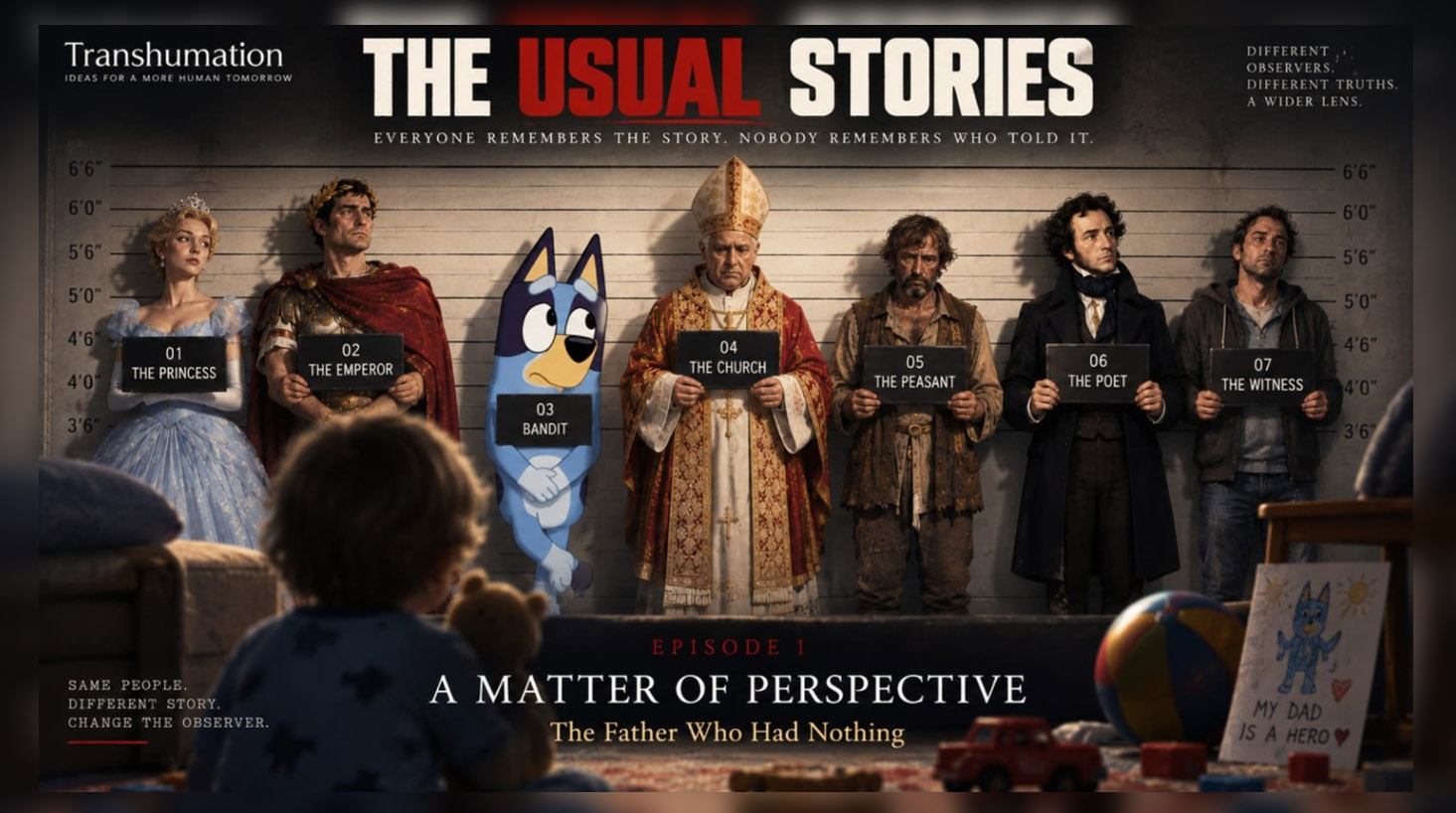
This is where Söze and Bandit unexpectedly touch. Söze controls the fragments so another person will construct the man he wants. Bandit does not control the fragments; childhood does. The machinery in the observer is similar, but the ethics are completely different. One exploits incompleteness. The other lives inside it.
You Are Already Living in Someone Else’s Story
We like to imagine freedom as the moment nobody tells us who we are. It is difficult to find such a moment. Your parents named you before you could object. A school described what counted as achievement. A state decided what counted as an adult, a marriage, a property line and a legal house. A bank has another story about your house. Your child has a story about you. So does your enemy.
You also write stories for other people. There is no neutral balcony outside narrative from which a human being simply observes reality as it is. We select, remember, compare and infer. Even refusing somebody else’s story usually requires another story about why it should be refused.
Freedom, then, cannot mean living without a narrative. A more realistic freedom is the ability to recognize that the inherited story is a model and that models can be revised. The danger begins when a useful description becomes immune to correction, when the map acquires more authority than the ground beneath it.
This is why a wrong or incomplete picture can still change the world. Religions, political doctrines, scientific models, family legends and private hopes have all organized real behavior. Their consequences do not prove every claim inside them. But calling a model “only a story” does not make its effects disappear either. Stories can build churches, start wars, keep families together, ruin them, send spacecraft upward and persuade a frightened child to take one more step.
Then Al Bundy Walks Through the Door
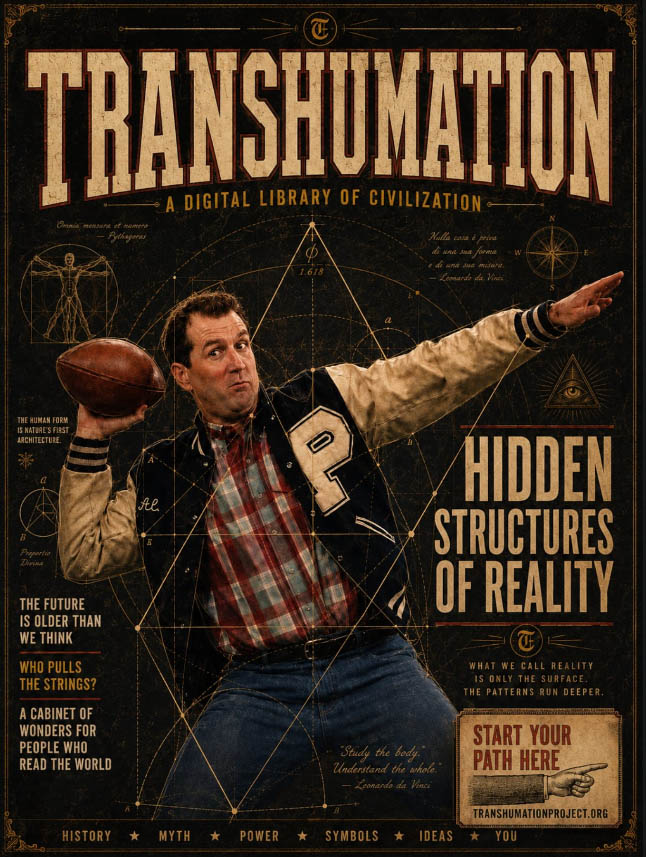
Bandit gives us the father seen through affection. Söze gives us the man assembled through manipulation. Al Bundy brings a less elegant problem: Tuesday morning. His model of the world is crude, his family understands him imperfectly, he understands them imperfectly, and nevertheless the car has to start, someone has to go to work and somebody will eventually need help.
Al is useful precisely because he is not an ideal. He reminds us that a family does not wait for its members to achieve philosophical clarity. Life keeps requesting decisions from people who possess partial information, contradictory rules and embarrassingly provisional theories about one another.
The question is no longer merely, “Who is telling you this?” It becomes: “What are you going to do with what you know?” That is where observation turns into responsibility.
The Ball That Never Fell
There is a neat little trick in Minority Report. A ball is sent toward the edge of a table and caught before it falls. Why catch it? Because it was going to fall. But it did not fall. The intervention seems to cancel the event while depending on confidence that the event would otherwise occur.
The scene is useful not because a human future behaves exactly like a falling ball. It does not. It is useful because it exposes the strange territory between prediction and action. We often act because of a future we hope will never become real. A parent reaches for a child before the child falls. A doctor treats a risk before it becomes a disease. A civilization builds a seawall for a flood it hopes not to experience. If prevention succeeds, the predicted disaster becomes the event that did not happen.
Hope can work in the same territory. It is not evidence that the future will be kind. It can be a technology for remaining capable of action while the future is unresolved. The parent cannot promise that nothing terrible will happen. He can still make breakfast, fasten the seat belt and tell the child that tomorrow is worth preparing for.
Knowing Is Not the Same as Being Right
Human beings have repeatedly possessed models that worked brilliantly until the edge of their resolution appeared. A useful model is not necessarily a final one. The discovery of a deeper description does not mean the older description never worked; it means reality contained more than the model could express.
That distinction matters far beyond science. Knowing what an egg is biologically does not exhaust what an egg can be to a human being. It can be breakfast, an embryo, a commodity, an Easter symbol, a childhood memory or the object at the centre of a ritual. These meanings do not magically alter its chemistry, but chemistry does not erase them either. Knowing what something is does not guarantee that you know what you are looking at.
This is the territory of the Hi-Fi Preacher. Not a preacher who owns the final revelation, and not a salesman who offers inspiring half-truths. His job is to listen for a structure beneath familiar noise and then ask whether it survives contact with the world. A believer may call the structure transcendent. An atheist may call it emergent. The label can wait. First ask whether the floor is actually hot.
A child can announce that the floor is lava and everybody can play. The game may organize behavior for ten minutes, but the floor does not burn anyone. If shoes begin to melt, the situation changes. Reality has answered back. This is the boundary that prevents perspective from collapsing into the claim that every story is equally true.
No Instructions
The mature response to incomplete knowledge is therefore neither blind faith nor permanent suspicion. It is provisional commitment. Use the model. Make the move. Protect the child. Build the house. Follow the evidence. Keep enough doubt to notice when reality objects.
This may be the small freedom available inside other people’s stories. We cannot begin outside language, family, culture, law, history or inherited ideas. We can notice their seams. We can ask who selected the pieces. We can distinguish the fact from the arrow drawn between facts. And when a better explanation appears, we can redraw the arrow.
The perfect bandit knows how badly we want the fragments to become a person. The good parent knows that a child cannot receive the whole world at once. Al Bundy knows, mostly by accident, that Tuesday arrives whether the theory is finished or not. Between them sits a simple rule: do not postpone living until certainty arrives, and do not turn today’s useful story into tomorrow’s prison.
You may know exactly what you are looking at and still have no idea what you are seeing. That is not a reason to stop looking. It is a reason to leave the model open.
Watch the Video
How to Read the World
Current Knowledge
Human beings routinely form models of other people from incomplete evidence. Memory is reconstructive rather than a literal recording, and attention, emotion, later experience and context influence what is retained and how events are organized. Different people can therefore preserve different but sincere accounts of the same relationship or event.
Incomplete information and manipulated information are not the same. Ordinary perception is necessarily selective because no observer receives everything. Deliberate deception can exploit that limitation by controlling evidence, context or attention. In both cases the observer must infer relationships among fragments, but the source and purpose of the incompleteness differ.
Decision-making also normally occurs under uncertainty. People act without complete knowledge of motives, consequences or future events, using evidence, experience, probability, social rules and heuristics. This does not make every interpretation equally valid: models can be tested, predictions can fail, evidence can accumulate and deliberate manipulation can be exposed.
Open Questions
How much truth should be given at once when understanding itself develops over time? Parenting makes the problem obvious, but education, medicine, politics and technology face versions of the same question. Simplification can enable understanding, yet simplification can also become paternalism or manipulation.
Where does freedom exist if human beings inevitably inherit narratives from families, institutions, cultures and earlier generations? Perhaps freedom is not the absence of models but the capacity to compare them, revise them and recognize when reality resists them.
Another question concerns useful incompleteness. When does a simplified model remain a legitimate tool, and when does loyalty to it become denial? The answer cannot be that usefulness proves truth. A model must remain open to correction by evidence and by consequences it failed to predict.
Transhumation Interpretation
The Perfect Bandit treats narrative as an interface between an incomplete observer and a world too large to receive all at once. Bandit shows that a limited model can contain genuine truth. Söze shows that the same reconstructive machinery can be exploited. Al Bundy introduces the unavoidable next step: incomplete people still have to act.
The Hi-Fi Preacher begins here. He does not claim privileged access to absolute truth. He looks for recurring structures and asks whether they continue to explain what happens when the examples, scales and observers change. The interpretation remains an interpretation until reality answers.
For Transhumation, the essential discipline is therefore simple: facts matter, interpretations matter, and they are not the same thing. We may live through stories, but the world retains the right to contradict them. Intelligence is not merely knowing more. It is being able to act before certainty arrives without losing the ability to change your mind afterward.
FAQ
Why is Bandit called “perfect” if he is not perfect?
Because “perfect” describes a relationship and a point of view rather than a claim of flawlessness. A child receives only part of a parent, but that part can carry enormous structural weight in childhood.
Does the article argue that less truth is better?
No. It argues that truth also has an audience, a time and a usable resolution. A child cannot absorb the adult world all at once. The ethical problem is distinguishing developmentally useful simplification from manipulation.
What does Keyser Söze add?
He demonstrates that true or plausible fragments can be arranged into a misleading whole. Facts matter, but so do the relationships we infer among them.
Why is Al Bundy here?
Because uncertainty does not suspend ordinary life. Even an imperfect person with an imperfect model must still work, parent, choose and respond when Tuesday arrives.
Is every narrative equally valid?
No. Reality can resist a narrative. Evidence, prediction, consequences and independent observation can expose models that fail. Perspective is unavoidable; correction is still possible.
What is the Hi-Fi Preacher?
He is not a prophet of final answers. He is a reader of patterns: someone interested in the difference between knowing what something is and understanding what it means, while keeping every interpretation open to correction.
What is the deeper Transhumation question?
How do we remain free when we cannot live without stories, yet no story can contain the whole world? The answer proposed here is provisional commitment: use the best model available, act responsibly, and leave it open when reality answers back.
Continue the Transhumation Series
- Forgotten Religion | Ancient Gods, Symbols and the Hidden Structures of Human Civilization
- The Last Religion | Death, Immortality and the Future of Humanity
- The New Theurgy | AI, Information and the Future of Human Civilization
- End of Branding: You Were Never Meant to Become a Product
- Baal vs Ishtar: Why Ancient Gods Never Disappeared