
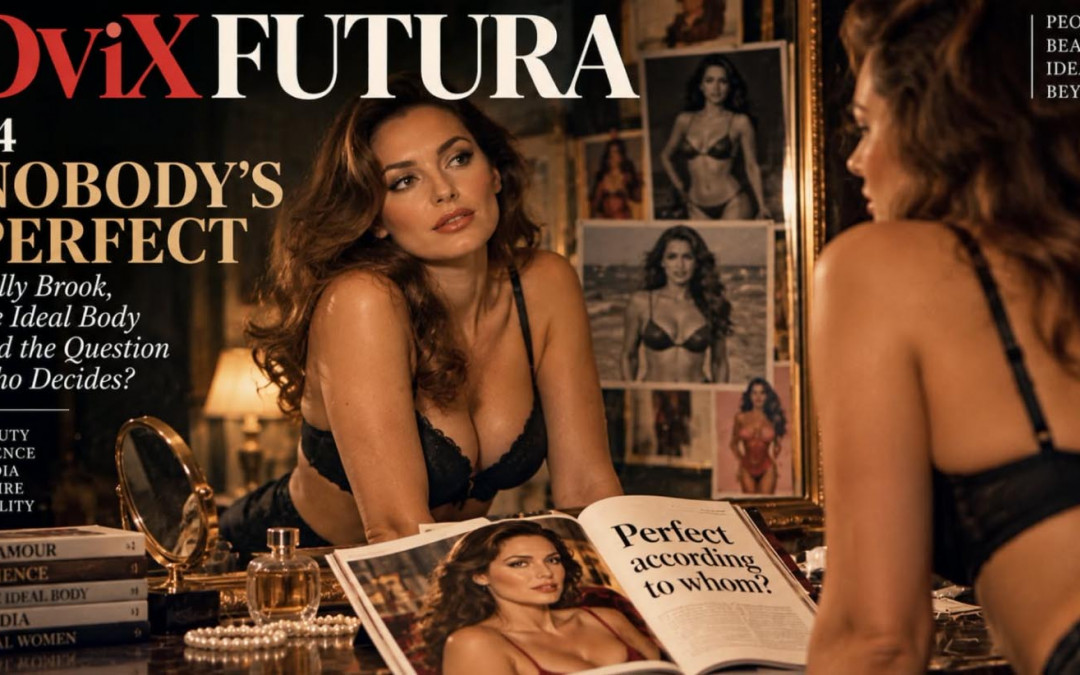
Nobody’s Perfect
Kelly Brook has spent years carrying an extraordinary label: the woman with the “perfect body.” The claim is usually dressed in a white coat. Scientists measured her, the story says. A university established the ideal proportions. Mathematics looked at a woman and finally announced that the search was over.
There is a problem. The science did not say that.
A real University of Texas study examined something much narrower: male preferences for female lumbar curvature. It tested a specific evolutionary hypothesis about a particular morphological cue. Kelly Brook was not crowned the winner. The internet did what culture often does with complicated information: it carried the result to the counter, removed most of the packaging and sold a much simpler product.
PERFECT.
Edith Vaughs would like to see the receipt.
Perfect According to Whom?
The first problem with perfection is grammatical. “Kelly Brook has a perfect body” sounds complete, but it is missing its most important words. Perfect according to whom? Perfect for what? Perfect by what measure? Perfect to whom?
A waist-to-hip ratio can be measured. Height can be measured. Lumbar curvature can be measured. None of those measurements contains the word perfect inside it. The moment a measurement becomes a verdict, an observer has entered the room.
This does not make biology imaginary. Bodies have real structures, real constraints and real statistical patterns. But the decision to select one feature, assign it importance and promote its optimum into an ideal of the whole person is already a model. A measurement can be objective while the decision about what deserves measuring remains a human choice.
Perhaps every declaration of perfection contains two portraits: the thing being measured and the person holding the ruler.
The Woman Who Didn’t Get It
That is what makes Brook unusually useful here. The woman repeatedly presented as evidence for a cultural ideal has herself spoken with bemusement about the label. She has described looking at herself and seeing features such as large hips and limbs rather than the mathematical revelation other people claimed to see. The exact wording matters less than the inversion: the owner of the celebrated body does not necessarily experience it as the audience does.
There is a temptation to turn that into another judgment about her. Resist it. The interesting question is not whether Kelly Brook understands her own attractiveness correctly. It is why we assume there must be one correct observer.
Beauty requires an observer. Desire requires another person. Biology asks different questions again. A physician, a lover, a fashion photographer, an evolutionary psychologist and the woman looking into her own mirror may all examine the same body and notice different information.
“I don’t get it” is therefore almost too good a line. Get can mean understand, receive, obtain. Perhaps perfection is something we keep trying to get because we have never agreed what it is.
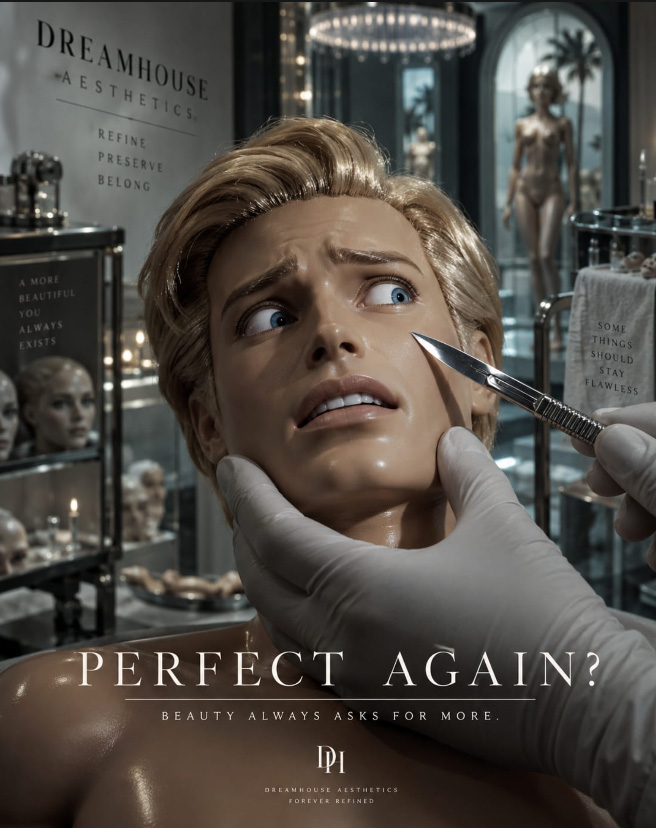
Perfect Body. Wrong Test.
In 1999 Brook was nineteen and presenting The Big Breakfast. A leaked production memo asked writers to simplify difficult words in her scripted links; contemporary reporting named “intrepid” and “satirical” among the words that had caused trouble. Later retellings compressed the episode into an even cleaner story: the beautiful model who could not read the autocue.
There was another problem. The Big Breakfast presenters were not using an autocue. They relied heavily on handwritten cue cards.
The distinction matters because the story demonstrates the same machinery as “the scientifically perfect body.” Reality enters one end of the kiosk with qualifications attached. A simpler narrative comes out the other. Brook becomes simultaneously too perfect to be ordinary and too inadequate to read a teleprompter that was not there.
None of this demonstrates that she was unintelligent. It demonstrates something more interesting: excellence does not automatically transfer between tests. A body selected for visual appeal does not confer television-presenting skill. A gifted presenter need not satisfy a beauty ranking. Change the test and the hierarchy can reverse without anyone becoming better or worse.
Nothing happened to the person. The test changed.
The Perfect Goal Nobody Meant to Score
Football makes the problem easier to see because the objective appears wonderfully simple: put the ball in the goal. Yet even here perfection fragments under examination.
A player intends to shoot straight. He strikes the ball horribly and it leaves his foot at an absurd angle. It ricochets, wrong-foots the goalkeeper and goes in. The execution was terrible. The result was exactly what he ultimately wanted. Was it a perfect goal, an imperfect shot or a successful mistake?
Now reverse it. A player executes precisely the shot he intended, with the desired pace, spin and placement. The goalkeeper produces an extraordinary save. Perfect execution. No goal.
The replay makes football look particularly beautiful because replay is a selection machine. It preserves the overhead kick that connected, the ball that found the top corner and the improbable movement that ended correctly. It does not need to give equal time to every miskick that preceded them. Perfection often becomes visible after the result, when the unsuccessful possibilities have already disappeared from the edit.
This adds another question to Edith’s list: did you mean to do it? Perfection can describe intention, execution, outcome or merely the observer’s pleasure at watching the outcome. Those are not the same thing.

The Island Changes the Currency
Survival Island provides an almost embarrassingly literal experiment. Brook’s character and a wealthy husband are thrown into an environment where many of civilization’s familiar advantages lose their exchange rate. Money can command rooms, labour and comfort in a functioning economy. On an isolated shore it cannot negotiate with thirst.
The bodies have not changed. The environment has.
A feature that matters enormously in one system can become secondary in another. Practical competence can suddenly become more valuable than wealth; beauty can remain beauty without solving hunger; status can survive psychologically while losing much of its operational power. “Perfect” therefore cannot be detached from the world in which perfection is expected to perform.
This is not an argument that beauty is useless, money is fake or survival skill is the only authentic human value. It is the opposite. Different environments make different capacities consequential. The mistake is allowing the winner of one competition to walk away with the trophy for every other competition as well.
No Body Is Perfect
Culture has been playing this game for much longer than Kelly Brook. Religious art, advertising, fashion and popular entertainment repeatedly take bodies and make them carry meanings larger than anatomy. The Virgin Mary is an especially striking example. Within Christian theology, virginity and motherhood are joined through a miracle. To a believer, that conjunction can express holiness. To another observer, the same body belongs to an entirely different symbolic system.
Hugh Hefner would construct a different ideal. A football coach would ask a different question. A physician would ask another. None receives automatic ownership of the woman merely because his measurement is useful within his own field.
This is where the old problem of narrative returns. The danger is not that perspectives exist. They cannot be eliminated. The danger begins when one perspective dominates the counter and forgets that it is a counter at all — when one kiosk announces that it is the world.
Kelly Brook can therefore be beautiful, statistically unusual, professionally successful, poor at one particular television task, excellent at another, desired by millions, unwanted by someone, satisfied with herself on Tuesday and dissatisfied on Wednesday. There is no contradiction. A human being is not required to maintain one ranking across every possible test.
Perhaps the most revealing response to “the perfect body” is not disagreement but a question.
Perfect to whom?
Watch the Video
How to Read the World

by
Current Knowledge
Kelly Brook’s widely repeated status as the “scientifically perfect body” should not be presented as the conclusion of a University of Texas study. The relevant peer-reviewed research examined male preferences concerning female lumbar curvature and proposed an optimum around a specific curvature angle within that experiment. It did not run a competition among real women and crown Brook.
Brook joined Channel 4’s The Big Breakfast as a teenager in 1999. Contemporary reporting documented a leaked production memo asking writers to simplify some scripted material after difficulties with particular words. The programme’s presenters worked without an autocue and relied heavily on cue cards, making the later “couldn’t read the autocue” formulation an example of narrative compression rather than a precise description.
Open Questions
Can perfection ever describe an entire organism, or only performance against a defined criterion? How much of attraction can be generalized across populations before individual desire makes the ranking unstable? When does a useful biological model become a cultural prescription? And who should have authority when scientific, commercial, religious and personal accounts of the same body disagree?
Transhumation Interpretation
The interesting problem is not that perfection is impossible. A thing may be extraordinarily well optimized for a particular test. The problem begins when success in one test is mistaken for universal excellence.
A perfect wallet can still be bought with the last money you had to put inside it.
Every claim of perfection therefore hides an interface: a test, an observer, a purpose and a narrative. Remove them and “perfect” becomes strangely empty. Restore them and the word becomes useful again — but smaller.
Billy Wilder found the shortest version. At the end of Some Like It Hot, Osgood Fielding III is finally given the information that should destroy his plan. Instead he changes the importance of the information.
Nobody’s perfect.
Read slowly enough, it contains another sentence.
No body is perfect.
FAQ
Did scientists prove that Kelly Brook has the perfect body?
No. The claim is widely repeated online, but the relevant University of Texas research concerned preferences for female lumbar curvature. It did not identify Kelly Brook as the scientifically perfect woman.
What does “perfect to whom?” mean?
It asks us to identify the observer hidden inside a claim of perfection. A biological researcher, photographer, lover, doctor and the person inhabiting the body may use different criteria and reach different judgments.
Was Kelly Brook fired because she could not read an autocue?
That familiar version is misleading. Contemporary reports documented difficulty with some scripted words and a leaked memo asking writers to simplify material, but The Big Breakfast presenters worked without an autocue and relied on cue cards. Brook later resigned from the programme.
Why does the article use football?
Football separates intention, execution and outcome. A badly executed kick can produce the desired goal, while a technically excellent shot can be saved. It shows how quickly the word “perfect” becomes ambiguous once we ask what exactly is being judged.
Is the article arguing that beauty is purely subjective?
No. Human preferences can show measurable patterns, and bodies have objective properties. The argument is narrower: a measurable preference or physical feature does not automatically establish universal perfection.
What is the deeper Transhumation question?
When an observer calls something perfect, how much has been discovered about the object — and how much has been revealed about the observer, the test and the narrative through which the object is being seen?
Continue the Transhumation Series
- Forgotten Religion | Ancient Gods, Symbols and the Hidden Structures of Human Civilization
- The Last Religion | Death, Immortality and the Future of Humanity
- The New Theurgy | AI, Information and the Future of Human Civilization
- End of Branding: You Were Never Meant to Become a Product
- Baal vs Ishtar: Why Ancient Gods Never Disappeared