

The Future Has a Long Past
I was lying beside a swimming pool in Torrevieja, under a palm tree, reading about Claudius.
It was one of those slightly ridiculous arrangements in which we often encounter history: warm Spanish afternoon, blue water, cold drink within reach, and somewhere inside the book an emperor making decisions in a world of marble, dust, ships, taxes, marriages, executions and gods. I tried to imagine what it would have been like to live in ancient Rome. I pictured the Senate, the streets, the people moving through a city that had not yet become ruins.
And then I realized I was making a mistake.
I was already in Rome.
Not Rome the city, obviously. Not the first century. Torrevieja did not exist in anything resembling its present form, and the swimming pool certainly wasn’t waiting patiently for Claudius to discover package tourism. But I was sitting inside a landscape that had belonged to the Roman world. I had been trying to transport myself mentally into antiquity while physically occupying part of the same planet, under the same sun, surrounded by matter considerably older than either Claudius or me.
The realization was embarrassingly simple.
You do not need a reconstruction of ancient Rome to touch the ancient world.
Pick up a stone.
The Stone Has Been Here Longer Than You
We tend to imagine history as a succession of stage sets.
First there is Ancient Rome. Someone removes it. Medieval Europe is wheeled on. Then the Renaissance. Steam engines. Telegraph poles. Automobiles. Television. Smartphones. Each age appears to inhabit its own scenery.
The illusion is useful because it allows museums and textbooks to divide time into rooms.
The universe does not.
The stone in your hand does not know that one historical period ended and another began. Its precise location may have changed countless times. It may have been broken from larger rock, carried by water, moved during construction or brought from somewhere else entirely. We should not invent a biography for a particular pebble merely because it makes a good story.
But the material world from which it came was here.
That distinction matters.
A Roman never visited the ancient world. For him, it was simply the world. Claudius did not wake in the morning surrounded by antiquity. He woke in the present, with unfinished business, political problems and a future that had not happened yet.
That may be the strangest thing about history.
Nobody ever lived in it.
Everyone lived now.

Rome Already Had the Matter of the Future
Consider a more difficult object.
An iPhone.
Take one apart conceptually and you find no magical element delivered to Earth in the twenty-first century. Silicon existed. Copper existed. Gold existed. Carbon existed. The electromagnetic laws on which the device depends were operating perfectly well while Roman engineers were constructing aqueducts.
The ingredients were here.
The instructions were not.
That does not mean a Roman workshop could have built an iPhone if someone had simply handed the foreman a sufficiently detailed drawing. Modern electronics depend upon enormous layers of accumulated knowledge, precision manufacturing, energy systems, chemistry, logistics and machines that themselves depend upon earlier machines.
But that makes the distinction more interesting, not less.
Rome did not lack the matter of the future. It lacked its instructions.
Place a functioning smartphone on a table in the Roman Senate and the object becomes almost absurd. A polished rectangle produces light without flame. It remembers thousands of images. It reproduces the voices of absent people. Given the right stored data, it can display maps, perform calculations beyond the patience of a room full of scribes and play music without musicians.
Then the battery dies.
The god becomes a piece of glass.
What disappeared was not its matter. What disappeared was its connection to an informational and technological structure large enough to sustain its miracles.
That structure is what I think of as the Information Ladder.
How Many Rungs Until Technology Becomes Magic?
The Information Ladder is not simply a measure of how much a civilization knows.
It measures which impossibilities have already become tools.
Preserving a human voice was once impossible. Now we become irritated when the recording quality is poor. Seeing someone thousands of kilometres away was impossible. Now we complain when the video freezes. Flying was mythological until it became commercial, at which point humanity immediately discovered the more advanced problem of insufficient legroom.
We climb by turning impossibilities into inconveniences.
And every rung changes the meaning of the objects around us.
Imagine the child of a modern president stranded alone on an island. Remove the electrical grid, satellites, supermarkets, hospitals, search engines, factories and the millions of strangers whose specialized knowledge silently supports an ordinary day.
Soon enough, a sharp stone becomes advanced technology.
The intelligence of the child has not changed. The accessible ladder has.
This is why technological superiority can so easily resemble divinity. A sufficiently large difference between two informational positions does not merely produce better tools. It produces capabilities for which the lower position may not yet possess useful categories.
A Roman looking at a smartphone might ask the wrong questions about it for exactly the same reason that we may ask the wrong questions about technologies that do not yet exist.
We imagine the future using nouns from the present.
The Gods May Be Standing Higher on the Ladder
This is where the old idea of theurgy becomes unexpectedly useful.
The ancient ambition of theurgy was, in various forms, to approach, invoke or participate in divine operations. The modern temptation is either to believe the old language literally or to discard it completely.
There is a third possibility.
Ask what an operation looks like from different rungs.
To preserve the voice of the dead would once have sounded supernatural. We do it casually. To manufacture daylight inside a sealed room would have been astonishing. We flick a switch. To construct an artificial environment populated by responsive characters would once have belonged to mythology. Children now do primitive versions of it on computers.
None of this proves that gods were misunderstood engineers. It certainly does not prove that our universe is software.
It suggests something more modest and, to me, more interesting:
activities that appear metaphysical from one rung may appear technical from another.
That creates a peculiar symmetry.
We can look downward and see impossibilities that became engineering.
We cannot look upward with the same clarity.
If technological civilizations exist elsewhere in the universe—and we do not currently know that they do—we have no reason to assume that every one of them would stand on approximately our rung. Nor should we assume that a civilization far beyond us would merely possess faster spacecraft, larger computers and better batteries.
Those are our nouns.
The difference may lie in categories we have not acquired yet.
How many rungs above you does a technology have to be before you call it divine?
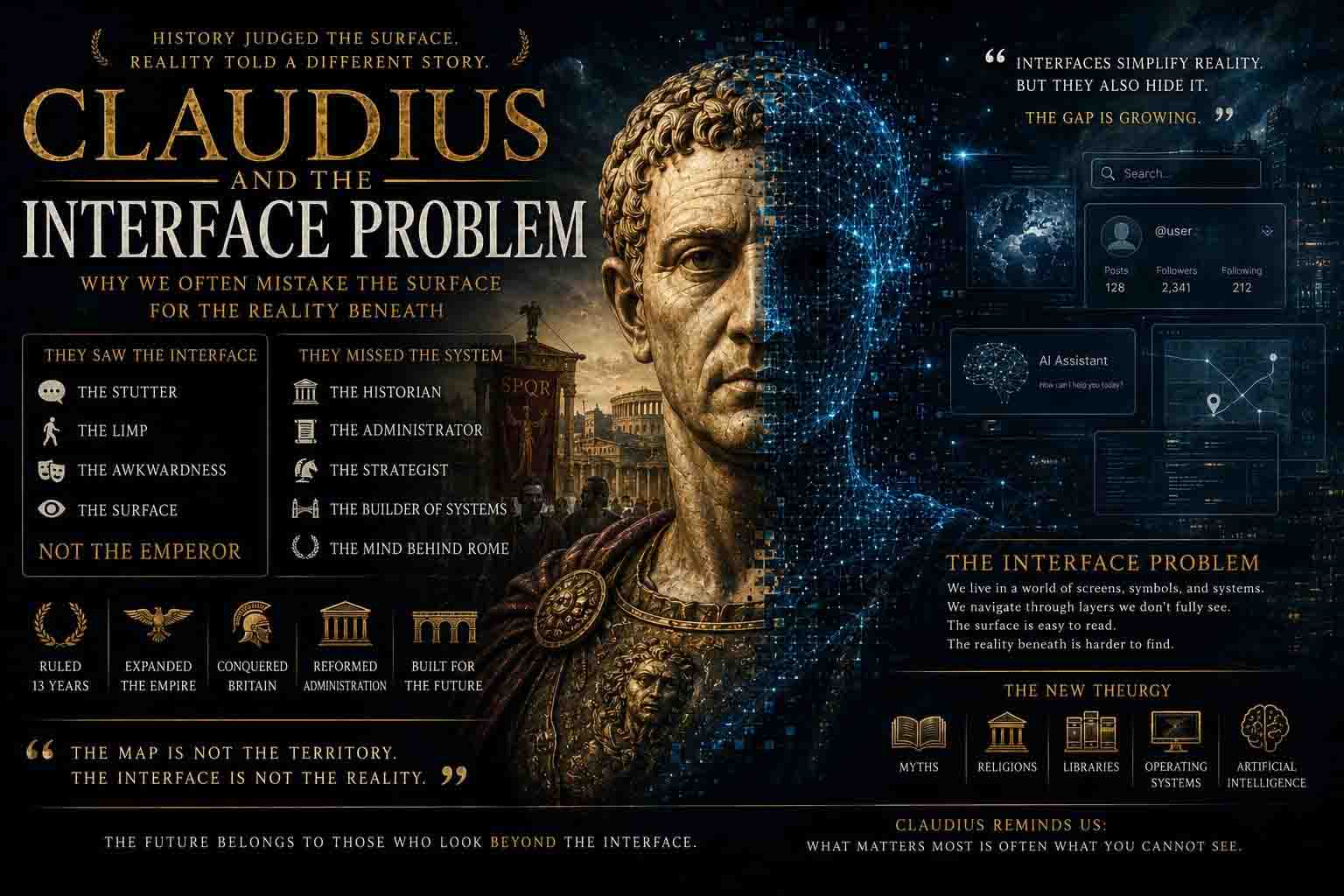
The Stone Had a Future
Now put the phone away.
Pick up the stone again.
When Claudius was alive, the material beneath our feet already contained futures no Roman could describe. Not because smartphones were hidden inside rocks waiting to be released, but because the physical world permitted arrangements that human beings had not yet learned how to produce.
The possibility was present before the instruction.
That should make us cautious whenever we declare that the present inventory of the possible is complete.
We may already possess the matter from which some of our future miracles will be made. What we do not possess are the instructions.
Perhaps those instructions concern energy. Perhaps computation. Perhaps biology. Perhaps consciousness. Perhaps questions for which we do not yet have names.
The Information Ladder does not promise that everything imaginable can be built. Nature has constraints, and some dreams will remain impossible precisely because those constraints are real.
But history gives us an uncomfortable control experiment.
Again and again, humans have mistaken the boundary of their instructions for the boundary of the world.
That afternoon in Torrevieja, I had been trying to imagine myself backwards into the time of Claudius. The stone suggested the opposite experiment.
Imagine Claudius looking forward.
He could not know what would eventually be done with the matter surrounding him. He could not know that voices would be stored, faces transmitted, diseases seen at microscopic scales, machines taught to manipulate language, or that a person lying beside a pool almost two thousand years later might be thinking about him.
His present contained a future invisible from his rung.
So does ours.
Pick up a stone.
In the time of Claudius, it had a future.
So do we.
Watch the Video
How to Read the World
by
Current Knowledge
The chemical elements and physical laws used by modern technologies long predate modern civilization. Technologies such as semiconductor electronics, however, require extensive chains of scientific knowledge, industrial processes, infrastructure and specialized manufacturing. It is therefore reasonable to say that ancient civilizations inhabited a world physically compatible with many later technologies, but not that those technologies were practically available to them.
Open Questions
How much of what we currently call impossible is prohibited by physical law, and how much is merely inaccessible from our present level of knowledge? Could future technologies require conceptual categories that are as difficult for us to formulate as semiconductor electronics would have been for an ancient Roman? And if technological civilizations exist elsewhere, how different could their informational positions be from ours?
Transhumation Interpretation
The Information Ladder is a way of separating matter from instruction and intelligence from access.
Civilizations do not necessarily advance because the universe supplies them with new ingredients. They discover new ways of organizing ingredients that were already present. Each successful organization can turn an old impossibility into an ordinary tool and expose a new set of problems above it.
From this perspective, the boundary between technology and theurgy becomes historically unstable. An operation described as divine from one informational position may become technical from another.
The future has a long past because its materials are often already here.
What is missing are the instructions.
FAQ
What is the Information Ladder?
The Information Ladder is a Transhumation model for thinking about technological capability. Rather than measuring intelligence alone, it asks which previously impossible operations a civilization has learned to perform reliably.
Could the Romans have built a smartphone?
No. Although the relevant matter and physical laws existed, Roman civilization lacked the scientific knowledge, manufacturing precision, energy infrastructure and enormous technological supply chain required to produce modern electronics. The distinction between available matter and available instructions is the point of the thought experiment.
Does advanced technology prove that ancient gods were technological beings?
No. The argument makes no claim about the historical existence or nature of gods. It asks why capabilities can appear supernatural from one technological position and ordinary from another.
Does the Information Ladder mean everything will eventually become possible?
No. Physical laws impose genuine constraints. The difficulty is determining which apparent impossibilities reflect fundamental limits and which reflect our present lack of knowledge.
Why does the article begin with a stone?
Because a stone makes material continuity difficult to ignore. Human categories divide the world into historical periods, but matter does not reset when one period ends. The ordinary object provides a way of seeing the present as one temporary configuration of a much older physical world.
What does “The future has a long past” mean?
It means that futures often emerge from materials, desires, problems and physical possibilities that existed long before anyone knew how to organize them. The future does not necessarily arrive with new ingredients. Sometimes it arrives when we discover new instructions.
Continue the Transhumation Series
- Forgotten Religion | Ancient Gods, Symbols and the Hidden Structures of Human Civilization
- The Last Religion | Death, Immortality and the Future of Humanity
- The New Theurgy | AI, Information and the Future of Human Civilization
- End of Branding: You Were Never Meant to Become a Product
- Baal vs Ishtar: Why Ancient Gods Never Disappeared