
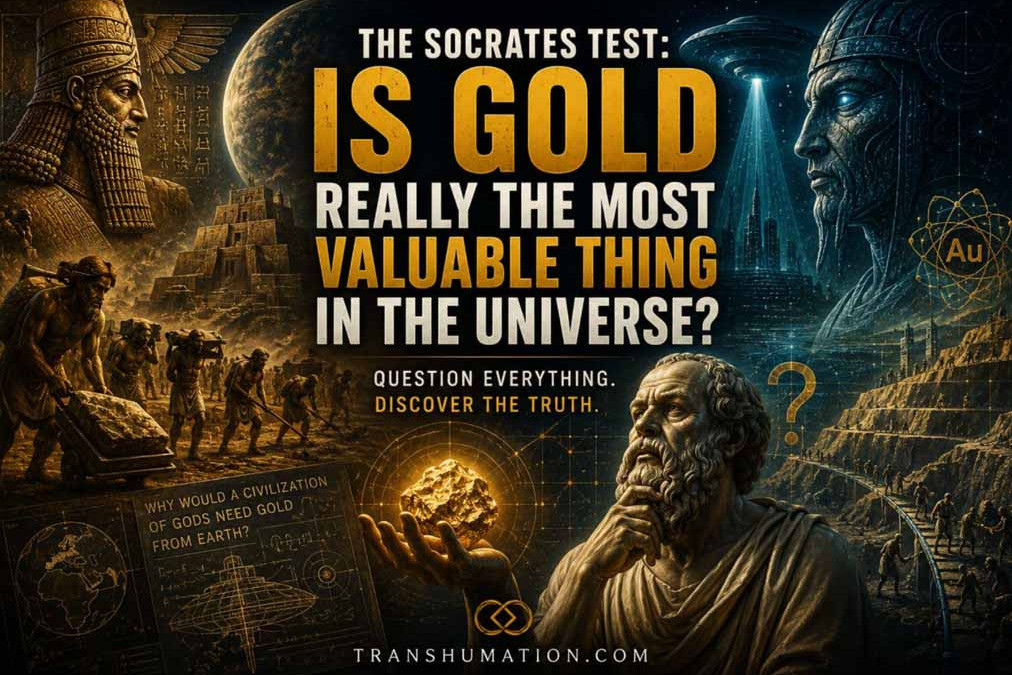
What Would Gods Need Gold For?
A piece of gold is surprisingly disappointing when you first hold one. It is heavy for its size, softer than most people expect, and unless it has already been turned into jewellery or a coin, it does not look much like the substance over which kings financed wars and prospectors crossed continents. Put a gold nugget beside a glass of water on a table and almost everyone in a comfortable room will reach for the gold. Leave the same two objects beside a man lost in a desert and the hierarchy reverses immediately. Nothing about the atomic structure of gold has changed. Only the circumstances have.
This is such an ordinary observation that it hardly seems capable of causing trouble. We know that value is conditional. A bottle of water at home is nearly worthless; in the wrong place it can become priceless. A wooden chair is mundane in Warsaw or London, but aboard a spacecraft assembled from metals, polymers and ceramics, a piece of naturally grown oak might become an exotic object. Yet when we imagine civilizations far beyond our own, we have a peculiar habit of packing our valuables into their luggage. We give them our precious metals, our political ambitions, our appetite for territory and sometimes even our need for servants. Then we send them across the stars.
This is where a small question begins to open a much larger door.
Why would gods need gold?
The Nugget on the Table
One of the best-known modern versions of the Anunnaki story was developed by Zecharia Sitchin, who interpreted ancient Mesopotamian material as evidence of technologically advanced extraterrestrial beings associated with a planet he called Nibiru. In his reconstruction, these visitors required gold and eventually became involved in the creation or modification of human beings as a labor force. Archaeologists and specialists in ancient Mesopotamian languages do not accept Sitchin’s translations or his extraterrestrial interpretation, but the story has acquired a cultural life much larger than the scholarly dispute that produced it. It combines several things modern audiences find almost irresistible: lost knowledge, ancient gods, genetic engineering, another world and an explanation for human origins.
Gold fits beautifully into that story because gold already arrives carrying several thousand years of human meaning. It does not corrode easily, can be worked into extraordinarily thin sheets and has genuine technological uses because of its conductivity and chemical stability. Long before electronics, however, it possessed something perhaps even more important: visibility. Gold looked permanent in a world where almost everything else decayed. It became associated with kingship, sacred objects, wealth and endurance. When a modern storyteller needs a material worthy of gods, gold therefore feels intuitively correct.
Socrates might have ruined the effect in less than a minute.
He would not need to prove that extraterrestrials had never visited Earth. He would only need to ask what seems almost embarrassingly simple: valuable to whom?
Once that question is allowed into the room, the gold begins to behave differently.
A Forest More Valuable Than Gold
Imagine a planet on which heavy elements are abundant but complex terrestrial biology has never evolved. Gold may exist there in quantities that would collapse its economic value on Earth, while cellulose produced by a living tree might be an extraordinary rarity. A polished piece of walnut could sit in a museum behind security glass. Families might inherit wooden objects. A dining table could be an aristocratic treasure.
The example is deliberately absurd, but that is what makes it useful. It separates a material from the cultural value we have attached to it. Gold possesses objective physical properties; its value does not follow automatically from those properties. Scarcity, technology, accessibility, usefulness and desire all matter. An extraterrestrial civilization would have its own combination of these conditions, and we have no reason to assume that its hierarchy of materials would resemble ours.
There is an even more troublesome problem. The Anunnaki of popular ancient-astronaut culture are not merely visitors from a neighboring island looking for a resource they lack. They are imagined as technologically superior beings capable of extraordinary travel and, in the more ambitious versions of the story, sophisticated biological engineering. Once we grant them those abilities, we must also grant the consequences. A civilization capable of overcoming the engineering problems involved in travelling between worlds would presumably possess forms of automation, energy production and materials processing far beyond those of an ancient terrestrial society.
Perhaps such beings could still need gold. We cannot know the resource requirements of an imaginary extraterrestrial technology. But that is not yet the interesting problem.
The interesting problem is why they would acquire it like pharaohs.
Socrates Enters the Mine
Picture the scene without the spacecraft. There is a valuable resource underground. A superior ruling group wants it. Workers are required to extract it. The rulers control knowledge and authority; the workers perform the labor. Remove the extraterrestrial vocabulary and the arrangement would have been perfectly understandable to an administrator in an ancient palace economy.
Now return the spacecraft.
Suddenly there is a peculiar mismatch between technological sophistication and social imagination. The beings can traverse enormous distances, perhaps manipulate genomes and command energies beyond human capabilities, yet the economic problem awaiting them on Earth is solved through something resembling a mine staffed by biological laborers. The chariot has become a starship and the temple has become a laboratory, but underneath the equipment an extremely old structure remains intact.
This does not by itself disprove extraterrestrial life or even every imaginable scenario involving extraterrestrial resource extraction. It does something more useful to the story: it identifies an assumption hiding inside it. We have imagined the alien’s technology much more radically than we have imagined the alien’s motives.
That is precisely the sort of asymmetry a Socratic question is good at exposing. Socrates’ enduring intellectual trick was not possession of a secret catalogue of correct answers. In Plato’s dialogues, the apparently innocent question repeatedly forces a confident claim to reveal the assumptions required to hold it together. What is courage? What is justice? What is knowledge? The first answer sounds obvious; the second question makes it less so. By the fourth or fifth, everyone discovers that the ordinary word at the center of the conversation contains a problem.
Gold can be treated the same way.
Gold is valuable.
Why?
Because it is rare.
Rare where?
Because it is useful.
Useful for what?
Because advanced beings need it.
Why would beings capable of crossing worlds obtain it through a labor system recognizable to people who lived thousands of years ago?
At that point, we are no longer really examining gold.
We are examining ourselves.
The Bronze Age Inside the Spaceship
Human beings have always been forced to imagine the unknown with materials borrowed from the known. Ancient societies did not possess the conceptual vocabulary of computers, genetics or astrophysics, so cosmic power was often rendered through structures that were intelligible to them: kingship, family, judgment, warfare, fertility, city, law and hierarchy. The gods could be unimaginably greater than humans while still inhabiting a universe whose relationships remained recognizably human.
Modernity likes to believe it escaped this limitation. In reality, we may simply have changed the available props. We possess rockets, so heaven can become another planet. We possess laboratories, so creation can become genetic engineering. We possess computers, so superior intelligence can become artificial intelligence. What earlier cultures expressed through divine power can now be expressed through sufficiently advanced technology without changing the underlying question.
The Anunnaki gold story is fascinating from this perspective precisely because it contains both ages at once. Its surface belongs to the twentieth century: planets, spacecraft, genetics and technological intervention. Its deeper economic architecture is ancient: rulers, resources and labor. We modernized the machinery but left the social operating system running underneath.
That possibility extends far beyond ancient-astronaut theories. Science fiction fills galaxies with emperors, armies, borders, corporations, prisons and dynasties because these remain available models of organized power. Our artificial superintelligences often desire domination, survival or control because these are motives we understand. Even when attempting to imagine something radically nonhuman, we repeatedly discover a human face behind the mask.
The limitation may not be stupidity. It may simply be the price of imagination. To imagine anything at all, we must begin somewhere we already know.
The mistake comes when we forget that we did so.
The Question Changes Direction
There is another reason the gold problem matters now that has little to do with ancient Mesopotamia.
For most of human history, creation was something we encountered from below. Humans asked where life came from, why consciousness existed and whether a greater intelligence stood behind the visible world. Creator and created occupied opposite sides of an almost unimaginable boundary. Mythology supplied many answers, philosophy supplied others, and science eventually transformed the question by explaining increasingly large parts of biological development without requiring a humanlike designer.
Now the geometry is changing.
Human beings can already edit genomes. We create artificial environments in which digital agents operate. We build machine-learning systems whose behavior cannot always be anticipated in detail by individual users. None of this makes humanity divine, and present AI systems are not evidence that we have created conscious artificial persons. But for the first time, questions that once belonged almost entirely to mythology are beginning to acquire an engineering dimension.
If we eventually create entities possessing some meaningful form of autonomy, intelligence or perhaps consciousness, the ancient question will turn around.
Instead of asking only, What would our creators want from us?, we may have to ask, What should we want from our creations?
That is a much less comfortable question.
Would we create intelligence primarily because it serves us? Would we regard an artificial mind as a tool because we made it? If synthetic beings could experience the world, would usefulness give us moral ownership over them? Would future humans look back at today’s language of „agents,” „workers” and „alignment” and see an early technological vocabulary for a relationship we did not yet understand?
Suddenly the absurd image of extraterrestrial gods creating workers for a mine is no longer merely a curiosity about ancient-astronaut literature.
It becomes a warning about creators.
The Real Treasure
We began with a gold nugget and a glass of water. That was enough.
The value of gold led to scarcity; scarcity led to extraterrestrial economics; extraterrestrial economics led to the strange persistence of ancient hierarchy inside futuristic technology. And beneath that hierarchy appeared something larger: the possibility that every civilization imagines superior intelligence using assumptions it has not yet learned to see.
This may be why Socrates remains useful more than two thousand years after his death. A good question does not merely demand information. It changes the position from which the problem is observed.
„Did the Anunnaki come for gold?” asks us to inspect the past.
„Why would gods need gold?” asks us to inspect the story.
„What would a creator want from its creation?” asks us to inspect the gods.
But the final question points in the opposite direction.
What will we want from ours?
The gold was never the treasure.
The question was.
Watch The Video
How to Read the World
Current Knowledge
The Anunnaki belong to ancient Mesopotamian religious traditions and were divine figures, not extraterrestrials in the surviving ancient sources. The interpretation of them as technologically advanced visitors from another planet is modern and is particularly associated with Zecharia Sitchin. His readings of Mesopotamian texts, including claims involving Nibiru, extraterrestrial intervention and gold mining, are not accepted by mainstream Assyriology, archaeology or ancient Near Eastern scholarship.
Gold itself has unusual and genuinely useful physical properties. It is corrosion-resistant, highly malleable and an excellent electrical conductor, which gives it important applications in modern technology. Its economic and symbolic value, however, is also historically and culturally conditioned. There is no scientific basis for assuming that an extraterrestrial civilization would assign gold the same value humans have assigned to it.
There is currently no accepted archaeological, genetic or astronomical evidence showing that extraterrestrial beings engineered humanity or established mining operations on ancient Earth.
Open Questions
Extraterrestrial life remains an open scientific possibility, and we cannot know what materials, energy sources or objectives a genuinely nonhuman technological civilization might possess. It would therefore be too strong to claim that an advanced civilization could never need gold. The narrower and more interesting question is whether stories about such civilizations unconsciously import human assumptions about scarcity, labor, hierarchy and value.
A second question concerns imagination itself. Can humans construct a genuinely alien intelligence without giving it recognizable human motives? Or must every attempt begin by borrowing something from ourselves?
The distinction matters because resemblance alone proves very little. A recurring pattern becomes interesting only when the same underlying function survives despite a genuine change of carrier.
Transhumation Interpretation
For Transhumation, the Socrates Test is not an argument against mythology. It is a method for finding the hidden assumption underneath an apparently familiar story.
In the Anunnaki narrative, the obvious object is gold. The deeper structure is the relationship between creator and creation. A superior intelligence creates or modifies a lesser being because that being performs a useful function. Once that structure is isolated from spaceships, tablets and ancient names, it becomes portable.
And suddenly it can move into our century.
Humanity is beginning to create increasingly autonomous technological systems and gaining greater control over biological information. We are not the Anunnaki, and today’s AI is not a new human species. But the direction of the question has changed. We are slowly acquiring powers that force the creator problem to be considered from the creator’s side.
For thousands of years we asked what the gods wanted from us.
The more important future question may be what we will demand from the beings that come after us.
A civilization can change its machines without changing its structure. That is the danger hidden inside the Bronze Age spaceship.
The real technological revolution will occur when the structure changes too.
FAQ
What is the Socrates Test?
A way of testing an idea by questioning the assumptions that make it appear obvious.
Did the ancient Anunnaki come to Earth for gold?
There is no accepted historical or archaeological evidence for that claim. It comes from modern ancient-astronaut interpretations.
Could an advanced civilization need gold?
Possibly. We cannot know the requirements of hypothetical extraterrestrial technology. The article questions the assumption that its value and methods of obtaining it would resemble ours.
What is the Wood Paradox?
A thought experiment showing that rarity and value depend on environment. On another world, an ordinary terrestrial material could theoretically be more exotic than gold.
What is the Bronze Age spaceship problem?
We often imagine radically advanced technology while leaving familiar human hierarchies, motives and economic structures unchanged.
How does this connect to Transhumation?
The deeper question is no longer only who might have created humanity, but what happens when humanity itself becomes capable of creating increasingly autonomous forms of intelligence and life.
Continue the Transhumation Series
- Forgotten Religion | Ancient Gods, Symbols and the Hidden Structures of Human Civilization
- The Last Religion | Death, Immortality and the Future of Humanity
- The New Theurgy | AI, Information and the Future of Human Civilization
- End of Branding: You Were Never Meant to Become a Product
- Baal vs Ishtar: Why Ancient Gods Never Disappeared