
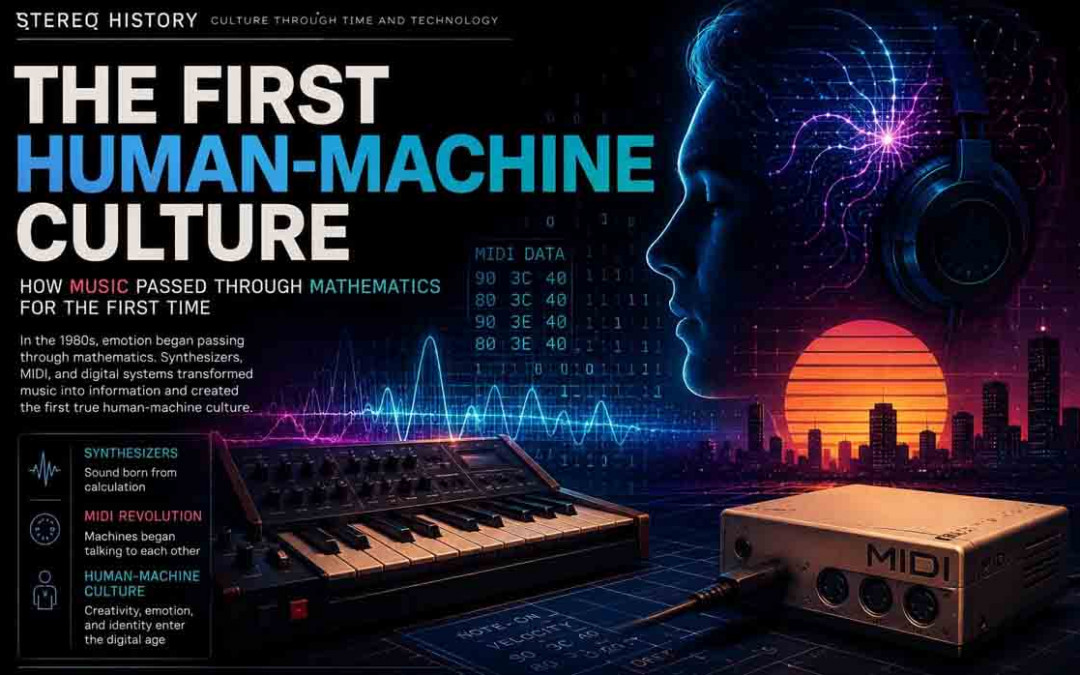
The First Human-Machine Culture
There is a moment in an old recording studio that would have seemed almost supernatural to a musician from another century.
Nobody strikes the drum.
It plays anyway.
A keyboard sends instructions to a machine across the room. Another device repeats a sequence the musician performed several minutes earlier, but now with a different sound. A rhythm continues with perfect regularity while the performer changes chords above it. A fragment of recorded audio is lifted from one context, stored, transformed and returned as something new. The musician is still present, still listening, still deciding. Yet part of the performance has migrated into a system capable of remembering, repeating and transforming instructions.
Nothing about this is unusual now.
That is why its historical strangeness is easy to miss.
Music had always depended on technology in the broadest sense. A violin is engineered wood. A piano is an elaborate mechanical apparatus. An organ can contain thousands of pipes and an astonishing architecture of air, valves and keys. Recording itself had already changed musical culture profoundly before the 1980s.
The new threshold was not the simple arrival of machines.
It was the growing arrival of programmable mediation inside ordinary creative practice.
The machine could increasingly remember an action, reproduce it precisely, trigger another machine, transform a recorded fragment and participate in the organization of time itself.
The musician was no longer interacting only with matter.
The musician was interacting with rules.
The Machine Had Been in the Room for Centuries
It is tempting to tell the history of music as a progression from pure human expression toward technological intervention.
That story is false from the beginning.
Musical instruments are technologies. Notations are technologies. Concert halls are acoustic technologies. The piano altered what hands could do. The microphone changed what counted as a powerful voice. Magnetic tape allowed performances to be cut, rearranged and assembled into events that had never occurred continuously in a room.
By the middle of the twentieth century, electronic composers were already working directly with oscillators, tape loops, filters and synthesized tones. Musique concrète transformed recorded sound into compositional material. Studios in Cologne, Paris and elsewhere treated electricity and tape as legitimate musical substances. Popular musicians later absorbed these experiments, while synthesizers entered rock, disco, funk and pop long before the 1980s began.
So the decade did not invent machine-mediated music.
Its importance lies elsewhere.
The machinery became increasingly portable, standardized, programmable and culturally visible.
A technique that had once required specialized laboratories could increasingly enter commercial studios, touring rigs and eventually bedrooms.
The machine stopped appearing only as exotic equipment.
It began to become part of the grammar of popular imagination.
When a Sound No Longer Needed an Ancestor
Traditional instruments produce sounds through physical systems whose origins are usually recognizable.
The piano has strings.
The trumpet has vibrating air.
The drum has a membrane.
Electronic synthesis loosens that relationship.
A synthesizer can imitate an existing instrument, but it does not need to. It can generate a sound that has no obvious acoustic ancestor: a tone shaped by oscillators, filters, envelopes and modulation until the final result belongs less to an identifiable object than to a designed relationship among parameters.
This was not the first time humans created unfamiliar timbres.
But synthesis made the design process unusually explicit.
The musician could decide not merely which note to play but what kind of sound the note would become.
Attack.
Decay.
Harmonic content.
Movement.
Texture.
The instrument increasingly resembled a small laboratory for constructing possible acoustic objects.
This matters philosophically because the musician’s role changes.
A violinist learns how one physical system responds.
A synthesist can partly determine what the system is.
The distinction should not be exaggerated. The synthesizer still has material limits, circuitry, interfaces and a history designed by engineers. It never becomes an infinitely neutral machine.
But its creative invitation is different.
The artist is not merely selecting notes.
The artist is designing conditions under which notes acquire identities.
MIDI and the Separation of Gesture From Sound
Then, in the early 1980s, something remarkably modest appeared.
MIDI.
The Musical Instrument Digital Interface was introduced as a standard that allowed electronic instruments and other devices to exchange musical instructions. It did not transmit audio in the ordinary sense. It transmitted information about events: a note has been pressed, a note has been released, a control has changed, a particular velocity has been used.
That distinction is easy to overlook.
A piano performance traditionally binds action and sound together. Press this key on this instrument and this instrument responds.
MIDI allows the gesture to become comparatively portable.
The same sequence of note events can trigger a piano sound, a synthetic pad, percussion or something else entirely. A performance can be recorded as a set of instructions, edited after the fact, slowed down, transposed, repeated or sent to another device.
The musician’s action and the sound produced by that action become partially separable.
That is a profound cultural shift.
The hand performs one thing.
The system stores a description of what happened.
Another system can reinterpret the description.
The gesture acquires an informational afterlife.
This is much closer to the deeper Transhumation question than the simple claim that “music became mathematics.”
Music had always contained mathematical relationships.
What changed was that musical behavior became increasingly addressable as data.
The Drum That Never Became Tired
The drum machine introduces another transformation.
A human drummer has a body.
The body introduces variation.
Fatigue.
Timing drift.
Accent.
Mistake.
Intentional imperfection.
A programmed drum machine can repeat a pattern with extraordinary regularity. This initially made machine rhythm sound artificial, but artists quickly discovered that artificiality was not necessarily a defect.
It could become style.
The perfect repetition of a machine created a framework against which human voices, guitars and gestures acquired another kind of tension. Producers could design rhythm rather than merely record it. A beat could be constructed bar by bar, revised, duplicated and treated almost architecturally.
Eventually musicians learned to humanize machines and mechanize humans.
Drummers played against sequencers.
Producers quantized performances.
Machines were deliberately made to swing.
Human imperfections were sampled and repeated until their irregularity itself became regular.
The opposition between human and machine began to collapse into a feedback system.
This is where the phrase human-machine culture becomes useful.
Not because the machine acquired creativity in the human sense.
Because the creative process increasingly took place inside a negotiation between two kinds of behavior.
Human intention.
Machine repeatability.
Human judgment.
Machine memory.
Human surprise.
Machine precision.
The finished work emerged from the interaction.
Sampling and the Portable Past
Sampling complicated the relationship further.
A recorded sound could now be detached from its original performance, stored digitally and placed inside another musical structure. A drum hit recorded years earlier could become part of a new rhythm. A fragment of speech could become texture. A piece of another recording could be altered, looped, pitched or reorganized until its original context became distant or disappeared.
This created legal and cultural conflicts, but also a new philosophy of the musical object.
A recording no longer needed to remain only a document of something that happened.
It could become material.
The archive became instrument.
This is another point where the 1980s and the emerging digital world belong to the same larger transformation.
Previous media preserved.
Digital systems increasingly made preservation operational.
The stored fragment could be acted upon.
Copied without significant degradation.
Recontextualized.
Combined.
The past no longer sat quietly on the shelf.
It could return inside a new structure.
The difference is subtle but enormous.
A record preserves a performance.
A sampler allows part of that preserved performance to participate in another one.
The Studio Becomes an Instrument
By the late twentieth century, the idea that a recording studio merely captured musicians playing had become increasingly inadequate.
Studios could construct events.
A singer might perform several takes whose strongest passages were combined.
A sound could be transformed beyond recognition.
Tracks could be layered in numbers no physical ensemble could easily reproduce.
Sequencers could determine timing.
Machines could synchronize with one another.
Production itself became composition.
This had begun much earlier than the 1980s, but the decade made the idea culturally dominant in new ways.
A producer did not need simply to ask:
How do we record this song?
The question increasingly became:
What can this song become because recording technology exists?
That is a different relationship with the machine.
The machine is no longer only a witness.
It becomes part of the space in which the creative object is discovered.
And once this logic becomes ordinary, the distinction between instrument and system begins to blur.
The synthesizer is an instrument.
The sequencer organizes instruments.
MIDI connects them.
The studio records and transforms them.
The musician operates inside a network.
Creative agency remains human, but creativity is increasingly expressed through architecture.
Why the 1980s Still Sound Artificial
There is a reason certain records from the period remain instantly identifiable.
The technology had not yet learned to hide itself.
Electronic drums sounded electronic.
Synthesizers often announced their synthetic character rather than successfully impersonating acoustic instruments.
Digital reverberation could create implausibly enormous rooms.
Early sampling had recognizable textures and limitations.
The interface was audible.
Later digital production became far more sophisticated and eventually so pervasive that synthetic mediation stopped sounding inherently futuristic. A contemporary recording may involve vastly more computation than anything produced in 1984 while presenting itself as intimate, organic or acoustically natural.
This creates the same paradox we encounter elsewhere in digital history.
The more advanced technology becomes, the less technological it may appear.
The 1980s preserve an earlier moment when machinery still had an accent.
That accent is what later culture hears as the future.
But it was never simply the sound of technology.
It was the sound of humans discovering what the technology permitted.
The Machine Did Not Remove Emotion
The anxiety surrounding electronic music often rested on an assumption that still appears in discussions of artificial intelligence: if machines enter deeply enough into creative production, something human must leave.
History has not supported such a simple equation.
A drum machine contains no heartbreak.
A synthesizer has no childhood.
MIDI does not fall in love.
Yet human beings can use these systems to produce music that listeners experience as intimate, melancholic, ecstatic or devastating.
This tells us something important about carriers.
Human emotion does not need an acoustic guitar in order to remain human emotion.
The structure through which emotion is expressed can change.
The listener may respond to harmony, timing, timbre, expectation, memory, lyrics and cultural association regardless of whether the original sound began with a vibrating string or an electronic oscillator.
That does not mean emotion literally becomes mathematics.
It means mathematics and engineering can participate in a carrier through which humans organize emotional structure.
The machine does not need to feel the music for the listener to feel it.
That distinction becomes crucial once AI enters the discussion.
AI Is Not the Next Synthesizer
The comparison between synthesizers and artificial intelligence is tempting because both provoke the fear that a machine is entering a space previously reserved for human creativity.
But the analogy has limits.
A synthesizer does not normally generate a finished artistic proposal independently. A drum machine repeats or follows structures programmed or triggered by people. MIDI is a protocol, not an author.
Modern generative AI can produce outputs that are much less locally determined by the user. A prompt may influence the result without specifying every word, image or musical decision.
This changes the distribution of agency.
The useful continuity is therefore not:
synthesizer → AI.
The continuity is:
human creativity repeatedly encounters systems that change which level of the creative process humans directly control.
The violinist controls continuous physical gesture.
The producer may control arrangements of recorded events.
The programmer may define rules.
The AI user may increasingly define intention, constraints and selection while the system generates lower-level details.
Each transition moves part of the operation behind another interface.
That does not make the transitions equivalent.
It makes them members of the same family of questions.
Where is the human decision?
What did the machine determine?
What did the interface hide?
Which part of the result still belongs meaningfully to the author?
Watch The Video
How to Read the World

Current Knowledge
Electronic music and human-machine creative collaboration long predate the 1980s. Experimental electronic composition, tape manipulation, synthesis and technologically mediated recording developed throughout the twentieth century, while musical instruments themselves have always embodied engineering.
What changed substantially during the 1980s was the broader availability and cultural influence of programmable electronic instruments, drum machines, sequencers, digital recording systems and emerging sampling technologies.
MIDI was introduced in 1983 as a standardized protocol allowing compatible electronic musical devices to exchange performance and control information. MIDI does not inherently transmit recorded audio; it communicates instructions that receiving devices interpret.
Synthesizers can generate and shape sound electronically through several different technical methods. Some are analog, some digital and some hybrid. It is therefore inaccurate to describe synthesis simply as “music created by mathematics,” although mathematical and electrical relationships are fundamental to electronic sound generation and control.
Machine involvement in music does not establish machine emotion or consciousness. Human listeners can experience strong emotion from highly mediated or algorithmically structured music without implying that the producing equipment possesses subjective experience.
Open Questions
One unresolved question concerns authorship. As creative systems become increasingly capable of generating detailed outputs from high-level instructions, where should authorship be located: in the person who defines the concept, the engineers who constructed the system, the dataset, the system’s generated choices, or some combination of these?
Another question concerns the value of friction. Earlier electronic systems often required significant technical skill and imposed strong constraints on creators. AI can remove some of that friction. Will easier production broaden creativity, or will the disappearance of constraints also remove part of the exploratory process through which distinctive styles emerge?
There is also the problem of cultural homogenization. MIDI standardized communication among musical devices and expanded creative possibility, but standards always privilege certain assumptions. AI systems trained on enormous existing corpora may similarly widen access while encouraging recurrence of patterns that are statistically common.
The deepest question concerns creativity itself. If a machine can generate an artifact that produces genuine emotion in a human audience, what exactly do we require before calling the process creative: intention, novelty, consciousness, selection, interpretation, or only the existence of a valuable result?
Transhumation Interpretation
The 1980s matter to Transhumation because they show that the most important technological revolutions often occur not when machines replace human beings, but when machines change the level at which human intention enters the process.
The musician once struck the surface directly.
Then the musician controlled electricity.
Then parameters.
Then sequences.
Then networks of devices.
The creative act moved gradually from shaping every physical event toward shaping systems capable of producing events.
This should not be confused with the disappearance of the human.
In many cases the opposite occurred.
The artist acquired another layer of agency.
A composer could create an ensemble without physically assembling every instrument.
A producer could manipulate timing at a level impossible in live performance.
A musician could invent sounds that had no acoustic equivalent.
The machine expanded the grammar.
But every expansion introduced another interface.
And every interface removed something from direct view.
When a drum machine repeats a rhythm, the listener no longer sees the hand producing every beat.
When a sequencer stores a performance, the action separates from the moment of execution.
When MIDI carries musical gestures between devices, one carrier hands a structure to another.
When a sampler reuses sound, the original event acquires another life.
This is why the period connects naturally with the Carrier and the Pattern.
A musical idea becomes increasingly capable of surviving changes in the mechanism that instantiates it.
A note sequence can move from one synthesizer to another.
A performance can trigger another sound.
A sample can migrate into another composition.
The pattern becomes more portable.
But portability is not independence from matter.
Every sound still requires a physical system to exist.
Every digital event requires hardware.
Every performance reaches a biological nervous system through physical sound or another sensory channel.
The interesting change lies in the declining importance of one particular carrier.
That principle later becomes central to digital civilization.
A file can move between devices.
A model can run on different machines.
A message can be reconstructed across networks.
The 1980s made one version of this increasingly tangible through culture rather than philosophy.
People could hear carrier-independence.
Yet music also gives Transhumation an important warning.
A MIDI file can preserve notes and timing while losing the exact physical gesture of the original performer.
A sample can preserve sound while losing context.
A recording can preserve a voice without preserving the singer.
A model can preserve style without preserving the consciousness that produced it.
Representation becomes more sophisticated.
Continuity does not automatically follow.
That distinction becomes essential with AI.
A machine may eventually reproduce someone’s musical style so convincingly that listeners cannot distinguish new compositions from old ones. That would demonstrate extraordinary pattern reconstruction.
It would tell us very little about whether the person had survived.
This is why the human-machine culture of the 1980s should not be romanticized as the first step toward merging humanity with computers.
The more historically interesting story is quieter.
Humans discovered that machines could become places in which creative decisions were stored, transformed, repeated and recombined.
The instrument began to remember.
The studio began to construct.
The interface began to mediate intention at increasingly abstract levels.
And culture remained recognizably human.
This suggests a more useful principle for Transhumation:
humanity does not become less human every time another layer enters between intention and expression.
The paintbrush is a layer.
The camera is a layer.
The synthesizer is a layer.
The prompt is a layer.
What matters is what happens to agency, understanding and meaning as the interface changes.
That is the boundary worth watching.
The 1980s did not create the first human-machine culture.
But they made one version of it audible to millions of people.
A human pressed a key.
A machine remembered.
Another machine answered.
A sequence continued after the hand had stopped moving.
For a generation hearing it on the radio, none of this needed to sound philosophical.
It simply sounded like pop music.
That may be how the deepest technological transitions usually arrive.
Not with a declaration that humanity has entered another age.
With a new sound that everyone begins dancing to before anyone has decided what changed.
FAQ
Were the 1980s really the beginning of human-machine culture?
No. Humans had created culture through machines and complex instruments for centuries. The 1980s were important because programmable electronic systems became unusually visible and influential within mass popular culture.
Why were synthesizers such an important change?
They allowed musicians to design and control sounds electronically rather than relying only on the acoustic properties of traditional instruments, greatly expanding the available sonic vocabulary.
What exactly does MIDI do?
MIDI allows compatible devices to exchange musical control information such as note events and parameter changes. It separates aspects of a performance from the particular sound generator that originally produced them.
Why does 1980s music still sound futuristic?
Partly because electronic mediation was conspicuous. Machines often sounded unmistakably synthetic, while later digital production became sufficiently sophisticated and ubiquitous that it stopped automatically signaling “the future.”
Is AI simply the next synthesizer?
No. Generative AI can make far more detailed decisions than a conventional synthesizer or MIDI system. The useful comparison concerns how new tools change which parts of a creative process humans directly control.
What is the deeper Transhumation question?
The important question is not whether creativity can pass through a machine. It already has, for a very long time.
The harder question is what happens as the interface takes responsibility for increasingly larger parts of the creative act.
The 1980s made the machine part of the performance.
Our period may be deciding how much of the performer can move into the machine before we need a new definition of performance itself.
Continue the Transhumation Series
- Forgotten Religion | Ancient Gods, Symbols and the Hidden Structures of Human Civilization
- The Last Religion | Death, Immortality and the Future of Humanity
- The New Theurgy | AI, Information and the Future of Human Civilization
- End of Branding: You Were Never Meant to Become a Product
- Baal vs Ishtar: Why Ancient Gods Never Disappeared