
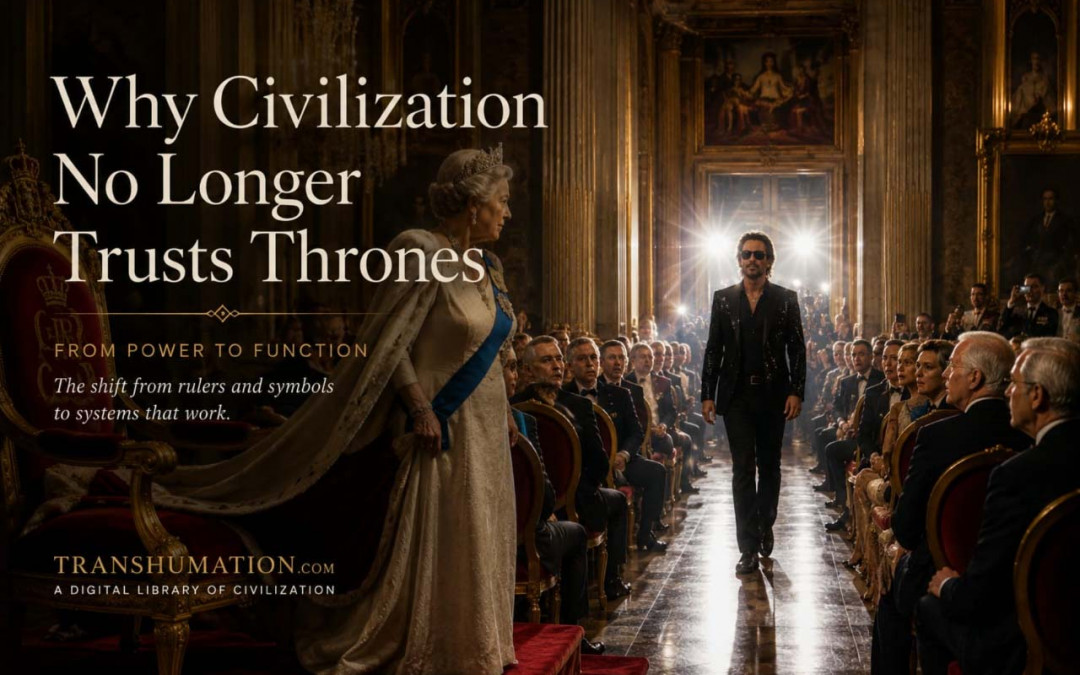
The throne as interface
For most of history, power had a face. It wore a crown, occupied a palace, sat above the court and possessed a name that could be carved into stone. A king ruled because he was the king; a priest spoke with authority because he belonged to the priesthood; an aristocrat inherited not merely land but a position in the architecture of society. Competence could strengthen authority, incompetence could destroy it, but neither created the original claim. The claim came first. It was inherited, consecrated or conquered.
Modern civilization has not escaped power, and it has certainly not escaped hierarchy. Yet something important has happened to the way authority justifies itself. Increasingly, the question is not simply Who are you? but What does the system under your control actually do? We still have presidents, monarchs, billionaires and institutional elites, but much of everyday civilization is held together by forms of authority that would have looked strangely anonymous to an ancient observer. The road does not ask us to believe in the road. The payment network does not demand a genealogy. The navigation system offers no coronation. It acquires authority each time it works.
The throne has not disappeared. It has become harder to see.
The Man Behind the Aqueduct
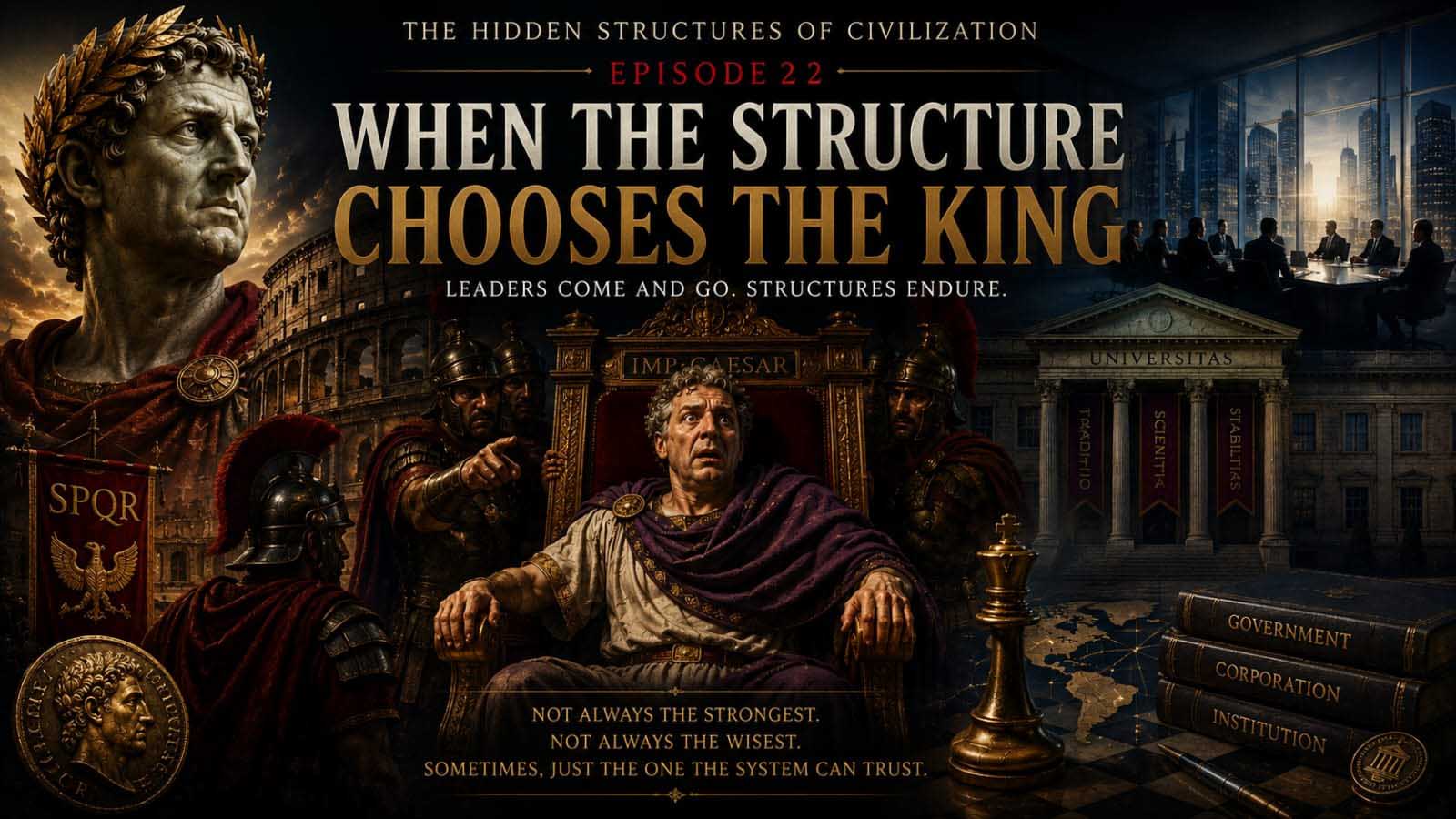
Rome is a useful place to begin because Rome never ceased to love hierarchy. Its society was saturated with rank, ancestry, patronage, citizenship and public status. Senators advertised their lineage; emperors surrounded themselves with the language of legitimacy; monuments transformed political authority into architecture. It would be absurd to describe Rome as a meritocracy in the modern sense.
But an empire eventually encounters a problem that ceremony cannot solve: scale.
A magnificent emperor cannot personally measure a road, administer a distant province, maintain an aqueduct, collect taxes across thousands of settlements, adjudicate every dispute or preserve every record. Expansion forces power to divide itself into functions. Surveyors survey. Governors govern. Clerks record. Engineers calculate. Lawyers interpret. Soldiers patrol. Administrators transmit instructions through a machine larger than any individual occupying its summit.
This creates a peculiar transformation. The emperor may remain the symbolic center, but increasingly the empire survives through people whose names most citizens will never know. Their importance derives less from who they are than from whether a particular function continues to operate when morning arrives.
Rome did not replace power with competence. It discovered that power without competence has a limited radius.
That distinction matters. A throne can command an aqueduct to exist. It cannot persuade water to flow uphill.
The Civilization Beneath the Crown
Imagine removing the emperor from an ancient coin. Something obvious disappears: the image of authority. Now imagine removing the roads from the empire, the granaries from the cities, the tax records from the administration, the harbors from the coast and the legal machinery connecting distant communities. Something less visible disappears, but the consequences are considerably greater.
This is one of history’s persistent optical illusions. We remember civilizations through their most visible people while civilizations function through largely invisible systems. Augustus receives a biography. The anonymous official who kept a provincial archive legible does not. Napoleon becomes a portrait; standardized administration becomes a footnote. Brunel becomes a name; thousands of workers, procedures, measurements and maintenance routines dissolve into infrastructure.
The crown is memorable because it compresses power into an image. Infrastructure is forgettable because successful infrastructure tends to disappear into ordinary life.
You notice a bridge when it collapses.
You notice a payment network when the payment fails.
You notice electricity when the room goes dark.
Reliability has a strange relationship with attention: the better a system performs, the less often we are required to think about it. This produces a form of authority almost opposite to royal spectacle. The king had to be seen. The mature system succeeds when it becomes invisible.
That may be one of the largest changes in the history of power.

When Function Becomes Legitimacy
The modern world pushes this logic much further than Rome could have imagined. Consider the systems an ordinary person may trust before breakfast: electricity, water, telecommunications, banking, navigation, authentication, transport, weather forecasting, search. Almost none derives everyday legitimacy from the personal magnificence of its operator. We judge it through performance.
This does not mean modern societies have become pure meritocracies, nor that inherited wealth, political status, branding or institutional prestige have ceased to matter. They plainly have not. Nor is a functioning system necessarily a benevolent one. A surveillance apparatus can work beautifully. An authoritarian bureaucracy can be efficient. A monopoly can provide an indispensable service while accumulating extraordinary power.
The change is subtler. Function has become one of the principal languages through which power explains itself.
A modern institution says: use me because I work. A platform says: remain because everyone else is here. An algorithm says nothing at all; it simply produces a result quickly enough that its recommendation begins to acquire authority. The legitimacy is experienced operationally before it is considered philosophically.
GPS is an almost comic example. Nobody asks whether a satellite possesses noble ancestry. We accept the instruction because the blue dot has repeatedly survived contact with the street. Turn left. Continue for six kilometres. Take the second exit. Reliability accumulates into trust.
Yet this reveals the darker side of functional authority. When something works often enough, we may stop asking who designed it, who controls it, what assumptions it contains, and whose interests its definition of “working” serves.
The throne has become less visible.
Power has not.
The Control Room
There was a time when political imagination naturally placed power at the top of a pyramid. Find the king and you have found the center. Modern systems make that intuition increasingly unreliable. Power can now reside in standards, protocols, databases, rankings, access permissions and technical architectures that have no obvious throne room.
The person who controls a gate may matter more than the person standing ceremonially above it.
This is why the modern administrator, engineer and designer are more politically interesting than their modest titles suggest. They determine categories. They construct procedures. They decide which options appear on a screen and which do not. They maintain the systems through which other people act. Their authority may be narrower than a king’s, yet it can operate at extraordinary scale.
The transition is visible in the architecture of our metaphors. The fortress belonged to a world of walls: power meant possession, exclusion and defense. The network belongs to a world of gates: power increasingly means deciding who or what can enter, connect, transact, publish, travel or participate.
A wall says you cannot pass.
A gate asks under what conditions may you pass?
The difference appears modest until an entire civilization begins organizing itself around gates.
Janus at the Airport
The Romans already possessed an unexpectedly elegant image for this kind of power. Janus was associated with beginnings, transitions, doors and gates, conventionally represented with two faces looking in opposite directions. He was not simply the god of a wall. His domain was the threshold: the strange place at which one state becomes another.
A modern airport would have fascinated him.
Its authority is distributed through thresholds. Passport control, boarding pass, security gate, biometric scanner, customs channel, lounge access, departure gate. Almost every stage asks the same structural question in a different language: May this person proceed?
The building does not need a king standing in its center. The rules are embedded in the architecture.
The same structure appears online. Passwords, accounts, permissions, subscriptions, memberships, verification systems and APIs are digital gates. They rarely look like power because their appearance is administrative. A button marked Continue does not resemble a throne.
But it decides whether you may continue.
This is the Janus transition: not the disappearance of hierarchy, but the migration of hierarchy from visible status into systems of access.
The old ruler possessed territory.
The modern system increasingly governs participation.
The Throne Nobody Notices
This is where the argument enters the territory of the New Theurgy. The interesting historical pattern is not that technology has replaced kings, or that engineers are the new priests, or that algorithms are secretly gods. Those comparisons are too easy. The deeper question is whether an ancient function has migrated into a different carrier.
Civilizations have always required mechanisms that coordinate individuals with structures larger than themselves. Once that coordination might have been represented by a crown, temple, bureaucracy or city gate. Today it may be represented by an interface. The materials change. The function survives.
That gives modern power its peculiar character. The most successful systems often do not need us to profess belief in them. They need us to participate. We enter the network, use the protocol, accept the standard, follow the route, maintain the account. Repeated participation makes the structure durable.
And here the original thesis needs one correction. Civilization has not moved cleanly from power to function. Power and function have become entangled. A system that performs an indispensable function can acquire enormous power precisely because people depend upon it. Reliability produces participation; participation produces dependence; dependence can produce authority.
The throne therefore has not vanished.
It has migrated.
Sometimes it is no longer a chair occupied by a sovereign. It is the architecture that determines which doors exist, who receives a key and what happens when the system says no.
The old question was: Who rules?
The more difficult modern question may be:
What has become so useful that we no longer notice it ruling?
Watch The Video
How to Read the World
Current Knowledge
Premodern societies varied enormously, and hereditary status was never the sole basis of authority. Ancient states also depended on military ability, administrative competence, law, commerce, technical specialists and complex bureaucracies. Rome in particular developed extensive administrative, legal and infrastructural systems, although patronage, citizenship status, wealth and social hierarchy remained fundamental.
Modern states and technological societies rely to an unprecedented degree on specialized institutions, professional administration, infrastructure, standards and large technical networks. These systems can continue functioning across changes of individual leadership, which gives institutional continuity a significance distinct from personal rule.
There is no simple historical progression in which status has been replaced by competence. Hereditary wealth, political symbolism, charisma, institutional prestige and social position continue to influence modern authority. Functional performance is therefore better understood as an increasingly important source of legitimacy rather than a complete replacement for older forms.
Open Questions
Does dependence on functioning systems actually make civilization less hierarchical, or does it merely relocate hierarchy into places that are more difficult to see? When a platform, network or institution becomes indispensable, does its usefulness constrain its power or increase it?
There is also a problem of accountability. A king is visible enough to blame. A distributed system may produce consequential decisions without presenting any single human being who appears to have made them. What happens to political responsibility when authority migrates from persons into procedures, protocols and technical architecture?
Finally, if participation increasingly replaces obedience as the mechanism through which systems reproduce themselves, at what point does voluntary use become practical dependence?
Transhumation Interpretation
Transhumation is interested in structures that survive changes of carrier. Seen from that perspective, the history of authority may not be a sequence in which one form simply destroys another. It may be a migration.
The crown organized legitimacy around a person.
The bureaucracy distributed it across offices.
Infrastructure embedded it in systems.
The network distributes it through connections.
The interface places it at the threshold between the individual and the system.
The materials are different, but something persists: civilization must decide who can act, who can enter, what can move and which rules coordinate participation.
Janus therefore survives remarkably well in a world that no longer requires his temple. Every login screen is a small threshold. Every permission is a gate. Every protocol distinguishes between what may pass and what may not. The ancient symbol has disappeared while the function it represented has multiplied.
Perhaps that is why modern power can feel simultaneously weaker and more pervasive than the old kind. There may be no emperor in the room. There may not even be a room.
There is simply a system that works.
And somewhere inside the fact that it works is the reason we obey it.
FAQ
Why does civilization no longer trust thrones?
Because modern authority increasingly depends on whether a system works, not on inherited status or symbolic power.
What does “From Power to Function” mean?
It describes the shift from legitimacy based on rank and position toward legitimacy based on competence, usefulness, and performance.
Did Rome begin this transition?
Rome did not abandon hierarchy, but its enormous administrative system made specialized roles, law, infrastructure, and bureaucracy increasingly important.
Why is infrastructure more durable than rulers?
Rulers disappear. Roads, laws, institutions, and administrative systems can continue functioning long after the people who created them are gone.
What is the “Administrator Age”?
It is a way of describing a civilization in which enormous power increasingly belongs to those who design, operate, and maintain systems rather than visibly rule from a throne.
How does this connect to The New Theurgy?
The New Theurgy examines how old structures of authority can survive in new forms. The throne may disappear while its function migrates into systems, networks, platforms, and interfaces.
Continue the Transhumation Series
- Forgotten Religion | Ancient Gods, Symbols and the Hidden Structures of Human Civilization
- The Last Religion | Death, Immortality and the Future of Humanity
- The New Theurgy | AI, Information and the Future of Human Civilization
- End of Branding: You Were Never Meant to Become a Product
- Baal vs Ishtar: Why Ancient Gods Never Disappeared