
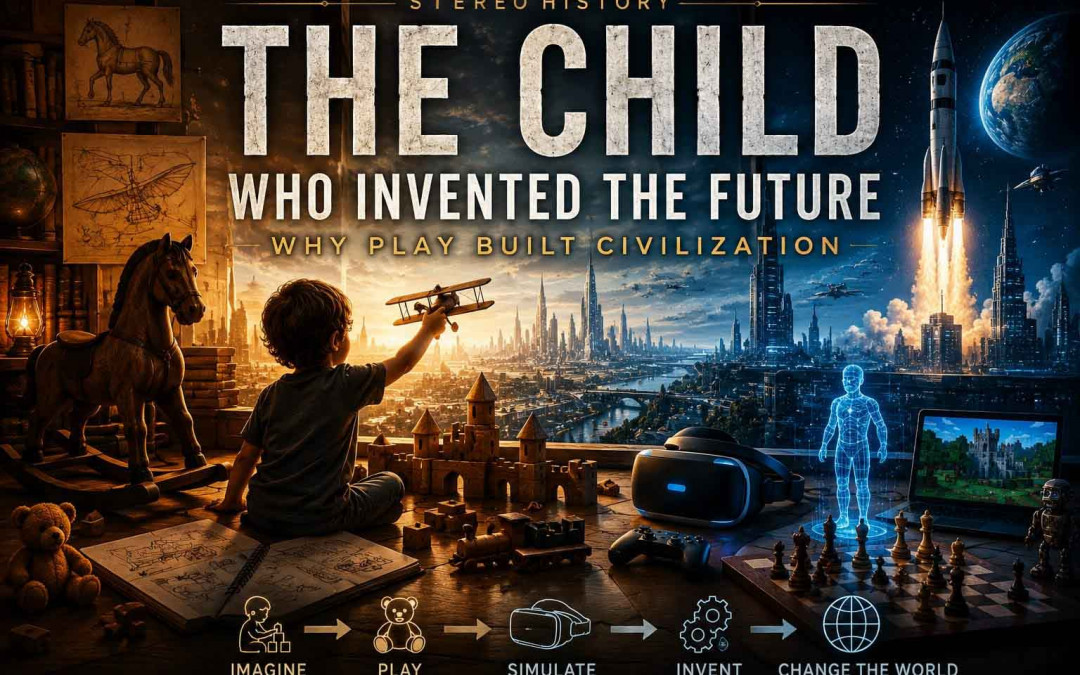
The Laboratory of Possible Worlds
A wooden block has almost no ambition.
It is not a house. It is not a bridge. It is not a ship, a fortress, a telephone, a piece of food or a planet. It has no engine, no screen and no instruction demanding that it perform one permanent function. Yet place it in front of a child and, within minutes, it may become all of those things.
That transformation is easy to dismiss because nothing physically important has happened. The block has not changed. No patent has been filed. No engineering problem has been solved. The room remains exactly where it was.
Only the relationship has changed.
For a few minutes, an object has escaped its assigned use.
This may be one of the most important things play does. It allows a mind to separate what something is now from what it could become under another arrangement. A chair becomes a ship. The carpet becomes an ocean. A row of stones becomes a border, then a road, then a city wall. Reality remains present, but its functions temporarily loosen.
The child does not discover the future.
Something subtler happens.
The child discovers that the present is not the only possible configuration.
Civilization has been exploiting that discovery ever since.
Why Is Play Important for Human Development?
Play is often described as preparation for adult life, and there is some truth in that description. Children rehearse movement, language, social roles, negotiation, rule-following, improvisation and emotional regulation through forms of play that differ across age and culture. Pretend play allows them to occupy roles they do not actually possess; games allow rules to be learned, challenged and sometimes rewritten; construction play lets physical relationships be tested repeatedly without requiring the result to have lasting value.
But preparation is only part of the story.
Play is unusually powerful because its goals can remain partially detached from immediate survival or economic utility. A child may build a tower for no reason beyond wanting to know whether it will stand. When it collapses, the failure does not need to be justified to a manager, defended before investors or explained to a city that has just lost a bridge.
The cost of being wrong is low.
That changes cognition.
In ordinary life, mistakes can create embarrassment, financial loss, injury or irreversible consequences. In play, many mistakes can be repeated almost immediately. The pieces go back in the box. The board resets. The imaginary kingdom can be rebuilt.
Play therefore creates something civilization values enormously: reversible consequence.
It gives curiosity permission to continue after failure.
Why Is Failure Useful in Play?
The romantic version of innovation says the child dreams and the world eventually catches up.
Reality is less generous.
Most towers fall.
Most invented rules make the game worse.
Most strange combinations produce nothing useful.
Most imagined machines remain imaginary.
That is precisely why play matters.
An environment that permits cheap failure can generate many more variations than an environment in which every experiment must succeed. A child can discover that a narrow tower collapses, that a certain jump is too far, that another player refuses an unfair rule or that an imagined scenario becomes boring when nobody else understands it.
The child proposes.
Reality edits.
That second half is essential.
Imagination by itself is not innovation. A fantasy that never encounters resistance can become internally perfect and externally useless. Progress begins when possibility collides with constraint and learns from the collision.
Play creates repeated cycles of proposal and correction at low cost.
Build.
Test.
Collapse.
Modify.
Try again.
The structure resembles later scientific and engineering experimentation not because childhood play secretly contains science, but because both benefit from environments in which hypotheses can encounter consequences without every failure becoming catastrophic.
A playground is not a laboratory.
But both can make error informative.

Are Toys Simulations of the Real World?
Sometimes, but not always.
A toy kitchen clearly refers to an adult activity. A model train compresses features of transportation into a manipulable scale. Dolls can support social role play. Board games can model competition, resource allocation or movement through rules.
But reducing every toy to rehearsal for reality would make play unnecessarily serious.
A stick can become a horse not because the child is practicing equestrian technology, but because imagination permits one structure to stand temporarily for another. The interesting thing is not the accuracy of the simulation.
It is the flexibility of representation.
This is where the child’s world begins to resemble some of civilization’s most sophisticated intellectual technologies.
A map is not territory.
An equation is not the physical system it describes.
A model aircraft is not an aircraft.
A computer simulation is not weather, traffic or an economy.
Each removes enormous amounts of detail while preserving a set of relationships considered relevant for a particular purpose.
Children do something structurally related when a blanket becomes a cave.
Most details of an actual cave are absent.
The relevant structure might be only inside, outside, hidden, safe.
That is enough for the game.
The intelligence lies partly in knowing how little reality must be preserved for a new relation to become usable.
The Object Before Its Purpose
Adults become extremely good at recognizing established function.
A coffee cup is for coffee.
A staircase is for moving between levels.
A newspaper is for reading.
A phone is for communication.
Expertise depends partly upon this stability because civilization would be impossible if everyone renegotiated the meaning of every object each morning.
But stable categories can also hide possibility.
Once an object has acquired a successful function, alternative uses begin to look like mistakes.
The child has an informational advantage here, although not because the child understands the world better. The opposite is often true. The child knows less about why categories are fixed.
That ignorance can temporarily preserve flexibility.
A cardboard box does not yet have one obvious destiny.
This is one reason play and innovation sometimes resemble one another. Both can involve discovering an affordance the established description of an object did not emphasize.
A technology developed for one use finds another.
A communication system becomes entertainment.
A game mechanic becomes a training method.
An industrial material becomes an artistic medium.
The future sometimes begins with the apparently improper use of the present.
But most improper uses remain merely improper.
Reality still gets the final vote.
Does Play Make Humans More Creative?
The relationship is more complicated than a slogan.
Creative thinking often involves generating unusual combinations, tolerating ambiguity and exploring alternatives before selecting among them. Play can support these processes because it reduces immediate pressure for one correct answer and allows objects, roles and rules to be recombined.
But play does not automatically produce creativity.
A repetitive game can become rigid.
A child can imitate rather than invent.
Highly structured play may reward compliance more than exploration.
Adults can remain intensely creative without behaving childishly.
The useful contrast is therefore not child versus adult.
It is fixed function versus possible relation.
Expertise tells us what normally works.
Play asks what else could work.
The strongest form of intelligence may require both.
Without expertise, imagination repeatedly proposes impossible bridges.
Without flexibility, expertise may build only bridges it already recognizes.
Innovation occurs somewhere between them.
The adult remembers why the structure must stand.
The child keeps asking whether it has to look like that.
Civilization Never Really Stopped Playing
Adults usually remove the word play once the stakes become respectable.
A flight simulator is training.
A military simulation is a war game.
An economic model is analysis.
A prototype is development.
A scientific model is research.
A digital twin is engineering.
The terminology changes because the consequences and standards have changed, but a familiar operation remains: build a restricted environment in which possibilities can be tested before committing fully to reality.
This should not be confused with literal continuity from children’s games. A professional simulator is not an expensive toy merely because both involve representation.
The structural relation is narrower.
Civilization repeatedly creates environments in which mistakes are cheaper than they would be in the system being modeled.
A pilot can crash a simulated aircraft and begin again.
An engineer can stress a digital model before building the physical structure.
A city can model traffic changes before excavating a road.
A chess player can explore a disastrous move without losing an army.
The more expensive reality becomes, the more valuable controlled unreality can become.
That is one of civilization’s strangest achievements.
It advances partly by building places where consequences are temporarily reduced.
Did Games Help Build Civilization?
Games have long been entangled with culture, mathematics, probability, strategy and social interaction, but we should resist telling a heroic story in which games directly produced civilization.
Chess did not create military strategy. Board games did not invent mathematics. Video games did not create economic thinking.
What games provide is a bounded world.
There are rules.
There are permissible actions.
There is a state of the system.
Decisions alter that state.
Consequences follow.
Because the world is reduced, relationships that are hard to inspect in ordinary life can become visible.
A board game can make scarcity explicit.
A strategy game can make trade-offs legible.
A cooperative game can reveal coordination problems.
A puzzle can expose how assumptions restrict solutions.
This makes games useful intellectual objects even when they were designed primarily for entertainment.
They create miniature realities in which cause and consequence can be manipulated.
The world is simplified enough to play with.
That is not the same as understanding the real world.
But it is one way of learning how systems behave.
The Digital Playground
Video games expanded this possibility because computation allows rule systems to become dynamic.
A board preserves rules largely through human interpretation.
A computer can execute them continuously.
Objects move.
Environments respond.
Economies change.
Characters act.
Thousands or millions of players can occupy related systems simultaneously.
This does not make digital worlds laboratories automatically. Most games are designed for pleasure, challenge, narrative or social interaction, and observations made inside them cannot simply be transferred to real human society.
But digital play creates new categories of experimentation.
Virtual economies can reveal behavior under artificial scarcity.
Online games can produce spontaneous cooperation and conflict.
Modding communities can transform software in ways original designers did not predict.
Players repeatedly discover behaviors the creators of a system did not explicitly intend.
This is an important pattern.
Once a sufficiently flexible environment exists, users stop merely consuming it.
They test its boundaries.
The playground becomes partly generative.
What Is the Connection Between Play and AI?
Artificial intelligence introduces another level because the environment can increasingly respond to intention rather than only to predefined commands.
A traditional construction toy gives the user components.
A video game gives components plus computational rules.
Generative AI can produce new components in response to language, images or other forms of instruction.
That lowers the cost of trying possibilities.
A person who cannot draw can test a visual concept.
Someone who cannot program fluently can explore software behavior.
A writer can generate alternative structures rapidly.
A designer can compare versions before committing resources to one.
This can make AI a powerful playground for ideas.
But cheap possibility creates a new problem.
When producing alternatives becomes nearly effortless, selection becomes more important.
A thousand images are not automatically more creative than one sketch.
A hundred possible answers do not solve the problem of deciding which one is true.
Generative systems can increase variation while simultaneously increasing the amount of attractive nonsense.
The future of creative intelligence may therefore depend less on producing possibilities than on developing stronger ways to test them.
Play expands the field.
Reality still has to edit.
Watch The Video
How to Read the World
Current Knowledge
Play is widespread in human childhood and also appears in a range of nonhuman animals, so it should not be treated as a uniquely human invention. In humans, research has associated different forms of play with motor practice, social learning, language use, emotional regulation, problem solving and exploration, although effects vary by type of play, developmental stage and environment.
Pretend play allows children to represent objects and situations as something other than their immediate physical identity. This capacity is related to symbolic thought, but it does not mean children’s fantasy directly predicts later technological invention. A child pretending to fly is not historically designing aviation.
Games and simulations can create lower-cost environments for practice and experimentation. Modern flight simulators, engineering models and computational simulations allow some risks and variables to be explored without reproducing the full consequences of the real system, although the validity of any simulation depends on what the model includes and omits.
Innovation does not arise only from play or curiosity. Necessity, accumulated craft knowledge, scientific research, economic incentives, institutional investment and accidental discovery all contribute. Play is best understood as one mechanism that can increase exploratory variation rather than as the single origin of technological progress.
Digital games and generative systems create increasingly complex environments for experimentation, but behavior inside artificial environments cannot automatically be generalized to real life. Models remain useful only to the extent that the relevant relationships survive the return of real-world complexity.
Open Questions
One unresolved question is how much unstructured play matters relative to guided learning. Complete freedom can support exploration, while constraints can sometimes make creativity more productive by giving the mind something specific to resist. The most generative environment may therefore lie between total openness and rigid instruction.
Another question concerns adulthood. Modern societies value innovation rhetorically while organizing education and work around evaluation, efficiency and predictable outcomes. It remains unclear how much exploratory behavior institutions can preserve once failure becomes financially or professionally expensive.
Digital environments create another ambiguity. Games and generative AI can make experimentation extraordinarily cheap, but they can also remove forms of physical resistance that historically taught people when an idea would fail. An object generated perfectly on a screen may be impossible to manufacture, unsafe to inhabit or economically irrational.
AI makes the final question especially important: if machines can generate possible configurations faster than humans can evaluate them, does creativity move from invention toward selection? The bottleneck of the future may not be imagining alternatives. It may be deciding which alternatives deserve reality.
Transhumation Interpretation
For Transhumation, play is useful because it demonstrates that intelligence can temporarily separate function from carrier.
A block does not stop being wood when it becomes a ship inside the game. What changes is the relationship imposed upon it. The child tests whether a structure remains meaningful after its ordinary function has been suspended.
That resembles the Transhumation method at its most basic: change the carrier, change the scale, change the context, and ask which relation survives.
But play needs its opposite.
Reality.
A possibility earns importance only when it survives the return of constraint. That is why the child proposes and reality edits.
The future may begin in play, but civilization starts when the game encounters a world that can say no.
FAQ
Why is play important for human development?
Play provides opportunities to explore movement, social roles, rules, symbols and possible outcomes in environments where many mistakes have relatively low consequences.
Are toys really simulations of the real world?
Some are, but not all. More broadly, toys can let children assign new functions to objects and experiment with relationships that are absent from the object’s ordinary use.
Does play make people more creative?
It can support exploratory thinking and unusual combinations, but creativity also depends on knowledge, skill, constraint and the ability to evaluate which ideas actually work.
Do games help civilization innovate?
Games can create bounded systems in which strategy, cooperation, scarcity and decision-making become easier to inspect. They do not automatically generate innovation, but they can provide useful spaces for experimentation.
What does AI change about play?
Generative AI dramatically lowers the cost of producing and testing possible texts, images, designs and software structures. That increases experimentation but makes judgment and verification more important.
What is the deeper Transhumation question?
The child with the wooden block demonstrates something civilization repeatedly forgets: an object does not exhaust the possible relationships it can enter.
Play gives the mind permission to rearrange those relationships before usefulness has been proven. Expertise later restores constraint. Reality removes the impossible.
The future does not belong simply to the child who dreams or the adult who knows better.
It appears in the brief interval where imagination is still free enough to propose another world, and knowledge is strong enough to discover whether that world can stand.
Continue the Transhumation Series
- Forgotten Religion | Ancient Gods, Symbols and the Hidden Structures of Human Civilization
- The Last Religion | Death, Immortality and the Future of Humanity
- The New Theurgy | AI, Information and the Future of Human Civilization
- End of Branding: You Were Never Meant to Become a Product
- Baal vs Ishtar: Why Ancient Gods Never Disappeared