
How Can I Help?
A perpetual-calendar watch makes a small promise that sounds larger than it is.
Inside the case, gears remember that some months have thirty days, others thirty-one, February behaves differently, and leap years occasionally intervene. Properly set, the mechanism can track the calendar for years with almost no correction. To the owner, it feels like a victory over inconvenience.
Then the watch stops.
The movement needs energy. Lubricants deteriorate. Parts wear. Seals age. The object called perpetual turns out to be astonishingly sophisticated and completely dependent upon maintenance.
There is something useful in that contradiction.
Human beings tend to imagine immortality as though it were the final achievement on a technological checklist. Aging is defeated. Disease becomes manageable. Death becomes optional. The story ends with the doors opening onto an infinite future.
But forever is not an event.
It is a duration.
And durations have costs.
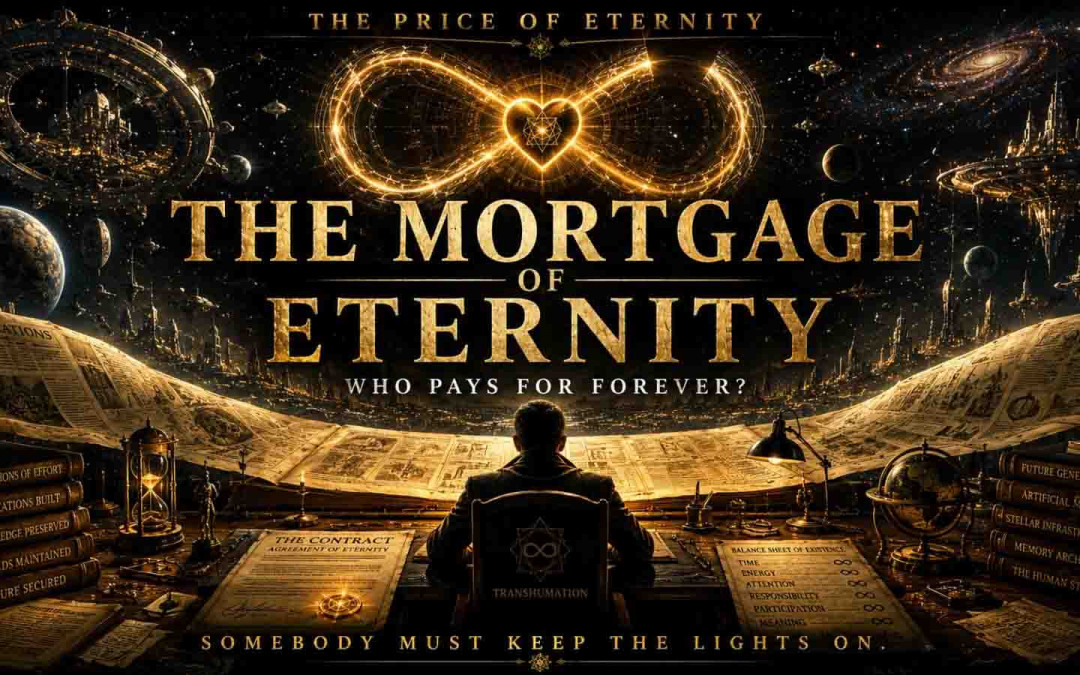
If humanity ever succeeds in extending healthy life far beyond its present biological limits, the difficult question may no longer be how to keep a person alive. It may be what must be continually repaired, remembered, forgotten, renewed and chosen in order for that life to remain worth continuing.
Immortality has always been sold as an escape from the bill.
Perhaps it is the longest bill imaginable.
What Would Immortality Actually Require?
The word immortality hides several different ideas.
One possibility is radical biological life extension: the body continues repairing itself and the diseases associated with aging become increasingly controllable. Another is negligible senescence, in which aging ceases to impose the familiar rising probability of death. Another is periodic replacement of biological parts. Still another is digital reconstruction: preserving enough information about a person to reproduce aspects of memory, behavior or cognition in another system.
These should not be treated as interchangeable.
A person living healthily for five hundred years would still be biologically continuous.
A digital model trained on that person’s writings might preserve recognizable patterns without preserving the person.
A perfect neurological copy could create an even harder problem because informational similarity would still not demonstrate first-person continuity.
For this essay, therefore, immortality is best treated as a thought experiment: suppose an individual could remain conscious, healthy and recognizably continuous for an indefinitely long period. What happens next?
The first answer is surprisingly mundane.
Tomorrow morning still arrives.
The House Problem
Buying a house is a moment.
Owning one is a process.
The photographs are taken on the day the keys change hands. Nobody photographs the fourth time the gutter needs cleaning, the invoice for replacing a boiler or the gradual discovery that water has been entering through a crack nobody noticed.
Possession converts achievement into obligation.
A civilization extending human life would encounter the same transformation.
Defeating one cause of death would not defeat entropy. Bodies would still require maintenance unless biology itself had been redesigned beyond anything we currently know. Technologies maintaining life would require inspection and repair. Systems storing memories or augmenting cognition would have security problems, compatibility problems and eventually legacy problems.
The longer the duration, the more maintenance ceases to be an inconvenience and becomes part of the architecture.
A bridge expected to stand for ten years can be designed differently from one expected to stand for centuries.
A life expected to last eighty years can tolerate forms of deferred maintenance that a life expected to last eight hundred may not.
Forever changes engineering because small probabilities accumulate.
It may change personhood for exactly the same reason.
Who Maintains an Immortal Civilization?
Science fiction often solves longevity and then quietly assumes everything else continues working.
The energy arrives.
Networks function.
Archives remain readable.
Political systems remain legitimate.
Medical technologies stay available.
Food systems continue.
Someone repairs the orbital habitats.
Someone patches the software.
Someone notices that an apparently minor failure has become dangerous.
Longevity therefore does not abolish the old truth that civilization is maintenance.
It intensifies it.
A long-lived civilization might become exceptionally good at automation. Machines could perform most routine work. AI systems could monitor infrastructure, predict failures and repair increasingly complicated systems.
But automation does not eliminate responsibility.
It relocates it.
Who decides which systems deserve preservation?
Who audits the automated caretaker?
Who updates rules written five centuries earlier?
Who determines whether an institution is a load-bearing wall or an obsolete prison?
The longer civilization survives, the more layers of inherited structure it may accumulate.
Eternity creates not only maintenance.
It creates archaeology of the present.

The Utility Bill of Existence
The phrase sounds financial, but the deeper cost is attention.
Everything that persists competes for maintenance.
A garden needs water.
An archive needs cataloguing.
A friendship needs contact.
A city needs repair.
A body needs regulation.
Even memory requires selection because a mind that retained every detail equally would not necessarily become wiser.
This is where immortality begins to resemble information overload.
Imagine a person after nine hundred years.
Thousands of acquaintances.
Several professions.
Multiple families perhaps separated by centuries.
Languages learned and forgotten.
Political loyalties that once felt permanent and later became embarrassing.
Promises made to people who have been dead for six hundred years.
Homes that no longer exist.
Entire periods of life whose emotional importance competes for a place in the present.
The problem may not be whether memory can technically be stored.
It may be whether a person can remain psychologically navigable under the weight of their own archive.
Eternity could transform identity into a library problem.
And every good library eventually needs rules about what belongs near the entrance and what can remain in the stacks.
Would Memory Become a Problem in an Extremely Long Life?
Human memory is already selective.
That is often treated as a flaw because forgetting can be painful and dangerous. But total retention might create problems of its own.
Forgetting can reduce interference.
Emotional intensity can fade.
Old models of the world can loosen enough to permit new ones.
A mind that lived indefinitely might require deliberate forms of forgetting, compression or archival storage simply to preserve a workable present.
This leads to an unsettling possibility.
The technology that allows a person to live forever may eventually force them to decide which parts of themselves should stop occupying immediate consciousness.
Perhaps memories are moved into external stores.
Perhaps entire centuries become searchable rather than continuously intimate.
Perhaps personality changes so extensively that the person from year eight hundred regards the person from year fifty almost as an ancestor.
At what point does indefinite duration begin to threaten the identity it was designed to preserve?
A life can continue biologically while changing psychologically.
Personal continuity may turn out to require more than duration.
It may require some minimum bridge between earlier and later selves.
Is Immortality the Same as Personal Continuity?
No.
This distinction becomes more important the further technology advances.
A machine can preserve data without preserving the original device.
A culture can preserve a name without preserving the person.
An AI reconstruction can preserve elements of conversational style without continuing the original conscious subject.
Immortality in the meaningful first-person sense would require something stronger.
The person who begins the process must somehow be continuous with the person centuries later.
Ordinary human life gives us an intuitive version of this. A seventy-year-old is radically different from their ten-year-old self, yet there is continuous biological and psychological development connecting them.
Extend that chain to a thousand years and the intuition becomes less secure.
If almost every belief changes, every social relationship changes, much of the body changes and memory becomes heavily edited or externally stored, what exactly carries identity across the interval?
There may be good answers.
But lifespan extension does not provide them automatically.
Eternity does not merely require survival.
It requires defining what is supposed to survive.
Would Humans Get Bored If They Lived Forever?
This is one of the oldest objections to immortality, and it deserves more than the easy answer that humans will simply invent new hobbies.
Philosophers have long explored whether endless life would eventually exhaust desire. If every ambition can be completed and every novelty becomes familiar, perhaps infinite duration becomes empty.
But this assumes the space of possible experience is finite in a psychologically meaningful sense.
We do not know that.
Art continues generating forms despite millennia of art.
Science creates new questions while solving old ones.
Relationships are not consumed like items on a list.
An infinitely long life could also contain deliberate reinvention, periods of withdrawal, new environments and problems produced by technologies that did not exist centuries earlier.
The deeper issue is not boredom itself.
It is whether motivation depends partly upon finitude.
A deadline creates priority.
A lifespan creates selection.
Knowing that not everything can be done forces a person to decide what deserves attention.
Remove the deadline and choice changes.
Perhaps freedom increases.
Perhaps indecision increases with it.
An immortal person does not merely gain more time.
They lose one of the mechanisms that previously made time valuable.
Can Meaning Survive After Survival Is Solved?
Human meaning never came exclusively from survival.
People living under terrible material conditions still produced art, religion, humor, philosophy, games, exploration and acts of generosity that had no straightforward survival payoff.
So a future without aging or scarcity would not suddenly become meaningless.
But necessity currently performs an enormous amount of motivational work.
Food must be obtained.
Children must be protected.
Bills must be paid.
Bodies require sleep.
Time is scarce.
Death makes postponement costly.
Remove enough of these constraints and meaning becomes more elective.
This might be liberating.
It could also be psychologically demanding.
A person forced to work can blame necessity.
A person completely free must explain their choices to themselves.
Why study astronomy for another century?
Why build a garden on Mars?
Why remain married?
Why write a book when ten million excellent books already exist?
Why learn another language when translation is perfect?
Why continue tomorrow?
The immortal civilization may discover that solving necessity does not solve purpose.
It exposes it.
The Immortal Citizen
Longevity would also transform politics.
Imagine individuals holding wealth, influence or office not for decades but for centuries.
Inheritance changes.
Generational turnover slows.
Land ownership becomes strange.
A founder could still control a company five hundred years after establishing it.
A political revolutionary might remain alive long enough to become the conservative defending the system created by their revolution.
Societies currently receive one form of renewal automatically.
People die.
New generations arrive without memories of having built the existing order and are therefore more willing to challenge it.
Indefinite lifespan could weaken that mechanism.
The solution might require institutional forms of forgetting even if individuals remain alive.
Term limits become more important.
Ownership rules change.
Power may need deliberate circulation.
Eternity, paradoxically, could require society to manufacture endings because biology no longer provides enough of them.
Death currently performs political functions we rarely notice because nobody designed it to perform them.
Removing death would expose those functions.
The Cosmic Mortgage
At interstellar scale, the maintenance problem grows stranger.
Suppose humanity or its descendants inhabit several star systems.
Communication takes years.
Habitats operate for centuries.
Autonomous infrastructure becomes indispensable.
Artificial minds participate in civilization.
Archives contain histories longer than any present human society has existed.
The phrase keeping the lights on becomes literal on worlds separated by light-years.
No one consciousness can oversee the whole.
No central authority can respond instantly.
Civilization must become distributed enough to survive local failure.
Here the mortgage is not a punishment for success.
It is the price of scale.
Every new habitat creates something else capable of breaking.
Every new archive creates something else capable of being lost.
Every new relationship creates an obligation someone may eventually inherit.
Growth expands possibility and maintenance together.
That is the same Balance Problem at civilizational scale.
Structure creates capability.
Capability creates stewardship.
The Right to Leave
There is a darker question that immortality stories often avoid.
If life can continue indefinitely, must it?
A civilization capable of radically extending existence may need an ethical language for ending it voluntarily.
Today death is largely imposed by biology, accident and disease.
In an indefinitely long-lived future, continuation could become an active choice.
That changes the moral architecture completely.
The question would no longer simply be whether suicide is permitted under exceptional suffering. It might become whether a person has an obligation to continue merely because continuation is technically available.
Can someone say, after eight hundred meaningful years, that their life is complete?
Would society regard that as tragedy, autonomy or waste?
If immortality becomes possible, mortality may eventually become one of the freedoms that technology has to preserve.
The mortgage metaphor reaches its limit here.
A mortgage can be paid off.
Forever cannot.
A genuinely voluntary eternity must include the possibility of refusing renewal.
Otherwise immortality stops looking like freedom.
The Caretaker of Forever
Perhaps the immortal future belongs less to conquerors than to caretakers.
People willing to repair things.
Curate archives.
Revisit old institutions.
Teach newly created minds.
Preserve places that cannot defend themselves.
Destroy structures that have outlived their purpose.
The heroic image of civilization usually celebrates beginnings.
The founder.
The explorer.
The inventor.
The person who opens the door.
A very long-lived civilization may discover that continuation requires another kind of prestige.
The person who returns two hundred years later to check the foundations.
This is not glamorous.
It may be the essence of durability.
Any civilization can be excited about tomorrow.
The difficult civilization is the one still willing to care on the ten-thousandth tomorrow.
Watch The Video
How to Read the World
Current Knowledge
Human beings have not achieved biological immortality, indefinite healthy lifespan or demonstrated transfer of conscious personal identity into digital systems. Current research can investigate mechanisms of aging and age-related disease, but radical indefinite life extension remains speculative.
Human motivation is not reducible to survival. Art, play, intellectual curiosity, religion, social attachment and exploration occur across a wide range of material conditions, suggesting that eliminating some survival pressures would not automatically eliminate purpose.
Long-lived systems require maintenance. Biological organisms depend upon continuing repair and regulation; technological infrastructure depends upon inspection, replacement and energy; social institutions require adaptation and legitimacy. Increased duration generally increases the importance of maintenance even when automation performs much of the work.
Memory is selective and reconstructive rather than a complete recording of experience. Whether extremely long-lived humans would require new forms of memory management is speculative, but a radically expanded lifespan would create genuine questions about information load, identity and psychological continuity.
Personal continuity should be distinguished from preservation of information. A digital reconstruction capable of reproducing memories or behavior would not by itself demonstrate survival of the original first-person subject.
Open Questions
One major question is psychological. We do not know whether human motivation systems could adapt comfortably to lives lasting centuries, particularly if biological aging, scarcity and many forms of involuntary risk were removed. Longer life might expand meaning rather than diminish it, but it would almost certainly change how urgency and commitment operate.
Another concerns memory and identity. How much can a person forget, edit or externalize while remaining meaningfully continuous with earlier versions of themselves? Extremely long lifespans could turn an old philosophical problem into a practical one.
Political systems would face equally difficult questions. Long-lived individuals could accumulate wealth, authority and institutional memory on unprecedented scales, potentially requiring artificial mechanisms of renewal that mortality currently provides automatically.
The deepest uncertainty is whether immortality would remain desirable after it ceased to be hypothetical. Human beings currently imagine infinite life from within mortal psychology. A mind actually adapted to extreme longevity might value continuation, forgetting, change and even voluntary death in ways we cannot reliably predict.
Transhumation Interpretation
For Transhumation, eternity is not primarily a question of defeating death.
It is a question of maintenance across changing carriers and changing selves.
A civilization may preserve bodies, memories, institutions and machines for extraordinary periods. None remains meaningful merely because it continues to exist.
The relevant question is what still deserves to be carried forward.
A good caretaker of eternity would therefore need two abilities that appear contradictory: the discipline to preserve and the courage to let some things end.
Forever cannot mean keeping everything.
It must mean knowing what is still worth renewing.
FAQ
What is the “Mortgage of Eternity”?
It is a metaphor for the continuing obligations created by radical longevity. Reaching extreme lifespan would not end maintenance, responsibility or the need to choose what matters.
Does immortality necessarily lead to boredom?
No one knows. Unlimited time could reduce urgency, but new relationships, knowledge and environments could continually create new purposes. The psychological effects of extreme longevity remain speculative.
Would an immortal civilization still need work?
Almost certainly in some form. Automation could remove enormous amounts of routine labor, but systems would still require goals, governance, repair, auditing and decisions about what should be preserved or changed.
Would perfect memory be useful in an immortal life?
Not necessarily. Human memory already relies heavily on selection. Over centuries, some combination of forgetting, compression and external archives might become important for maintaining a usable sense of self.
Is digital immortality the same as living forever?
No. Preserving data, memories or a behavioral model is different from demonstrating continued first-person consciousness. Informational survival and personal survival should remain separate questions.
What is the deeper Transhumation question?
The deepest question is not whether humanity can make life last forever.
It is what kind of person could remain capable of choosing forever after the emergency of survival had finally ended.
A mortal life receives some of its structure for free. The body imposes limits. Time removes options. Death closes the account whether we are finished or not.
An indefinitely long life would remove part of that architecture.
Then the responsibility shifts.
You decide what remains.
You decide what is forgotten.
You decide which obligations still bind the person you have become.
You decide whether an institution deserves another century, whether a relationship deserves renewal, whether a project deserves another morning.
Technology might one day solve part of death.
It cannot automate the answer to the question that follows.
What is worth maintaining when maintenance can continue forever?
That may be the true mortgage of eternity.
Not the cost of staying alive.
The cost of continuing to care.
Continue the Transhumation Series
- Forgotten Religion | Ancient Gods, Symbols and the Hidden Structures of Human Civilization
- The Last Religion | Death, Immortality and the Future of Humanity
- The New Theurgy | AI, Information and the Future of Human Civilization
- End of Branding: You Were Never Meant to Become a Product
- Baal vs Ishtar: Why Ancient Gods Never Disappeared