
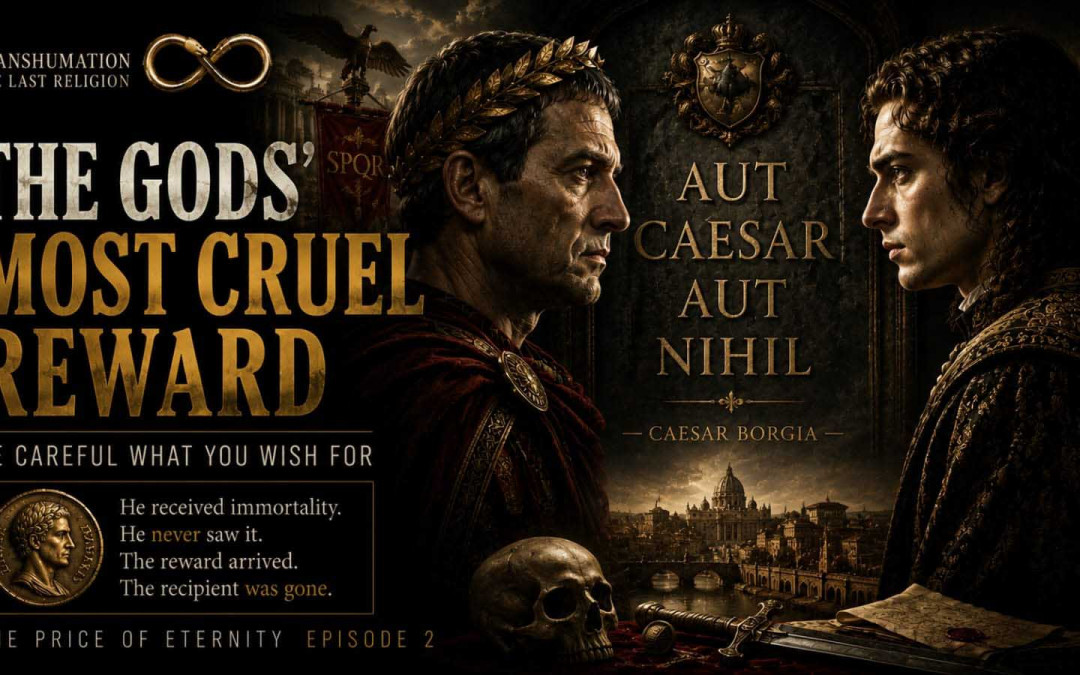
The Gods’ Cruelest Reward
What If You Get Exactly What You Asked For?
There is an old joke about wishes that children understand before philosophers get anywhere near it. Someone finds a lamp, rubs it, and is offered three wishes. The first few possibilities are obvious: money, beauty, power, perhaps eternal life. Then someone in the room begins spoiling the fun. How much money? In what currency? Eternal life at what age? Does immortality include health? If you ask to become the richest person alive, does the wish make you richer—or everyone else poorer?
Suddenly the wording matters.
The joke survives because a wish is really a contract with an unknown future. We know what we want under present conditions, but the fulfillment of the desire changes those conditions. The person making the wish imagines receiving a gift while remaining essentially the same person in essentially the same world. Mythology was rarely so generous. Midas receives the golden touch and discovers that food belongs to the category of things he can turn into gold. Tithonus receives immortality but, in the best-known version of his story, not eternal youth. Achilles receives the possibility of imperishable fame at the price of the long life in which he might have enjoyed being famous.
The gods do not always need to refuse us.
Sometimes the cruelest thing they can do is say yes.
The Man Who Received His Wish Too Late
Julius Caesar provides an unusually elegant historical version of the mythical bargain, although we should be careful not to pretend that we know precisely what private form his desire for posterity took. We know enough about his extraordinary political ambition, his cultivation of public image and his pursuit of distinction to say that obscurity was hardly the life he chose.
On that measure, history gave him an almost absurd victory.
The senators who killed Caesar on the Ides of March in 44 BCE succeeded in the most literal objective imaginable: Caesar was dead. What they did not achieve was a durable restoration of the political order they believed they were defending. More civil wars followed. Octavian emerged victorious, became Augustus, and established the political settlement conventionally associated with the beginning of the Roman Empire.
Caesar never saw it.
He never saw Augustus rule for decades. He never saw the imperial system mature, and he certainly never saw the most peculiar part of his own afterlife: his name escaping from biography and becoming associated with the office of supreme ruler. Caesar became an imperial title; much later, German Kaiser and Slavic Tsar/Czar developed from it.
This is more than ordinary fame. Shakespeare remained Shakespeare. Napoleon remained Napoleon. Caesar became something people could be.
And yet the man who achieved this astonishing victory over oblivion received none of its experiential benefits. He did not wake one morning in the sixteenth century and discover that emperors still carried an echo of his name. The information survived. The observer did not.
The wish was fulfilled after the recipient had left the room.
Achilles Read the Small Print
The Greeks had already constructed a cleaner version of the problem. Achilles, in the Iliad, describes two possible destinies. If he remains at Troy, he will lose his homecoming but gain imperishable fame; if he returns home, his fame will perish but his life will be long.
It is a remarkable bargain because nothing is hidden.
Achilles is not tricked by a malicious god. He understands the price. He chooses a form of continuation that requires the termination of the person who desires it.
We tend to soften this contradiction by treating fame as though it were a possession. Achilles “has” immortality because we still know his name. But from the perspective of experience, this is peculiar language. A dead person cannot inspect his reputation. Caesar cannot hear Kaiser. Achilles cannot count editions of Homer.
Cultural immortality belongs partly to the living.
We are the ones doing the remembering.
This exposes a distinction that becomes increasingly important as technology gives humanity new ways to preserve itself. There is biological continuation, informational continuation, and the far more difficult possibility of continuity of experience. They are not obviously the same thing.
A portrait can survive you.
A recording can speak with your voice.
A sufficiently sophisticated future system might imitate your conversational patterns.
None of those facts alone demonstrates that you are there to receive the reward.

Ishtar Wants Something
This is where desire itself becomes more interesting than any individual wish.
The Mesopotamian goddess known as Inanna in Sumerian tradition and Ishtar in Akkadian tradition cannot responsibly be reduced to “the goddess of wanting more.” Historically, she was associated with love and sexuality, fertility, warfare, political power and other domains whose combinations can seem surprising to modern readers. She was a major and complicated deity, not an ancient psychological diagram designed for Transhumation.
But precisely that combination makes her a powerful modern mirror.
Desire and conflict are not as far apart as they appear.
To desire something is to perceive a distance between the world as it is and the world as we want it to become. Civilization is built inside that distance. People cross oceans because somewhere else matters. They accumulate wealth because enough has not yet become enough. They create art because the existing world does not contain the thing they want to see. They pursue knowledge because ignorance becomes intolerable.
Ambition can build a library or an empire.
The mechanism does not guarantee the destination.
That is why desire cannot simply be classified as a defect. Remove the human appetite for what does not yet exist and much of civilization disappears with it. But the same engine contains no automatic instruction telling us when to stop. Alexander can reach another frontier. The billionaire can acquire another billion. The scientist can solve another problem. The civilization can demand another unit of energy.
The object changes.
The verb remains: more.
The dangerous wish may therefore not be immortality, beauty or power. It may be the assumption hidden beneath all three—that obtaining what we lack will leave the meaning of the desire unchanged.
It rarely does.
When Fortuna Enters the Casino
The Romans gave uncertainty a memorable face of its own. Fortuna could be represented with the wheel, the rudder or the cornucopia, imagery that captured different aspects of fortune, chance, abundance and the unstable distribution of human circumstances. Medieval and later European culture would make the turning Wheel of Fortune particularly famous: those above descend, those below rise, and nobody owns the wheel merely because he currently occupies its highest point.
Fortuna introduces something missing from the simple morality tale of “be careful what you wish for.”
You can be careful and still lose.
A person can make intelligent decisions and encounter disease, war, economic collapse, another person’s decision, an accident, or simply the accumulation of consequences too complex for anyone to calculate. Conversely, someone can make a foolish decision and be rescued by luck.
Human agency is real without being total.
That distinction becomes especially important when looking backward at successful lives. Once we know that Caesar became Caesar, the route can begin to look inevitable. It was not. Historical outcomes acquire a deceptive neatness after they have happened. The dead ends disappear from the story, and Fortuna quietly leaves the photograph.
The wheel reminds us that desire is only one participant in the bargain.
The world gets a vote.
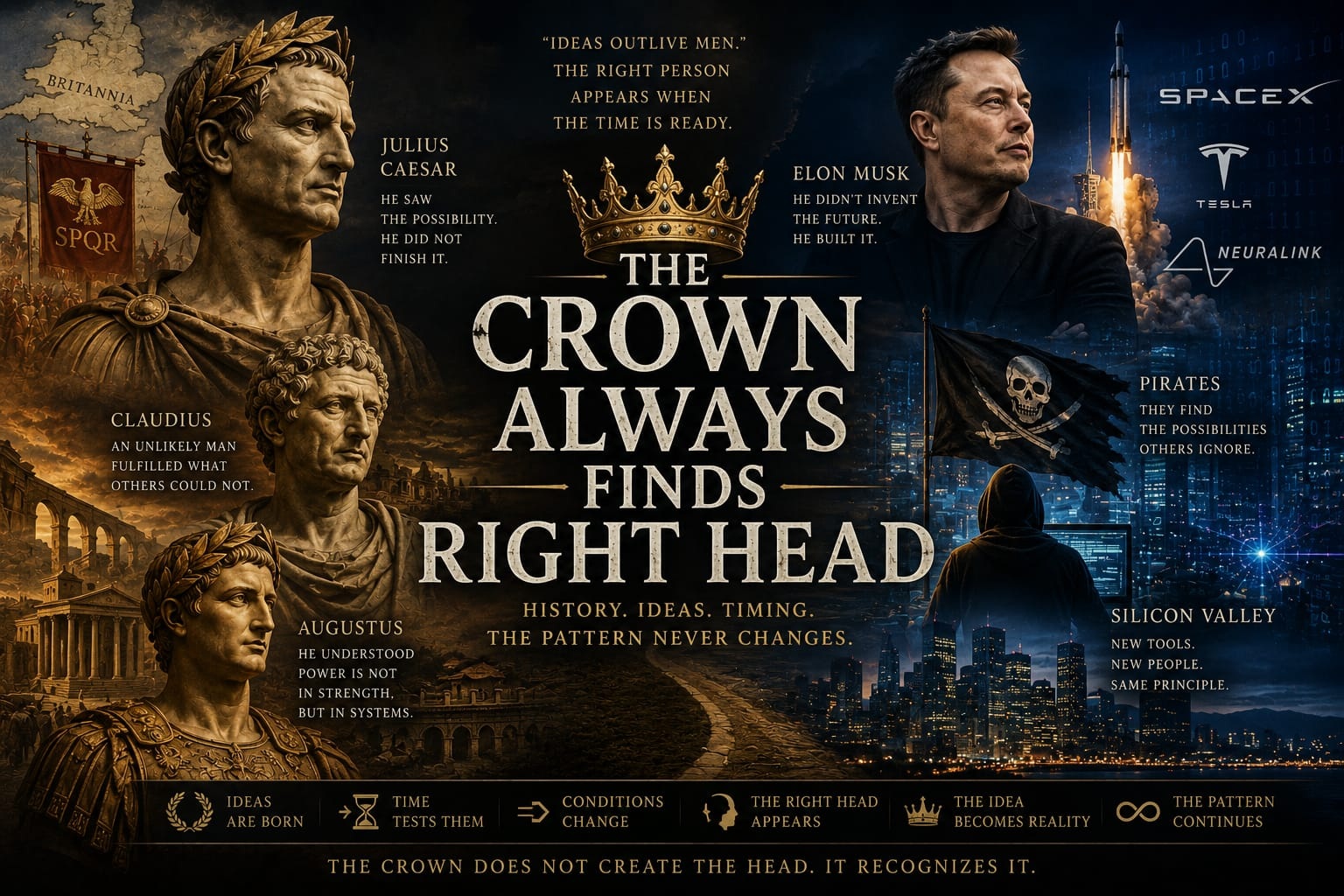
The New Wish Machine
We no longer need to stand before Ishtar to ask for beauty, fertility or victory. We have clinics, laboratories, corporations, financial markets, social networks and increasingly artificial intelligence. The vocabulary has changed so dramatically that it is easy to miss how familiar many of the requests remain.
We want longer lives.
More intelligence.
Greater beauty.
More attention.
Better memory.
Greater control over nature.
Children protected from disease.
Knowledge available immediately.
Perhaps, eventually, some version of ourselves that does not disappear when the biological body does.
Technology is unusually powerful because it does not merely promise these things symbolically. Sometimes it delivers them.
That makes the old warning more relevant, not less.
Imagine that digital technology eventually allows a person’s voice, appearance, memories and conversational patterns to be reconstructed with extraordinary accuracy after death. Something has unquestionably been preserved. But what exactly has been granted? The wish “I don’t want to disappear” contained an ambiguity that did not matter until technology became capable of fulfilling one interpretation of it.
The archive survives.
Perhaps the personality model survives.
Perhaps descendants can speak to it.
But did the observer survive?
The genie has become an engineer, and the contract still needs to be read carefully.
The Gods Were Not Lawyers
It would be easy to turn all of this into a conservative lesson: desire less, accept limits, do not touch the strange machine. That would miss half of what mythology understood.
Prometheus steals fire.
Odysseus wants home.
Gilgamesh refuses initially to accept the ordinary boundary of death.
Human stories move because somebody wants the world to be different.
The interesting warning is subtler. A desire is formulated by a person who has not yet experienced its fulfillment. We therefore ask the future to solve a problem defined by the present self. If the solution transforms us, our values or the world around us, the original request may no longer mean what it meant when we made it.
This is why the treasure at the end of an adventure is almost never merely the object marked on the map. The child opens the chest expecting gold and discovers that the journey has altered the value of gold.
Perhaps the gods’ cruelest reward was never cruelty at all.
Perhaps it was precision.
You asked for fame.
Here is fame.
You asked for power.
Here is power.
You asked to be remembered forever.
Humanity remembers you.
Only afterward comes the question mythology has been keeping behind its back:
Was that actually what you wanted?
Watch The Video
How to Read the World

Current Knowledge
Julius Caesar was assassinated in 44 BCE and did not live to see the political order established by Augustus. His name subsequently became an imperial title in Rome and ultimately contributed etymologically to titles including Kaiser and Tsar/Czar. It is reasonable to describe this as an extraordinary form of cultural survival, but it should not be confused with personal or conscious survival.
In Homer’s Iliad, Achilles explicitly describes the choice between a short life associated with imperishable fame and a long life in which that fame will not endure. The episode provides one of antiquity’s clearest literary examinations of the tension between life and posthumous glory.
Inanna/Ishtar was a complex Mesopotamian deity associated with several domains, prominently including love, sexuality and warfare. Interpreting her as a general symbol of human ambition or the desire for transcendence is a modern philosophical use of the figure rather than an established historical description of her ancient cult.
Fortuna was the Roman personification and goddess of fortune, with traditions emphasizing prosperity, chance and changes in human circumstances. The famous Wheel of Fortune became particularly prominent in later cultural representations.
Open Questions
The oldest question remains surprisingly difficult: who benefits from posthumous immortality? If a person’s name, work or informational pattern survives while subjective experience does not, should we call that survival or influence?
Technology adds harder versions. How much of a person can be externalized before a preserved pattern begins to appear like continuity? Would perfect behavioral reconstruction change the philosophical problem, or merely produce a more convincing memorial?
There is also the problem of desire itself. Can humans reliably predict which goals will remain valuable after those goals transform their circumstances? And as biotechnology and AI make increasingly ambitious wishes technically possible, will our ability to formulate good wishes grow as quickly as our ability to grant them?
Transhumation Interpretation
Transhumation treats the ancient wish not as superstition but as a remarkably persistent structure.
Desire → transformation → unexpected consequence.
The carrier changes. The structure survives.
Once the wish was addressed to a god. Later it might be addressed to a king, a physician, a market or a machine. The essential problem remains: an intelligence operating at one level imagines a future state and attempts to cross the boundary toward it without possessing complete knowledge of what exists on the other side.
Caesar reveals another part of the structure. Information can survive when the person cannot. A name can migrate from man to office, from office to title, from one language into another. Something genuinely persists, but persistence alone does not tell us what has persisted.
This matters enormously for the Transhumation question of continuity. If technology eventually allows human patterns to survive biological death, we will need a better vocabulary than simply “immortality.” A surviving archive, a surviving pattern and a surviving observer describe radically different achievements.
The ancient gods may therefore have left us a useful test for technological civilization.
Before asking whether a wish can be granted, ask what would count as granting it.
Before asking for immortality, decide what must survive.
Before asking for intelligence, decide what intelligence is for.
Before asking for more, ask which part of you is doing the asking.
The gods’ cruelest reward was not necessarily punishment.
It was giving humanity enough rope to discover that getting what we want and getting what we meant are two different things.
FAQ
What is “the gods’ cruelest reward”?
It is the paradox of receiving what you asked for while discovering that its consequences or meaning are different from what you expected.
How does Julius Caesar illustrate it?
His name achieved extraordinary historical longevity, but Caesar himself could never experience that posthumous survival.
What choice did Achilles face?
In the Iliad, Achilles describes a choice between a long life without enduring fame and a short life accompanied by imperishable glory.
Does the article claim Ishtar represented ambition?
Not historically in that simple sense. Ishtar is used here as a modern interpretive mirror for desire, power and the forces that push humans toward what they do not yet possess.
What does Fortuna represent?
Fortuna represents fortune and the instability of human circumstances—the part of an outcome that cannot be reduced to intention or control.
What does technology change about the ancient problem?
Technology increasingly makes old desires—longer life, greater intelligence, preserved memory and enhanced capability—practical engineering questions rather than purely mythical wishes.
Is informational survival the same as immortality?
Not necessarily. Information about a person can survive without establishing that the person’s subjective experience continues.
How does this connect to Transhumation?
It asks what humans actually mean when they seek transcendence. Before technology grants an ancient wish, we need to know which part of ourselves we expect to reach the other side.
Continue the Transhumation Series
- Forgotten Religion | Ancient Gods, Symbols and the Hidden Structures of Human Civilization
- The Last Religion | Death, Immortality and the Future of Humanity
- The New Theurgy | AI, Information and the Future of Human Civilization
- End of Branding: You Were Never Meant to Become a Product
- Baal vs Ishtar: Why Ancient Gods Never Disappeared