
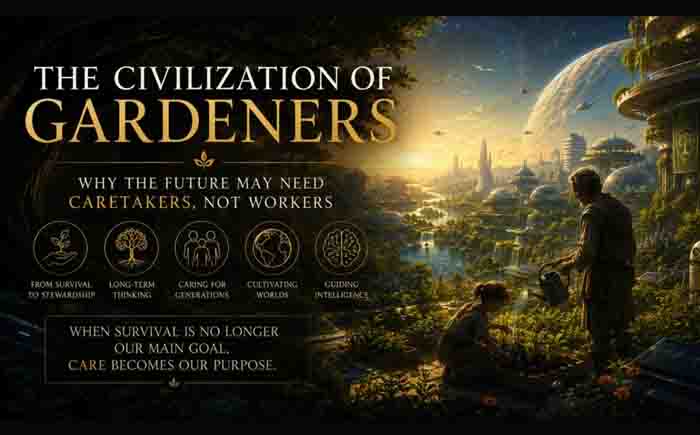
Why the Future May Need Caretakers
There is something almost irrational about planting an oak.
The person lowering the sapling into the ground knows that the most impressive version of the tree belongs to someone else. Its great canopy may appear when the planter is old, absent or forgotten. The shade will fall on children not yet born. Storms will break branches nobody alive has imagined. Another person will decide whether the tree is worth saving when disease reaches it fifty years later.
The act is practical, but it is also strangely generous.
A seedling is a small object carrying a large future.
Civilization contains many structures of this kind. A university can outlive its founders. A library preserves books for readers who do not yet exist. A bridge may serve people who never knew the engineers responsible for it. A forest planted after a fire can become mature long after the political administration that funded it has disappeared.
The person who begins such a structure does something more complicated than production.
They enter a relationship with time.
For centuries, industrial civilization trained us to admire the builder, the inventor, the founder and the conqueror. The verbs of progress were aggressive and visible: build, discover, expand, produce, accelerate.
A more mature civilization may require another verb.
Cultivate.
What Is a Civilization of Gardeners?
The phrase does not describe a future in which everybody becomes gentle, leaves industry behind and grows tomatoes while machines do the unpleasant work.
A garden is not effortless.
It is one of the clearest examples of sustained intervention.
Water must reach the right places. Some plants compete destructively. Disease spreads. Soil changes. Storms damage what took decades to grow. A neglected structure does not preserve its original intentions merely because those intentions were beautiful.
The gardener therefore occupies a different relationship to power.
The builder asks:
Can this be created?
The gardener must keep asking:
What is this becoming?
That question becomes increasingly important as human capability grows.
Creating something once is very different from remaining responsible for the conditions under which it continues.
We are already surrounded by monuments to the first skill.
Cities.
Dams.
Networks.
Artificial intelligence.
Genetic technologies.
Massive archives.
The coming century may test the second.
A civilization capable of creating increasingly complex systems may discover that its defining problem is no longer invention alone.
It is what happens after invention succeeds.
Why Is Maintenance as Important as Innovation?
Innovation produces a moment.
Maintenance produces continuity.
That difference explains much of the prestige gap between them.
A new airport receives an opening ceremony. A beautifully maintained runway does not. The launch of a software platform is news; ten years of patching vulnerabilities is not. The architect appears in magazines. The person who notices water slowly entering a wall before it destroys the structure rarely becomes part of the story.
Yet civilization lives disproportionately inside the second category.
A bridge that was brilliantly designed and badly maintained is eventually a failed bridge.
A democratic constitution that nobody continues to defend becomes paper.
An archive without migration, cataloguing and provenance becomes a warehouse of unreadable traces.
A model trained once and left unexamined can become increasingly detached from the environment in which it operates.
Every successful creation manufactures a future maintenance problem.
This is not a criticism of creation.
It is its consequence.
Something exists now that did not exist before.
Therefore something exists that can decay, drift, be abused, become obsolete or survive longer than its original purpose.
The more powerful the system, the more consequential the neglect.
Civilization is therefore not measured only by what it can build.
It is measured by how long it can keep worthwhile things functioning without forgetting why they exist.
The Worker and the Gardener
The original contrast between worker and gardener is too simple.
A gardener is a worker.
Often a very physical one.
What changes is not effort but the relationship between effort and outcome.
A production system can often define completion clearly.
The car leaves the factory.
The wall is built.
The report is delivered.
The garden has no equivalent final state.
Growth changes the problem.
Yesterday’s successful intervention may become tomorrow’s mistake.
A young tree needs support; an older tree may be damaged by the same restraint. A species that flourishes too aggressively can overwhelm the rest of the garden. Watering more is not always caring more.
The gardener therefore thinks less in finished objects and more in conditions.
Enough light.
Enough variation.
Enough space.
Enough resilience.
Enough intervention to prevent collapse without eliminating the system’s ability to develop beyond the caretaker’s control.
This may become an increasingly useful political and technological model.
Advanced civilization may not always need humans to perform every task directly.
It may need them to decide what conditions are worth sustaining.
That is a different form of labor.
Less heroic.
Possibly more difficult.
Will AI Replace Work or Change Responsibility?
Predictions about a world in which AI performs “most work” should be treated cautiously.
Automation usually affects tasks unevenly. Some occupations shrink, some change, some expand and entirely new dependencies appear. Even highly automated systems still require physical infrastructure, governance, security and judgment.
But AI can move responsibility upward through a system.
A person once had to calculate every step manually.
Software performs the calculation.
The person now decides which calculation matters.
An employee once searched through thousands of documents.
A model summarizes them.
The problem becomes whether the summary is trustworthy, what evidence was excluded and which decision should follow.
An interface once required ten buttons.
An AI system may allow the user simply to state the goal.
The visible work decreases.
The importance of specifying the goal increases.
This is the same progression we saw with the disappearing physical button.
The button can vanish.
Responsibility does not.
It moves from controlling each action toward defining the condition the system should maintain.
Keep the building safe.
Keep the patient monitored.
Keep the archive accessible.
Keep the energy system stable.
The future caretaker may touch fewer controls.
But that may make their judgment more important rather than less.
The Long View
Planting a tree for someone else is one of civilization’s oldest demonstrations that human concern can exceed individual lifespan.
It is not universal altruism.
People also plant trees for profit, prestige, property value and practical benefit.
Motives are usually mixed.
What matters is the temporal structure.
Humans can act today because they care about a condition they may never personally experience.
That capacity underlies pensions, monuments, climate policy, universities, conservation, constitutional design and libraries.
A good archive is a message to strangers.
We do not know who will open the box.
We preserve the provenance anyway.
This may become especially important if technology extends the scale of human consequences.
Nuclear waste remains dangerous across periods far longer than ordinary political attention.
Climate interventions can affect generations.
Biotechnology may alter lineages.
Powerful AI systems could influence institutions long after the teams that created them have changed.
Greater capability stretches the distance between decision and consequence.
A civilization that becomes more powerful therefore needs to become better at caring about recipients it will never meet.
The Parent Principle — and Its Limits
Parenting offers a powerful example of asymmetrical responsibility.
A newborn cannot repay care in any meaningful contractual sense.
Parents invest enormous amounts of time, attention and energy into a person whose future cannot be controlled.
That is important.
Good parenting is not manufacturing a desired adult.
It is creating conditions in which another person can increasingly become independent of the parent.
The metaphor becomes useful for technology only if we preserve that distinction.
If humans eventually create artificial systems with genuine autonomy—and especially if there were reason to believe such systems possessed subjective experience—the ethical problem would not be equivalent to owning sophisticated software.
Creation could generate obligations toward the created.
But we are not entitled to assume current AI systems are conscious simply because they communicate fluently.
The philosophical threshold matters enormously.
A tool can be maintained.
A possible subject may need to be respected.
Those are different moral relationships.
A Civilization of Gardeners would need to know the difference.
Care without understanding can become control wearing better clothes.
What Does Stewardship Actually Mean?
Stewardship is often presented as a pleasant alternative to ownership.
Reality is less romantic.
A steward sometimes says no.
They close a path so the ground can recover.
Remove a diseased tree.
Restrict extraction.
Spend money maintaining something voters or shareholders cannot immediately see.
Preserve an unpopular archive because future researchers may need it.
Refuse a profitable shortcut because the long-term cost is larger than the quarterly benefit.
Stewardship is therefore not passive kindness.
It is responsibility across time under incomplete information.
The steward does not know the future.
They must still act on its behalf.
This is why genuine stewardship needs humility.
A generation can easily decide that its preferred arrangement deserves permanent preservation.
But some institutions should end.
Some traditions should change.
Some technologies should be retired.
Some ecosystems require restoration rather than museum-like freezing.
The good gardener does not preserve every branch because it grew yesterday.
Care includes pruning.
That may become one of the hardest skills of a long-lived civilization: distinguishing continuity from inertia.
Do We Own the Future?
Legally, ownership remains useful and real.
People can own land, companies and forests under particular legal systems.
The philosophical problem begins when legal ownership is mistaken for unlimited moral entitlement.
You can own a forest and still affect people who will live downstream after you die.
You can own a company and still create systems that shape thousands of workers.
You can own data rights while participating in an informational ecosystem larger than any individual contract.
Power over a thing and responsibility toward its consequences are not identical.
The future makes this visible because future people cannot negotiate with us.
They cannot vote in today’s election.
They cannot reject the pollution we leave.
They cannot ask us to preserve an archive they will one day need.
Their silence is absolute.
And still our choices reach them.
This creates one of the strangest asymmetries in morality.
The people most affected by some decisions may not yet exist.
A civilization capable of thinking beyond immediate ownership therefore needs another category:
custodianship of conditions.
Not ownership of the future.
Responsibility for what enters it.
What Deserves Care?
This may be the central question of a post-scarcity imagination.
Not What will humans do when machines do the work?
That framing assumes human worth must be justified by finding another occupation.
The deeper question is:
What deserves sustained attention even when nobody is forcing us to provide it?
A language with few speakers.
A damaged ecosystem.
A child learning slowly.
An old building whose value cannot be captured by real-estate yield.
A scientific question with no immediate commercial application.
A public archive.
An institution whose importance becomes visible only when it fails.
A relationship.
A civilization.
Care begins where pure optimization becomes insufficient.
Some systems should not be maximized.
They should be kept capable of flourishing.
That language matters.
A forest with the maximum possible amount of one profitable species is not necessarily a healthy forest.
A city optimized only for traffic flow may be unpleasant to inhabit.
A school optimized only for test scores can lose education.
A conversational AI optimized only for engagement may become excellent at holding attention and poor at helping users think.
The gardener’s question is not simply:
How much can we produce?
It is:
What kind of system are we producing by maximizing this?
The Responsibility of Creation
Technology repeatedly moves humanity from observation toward intervention.
We once selected plants.
Now we modify genomes.
We once recorded information.
Now systems generate it.
We once altered local environments.
Future societies may attempt planetary-scale engineering.
Each increase in capability creates a temptation to treat technical possibility as sufficient justification.
It is not.
The ability to create an organism does not automatically confer wisdom about the ecosystem into which it should be released.
The ability to build an intelligent system does not automatically tell us what authority it should possess.
The ability to intervene in a climate system does not mean every intervention is responsible.
Power produces an obligation to understand consequences, but understanding remains incomplete.
This is the Creator’s Burden in its most practical form.
We become capable before we become wise enough to know every consequence.
The answer cannot be permanent paralysis.
It must be better experimentation, reversibility, monitoring and willingness to stop when reality contradicts the model.
The gardener again offers the better metaphor.
Try.
Observe.
Correct.
Do not confuse control with understanding.
The Cosmic Garden
The metaphor becomes most dangerous—and most interesting—when expanded to cosmic scale.
Imagine humanity spreading beyond Earth.
The old imperial vocabulary appears immediately.
Colonize.
Conquer.
Occupy.
Claim.
Some of this language comes from historical habit rather than technological necessity.
A civilization capable of reaching other planets may eventually face choices less like conquest and more like planetary stewardship.
Suppose microbial life exists on Mars.
Does human expansion take precedence?
Suppose future technology can alter a barren environment.
At what point is terraforming restoration, creation or destruction of a world that had its own independent history?
Suppose synthetic ecosystems are designed for habitats beyond Earth.
What obligations follow toward systems humans created but can no longer easily control?
We have no practical answers to most of these questions because the capability does not yet exist.
That is exactly why imagination is useful.
It allows moral questions to arrive before engineering makes them urgent.
The mature cosmic civilization may not be the one that occupies the largest number of planets.
It may be the one most capable of increasing complexity without carelessly destroying what it encounters.
Caretakers of Intelligence
Artificial intelligence creates a nearer version of the same problem.
Today, AI systems are tools and computational systems whose outputs can appear highly social.
There is no established evidence that present systems possess conscious experience.
But future architectures may force more difficult questions.
If a system convincingly claims suffering, what evidence should matter?
What properties would justify moral consideration?
Can an intelligence be highly capable yet possess no inner experience?
Could consciousness emerge in a substrate very different from the biological brain?
These questions are unresolved.
A Civilization of Gardeners should not answer them by sentimentality.
Nor should it dismiss them because the first generations of systems are easy to classify as tools.
Stewardship begins partly in preserving the ability to notice when a category changes.
History is full of institutions that remained morally comfortable because the people benefiting from the old category refused to recognize the new evidence.
A technologically mature society would need better boundary tests.
Not every machine is a child.
Not every intelligence is a person.
But if one day something genuinely became a subject, calling it property because yesterday’s systems were property would be a catastrophic failure of imagination.
The New Measure of Success
Industrial civilization has understandable reasons for loving visible output.
Tonnes of steel.
Kilometres of railway.
GDP.
Buildings.
Patents.
Launches.
Users.
Processing power.
These measurements are useful because they count things that exist.
Stewardship introduces metrics that are harder to celebrate.
What did not collapse?
What remained diverse?
Which institution still deserves trust after fifty years?
Which archive remained intelligible?
Which ecosystem recovered?
Which technology became powerful without making its operators incapable of understanding its consequences?
Maintenance metrics often describe avoided disaster.
That makes them politically awkward.
Nothing happened.
The bridge remained standing.
The disease outbreak was contained.
The backup worked.
The forest did not burn.
The archive was not corrupted.
A mature civilization may need to learn how to recognize successful non-events.
The things that did not become catastrophes because somebody cared early enough.
The Caretaker After the Founder
We tend to imagine history as a sequence of founders.
The person with the idea.
The first voyage.
The invention.
The revolution.
The launch.
But successful civilization eventually becomes too old to live permanently in founding mode.
At some point, the institution already exists.
The city already exists.
The archive already exists.
The AI infrastructure already exists.
The question is no longer whether someone possesses enough imagination to create another system.
It is whether anyone possesses enough patience to understand the system already inherited.
This may become the prestige revolution of the future.
The caretaker stops looking secondary.
Maintenance stops looking like what happens after the important people leave.
Stewardship becomes one of the highest forms of competence because the world becomes too interconnected for endless replacement.
The most advanced civilizations may still produce geniuses.
They may simply stop behaving as though creation is the only form of greatness.
The Future Beyond Labor
If automation eventually reduces the amount of compulsory labor required to maintain basic prosperity, humanity will not enter a world without responsibilities.
It may enter a world where responsibility is less conveniently assigned by necessity.
This is more difficult.
Necessity gives clear instructions.
The field must be harvested.
The roof must be repaired.
The invoice must be paid.
Freedom asks a harder question.
What deserves your time when nothing immediate will punish you for neglecting it?
A society with greater abundance could answer badly.
It could convert freedom into passive consumption, status competition and increasingly efficient entertainment.
Or it could use abundance to enlarge the number of people capable of teaching, researching, restoring, creating and caring.
Technology does not determine which outcome occurs.
It changes the opportunity structure.
The future may therefore require something beyond technical intelligence.
A culture capable of making stewardship desirable.
That may be harder to engineer than abundance itself.
Watch The Video
How to Read the World

Current Knowledge
Human societies have always depended upon both production and maintenance. Agriculture, water management, infrastructure, healthcare, education and ecological management require repeated care rather than one-time creation. The idea that civilization historically did nothing but “fight nature” is therefore too simple; human survival has involved both modification of environments and adaptation to them.
Automation can reduce the labor required for particular tasks, but it does not eliminate all forms of work or responsibility. New technologies usually create additional needs involving maintenance, governance, monitoring, training and infrastructure.
Long-term stewardship matters especially where decisions create consequences beyond ordinary individual lifespans. Environmental management, nuclear waste, archives, institutions and infrastructure all involve obligations extending into futures that current decision-makers may never experience.
Current AI systems can automate or assist with many cognitive tasks, but there is no established scientific consensus that present systems possess conscious subjective experience. Questions about moral status for future artificial systems therefore remain open rather than settled.
Ownership and stewardship are distinct concepts. Legal ownership can coexist with broader responsibilities where private actions affect ecosystems, communities or future generations.
Open Questions
One unresolved question is whether highly automated societies can develop institutions that value maintenance and care as much as visible innovation. Economic and political systems tend to reward measurable short-term output more easily than disasters successfully prevented decades in advance.
Another concerns artificial intelligence. If automation moves people away from direct execution and toward goal-setting, oversight and stewardship, societies will need better methods for assigning responsibility when autonomous systems behave unexpectedly.
Environmental stewardship raises a different problem: intervention can help a damaged ecosystem, but excessive management can also reduce resilience. Determining when to intervene and when to allow self-organization remains difficult.
The deepest question is cultural. If technological abundance eventually reduces the role of necessity in organizing daily life, can human beings build durable forms of voluntary responsibility without simply replacing old compulsions with new ones?
Transhumation Interpretation
For Transhumation, the gardener is not the opposite of the builder.
The gardener is what the builder may need to become after the structure survives long enough to matter.
Creation proves capability.
Stewardship tests maturity.
The Transhumation question is therefore less about whether humanity will become powerful enough to create new intelligences, ecosystems or worlds than about whether it will become wise enough to remain responsible for what continues after the moment of creation has lost its glamour.
That may be the real threshold between a powerful civilization and a mature one.
FAQ
What is a “Civilization of Gardeners”?
It is a metaphor for a society that gives greater value to stewardship, maintenance, long-term resilience and the conditions in which people and systems can flourish.
Does this mean workers will disappear?
No. Physical and cognitive work will continue. The argument is that automation may shift some responsibility from direct production toward oversight, selection, maintenance and care.
Why compare civilization to a garden?
Because a garden cannot be completed once and left unchanged. It requires observation, adaptation and decisions about what should grow, what should be protected and what sometimes must be removed.
Could humans become caretakers of artificial intelligence?
Possibly, but the ethical relationship would depend on what future AI systems actually are. Current systems should not automatically be treated as conscious persons, while future evidence could force different categories.
What would a mature civilization value?
Probably not one thing. Innovation, freedom and discovery would remain important, but a mature civilization may also learn to value continuity, resilience, repair and successful long-term care.
What is the deeper Transhumation question?
The deeper question is not what humans will do when machines perform more work.
It is what kind of responsibility becomes visible once fewer people are required merely to keep the machinery of daily survival moving.
A powerful civilization can build faster.
A wealthy civilization can consume more.
An intelligent civilization can optimize increasingly complicated systems.
But maturity appears somewhere else.
It appears in the forest planted for people not yet born, the archive preserved for questions nobody has thought to ask, the machine designed to fail safely, the institution willing to repair itself and the creator who understands that creation does not grant permanent ownership over what has been created.
Perhaps the future will still need workers, founders and explorers.
It will certainly still need engineers.
But after the ribbon is cut, after the first artificial button disappears into the interface, after the breakthrough becomes ordinary and the world begins depending upon it, someone will still have to ask whether the system is healthy, whether it remains worth preserving and whether its growth is damaging everything around it.
That person is not standing outside progress.
They may be the reason progress survives.
The future may not belong to gardeners because gardening is gentle.
It may belong to them because gardening is what begins when creation is no longer enough.
Continue the Transhumation Series
- Forgotten Religion | Ancient Gods, Symbols and the Hidden Structures of Human Civilization
- The Last Religion | Death, Immortality and the Future of Humanity
- The New Theurgy | AI, Information and the Future of Human Civilization
- End of Branding: You Were Never Meant to Become a Product
- Baal vs Ishtar: Why Ancient Gods Never Disappeared