
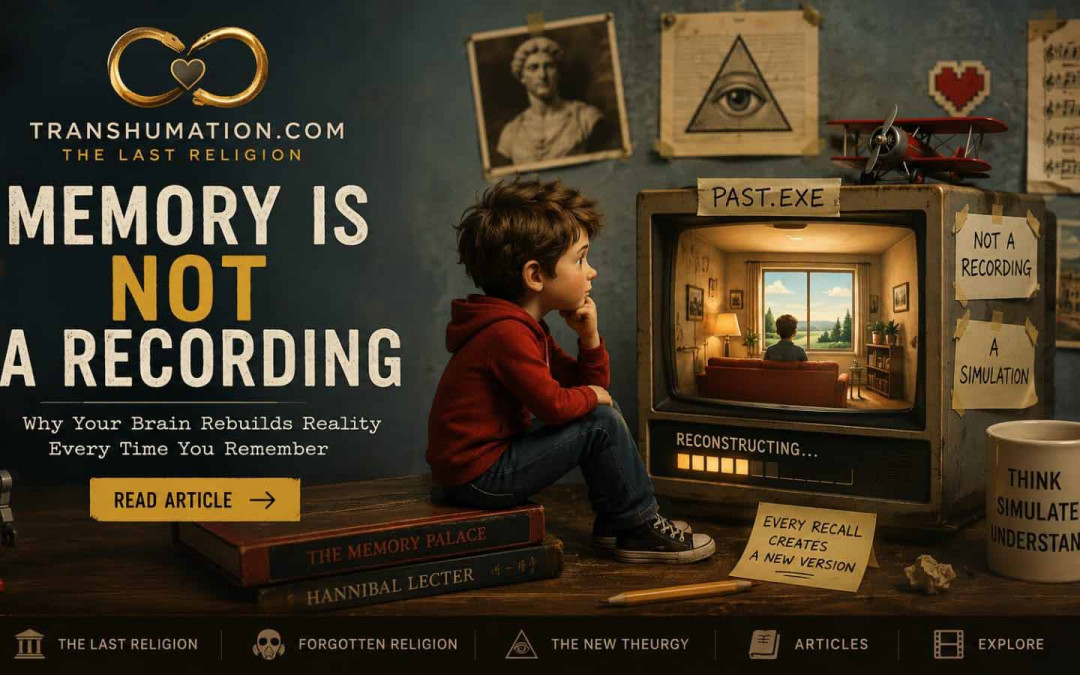
There is No Play Button
There is probably a room from your childhood that you can still enter without moving. Perhaps you remember the position of the bed, the pattern on the wallpaper, the view through the window, or the peculiar geography of objects that mattered enormously when you were eight and became worthless a decade later. If someone asked you to close your eyes, you might even be able to walk through it. Turn left at the door. The wardrobe is there. The window is opposite. A particular toy should be somewhere on the floor. For a few seconds, a room that may no longer exist is available again.
It feels as though you have retrieved something. This is why the most natural metaphor for memory is an archive: experience happens, the brain records it, and years later consciousness presses play. We speak this way constantly. We “store” memories, “retrieve” them, “search” our memory, and sometimes complain that our mental files have become corrupted. Computers have made the metaphor so intuitive that it is difficult to imagine an alternative.
The trouble is that human memory does not behave much like a recording. Details disappear, migrate and acquire new meanings. Two people can remember the same dinner differently without either consciously lying. A story repeated within a family can slowly become indistinguishable from one’s own recollection. Something learned years after an event can find its way backward into what appears to be a memory of the event itself. The room you entered a moment ago may therefore be less like an old photograph taken from storage than a film set rebuilt each time you return.
And that distinction changes much more than our understanding of the past.
The Room That Changes When You Enter It
Experimental psychology has spent more than a century demonstrating that memory is selective and reconstructive. We preserve some elements of experience and lose others; later knowledge can influence recollection, suggestion can alter reports, and eyewitness confidence does not guarantee eyewitness accuracy. The important point is not simply that memory sometimes fails. A damaged video recording is a failed recording. Human memory appears to work differently at a more fundamental level: remembering requires reconstruction.
Think again about the childhood room. The brain does not need to keep a miniature room hidden somewhere inside the skull. Information associated with its spatial arrangement, objects, emotions, people and significance can be distributed across systems involved in perception and memory. Recollection brings relevant elements back into a temporary relationship. The result can feel extraordinarily complete even when parts of it have been inferred, simplified or supplied by later experience.
This explains one of memory’s strangest properties: recollection can change what is subsequently remembered. Memories can become labile when reactivated and, under some circumstances, undergo reconsolidation. Remembering is therefore not always the innocent inspection of an untouched original. Opening the box can alter what will be inside the box the next time.
That sounds like an appalling design for an archive. It begins to look considerably more intelligent when we stop assuming that evolution was trying to build an archive.
The Animal That Needed Tomorrow
Imagine an early human hearing movement in grass at dusk. An exact recording of every previous encounter with grass would be impressive but cumbersome. What matters now is whether the sound predicts danger. Wind has a pattern. An animal has another. A predator may require immediate action. Past experience is valuable because it can be recombined with present evidence to anticipate what happens next.
This is one reason contemporary cognitive science increasingly connects memory with prediction and imagination. The brain is not simply preserving a museum of completed moments. Remembering past events, imagining possible futures and navigating hypothetical situations rely on substantially overlapping neural machinery. Damage to memory systems can impair not only recollection but also the ability to construct rich imagined scenes.
The apparent weakness of memory now begins to reveal its advantage. A perfectly fixed recording gives you yesterday exactly as yesterday occurred. A reconstructive system can take pieces of yesterday and ask what they imply about tomorrow. It can separate useful regularities from irrelevant details, combine experiences that never occurred together, rehearse dangers that have not yet happened and imagine rewards that do not yet exist.
A recording preserves a world.
A reconstructive memory helps an organism survive a world that keeps changing.
This also explains why remembering and imagining can feel uncannily similar. When you picture next summer, you cannot retrieve next summer from storage; it has never happened. You construct it from places you know, people you remember, expectations, fragments of previous summers and knowledge about how the world behaves. The future is assembled from pieces of the past.
Memory, viewed this way, is not primarily nostalgia. It is raw material for possibility.

Hannibal Lecter’s Palace
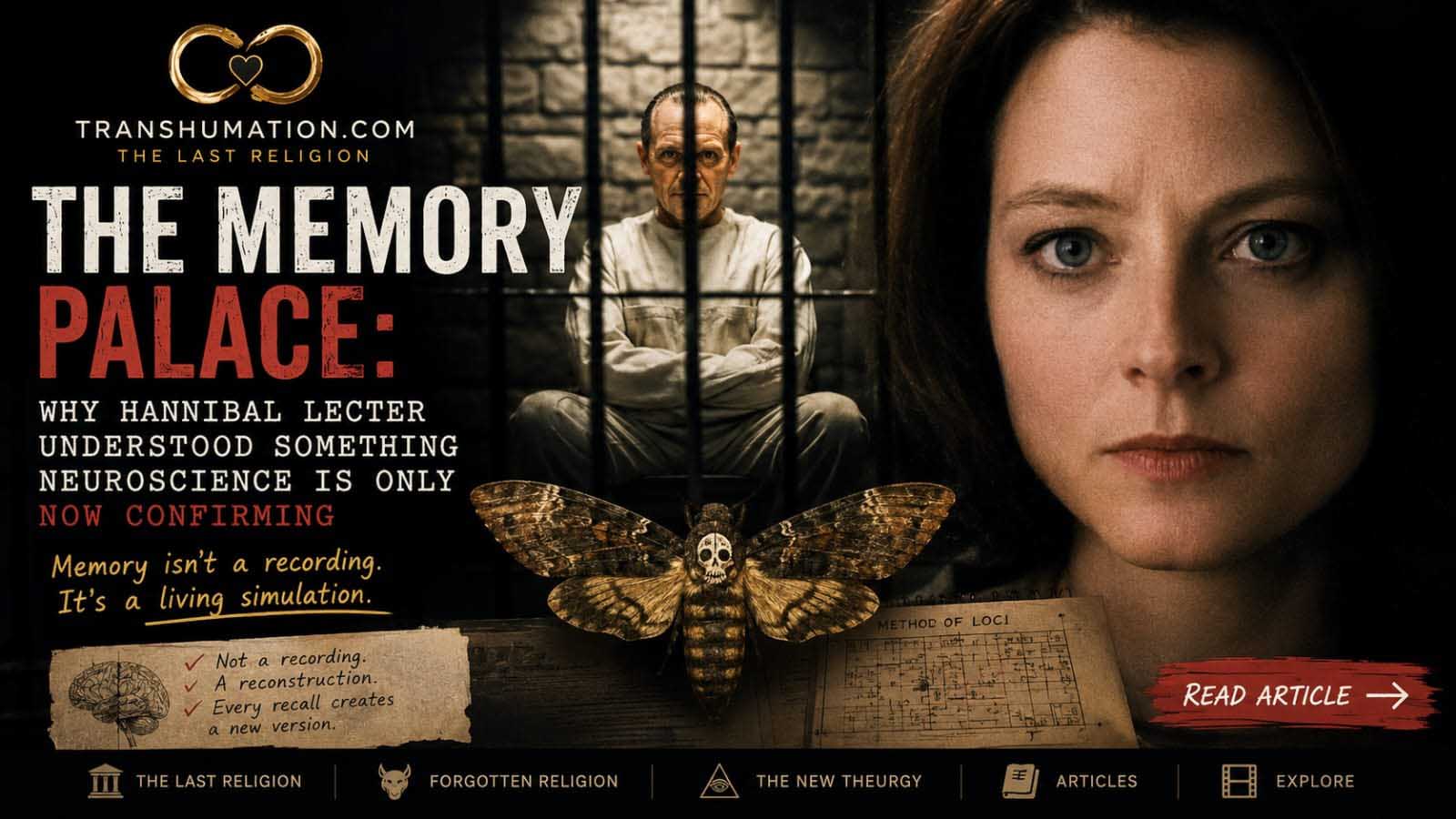
Thomas Harris gave this idea an unusually elegant fictional form. His Hannibal Lecter can be physically confined while remaining mentally difficult to imprison. In Hannibal, the memory palace becomes an elaborate internal architecture through which Lecter can move, arranging knowledge spatially and returning to rooms unavailable in the external world. Harris was drawing on a real and very old mnemonic tradition—the method of loci, associated with classical rhetoric—in which information is attached to imagined locations and recovered by mentally travelling through them.
The fascinating part is not Lecter’s superhuman precision. It is the ordinary cognitive ability exaggerated beneath it.
Close your eyes and imagine the kitchen of a house you know well. Move from the refrigerator to the sink. Open a cupboard. Now replace the table with a piano. Nothing physically happened, yet a navigable scene appeared, and then you edited it. The brain can retrieve features of a familiar environment while simultaneously introducing something that was never there.
That is an astonishing piece of machinery to carry around unnoticed.
The memory palace therefore sits somewhere between recollection and invention. It works precisely because human memory is capable of binding information to internally constructed space. Lecter’s palace is theatrical, but the principle underneath it is mundane. We all possess some ability to enter places that are not currently around us, populate them with absent people, hear conversations that have ended and test events that have never occurred.
Virtual reality did not invent virtual worlds.
It externalized something brains had been doing for a very long time.
The Page Outside the Skull
There is another small trick that reveals the same architecture. Try solving a complicated problem entirely in your head, then write it down. The intelligence involved has not suddenly changed, yet the problem often becomes easier. Contradictions become visible. A vague intuition develops edges. One sentence produces another that had not been consciously available before the first was written.
The page has joined the cognitive system.
Writing is obviously not literally part of the biological brain, but it can function as an external support for memory and reasoning. A notebook preserves intermediate steps that working memory would otherwise need to maintain. A diagram turns relationships into visible space. A library allows one human lifetime to consult thoughts produced across thousands of other lifetimes. Computers expanded this arrangement dramatically, and artificial intelligence introduces another variation: an interface capable not merely of storing information but of helping reorganize, compare and navigate it.
This matters because it complicates the intuitive boundary between memory and intelligence. Human cognition has never operated only through neurons. We remember with photographs, calendars, monuments, stories, books and other people. Civilization itself can be understood, in part, as the progressive construction of external memory.
The individual brain reconstructs experience.
Civilization reconstructs itself from archives.
Neither process is perfectly faithful.
The World You Never Receive Directly
At this point the argument becomes more uncomfortable. If memory is constructed, perhaps memory is not the exceptional case.
Perception itself is not a tiny cinema in which consciousness watches an untouched copy of external reality. Sensory signals must be selected, integrated and interpreted by a nervous system. Expectations and prior knowledge can affect what we notice and how ambiguous stimuli are understood. The external world constrains perception enormously—we cannot simply imagine a wall away and walk through it—but our conscious experience is nevertheless a model generated through an interaction between incoming signals and the brain interpreting them.
The distinction matters. Saying that experience is constructed does not mean that reality is imaginary. A map is constructed, but the mountain it describes can still kill the cartographer. A model can be internally produced while remaining answerable to something outside itself.
The stranger possibility is that consciousness spends its entire life inside this relationship. We remember a constructed past, anticipate a constructed future and encounter the present through a continuously updated model. Reality pushes back against that model, correcting it whenever our predictions fail.
The mind is therefore neither a passive camera nor a private fantasy machine.
It is closer to an unfinished simulation constantly negotiating with the world.
When Memory Becomes a Future Machine
Artificial intelligence makes the old distinction newly interesting. We often compare human memory with computer storage because computers provide the dominant metaphor of our age. Yet conventional storage is almost the opposite of what makes biological memory remarkable. A hard drive is valuable because a file retrieved tomorrow can remain identical to the file written today. Human recollection is valuable partly because remembered material can be generalized, connected, compressed and recruited for circumstances that have never occurred before.
Current AI systems should not be casually equated with human brains. Their architectures, learning processes and relationship to experience differ profoundly, and there is no established evidence that present language models possess human-like autobiographical consciousness. Still, the comparison points toward an important direction. Intelligence may depend less on possessing an enormous warehouse of facts than on maintaining models that can be revised when the world contradicts them.
An intelligent system needs history, but history alone is insufficient. It needs the capacity to ask what history permits it to expect next.
That brings us back to the childhood room. Perhaps you never stored the room in the way you imagined. Perhaps what survived was enough structure to make the room possible again: spatial relationships, emotional significance, fragments of color and texture, knowledge accumulated afterward. Each visit is partly archaeology and partly construction.
And yet you recognize it.
Somewhere between perfect preservation and complete invention, continuity survives.
That may be the real mystery of memory.
Watch The Video
How to Read the World
Current Knowledge
Research in cognitive psychology and neuroscience strongly supports the view that episodic memory is reconstructive rather than a literal recording of experience. Memory can be altered by forgetting, suggestion, later information and the conditions under which an event is recalled. Research on reconsolidation also indicates that reactivated memories can, under some conditions, become susceptible to modification before being stabilized again.
The hippocampus and connected brain networks are important for episodic memory and for constructing imagined scenes and possible future events. Neuroimaging and neuropsychological research has found substantial overlap between remembering past experiences and imagining future ones, although the two processes are not identical.
The method of loci, commonly called a memory palace, is a genuine mnemonic technique with roots in classical antiquity. It exploits spatial organization and imagery to improve recall.
Writing and other external representations can also reduce demands on working memory and support reasoning. Researchers sometimes discuss such practices in terms of cognitive offloading: information or intermediate operations are transferred to an external medium so that they do not have to be maintained entirely internally.
None of these findings demonstrates that reality itself is a simulation. The claim concerns how nervous systems represent and interpret reality, not whether an external physical world exists.
Open Questions
Neuroscience still lacks a complete account of how distributed neural activity produces the subjective experience of remembering. Researchers can study encoding, retrieval, hippocampal function and changes in memory, but why a reconstructed event is experienced as my past remains connected to the broader unresolved problem of consciousness.
It is also unclear how far the simulation metaphor should be taken. Brains clearly use prediction, but competing theories disagree about how fundamental predictive processing is to cognition and perception.
AI introduces another unresolved boundary. Machines can already store information, generate counterfactual scenarios and use previous information to make predictions. Whether systems with increasingly sophisticated internal models would possess anything resembling autobiographical memory—or merely reproduce some of its functions without experience—remains unknown.
Transhumation Interpretation
The interesting part of memory may not be that information changes. It may be that identity survives despite the change.
The atoms of the childhood room may be gone. The child who experienced it has changed biologically and psychologically. The memory itself has been reconstructed countless times. Some details have disappeared; others may have entered later. Yet a recognizable structure continues moving across carriers and across time.
This is where memory becomes part of a larger Transhumation question. Civilization behaves similarly. A Greek myth copied by a medieval scribe, translated into another language, printed in a nineteenth-century book, scanned into a database and discussed with an AI has changed its physical carrier repeatedly. No original molecule needs to survive. What matters is whether enough of the structure survives to be recognized and reconstructed by another observer.
A library therefore exists not merely to store books. It exists for readers. Without an interpreting mind, the archive is dormant. The reader reconstructs relationships between fragments, just as memory reconstructs an experience from traces. AI can become another kind of librarian in this architecture—not a replacement for the library or the reader, but an interface capable of helping navigate a quantity of inherited information no individual could inspect alone.
This also places a limit on the fashionable comparison between brains and computers. Perhaps we have been asking whether the brain stores enough information to reproduce a person when the deeper question concerns structure: what must survive for the observer to remain recognizably the same observer?
Memory offers no proof that consciousness can survive a change of biological carrier. Reconstructing information is not the same as transferring subjective experience. But memory does demonstrate something smaller and stranger: human continuity has never required perfect material continuity or perfect informational preservation.
We are already reconstructed creatures.
Every morning, the past is rebuilt sufficiently well for us to recognize ourselves inside it.
Perhaps memory is not the archive of the self.
Perhaps it is one of the processes by which the self continually returns.
FAQ
Is memory really reconstructed every time we remember?
Episodic recollection is reconstructive rather than a literal replay. The brain rebuilds an event from stored information, and recollection can sometimes modify subsequent memory.
Does that mean our memories are false?
No. Reconstructive does not mean fictional. Memories can accurately preserve important aspects of events while losing or altering other details.
Why would evolution favor imperfect memory?
One possibility is that flexible memory is useful because past experience can be generalized and recombined to anticipate new situations rather than merely preserved as an exact archive.
Are memory and imagination connected?
Yes. Remembering past events and constructing possible future events recruit substantially overlapping neural systems.
Is Hannibal Lecter’s memory palace based on something real?
Yes. The method of loci is an ancient mnemonic technique that associates information with imagined spatial locations, although Lecter’s abilities are fictionalized.
Does the brain create reality?
The brain constructs our conscious representation of reality from sensory information, prior knowledge and expectations. That does not imply that the external world itself is imaginary.
Does AI remember like a human being?
Not in the ordinary human sense. Current AI systems process and retain information through mechanisms very different from autobiographical human memory, and there is no established evidence that they subjectively experience recollection.
How does this connect to Transhumation?
Memory provides a concrete example of a recurring Transhumation problem: continuity does not require an unchanged carrier. The harder unanswered question is how much of a changing pattern must survive before we can still call it the same person.
Continue the Transhumation Series
- Forgotten Religion | Ancient Gods, Symbols and the Hidden Structures of Human Civilization
- The Last Religion | Death, Immortality and the Future of Humanity
- The New Theurgy | AI, Information and the Future of Human Civilization
- End of Branding: You Were Never Meant to Become a Product
- Baal vs Ishtar: Why Ancient Gods Never Disappeared