
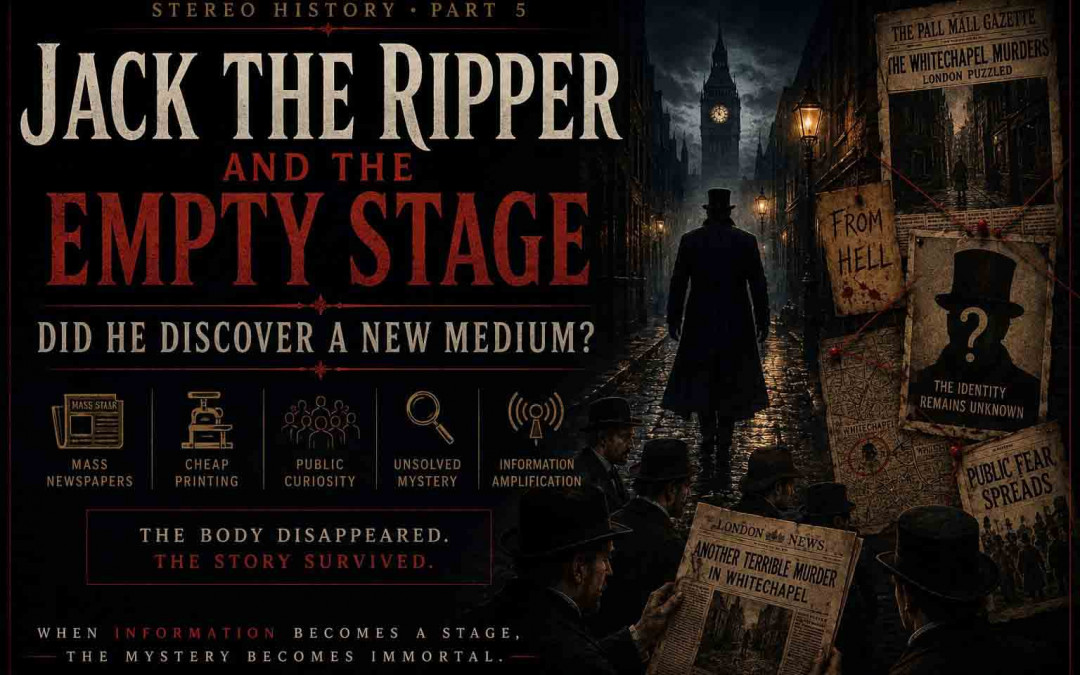
Did Whitechapel Discover a New Medium ?
On 27 September 1888, the Central News Agency received a letter.
It was written in red ink. The author mocked the police, referred casually to killing women and signed himself with a name that would become more durable than almost any real criminal identity of the nineteenth century.
Jack the Ripper.
Whether the murderer wrote the letter remains doubtful. There are good reasons to suspect that he did not. The famous correspondence may have been the work of a hoaxer, journalist, opportunist or someone else entirely. Hundreds of similar letters would follow, many obviously fraudulent. Yet the uncertainty does not diminish the importance of what happened next.
It makes it stranger.
A potentially invented signature attached itself to real murders committed by an unidentified man. Newspapers repeated it. The public recognized it. Police had to deal with it. Copyists imitated it. Later books, films and theories inherited it. The name eventually became so powerful that it almost swallowed the anonymous human being whose actions had made the whole phenomenon possible.
This is usually told as a chapter in criminal history.
It may also belong to the history of media.
Victorian London had not invented murder, fear, rumor or sensational journalism. But by the autumn of 1888, several technologies and social conditions had converged strongly enough to create something historically significant: an unresolved event could circulate through mass communication, accumulate interpretations from thousands of strangers and produce a recognizable public identity even when the original individual remained absent.
The stage existed.
No one needed to understand what kind of stage it was.
Before the Name
London knew spectacular crimes before Whitechapel.
So did Paris.
So did New York.
Executions drew crowds. Murder trials became public dramas. Broadsides transformed violence into popular stories long before the modern newspaper. The nineteenth century had already produced famous criminals whose names circulated far beyond the places where their crimes occurred.
Jack the Ripper was therefore not the first murderer to become media.
That claim would be historically indefensible.
What distinguishes Whitechapel is the peculiar relationship between extreme publicity and extreme absence.
There was no captured suspect around whom the narrative could stabilize. No courtroom placed the accused beneath a fixed biography. No confession closed the interpretive space. No authenticated photograph allowed the public to say: there he is.
Instead, the murders generated an expanding body of information surrounding a missing center.
Reports described wounds.
Witnesses supplied men.
Doctors offered interpretations.
Police investigated suspects.
Journalists entered streets and lodging houses.
Readers proposed theories.
Letters supplied voices.
Illustrators supplied faces.
Rumor supplied motives.
The information increased while knowledge of the central person barely moved.
That imbalance is the beginning of the Empty Stage.
A Character Appears Before the Man
Ordinarily, identity works in one direction.
There is a person.
The person acts.
A reputation gradually forms around those actions.
Whitechapel produced almost the reverse.
A reputation became culturally stable while the person remained historically unstable.
The label Jack the Ripper allowed separate murders, anxieties, rumors and fragments of evidence to be collected beneath one memorable figure. The name compressed uncertainty into a character.
That character became surprisingly legible.
He was mocking.
Clever.
Elusive.
Perhaps medically trained.
Perhaps sexually deranged.
Perhaps foreign.
Perhaps respectable.
Perhaps hiding inside the East End.
Perhaps entering it from outside.
Different newspapers and different observers constructed different Rippers, but the underlying role was already present: an intelligent predator moving invisibly through the modern city.
The actual murderer may have possessed almost none of those characteristics beyond whatever was required to commit the crimes.
That possibility matters.
Because it means one of modern culture’s most recognizable criminal personalities may be partly the product of distributed authorship.
The killer supplied the events.
Other people supplied much of the character.

The Newspaper Does Not Merely Report the Murder
A newspaper appears to come after an event.
Something happens.
Then someone describes it.
That sequence encourages us to imagine media as a transparent secondary layer.
But once enough people begin reacting to the report, the report enters the event itself.
A newspaper describes fear in Whitechapel.
Readers become more afraid.
Fear alters behavior.
The changed behavior becomes another story.
A letter arrives claiming to come from the murderer.
The letter is printed.
Another person imitates it.
Police must spend time investigating the imitation.
That investigation becomes news.
The news generates more letters.
The event begins producing informational consequences that become causes of subsequent events.
At that point, asking where the original story ends becomes difficult.
This is not unique to the Ripper case, but Whitechapel demonstrates the mechanism with unusual clarity.
The murders produced reporting.
Reporting produced participation.
Participation produced new material.
New material produced more reporting.
The information system began feeding itself.
Modern readers recognize this immediately because the same architecture appears in viral events, conspiracy cultures, online scandals and breaking-news cycles. But in 1888 the machinery was comparatively new, physical and visible.
Printing presses.
Telegraph wires.
News agencies.
Street sellers.
Letters.
Crowds.
The network had no screen.
It nevertheless behaved like a network.
The Empty Stage Needs an Audience
A stage is useless without people looking toward it.
Victorian London supplied an enormous audience.
Literacy had risen substantially. Cheap newspapers competed aggressively. Urban populations created dense markets for information, while new communications technologies allowed stories to move faster than the bodies involved in them.
This did not create public curiosity.
It scaled it.
A murder in one district could become a subject of discussion across the city before most readers had any direct knowledge of the place. Whitechapel itself became partly geographical and partly imagined: a real district of labor, poverty, lodging houses, markets and ordinary life transformed in mass culture into a symbolic landscape of danger.
The murders therefore arrived inside a society already equipped to turn incomplete information into collective experience.
The stage contained several roles.
There was the killer.
The victim.
The detective.
The witness.
The doctor.
The reporter.
The suspicious stranger.
The terrified citizen.
And increasingly, the reader.
The reader was no longer entirely passive because newspapers solicited attention and participation. Members of the public wrote letters, reported suspicious people, invented theories and in some cases pretended to be the murderer.
This is where the metaphor becomes especially useful.
The role of Jack the Ripper was so powerful that people who clearly were not the killer wanted to step into it.
The stage began producing understudies.
The Voice That May Belong to Nobody
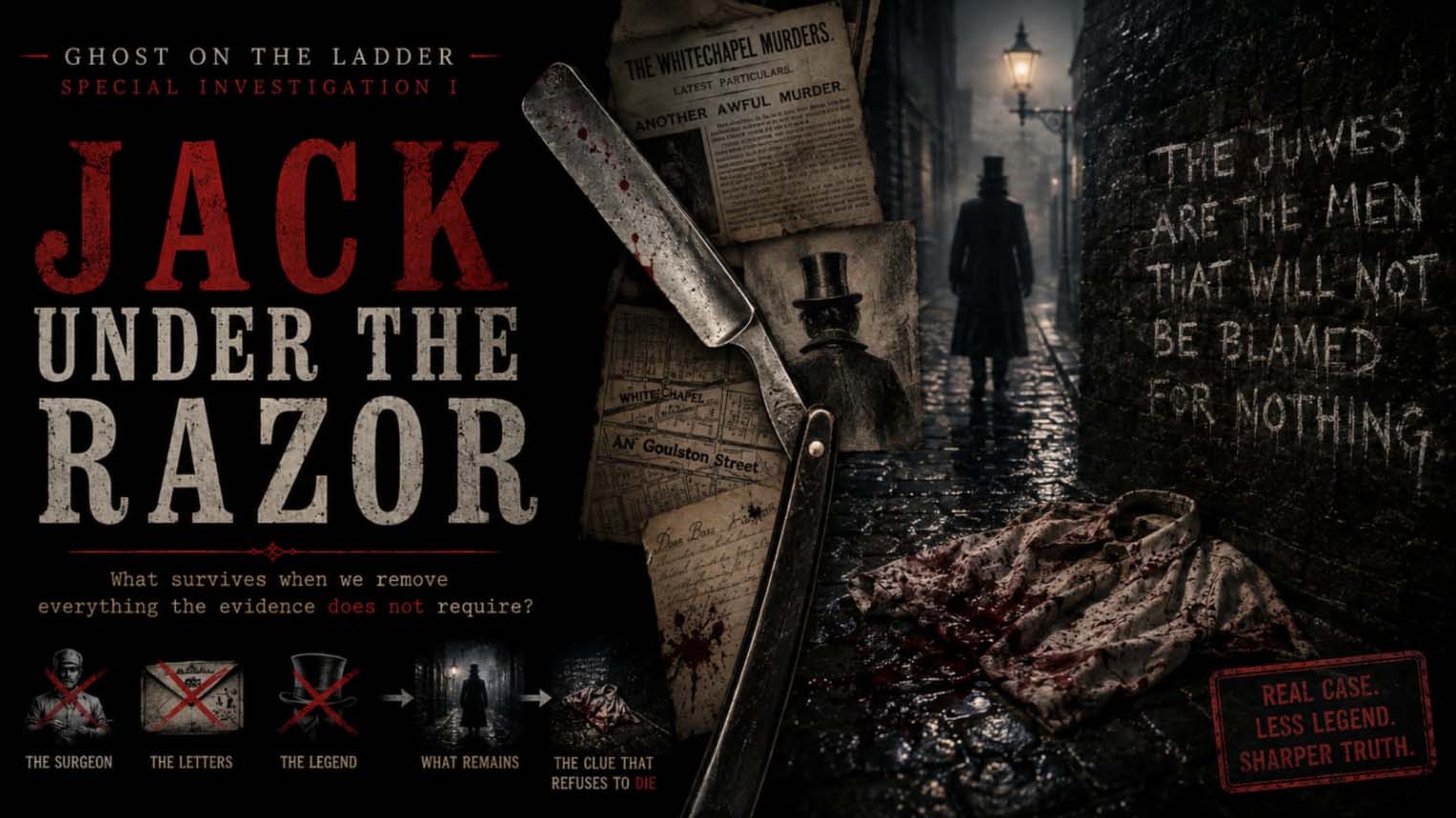
The famous Ripper letters create one of the strangest problems in the entire case.
A reader encounters the phrases attributed to “Jack” and quickly begins hearing a personality.
The jokes.
The taunts.
The theatrical spelling.
The apparent pleasure in performance.
Once the voice has been imagined, it becomes difficult to remove.
But historically we may be listening to the wrong man.
If “Dear Boss” was a journalistic invention or hoax, then the persona that modern culture associates with the Ripper was partially constructed by someone standing outside the murders.
This possibility is far more interesting than treating every famous line as evidence of the killer’s psychology.
It means the medium did not simply transmit a personality.
It may have manufactured one.
The distinction has enormous relevance today. Digital culture routinely encourages people to infer stable personalities from fragments of text whose authorship, context or authenticity may be uncertain. A few posts become a character. A screenshot becomes motive. A voice generated from sparse evidence becomes more psychologically convincing than the evidence itself.
Whitechapel gives us an early laboratory for the problem.
A voice appears.
The archive remembers it.
The author remains uncertain.
And eventually the voice can feel more real than the missing person.
Mystery Is an Engine, Not an Absence
Unsolved stories are often described as incomplete.
That is true from the perspective of investigation.
From the perspective of cultural survival, incompleteness can become productive.
A solved murder gradually closes possibilities. The suspect becomes one person with one biography, one history and one set of limitations. Some questions remain, but the interpretive field contracts.
Jack the Ripper never underwent that contraction.
Every missing fact preserved alternatives.
A surgeon remained possible because no definitive profession eliminated him.
A butcher remained possible.
A sailor.
A clerk.
A local resident.
A foreigner.
A gentleman.
A military man.
A mentally ill stranger.
A person who appeared nowhere in the surviving suspect lists.
The mystery behaves almost like negative architecture. Its empty spaces provide rooms into which later generations can place new theories.
That is one reason the case remains culturally active.
The archive is large enough to encourage analysis and incomplete enough to prevent final closure.
Too little evidence and the case would disappear.
Too much certainty and the myth would shrink.
Whitechapel occupies the uncomfortable middle.
The Mirror Was Built After the Crimes
Another reason the case survives is that every generation can use it to inspect something larger than murder.
Victorian observers saw poverty, policing, immigration, prostitution, morality, urban disorder and perceived degeneration. Later historians examined journalism, gender, social geography and institutional failure. Popular culture turned the Ripper into horror, detective fiction, conspiracy and gothic London.
The murders did not contain all of those meanings inherently.
Society attached many of them afterward.
This is why the familiar description of Jack the Ripper as a “mirror of Victorian England” needs caution. A mirror suggests passive reflection.
The case was more active than that.
It became a surface onto which Victorian and later cultures projected concerns already circulating through society.
Whitechapel did not create class anxiety.
It concentrated it.
The murderer did not invent fears about foreigners, doctors, sexual violence or the hidden lives of respectable men.
The unresolved identity gave those fears somewhere to gather.
That distinction matters because symbols become dangerous when we mistake everything projected onto them for information about their historical origin.
Jack the Ripper is an unusually powerful symbol.
That does not make every meaning attached to him evidence about the murderer.
The First Viral Ghost?
Calling Jack the Ripper the first viral ghost is irresistible.
It is also historically too strong if taken literally.
Information had spread virally long before 1888. Rumors, religious movements, political pamphlets, songs, scandals and legends could travel with extraordinary speed through earlier communication systems.
But the metaphor identifies something real.
The Ripper persona became capable of reproduction without a stable original.
A newspaper copied the name.
A letter copied the tone.
Another newspaper copied the letter.
An illustrator supplied a face.
A novelist borrowed the atmosphere.
A film inherited the silhouette.
The pattern moved.
The source became progressively less important.
This is the point at which Jack the Ripper becomes relevant to Transhumation without needing to romanticize the murderer.
The culturally durable entity is not necessarily the man.
It is the informational pattern generated around him.
That pattern is real in the sense that it has causal effects. It sells books. Shapes historical imagination. Influences tourism. Produces new research. Encourages hoaxes. Generates films and theories.
Yet it is not identical with the human being who walked through Whitechapel in 1888.
The difference between those two entities is the heart of the article.
History Has Two Channels
Stereo History becomes particularly useful here because the Whitechapel murders exist simultaneously on two historical channels.
The first is physical.
Women were killed.
Bodies were found.
Police officers walked streets.
Doctors conducted examinations.
Witnesses saw or believed they saw people.
Real events occurred in specific places at specific times.
The second channel is informational.
Reports circulated.
Suspects multiplied.
Letters arrived.
Newspapers competed.
Public fear expanded.
The name Jack the Ripper became stable.
Later retellings began reshaping memory of the original events.
Neither channel can be substituted for the other.
Reduce the case to media and the victims disappear into an intellectual game.
Reduce it entirely to the crime scenes and we fail to explain why these particular murders became one of the most durable cultural phenomena of modern history.
The two channels interact.
That is the real story.
A physical crime enters an informational system.
The system transforms the historical afterlife of the crime.
By 1888, civilization had begun to acquire machines capable of giving events an existence far beyond the places where they occurred.
The twentieth century would develop the mechanism enormously through radio, cinema, television, advertising and public relations.
The twenty-first would add social networks and algorithmic amplification.
Whitechapel did not invent that world.
But it lets us see an early version of the machinery operating while the machinery was still exposed.
Watch The Video
How to Read the World
Current Knowledge
The Whitechapel murders of 1888 occurred during a period of expanding mass journalism, high urban literacy and intense competition among newspapers. Sensational crime reporting existed long before the Ripper case, but the murders became an unusually large media event.
The identity of the murderer remains unproven. Because no confirmed individual was arrested and convicted, the public image of “Jack the Ripper” developed without a secure biography or authenticated physical appearance.
The name became famous through correspondence claiming to come from the murderer, particularly the “Dear Boss” letter. The authenticity of that letter remains doubtful, while many other Ripper letters were clearly hoaxes or are considered highly unreliable.
Victorian newspapers did not merely reproduce established facts. Different publications used varying degrees of sensationalism, speculation and political framing, while members of the public actively participated through letters, tips, rumor and imitation.
The media phenomenon surrounding Whitechapel therefore cannot be treated as a transparent record of the murderer himself. The historical criminal and the cultural persona known as Jack the Ripper must be kept analytically separate.
Open Questions
One major question is how deliberately the actual murderer interacted with public attention. Did he read the newspapers? Did reporting alter his behavior? Did he send any authentic correspondence? The surviving evidence does not allow confident answers, which means theories of a self-conscious media performer remain possibilities rather than established facts.
A second question concerns the origin of the Ripper persona. If key letters were hoaxes, then how much of what later generations imagine as the murderer’s voice was created by journalists, pranksters or members of the public? The answer could substantially change how we interpret the psychological image attached to the case.
There is also a broader media-historical question. Whitechapel was not the first sensational crime story, so what precise combination of anonymity, urban fear, newspaper competition, visual culture and unresolved investigation gave this case such exceptional durability?
Finally, the archive raises a methodological problem. The more cultural material a historical mystery produces, the easier it becomes to mistake later amplification for original evidence. How do we reconstruct the event without allowing the enormous story built around it to contaminate the smaller body of facts that actually survives?
Transhumation Interpretation
The Empty Stage matters to Transhumation because it reveals something fundamental about information systems: a representation can acquire continuity even when the original source remains inaccessible.
This does not make information independent of matter. The Ripper phenomenon required paper, ink, printing presses, telegraphy, archives, readers and institutions. The pattern survived by repeatedly changing carriers.
What became increasingly independent was its dependence on one particular carrier: the unknown man himself.
The murderer could disappear.
The informational structure did not need to disappear with him.
This is cultural survival without personal survival.
And the distinction is crucial.
The name survives.
The role survives.
The voice may survive even if the voice was never his.
The image survives despite the absence of a reliable face.
What survives most effectively can therefore be precisely what is least securely attached to the original individual.
That inversion should make us cautious about every future technology designed to reconstruct people from information.
Imagine an AI system given the complete surviving Ripper archive. Police reports, newspapers, maps, witness statements, medical opinions, correspondence, photographs and historical context could be integrated into one enormous model. The system might produce a highly plausible personality, speaking style, movement pattern and even visual reconstruction.
The result could be more coherent than anything Victorian investigators possessed.
It could also be fictional.
The problem would not necessarily be poor intelligence.
It would be the absence of sufficient constraints.
A powerful model is exceptionally good at closing gaps.
History sometimes needs the gaps to remain open.
This is where the role of the librarian becomes more important than the role of the storyteller. A good informational system should not merely produce the most convincing Jack the Ripper. It should preserve the boundary among documented fact, contemporary claim, later inference and imaginative reconstruction.
Otherwise the interface silently converts uncertainty into narrative.
The Empty Stage demonstrates that humans were doing this long before artificial intelligence.
We build characters around absence.
We hear voices in uncertain letters.
We organize unrelated fragments into coherent personalities.
The machine may simply become much better at performing the same instinct.
That is why Whitechapel belongs to the Library of Mirrors.
The case tells us something about the murderer.
It tells us at least as much about the people looking for him.
Victorian society built a stage from newspapers, anxiety, curiosity and incomplete evidence. Someone committed the crimes, but the role that emerged around those crimes became larger than any demonstrable biography.
Eventually the role became portable.
It could move into novels.
Film.
Television.
Games.
Tourism.
Historical research.
Internet forums.
Every new carrier modified the figure slightly while preserving enough of the pattern for recognition.
This is not immortality.
It is re-instantiation.
And the distinction may matter more in the digital future than it did in Victorian London.
A human being dies.
An informational character can continue being reconstructed.
Those two facts should never be confused.
Perhaps this is why the title should remain a question.
Did Jack the Ripper discover a new medium?
Probably not in any demonstrable sense.
He may never have understood the media phenomenon surrounding him. He may never have written a single famous letter. He may have wanted nothing beyond the crimes themselves.
But Whitechapel discovered something.
It discovered that a modern information system could create a character powerful enough to survive without a verified face, biography or voice.
The empty stage did not merely wait for a performer.
It learned how to manufacture one.
FAQ
What does “The Empty Stage” mean?
It refers to the media environment surrounding the Whitechapel murders: newspapers, public curiosity, letters, rumor and an unresolved investigation created a space in which a public character could develop around an unidentified person.
Did Jack the Ripper deliberately manipulate the newspapers?
We do not know. There is no secure evidence that the murderer wrote the famous letters or consciously designed the media persona later associated with him.
Was Jack the Ripper the first viral criminal?
No. Famous crimes and rapidly circulating stories existed long before 1888. The Ripper case is useful because anonymity, mass journalism and unresolved mystery combined with unusual intensity.
Why are the letters so important?
Because they helped give the Ripper persona a name and apparent voice. Their uncertain authorship also demonstrates how easily a cultural personality can become detached from the historical individual.
How does this connect to Stereo History?
The case has two simultaneous histories: the physical crimes themselves and the informational phenomenon created around them. Understanding Whitechapel requires listening to both without confusing one for the other.
What is the deeper Transhumation question?
If a person can disappear while a convincing identity built from fragments continues to evolve, then survival of information cannot automatically mean survival of the individual who produced it.
Jack the Ripper may be one of the clearest historical warnings that a pattern can become more famous than its source—and eventually make us forget how little we ever knew about the source at all.
Continue the Transhumation Series
- Forgotten Religion | Ancient Gods, Symbols and the Hidden Structures of Human Civilization
- The Last Religion | Death, Immortality and the Future of Humanity
- The New Theurgy | AI, Information and the Future of Human Civilization
- End of Branding: You Were Never Meant to Become a Product
- Baal vs Ishtar: Why Ancient Gods Never Disappeared