
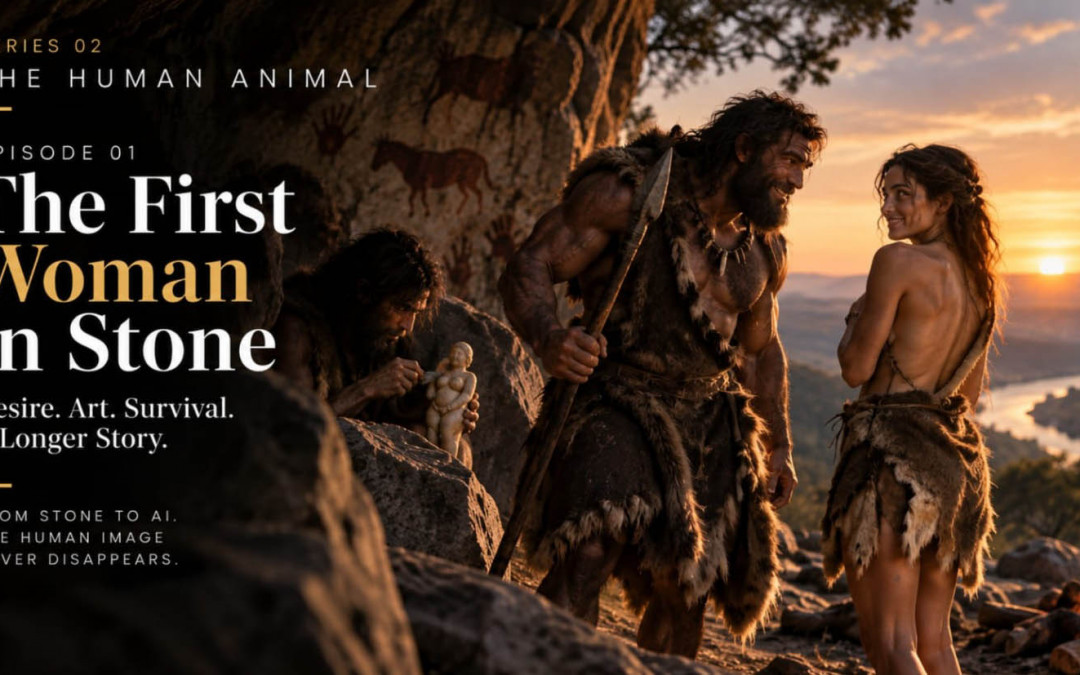
Someone Failed
Imagine a woman you cannot have.
Not an imaginary woman, but a real one. You know the way she moves, the shape of her body, perhaps the sound of her voice. She may live across the settlement or sleep beside another man. She may have refused you. She may not know that you exist. The reason hardly matters. What matters is much simpler: you want her, and when you go home, she does not come with you.
There is no photograph to steal a fraction of a second from her. No phone in which she can remain indefinitely young. No old message to reopen after midnight, no film, no portrait folded into a wallet. Memory will have to do what memory has always done badly: keep changing something while persuading you that it has remained the same.
Unless you make her.
A piece of stone will not laugh like her. Clay will not smell like her hair. Ivory cannot turn its head, become irritated, change its mind or decide that it would rather spend the evening with somebody else. Whatever you make will be an absurd reduction of the living woman. It will lose almost everything.
But it will come home with you.
The Woman Who Could Not Leave
This is not my explanation for the Venus of Willendorf. It is the thought that made me want to write about her.
If I had discovered that I could turn somebody I could not keep into something I could carry, I think I would have done it. That tells us nothing certain about the person who carved this particular female figure nearly thirty thousand years ago. It tells us something about the person looking at her now. Sometimes that is the more interesting place to begin.
The Venus of Willendorf is small enough to disappear inside a hand. She measures about eleven centimetres and was carved from limestone, then covered with red ochre. Her breasts, abdomen and hips are emphatic; thin arms rest across the upper body. Her head carries an elaborate arrangement usually described as hair or some kind of cap. Her feet are absent. So is the face.
The name *Venus* arrived incomprehensibly later than the woman herself. Rome was tens of thousands of years away. Aphrodite was nowhere on the horizon. We encountered an unknown woman and eventually gave her the name of a goddess from our own library.
Forget the library for a moment and look at her. Someone made a body and did not give it a face.

The Part That Looks Back
A face is a peculiar omission because the face is where looking becomes dangerous. Breasts can be looked at. Hips can be looked at. A face can catch you doing it.
A living woman is not merely an object available to an observer. She is another observer. She possesses the inconvenient ability to construct an entirely different version of the same encounter. You may think you are mysterious; she may think you are drunk. You may remember the evening as the beginning of something; she may have forgotten it before breakfast. The person we desire is simultaneously producing a world in which we are only one of the objects.
Representation changes that arrangement. The woman in stone cannot look back. She cannot correct the person looking at her, become bored with the attention or tell us that we have misunderstood everything. Whatever her original purpose may have been, the object now permits a relationship impossible with another living observer: we may look for as long as we please, and she remains.
Somewhere inside that difference lies one of the strangest discoveries human beings ever made. The appearance of a person could be separated from the presence of the person.
It was a terrible bargain, and we accepted it.
Perhaps Somebody Just Liked Breasts
There is a temptation whenever an object becomes sufficiently old to assume that everything about it must also have been profound. Perhaps somebody simply liked breasts. I cannot offer that as an explanation for Willendorf, and I like the question precisely because it is crude. A human being capable of making an image had not thereby ceased to possess a body. Culture did not abolish appetite.
But suppose desire had something to do with some prehistoric representation of a woman. We would still not have explained the interesting part. Why make her? A starving person would rather have meat than a sculpture of meat. A cold person wants a fire, not an exquisite representation of one. If the woman herself is available, a lump of limestone is a remarkably poor substitute.
The representation becomes interesting when something is missing. Perhaps the first important property of an image was not resemblance but availability. Reality could leave. The image could remain.
And once that distinction existed, something extraordinary had entered human life. We had invented a way of possessing an appearance without possessing the thing that produced it.
What If?
Think about someone you once wanted and did not get. The interesting part begins after reality answers.
If the answer was no, an entire possible life remained unreal. If the answer was yes, something equally strange happened: most of the imagined versions disappeared anyway. Possibility became Tuesday morning. Desire became breakfast, dirty glasses, trains to catch, illnesses, birthdays, disappointments, sex, boredom, tenderness and the discovery that the magnificent creature from across the room leaves towels on the floor.
This is not an argument against getting what you want. Life has one overwhelming advantage over fantasy: it happens. But happening has a price. Reality closes possibilities.
An image does not have to. The woman in a photograph does not wake up the next morning. The actress remains twenty-seven in a film made sixty years ago. The woman in a painting never tells the painter that he misunderstood her. An image can preserve a state long after the living person has moved into another one.
Perhaps that is why images of absent people can acquire such power. They do not merely remind us of somebody. They protect one version of that person from everything that happened later. We say that a photograph *captures* a moment, and it is a more revealing verb than we usually notice.
How Much Woman Do You Need?
Now return to Willendorf. Her face is absent. Her feet are absent. Her proportions are radically selective. Yet nobody needs a label to discover that the object represents a human female body. The reduction is enormous; recognition survives.
So forget for a moment why the maker omitted what was omitted. There is another question hiding inside the object: **how much can disappear before the woman disappears?**
We have been running versions of that experiment ever since. A photograph removes depth, movement, temperature and smell. Black and white can remove colour. A drawing can abandon almost everything except a handful of contours. A caricature can move features into anatomically ridiculous positions and somehow make its subject more recognisable. A child can draw a circle, two dots and several lines and transform them instantly into Mum.
Representation does not succeed by preserving everything. It succeeds by discovering what can be lost.
That is why the missing face fascinates me more than any confident explanation for it. I do not need to know why it disappeared. The remarkable fact is that the woman did not disappear with it. The maker is gone. The language is gone. The original occasion is gone. Whatever conversation once surrounded the object is gone.
The woman survived the losses.

The Perfect Woman Who Never Existed
For most of human history, the problem of representation was scarcity. There was never enough. Stone resisted the hand. Pigment faded. A photograph froze one instant and abandoned everything immediately before and after it. Film restored movement but not presence. Every new carrier seemed to rescue something the previous one had lost.
Now we have reached the opposite problem.
We can ask a machine for a beautiful woman who never existed. It can give her skin without a bad morning, cooperative hair, balanced features and eyes reflecting a light source from a room that exists nowhere. Ask again and another arrives. Then another. There is no original woman waiting somewhere to complain that the machine got her nose wrong.
Willendorf and the generated woman therefore occupy opposite ends of a remarkable experiment. With Willendorf, almost everything may disappear and a woman remains recognisable. With the generated image, enormous visual detail may appear even though there was never an original woman to preserve.
One begins with reality and removes information. The other begins without the person and manufactures information.
Yet both can produce the same immediate recognition: *woman*.
So where, exactly, is the woman in the image?
The question becomes stranger the longer you look at it. If recognition survives enormous loss, and can also occur without an original person, then perhaps what we recognise was never contained in any single breast, eye, contour or pixel. Perhaps representation works because the observer completes something the object only begins.
That may explain another modern puzzle. I have seen generated faces that were, feature by feature, more conventionally beautiful than people I remember decades after meeting them. The artificial face appeared to have everything it needed. The remembered one had the crooked smile, tired eyes, unusual nose or tiny imbalance that should have counted against it.
It did not.
That proves nothing about a universal formula for beauty. It makes me suspect that we have sometimes been looking for beauty in the wrong place. A face is not a bag of independently desirable parts, and looking is not a passive measurement performed by a pair of eyes. Memory, expectation, expression, arrangement and the history carried by the observer enter the room with us.
I do not think an image is finished when the maker puts it down.
I think it waits for another pair of eyes.
The Danger of Making Her Better
Modern technology gives us a temptation the original maker never had: we can improve the past.
A damaged photograph can be cleaned. Scratches disappear. Resolution increases. Colour can be inferred and added. A still face can be animated; lips can be made to speak. Each operation appears to return something that time removed. The direction seems obvious: more information must bring us closer to the original.
Until it doesn’t.
Imagine doing the same to Willendorf. Give her feet. Reconstruct the face. Add skin, eyes and hair. Let her breathe. Make her blink. Give her a plausible voice. At every stage we would be adding information, and eventually we would lose her.
Not because the reconstruction was ugly, but because information that never survived would have been replaced by our decisions. The result could become more vivid while the evidence became less visible. A face would appear, but whose face? A voice would speak, but whose voice? What looked increasingly like recovery would eventually become invention.
That is the strange danger hidden inside restoration: more complete does not necessarily mean more faithful.
Sometimes an absence has become part of what survived.
Unfinished Failure
Look at her once more.
Eleven centimetres of limestone. No face. No voice. No name we know. No explanation left by the person who made her. She was found at Willendorf in 1908, after spending an almost incomprehensible span of human history beyond the gaze of anyone who could have explained what she meant.
As a replacement for a living woman, she is hopeless. She cannot return affection. She cannot refuse it. She cannot grow older beside us or tell us that we have misunderstood her. Whatever living body, idea, ritual or desire once surrounded this object has escaped our reach.
But perhaps we have been measuring the wrong failure.
Flesh is incomparably better at being alive. Stone is better at waiting.
Nearly thirty thousand years passed. The people disappeared. Their language disappeared. The original question disappeared. The woman remained. Eventually another human being bent down, lifted her from the earth and looked at her again.
That is the part I cannot leave alone.
Whatever happened between the first observer and this object belonged to them. I cannot recover it, and I no longer need to invent it. This encounter belongs to us.
We have changed almost everything around her. We invented painting traditions, photography, cinema, magazines, smartphones and machines capable of producing women who never lived. Still, whenever reality refuses to hold still, we reach for some material that might.
The copy will always be poorer than the life.
But sometimes it is the copy that stays.
Someone failed, and something became eternal.
Watch the Video
How to Read the World
by José Fidel
Current Knowledge
The Venus of Willendorf is a small Upper Paleolithic female figurine discovered at Willendorf in Austria in 1908. It measures approximately eleven centimetres, was carved from oolitic limestone and was originally covered with red ochre. Current dating places it at roughly 29,500 years old.
Its anatomy is highly selective. The breasts, abdomen and hips are strongly emphasised, while the arms are comparatively slight, the feet are absent and no facial features are represented. The patterned surface around the head has commonly been interpreted as hair or some form of head covering.
The name *Venus* is modern. It does not tell us what the people who made such figurines called them or how they understood them. Paleolithic female figurines have generated interpretations involving fertility, sexuality, pregnancy, ritual, identity and self-representation, among others, but no single explanation for the Willendorf figure has been established.
What survives is therefore asymmetrical. We possess the physical object in extraordinary detail. We do not possess the maker’s explanation.
Open Questions
Why was the figure made? Was it intended to represent a particular person, a category of person, an ideal, a bodily condition, a social role, something sacred, or something for which our categories are inadequate? Why were some anatomical features emphasised while others were reduced or omitted? Was the absence of a face meaningful to its maker, technically irrelevant, culturally conventional—or none of these?
There are larger questions the object cannot answer by itself. At what point does representation cease to be a copy and become a new kind of thing? How much information can disappear while recognition survives? Why can an image of an absent person continue to affect an observer who never encountered the original?
And now there is an inverse question. If a machine can construct a recognisable human face without any original human being behind it, what exactly are we recognising? What belongs to the image, what belonged to the original, and what is supplied by the observer?
When we look at a prehistoric image and find desire, beauty, motherhood, sexuality or mystery in it, how much are we discovering—and how much are we bringing with us? There may be no final way to separate the two.
Transhumation Interpretation
Transhumation does not propose that the Venus of Willendorf was carved because somebody desired a woman they could not possess. The scenario at the beginning of this essay is a thought experiment, not an archaeological claim.
Its purpose is to ask a different question: what if representation became powerful not because it reproduced reality perfectly, but because reality possessed a property representation could partially escape?
Reality disappears. People leave. Bodies change. Animals run away. Fires go out. Faces age. Moments end. Memory alters what it tries to preserve.
An image cannot solve that problem completely. Stone cannot preserve a woman as a living woman. It preserves almost none of what makes a living person alive: movement, voice, temperature, intention, consciousness, response. But it can preserve something.
That changes the definition of failure. A representation may fail catastrophically as a replacement for reality while succeeding as a carrier across time. The information that survives does not need to be complete in order to remain recognisable, and what a later observer recovers from it need not be identical to what its maker intended.
The Venus of Willendorf therefore sits close to one of Transhumation’s central questions: **what must remain for something to continue being itself?**
Not everything. Perhaps never everything.
A face can disappear and the woman remain. A language can disappear and the object remain. An explanation can disappear and the question remain. Even the original observer can disappear while another arrives thousands of years later and completes a new encounter.
Artificial imagery now lets us approach the same boundary from the opposite direction. Instead of asking how much information can be removed while identity survives, we can ask how much information can be created before an original is required at all.
Willendorf gives us a woman after enormous loss. AI can give us a woman without a woman.
Between those two objects lies an uncomfortable possibility: representation may never have resided entirely in the thing being represented. Part of it has always existed in the mind capable of recognising the pattern.
The stone did not preserve the woman.
It preserved enough for another human being to see one.
And that may be one of the oldest forms of transmission we possess.
FAQ
How old is the Venus of Willendorf?
The Venus of Willendorf is approximately 29,500 years old and belongs to the Upper Paleolithic. It was discovered in 1908 near Willendorf in Austria.
Why does the Venus of Willendorf have no face?
We do not know. The absence of facial features may have been intentional, conventional or simply unimportant to the object’s original purpose. The surviving evidence does not allow us to choose confidently among these possibilities.
Was the Venus of Willendorf a fertility figure?
Possibly, but this has not been established. Fertility, pregnancy, sexuality, ritual, identity and self-representation are among the interpretations proposed for Paleolithic female figurines. Calling the Venus of Willendorf a fertility figure as though this were known would go beyond the evidence.
Why is the figurine called Venus?
The name is modern and refers to the Roman goddess Venus. The people who created the figurine lived tens of thousands of years before Roman religion existed, so the label tells us more about later interpreters than about the object’s original meaning.
What does the Venus of Willendorf tell us about representation?
At minimum, it demonstrates how little visual information may be necessary for a human observer to recognise a human body. The figure omits or radically reduces many anatomical features while remaining immediately recognisable as a representation of a woman.
What does AI-generated imagery have to do with the Venus of Willendorf?
They approach the problem of representation from opposite directions. The Venus of Willendorf preserves a recognisable human form despite enormous informational reduction. AI-generated imagery can produce a recognisable human form without a corresponding original person. Together they raise the question of how much recognition depends on the object itself and how much is supplied by the observer.
Is Transhumation claiming the Venus was made because of sexual desire?
No. The opening scenario is explicitly a thought experiment. The historical purpose of the Venus of Willendorf remains unknown. Desire is used as a way of exploring the broader problem of why humans create representations of things and people who are absent.
What is the central Transhumation question raised by the Venus of Willendorf?
The central question is: **what must remain for something to continue being itself?** The Venus suggests that recognition can survive extraordinary loss of information. Modern synthetic imagery raises the inverse possibility: recognition may also occur when there was never an original person to preserve.
Continue the Transhumation Series
- Forgotten Religion | Ancient Gods, Symbols and the Hidden Structures of Human Civilization
- The Last Religion | Death, Immortality and the Future of Humanity
- The New Theurgy | AI, Information and the Future of Human Civilization
- End of Branding: You Were Never Meant to Become a Product
- Baal vs Ishtar: Why Ancient Gods Never Disappeared