What Happens When the Longest Human Life Ends?
An ancient Roman clock, a woman who lived 122 years, and the possibility that all of recorded history has taken place inside a single biological age
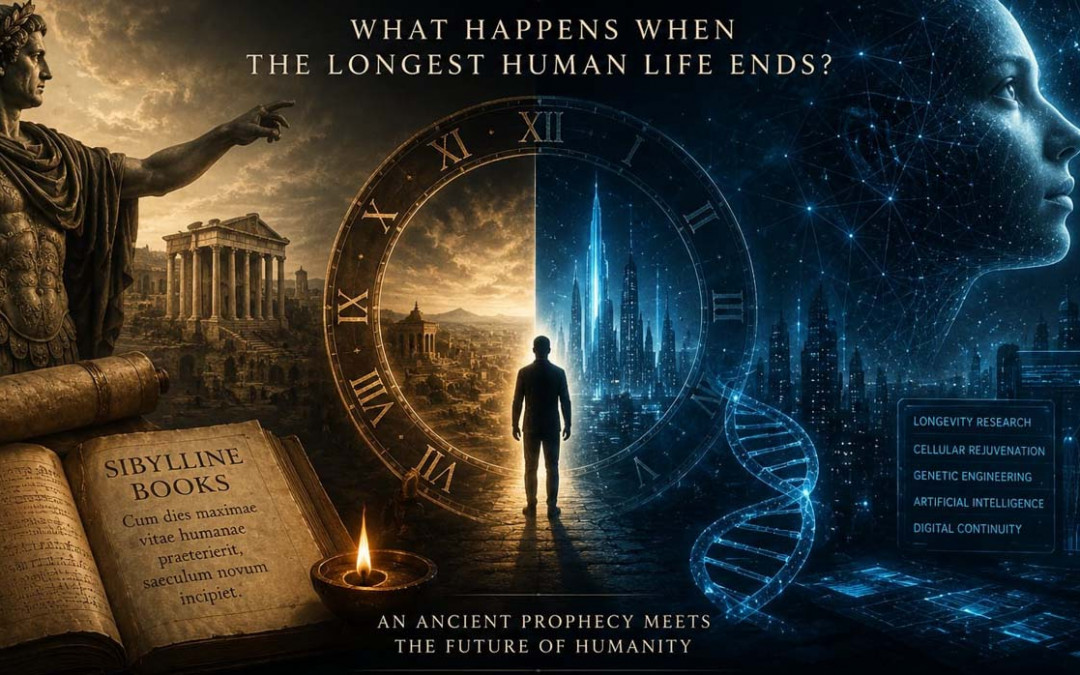
There is a peculiar kind of clock hidden in Roman history. It has no hands, no gears and, at first, not even a particularly interesting number. Its mechanism is simply a human life. Somewhere in the ancient tradition surrounding the Sibylline writings and the Roman idea of the saeculum appears a striking thought: an age can be understood as having passed when the span of the longest human life belonging to it has finally run out. The Romans could mark such transitions with the Ludi Saeculares, ceremonies rare enough that, ideally, no ordinary person should expect to witness them twice. It is easy to file all of this under the fascinating machinery of an extinct religion—until one notices the small detail that makes the idea difficult to leave in Rome.
The clock was not calibrated to the average human life. That would have made it wildly unreliable. Average longevity rises in prosperous societies and collapses during famine, disease and war; it changes when children stop dying young, when clean water arrives, when antibiotics work, when childbirth becomes safer. The more interesting boundary was the outer one: the longest life a human being might reasonably be expected to live. In some Roman conceptions of the saeculum, a span of roughly 110 years appears. More than two millennia later, the longest verified human life belongs to Jeanne Calment, who reached 122 years and 164 days. Between those two numbers lie Christianity, the fall of Rome, gunpowder, Shakespeare, Newton, electricity, Darwin, Einstein, the atomic bomb, the Moon landing, the internet and artificial intelligence. And yet the animal carrying all of those revolutions through history still seems to reach roughly the same wall.
Perhaps there is a treasure hidden in that rather banal observation. We have become so accustomed to dividing history into ages that we rarely ask whether the creature living through them ever entered a genuinely new age at all.
The Clock Beneath History
History presents itself as a succession of different worlds. A Roman senator travelling by horse appears to have almost nothing in common with someone checking a message on a smartphone while an artificial intelligence answers another question in the background. The medieval monastery, the Renaissance workshop and the semiconductor factory belong to civilizations separated not merely by technology but by different assumptions about nature, authority, knowledge and the place of the human being in the cosmos. From sufficient distance, history resembles a sequence of transformations so radical that the word age seems entirely justified.
Move closer to the body, however, and the picture becomes stranger. The Roman who survived childhood could grow old. So could the medieval merchant, the Renaissance painter and the Victorian scientist. Civilization repeatedly changed the probability of reaching old age without obviously redesigning old age itself. Roads, food distribution, political stability, sanitation, vaccination and medicine could determine whether millions died before reaching the biological possibilities already available to them, but the basic arc remained recognizable: childhood, maturity, decline and death within a range that an educated Roman would not find entirely alien.
This is why average life expectancy can be misleading when we use it to imagine the biological distance between ourselves and the past. Low historical averages often reflect enormous infant and childhood mortality rather than a world in which everyone routinely became old at forty. The achievement of modern civilization has been extraordinary precisely because vastly more people can now travel much farther along the human lifespan. Yet bringing more travellers safely to the end of an old road is not necessarily the same thing as extending the road.
That distinction opens a surprisingly large question. What if Rome, the Middle Ages, the Renaissance, industrial civilization and the digital age are genuinely different historical ages but belong to the same biological age? We changed almost everything around the human organism while leaving its deepest temporal boundary largely intact. The scenery changed. The traveller did not.
The Last Person Who Remembers
The Roman saeculum becomes more evocative when we stop treating it merely as an unusual way of counting years. Imagine an age beginning with the birth of a child. Other children are born, adults grow old, rulers change and buildings disappear, but somewhere a final witness survives who still physically connects the present with that earlier world. When that person dies, something more than an individual life ends. For the first time, nobody remains who inhabited the beginning as lived experience. Memory has crossed into history.
We still understand this instinctively. The death of the last veteran of a war, the final speaker raised with a disappearing language or the last survivor of a catastrophe attracts attention disproportionate to the statistical significance of a single death. We know that a door has closed. Photographs, recordings and archives remain, but the last biological bridge has disappeared. A person who could say I was there has become a document saying someone was there.
This may explain why the longest life is philosophically more interesting than the average one. The average tells us something about the condition of a population; the maximum marks the outer boundary of a human possibility. For almost all of history that boundary could be treated as background reality, as unquestionable as gravity. Kings could dream of immortality, alchemists could search for elixirs and religions could promise another existence, but civilization itself was built around generational replacement. Parents disappeared. Children inherited. Witnesses became ancestors. Power, property, memory and culture moved forward partly because biology continually removed their previous custodians.
We have lived inside this mechanism for so long that mortality does not merely appear in our philosophy. It is hidden inside the architecture of our institutions. Inheritance assumes departure. Retirement assumes a life course. Education assumes generations. Political succession assumes that rulers eventually leave, voluntarily or otherwise. Even our emotional vocabulary—youth, middle age, lifetime achievement, legacy—depends on a relatively stable expectation of how long the journey lasts. The Roman clock is still hanging on our wall because, beneath enormous historical change, its mechanism has never really been replaced.
The Number Is Not the Treasure
This is where it would be easy to become fascinated by 110 years. Ancient numbers have a dangerous magnetism; once a prophecy contains one, we begin waiting for the calendar to perform a trick. But the number itself may be the least interesting part of the story. Roman understandings of the saeculum varied, and the surviving Sibylline material reaches us through a complicated history of lost collections, reconstructions and later traditions. There is no responsible historical argument that an ancient Roman priesthood secretly calculated the arrival of modern longevity science.
The more interesting clue is that there was a limit to count. Whatever exact number a particular Roman calculation preferred, the human lifespan could function as a natural unit because everybody understood that it ended. A sufficiently long period would eventually exhaust every person who had belonged to its beginning. Biology guaranteed closure. An age could finish because the human body itself supplied the final punctuation mark.
Now consider how peculiar our own moment is. Modern medicine spent most of its triumphant history fighting the things that prevented people from reaching old age: infection, injury, infant mortality, cardiovascular disease and countless other threats. Increasingly, however, researchers are also studying ageing itself—cellular senescence, genomic instability, epigenetic change, mitochondrial dysfunction, stem-cell exhaustion and the complicated interactions through which organisms lose resilience. The scientific question is gradually shifting from How do we stop people dying prematurely? toward a stranger question: Why must the organism deteriorate on approximately this schedule at all?
There is no guarantee that this road leads to radical life extension. It may turn out that dramatically increasing maximum human lifespan is vastly harder than extending healthy years within the range we already know. The scientific uncertainties are enormous, and longevity attracts more than its share of extravagant promises. Yet something historically unusual has already happened before any miracle therapy exists. Humanity has begun examining the clock rather than merely counting its ticks.
Someone Has Opened the Back of the Clock
That change in perspective is easy to underestimate because contemporary technology rapidly becomes ordinary. A laboratory investigates cellular rejuvenation; another group studies senescent cells; artificial intelligence is used to search chemical and biological spaces too large for conventional methods; regenerative medicine attempts to repair tissues that earlier medicine could only manage as they deteriorated. Each development appears separately in journals, investment announcements and newspaper stories, and most will produce incremental rather than revolutionary results. Seen individually, none announces a new human age.
Seen together, however, they reveal a change in the direction of curiosity. For thousands of years, the maximum lifespan belonged primarily to fate, theology and legend. Now at least some of its mechanisms belong to experimental biology. The wall has not fallen, but we have reached it with instruments and begun asking what it is made of.
This is a much more interesting threshold for Transhumation than declarations that immortality is imminent. The latter converts uncertainty into marketing; the former preserves the adventure. We know enough to see that ageing is a collection of biological processes rather than a supernatural timer hidden somewhere inside the body, but we do not know whether understanding those processes will permit modest improvements, substantial extension or something that forces us to redefine a human lifetime. We have found the locked door, and for the first time we can see that it has hinges. We still do not know whether we possess the key.
That is precisely the kind of halfway point from which the future becomes most interesting. Jules Verne is less exciting after the submarine exists; the treasure map matters because part of the coastline is recognizable while the island remains uncertain. The modern longevity problem has reached that peculiar state. Radical extension of human life remains speculative, but the assumption that the present biological boundary must remain untouched forever is no longer as intellectually effortless as it once was.
Watch The Video
How to Read the World
What If the Last Witness Refuses to Leave?
Suppose, only as a thought experiment, that the road does extend. Not immortality, not a thousand-year-old billionaire floating in a tank, but something less theatrical: healthy human lives gradually stretch beyond the familiar maximum. One hundred and twenty becomes less exceptional, then 140 becomes possible, then perhaps something further. At what point would we stop describing this as improved medicine and admit that something structural had happened to civilization?
The answer would reach far beyond hospitals. A society in which large numbers of people lived for two centuries would have to reconsider inheritance, careers, education, marriage, political power and the accumulation of wealth. Generations would overlap in unfamiliar ways. A professor might teach the grandchildren of former students while remembering institutions two political eras removed. A founder might remain inside a company for a century. Historical events that for us pass from memory into archive might retain living witnesses for periods previously unimaginable. The past would take longer to become past because biology would stop clearing the room on its old schedule.
This is where the Roman idea suddenly feels less antique. The saeculum assumes that eventually the final witness disappears. Its clock works because human beings leave. But if the longest human life became elastic, then the very instrument used to mark an age would begin to malfunction. We would not merely have added years to an individual biography; we would have changed the rate at which civilizations replace the people carrying their memories, property, institutions and identities.
The first truly new biological age would therefore not require immortality. It might begin much earlier, at the moment when the phrase “the longest human life” stops referring to a reasonably stable horizon. Once the maximum becomes something technologically negotiable—even if only partially—the old clock no longer tells the same kind of time.
The Age After the Longest Life
There is a seductive temptation to return at this point to the ancient phrase and call it a prophecy fulfilled. That would make a wonderful ending and bad history. The Roman Sibylline tradition did not predict cellular reprogramming, artificial intelligence or modern biomedicine, and we gain nothing by pretending otherwise. The real discovery is subtler and, in a way, more beautiful: an ancient civilization built part of its understanding of historical time around a biological limit that still looks surprisingly familiar to us.
Perhaps that is the treasure hidden in the story. We thought we were reading about an old Roman calendar and discovered a ruler laid against the entire history of our species. Empires crossed it. Religions crossed it. Printing, electricity, antibiotics and computers crossed it. The ruler itself barely moved.
This gives Transhumation a different way of thinking about the phrase new age. History has produced countless new ages in politics, religion and technology, but perhaps humanity has never yet left the biological age into which Augustus was born. We still inherit approximately the same body, travel through approximately the same stages and disappear within a horizon that the ancient world would recognize. Almost everything we built became extraordinary while the traveller remained ancient.
For the first time, that may no longer be something we are willing simply to accept. We do not know whether the attempt will succeed, and that uncertainty is essential. The interesting moment is not the arrival of immortality but the moment in the adventure when humanity realizes that the wall it assumed was part of the landscape may actually be a structure.
More than two thousand years ago, the end of the longest human life could help mark the end of an age. Perhaps the next age will begin in a way no Roman could have intended: not when the longest-lived person finally dies, but when nobody is quite certain any longer how long that person is supposed to live.
And perhaps that is when we will discover that the old clock was measuring us all along.
Current Knowledge
The Roman saeculum was a concept of an age or generation whose length was connected in some traditions with the maximum span of human life, although Roman definitions and calculations varied. The Ludi Saeculares, or Secular Games, ritualized the transition between such ages. The original Sibylline Books consulted by Roman authorities were largely lost in antiquity, and surviving Sibylline material comes through a complicated mixture of quotations, later collections and traditions; claims about individual prophetic formulations therefore require historical caution.
Modern improvements in life expectancy have overwhelmingly resulted from reducing premature mortality and allowing more people to reach older ages. Maximum verified human lifespan has moved far less dramatically: Jeanne Calment's 122 years and 164 days remains the accepted record. Contemporary ageing research investigates multiple biological mechanisms associated with decline, and experimental approaches include senolytics, regenerative medicine, metabolic interventions, gene-related techniques and cellular reprogramming. None has yet demonstrated that humans can routinely exceed the established maximum lifespan by decades, much less eliminate ageing.
Open Questions
The central scientific uncertainty is whether the apparent human lifespan ceiling represents a deeply constrained biological limit or an emergent consequence of several processes that could eventually become modifiable. Even if medicine substantially extends healthy life, it remains unknown whether maximum lifespan will move with it or whether compression of morbidity—remaining healthy longer within roughly the same lifespan—will prove the more realistic outcome.
The civilizational questions may ultimately be just as difficult. If maximum lifespan changed substantially, would longer-lived societies accumulate wisdom or merely accumulate power? Would extended memory make cultures more stable or less capable of renewal? At what point does adding years cease to be a medical improvement and begin altering the fundamental architecture of generations?
Transhumation Interpretation
Transhumation does not interpret the Sibylline tradition as a technological prophecy. Its interest lies in a structure that survived the disappearance of the religion that once expressed it: an age can be measured against the outer boundary of a human life.
Seen from that perspective, recorded history presents a strange possibility. Humanity may have passed through dozens of historical ages while remaining inside a single biological one. We replaced empires, gods, economies, machines and systems of knowledge, yet the organism carrying those transformations retained a broadly recognizable temporal horizon.
A genuinely new age might therefore begin without a new emperor, revolution or calendar. It could begin when the biological ruler against which every previous civilization was measured finally starts to move.
The Romans counted the clock.
We inherited it.
Now, for the first time, we have begun opening the case to see how it works.
The treasure is that we still do not know what happens if we learn how to change it.
FAQ
What is the longest verified human lifespan?
Jeanne Calment of France holds the widely accepted verified record at 122 years and 164 days.
What was a Roman saeculum?
A saeculum was an age or generational span. Its precise definition varied, but some Roman traditions connected it with the maximum span of a human life and used it as a framework for rare Secular Games.
Did the Sibylline Books predict life extension?
There is no historical evidence that Roman Sibylline traditions predicted modern longevity biotechnology. The comparison in this article is a modern structural interpretation.
Can science extend the maximum human lifespan?
Research into the biology of ageing is active, but no intervention has yet demonstrated radical extension of the verified maximum human lifespan. Whether that boundary can move substantially remains unresolved.
Why would longer human lives change civilization?
Large increases in healthy lifespan could affect generational turnover, inheritance, careers, political power, education and living memory. At sufficient scale, life extension would therefore become a social and civilizational change rather than merely a medical one.
Continue the Transhumation Series
- Forgotten Religion | Ancient Gods, Symbols and the Hidden Structures of Human Civilization
- The Last Religion | Death, Immortality and the Future of Humanity
- The New Theurgy | AI, Information and the Future of Human Civilization
- End of Branding: You Were Never Meant to Become a Product
- Baal vs Ishtar: Why Ancient Gods Never Disappeared