
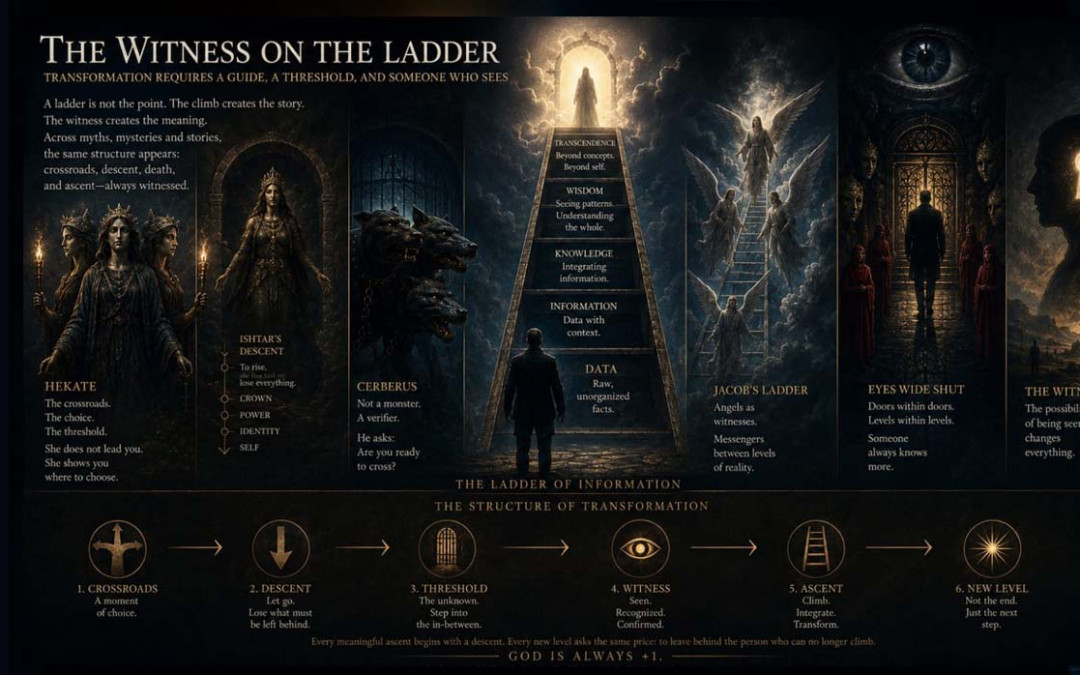
The Witness
Hekate, Jacob’s Ladder, Ishtar and the strange role of recognition in becoming someone else
A man enters a room wearing a mask. For several minutes he is allowed to remain there because everyone accepts the identity the mask provides. Then someone asks for the password again. The room changes without moving. The doors are still where they were, the people have not disappeared, the mask remains on his face, but the relationship has altered completely. He is no longer a guest observing the ritual. He has become the object of observation.
Stanley Kubrick understood something ancient in this moment of Eyes Wide Shut. A threshold is rarely important merely because somebody crosses it. What matters is that the crossing changes the relationship between the traveller and the world on the other side. Someone knows that he has entered. Someone recognizes that he does not belong. The secret is no longer simply something he has seen; it has become something that has seen him.
This structure is much older than Kubrick. Gates, crossroads, ladders, guardians, masks, passwords and guides appear with suspicious persistence in religious traditions and stories of initiation. Their historical meanings differ enormously, and it would be a mistake to pretend that Hekate, the Mesopotamian goddess Ishtar, Cerberus and the angels of Jacob’s dream were originally pieces of one forgotten doctrine. They were not. Yet placing them beside one another reveals a recurring human problem.
Change happens constantly.
Transformation is different.
Transformation requires us to decide that a change has crossed some boundary after which the old description no longer seems sufficient.
And very often somebody—or some larger structure—must recognize that the boundary has been crossed.
A Ladder Does Nothing Until Someone Climbs
The ladder is almost embarrassingly simple as an object. Two rails, a sequence of steps, the possibility of moving between levels. Left on the ground, it contains only potential. Put it against a wall and introduce a climber, and the same pieces of wood suddenly acquire direction.
Up.
Down.
Before.
After.
The important thing about a ladder is therefore not elevation alone. It is the division of continuous movement into recognizable stages. One step is not the next. A person can be halfway. Someone can fall. Someone can reach a place inaccessible from below.
This is partly why ladders become such durable symbols. They make an invisible process legible.
We speak casually about levels of education, stages of grief, ranks in organizations, degrees of initiation and steps toward mastery because continuous transformation is difficult to understand without dividing it into thresholds. The structure gives us a way to say: something has changed here.
But the ladder introduces a second problem. Who decides that someone has reached the next level?
A student may privately believe she has become a physician, but society requires an institution to recognize the transformation. A couple may love one another for years, yet a ceremony can alter their legal and social identity in minutes. A soldier passes through training and emerges with a rank that exists only because a larger structure acknowledges it.
The body may be nearly identical before and after.
Recognition changes what the transformation means.
Hekate at the Place Where Roads Divide
Hekate belongs naturally to this discussion because her historical associations include boundaries, entrances, roads and crossroads. Later representations frequently emphasize her triple form, and offerings to her were connected with liminal places. None of this makes her an ancient goddess of the modern psychological concept of “transformation.” It gives us something better: a remarkably durable image of the threshold itself.
A crossroads is peculiar because nothing has yet happened.
Three roads can lie silently beneath the moon for a hundred years. The drama begins when a traveller arrives.
Until that moment every road is possibility.
Then a choice converts possibility into biography.
The road not taken remains physically present, but it no longer belongs to the same future.
This makes Hekate useful to Transhumation not as someone who determines destiny, but as the figure standing where certainty becomes impossible. The traveller must move without possessing complete knowledge of where every road leads.
That is what genuine thresholds usually feel like.
We recognize them most clearly in retrospect.
The day someone accepted a job.
The evening a relationship ended.
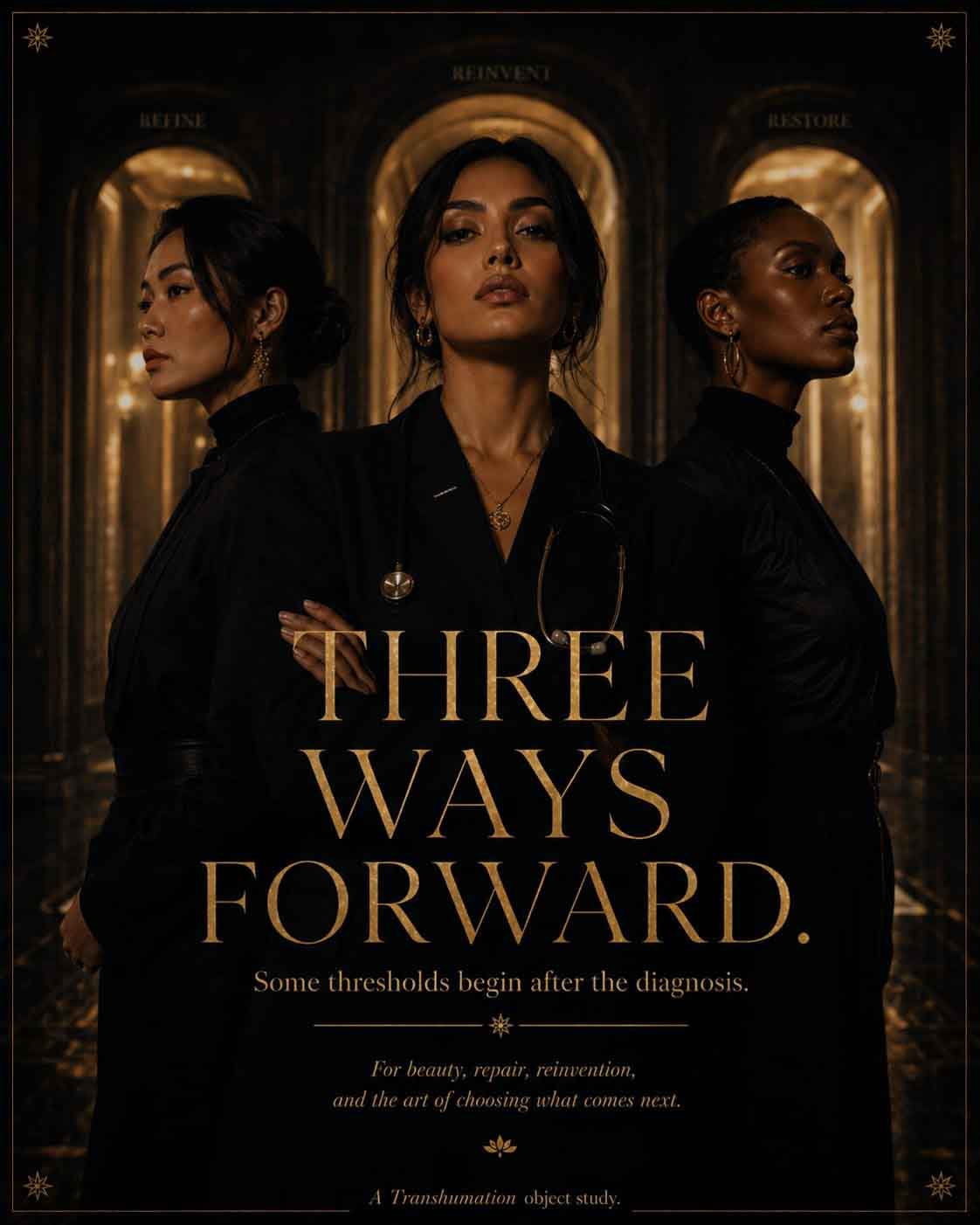
The diagnosis.
The departure.
The conversation whose significance became visible only twenty years later.
Life rarely supplies trumpets at the exact moment when one version of ourselves begins becoming another.
Myth supplies the figure at the crossroads because ordinary life often does not.
The Guardian Is Not the Gate
Cerberus introduces a different function.
The familiar image is monstrous: the many-headed dog guarding the entrance to the world of the dead. In Greek myth, Cerberus does not exist primarily to administer a philosophical test of personal development. His role is associated with guarding the boundary of Hades, especially preventing the dead from leaving and complicating unauthorized passage. Turning him literally into an ancient “validator” would therefore be modern invention.
As metaphor, however, the guardian is extraordinarily useful.
A locked door and a guarded door are not the same thing.
The first is an obstacle.
The second implies a system.
A guardian distinguishes between those who may pass and those who may not. The existence of the guardian tells the traveller that the space beyond the threshold operates under rules different from the space before it.
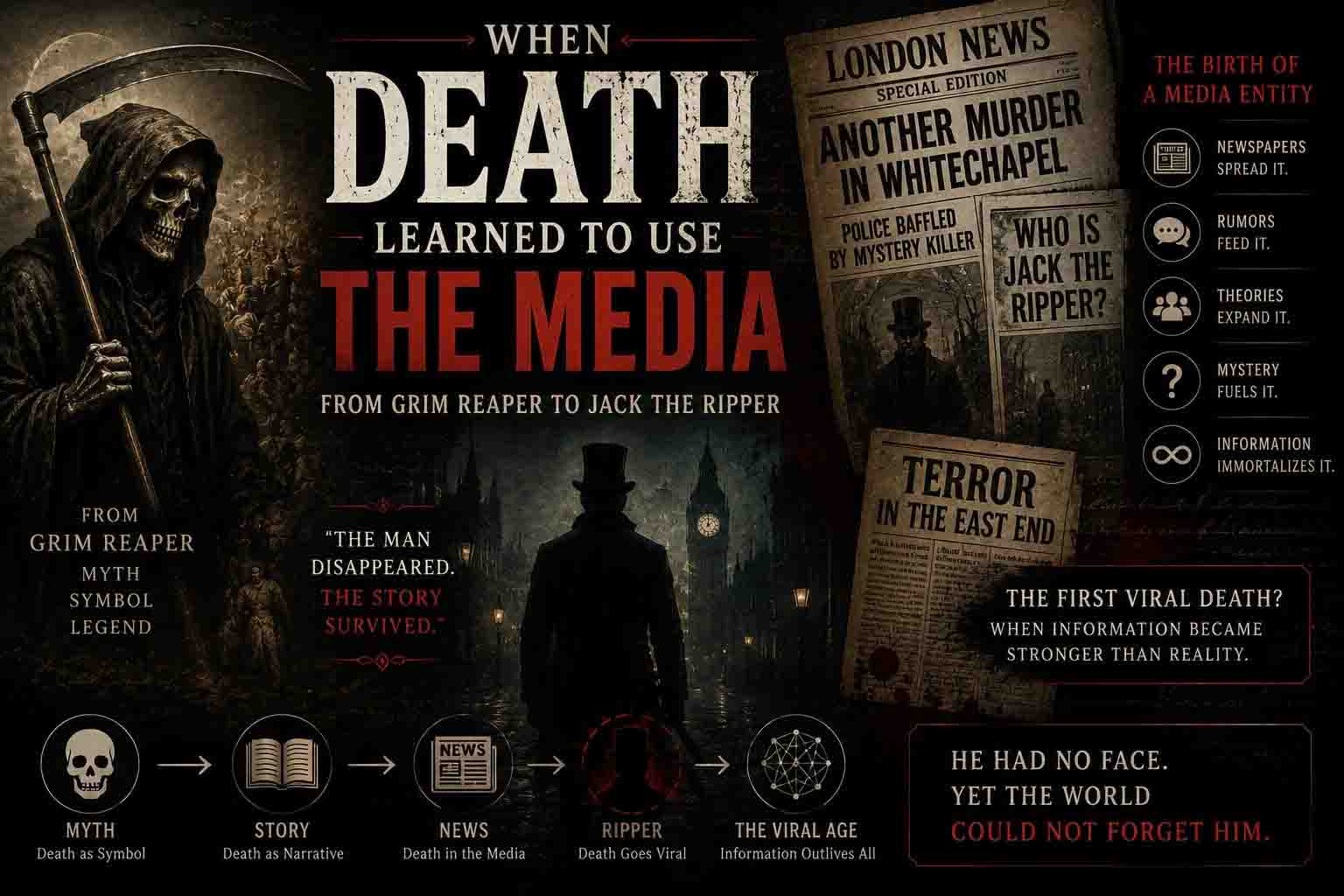
Modern civilization is filled with secular Cerberuses. Immigration officers, examination boards, security systems, passwords, professional licenses and algorithms all perform versions of the same structural function. They do not necessarily create the transformation. They determine whether the larger system will acknowledge it.
The distinction becomes important.
You may possess the knowledge of a surgeon without being legally permitted to operate.
You may know the password to a room without belonging to the society inside it.
You may have changed inwardly while everyone around you continues addressing the person you used to be.
The guardian asks a question that every institution eventually asks:
By what evidence should we recognize that you have crossed?
Ishtar Leaves Something at Every Gate
The Mesopotamian descent of Inanna or Ishtar gives the threshold a harsher quality. In the surviving traditions, the goddess descends into the underworld and passes through a sequence of gates. At each stage, an item associated with her power, dress or status is removed. By the time she reaches the deepest point, the figure who began the journey has been progressively stripped of the attributes with which she entered it.
It is easy to turn this into a modern self-help allegory about abandoning the ego, but the original myth is considerably stranger and belongs to its own religious world. Its value here lies in the architecture of the descent.
Movement costs something.
The traveller cannot simply accumulate.
At each gate, something that belonged to the previous state fails to cross unchanged.
This pattern appears far beyond Mesopotamian mythology because it corresponds to an ordinary feature of human transformation. Becoming something frequently requires becoming unable to remain something else.
Choosing one profession closes others.
Parenthood changes kinds of freedom that existed before it.
Knowledge can make an earlier innocence impossible to recover.
Migration creates attachments to a new place while altering the meaning of home.
Even healing can involve losing an identity organized around an old wound.
Transformation is therefore not simply acquisition.
Sometimes its evidence is what can no longer be carried.
Jacob Wakes Up in the Same Place
Jacob’s ladder offers almost the opposite movement. In Genesis, Jacob dreams of a structure connecting earth and heaven, with divine messengers moving upon it. He wakes and discovers that the physical location in which he slept has become something different in meaning. He marks the place and names it.
Historically and theologically, the angels are not presented simply as bureaucratic witnesses certifying Jacob’s spiritual advancement. That would distort the text.
But something fascinating does happen.
Jacob wakes in the same landscape.
The stones have not changed.
The sky has not changed.
Jacob has.
More precisely, the relationship between Jacob and the place has changed because an experience has been interpreted and remembered. What had been a location along a journey becomes a significant place.
The transformation occurs partly through recognition.
Jacob does not merely experience the dream.
He identifies the experience as important.
He marks it.
He gives the place a name.
He creates memory around the event.
That sequence may tell us more about transformation than the ladder itself. Events disappear unless some structure carries them forward. Recognition converts a passing experience into a point of continuity.
A witness need not always be another person.
Sometimes the witness is memory.
Why Initiation Needs an Audience
Anthropologists studying rites of passage noticed long ago that many cultures organize major transitions through a recognizable sequence: separation from an earlier status, an ambiguous intermediate condition, and incorporation into a new one. Birth, adulthood, marriage, religious initiation and death can all be surrounded by rituals because biological or psychological change alone does not automatically create social status.
A teenager does not become an adult at a universally obvious physical second.
A ruler is biologically the same person moments before and moments after a coronation.
A marriage ceremony may leave two bodies unchanged while altering an enormous network of obligations, expectations and legal relations.
Ritual solves this problem by making transformation public.
Witnesses matter because identities are partly relational.
I can decide privately that I am your king.
The difficulty begins when you disagree.
This gives recognition a much more precise meaning than simply “someone saw what happened.” A witness observes an event. Recognition places that event inside a larger system and says: from this point forward, we will treat you differently because of what has occurred.
Transformation becomes institutional memory.
The Mask in Eyes Wide Shut
This is why Eyes Wide Shut fits the structure so well.
Bill Harford repeatedly believes that access is knowledge. He obtains information, follows clues, enters rooms and looks behind surfaces. Yet entering the masked ritual does not make him an initiate. He possesses visibility without status.
The crucial reversal occurs when visibility becomes reciprocal.
He sees the system.
Then the system sees him.
The mask initially permits ambiguity. It conceals personal identity while providing enough symbolic identity to move through the room. Once his legitimacy is questioned, however, the mask changes function. Instead of granting anonymity, it becomes evidence that somebody is hiding.
This is the deeper violence of recognition in the film.
Bill imagined himself crossing into a hidden world as observer.
He discovers that the hidden world has the power to classify him.
The distinction extends far beyond Kubrick. A child experiences adulthood differently once adults begin treating him differently. A criminal act changes character once somebody knows. A private love becomes a social relationship once acknowledged. A secret can remain psychologically containable until one realizes that someone else possesses it.
To be recognized is to lose some control over the meaning of one’s own transformation.
Another observer now participates.
The Witness Can Save You—or Trap You
This is where the romantic idea that “transformation requires recognition” becomes dangerous.
Recognition is not always liberation.
Sometimes the witness refuses to let the transformation occur.
Families continue treating adults as children. Societies continue attaching identities to people long after those identities have ceased to describe them. Criminal records preserve an earlier version of a person indefinitely. Digital archives make adolescent mistakes searchable decades later. Algorithms infer categories and repeatedly return individuals to them.
The witness remembers.
But memory can become a prison.
This creates a modern inversion of initiation. Traditional rituals often marked a clear transition: before and after. Digital civilization increasingly remembers both states simultaneously. The person changes, while the archive preserves every previous version.
The problem is no longer merely whether anyone will know that you have changed.
It is whether the systems surrounding you will permit the old version to die.
This may be one of the defining identity problems of the information age.
Beauty Does Not Need a Witness—But Meaning Often Does
A deserted landscape does not cease to possess structure because nobody sees it. A painting does not physically disappear when the museum closes. Music written on a page can remain unperformed for centuries.
It would therefore be too strong to say that beauty literally requires a witness in order to exist.
But aesthetic experience certainly does.
The distinction matters.
The relationship between object and observer creates something neither term contains by itself. A composition becomes heard music. Pigment becomes an encounter with an image. A landscape becomes remembered beauty.
Human transformation often operates similarly.
An internal change can happen alone.
Its social meaning emerges through relationship.
This is why human beings seek witnesses at weddings, funerals, graduations, religious ceremonies and moments of achievement. The witnesses do not manufacture the experience. They ensure that the transformation is carried into a world larger than the individual.
Recognition is a form of continuity.
Someone remembers who crossed.
The Ladder of Information
Technology changes the scale of this ancient problem because civilization is constructing witnesses that do not forget in the human way.
Libraries were one early version. Writing allowed events, identities and ideas to be recognized by people who were not present when they occurred. Photography expanded the record. Cinema preserved movement and voice. Digital networks transformed recognition into permanent infrastructure.
Artificial intelligence may push the structure further.
A sufficiently powerful informational system can compare past and present versions of a person, recognize patterns across decades, reconstruct forgotten contexts and act as an interpreter between archives and living users. It can become something like a librarian standing on a ladder whose shelves extend through generations.
But that creates an uncomfortable question.
What authority should the witness possess?
If a machine knows every previous version of you, should it decide whether you have changed?
If an archive can reconstruct your old beliefs perfectly, does your present self have the right to contradict them?
If identity becomes increasingly distributed across databases, photographs, conversations and models, who possesses the authority to recognize continuity between the person you were and the person you claim to be now?
The ancient guardian asked whether you were permitted to enter.
The modern guardian may ask something stranger.
How do we know you are still you?
Watch The Video
How to Read the World
Current Knowledge
Crossroads, boundaries and entrances are historically important elements in the cult and iconography of Hekate, although modern interpretations often combine material from different periods and should not be treated as one fixed ancient doctrine. Cerberus belongs to the mythology of the Greek underworld as a guardian of its boundary; interpreting him as a validator of psychological transformation is a contemporary metaphor rather than a historical Greek teaching.
The Mesopotamian traditions concerning the descent of Inanna or Ishtar contain a sequence of gates through which the descending goddess loses items associated with status and power. These narratives existed in different versions and cultural contexts, so modern psychological readings should remain interpretations rather than claims about the original meaning of the myth.
The biblical account of Jacob’s ladder appears in Genesis 28. Jacob dreams of a connection between earth and heaven and of divine messengers moving between them. After waking, he marks the place and gives it religious significance. Reading the angels primarily as witnesses of transformation goes beyond the traditional text but can serve as a modern structural interpretation.
Anthropology provides a stronger empirical foundation for the broader argument. Rites of passage frequently organize transitions in social identity through separation, an intermediate or liminal stage and incorporation into a new status. In such cases public recognition can genuinely alter social reality even when the individual’s biological state changes little or not at all.
Open Questions
The first question is whether recognition is necessary for transformation or merely for certain kinds of transformation. Psychological change can clearly occur without witnesses, while social identity often depends upon recognition by others. The useful distinction may therefore lie between becoming different and being acknowledged as different.
A second problem concerns authority. Who is allowed to recognize a transformation? A family, state, religion, professional institution or digital platform can each assign identities, but those classifications can conflict with the person’s understanding of themselves. Recognition can validate identity, but it can also impose it.
There is also the question of continuity. If transformation involves genuine loss, how much can disappear before the new person should be treated as someone else? This becomes especially important in cases involving profound neurological change, future neural technologies and hypothetical digital copies.
Finally, information technology introduces an unprecedented problem: what happens when the witness never forgets? Human cultures historically allowed some earlier identities to fade. Digital archives can preserve contradictory versions of a person indefinitely. A civilization that remembers everything may need to develop a new cultural technology for permitting transformation.
Transhumation Interpretation
The Witness on the Ladder is not a hidden figure shared by every religion.
It is a structural role.
The ladder provides difference between levels.
The threshold marks the point at which movement becomes consequential.
The guardian tests whether passage will be acknowledged.
The descent strips away something that cannot continue.
The witness carries the event into memory.
Recognition tells the larger system that the traveller should no longer be treated exactly as before.
Once these roles are separated, Hekate, Ishtar, Cerberus, Jacob and Eyes Wide Shut no longer need to be forced into one mythology. They become mirrors placed around the same human problem.
How does change become identity?
This question matters enormously to Transhumation because technological civilization is increasingly capable of modifying the carriers through which identity is expressed. Bodies can be repaired. Memories can be externalized. Digital personas can survive the absence of their owners. Artificial systems can imitate language and behavior. Future technologies may alter cognition itself.
The difficult problem will not simply be whether transformation is technically possible.
It will be continuity.
If a human brain gradually integrates artificial components, who decides that the person remains the same?
If a digital model remembers an individual’s entire life, what kind of witness could distinguish continuation from imitation?
If someone changes so radically that every external system still recognizes the old person while the conscious individual recognizes only the new one, which recognition has priority?
The ladder therefore becomes more interesting when we stop treating it as a simple symbol of progress.
A ladder permits ascent.
It also permits descent.
It creates levels without telling us which one is morally superior.
It can lead to enlightenment or into an attic.
What matters is the movement, the threshold, the cost and the continuity between the traveller who placed a foot on the first rung and whoever eventually arrives at the last.
Perhaps the deepest question is not whether someone witnessed the transformation.
It is whether the witness can still recognize the traveller after it.
That distinction leads directly to the problem of identity.
Transformation asks:
What have you become?
Continuity asks:
Are you still the one who began the climb?
And somewhere between those two questions stands the witness.
FAQ
What does the ladder symbolize?
In this article, the ladder represents movement between distinguishable states rather than automatic spiritual improvement. It provides a structure through which gradual change can be understood as stages, levels or crossings.
Who is the Witness on the Ladder?
The Witness is a Transhumation metaphor for whatever recognizes that a meaningful transition has occurred. It may be another person, a community, an institution, an archive or even the individual’s own memory. It is not presented as a historical deity or universal religious figure.
Why is Hekate connected with thresholds?
Hekate has longstanding historical associations with crossroads, entrances and liminal places. Transhumation uses those associations as an image of the moment when several possible futures become a particular path.
Does Hekate decide someone’s destiny?
That is not the claim here. The article uses Hekate symbolically as a figure associated with thresholds and uncertainty, not as evidence that ancient worshippers possessed a theory identical to Transhumation.
Why is Cerberus described as a guardian?
Because that role belongs naturally to his ancient mythology. The additional idea of Cerberus as a “validator” is a modern analogy: guardians make boundaries operational by determining who may pass.
What happens in the descent of Ishtar?
In surviving Mesopotamian traditions, Inanna or Ishtar descends through the gates of the underworld and progressively loses items associated with her status and power. The story provides a powerful structure for thinking about transformations in which movement requires relinquishment.
What does Jacob’s Ladder mean in the Bible?
In Genesis, Jacob dreams of a connection between earth and heaven with divine messengers moving upon it. After waking, he recognizes the place as sacred and marks it. The interpretation of the angels as “witnesses” is a Transhumation reading rather than the literal meaning of the biblical account.
How does Eyes Wide Shut fit the pattern?
Bill Harford repeatedly crosses boundaries without fully understanding the structures he enters. At the masked ritual, the decisive change occurs when he moves from observer to observed. Recognition reveals that access and belonging are not the same thing.
Does every transformation require a witness?
No. Internal transformation can occur without anyone else knowing. Recognition becomes particularly important when transformation changes social identity, relationships, responsibilities or membership in a larger structure.
Why are rituals so often public?
One reason is that rituals make changes in status collectively recognizable. The witnesses do not necessarily create the internal transformation, but they allow a community to remember that the person’s relationship to the group has changed.
Can recognition become dangerous?
Yes. Recognition can validate a new identity, but it can also imprison someone within an old one. Modern digital archives intensify this problem because earlier versions of a person can remain permanently available even after substantial transformation.
What does artificial intelligence have to do with the Witness?
AI may become increasingly capable of connecting records across time, recognizing patterns of identity and mediating access to personal and civilizational memory. This could make artificial systems powerful witnesses of continuity, but it also raises questions about who should possess the authority to decide what counts as the “same” person.
What is more important: transformation or continuity?
Neither can be understood completely without the other. Pure continuity without transformation is stasis. Transformation without any continuity is replacement.
A meaningful journey requires both.
Something must change enough for the crossing to matter.
Something must remain enough for the traveller on the other side to belong to the story that began below.
What is the deepest question behind the Witness on the Ladder?
It may not be Who saw me change?
It may be something more difficult.
A child becomes an adult. A believer loses faith. A stranger becomes a spouse. A biological mind may someday integrate artificial structures. A civilization may transform beyond recognition.
At every scale, the ladder eventually confronts us with the same problem:
How much can change before recognition becomes impossible?
The witness stands at that boundary.
Not merely to say, “You have crossed.”
But to answer the question that waits on the other side:
Yes. I still know who you are.
Continue the Transhumation Series
- Forgotten Religion | Ancient Gods, Symbols and the Hidden Structures of Human Civilization
- The Last Religion | Death, Immortality and the Future of Humanity
- The New Theurgy | AI, Information and the Future of Human Civilization
- End of Branding: You Were Never Meant to Become a Product
- Baal vs Ishtar: Why Ancient Gods Never Disappeared