
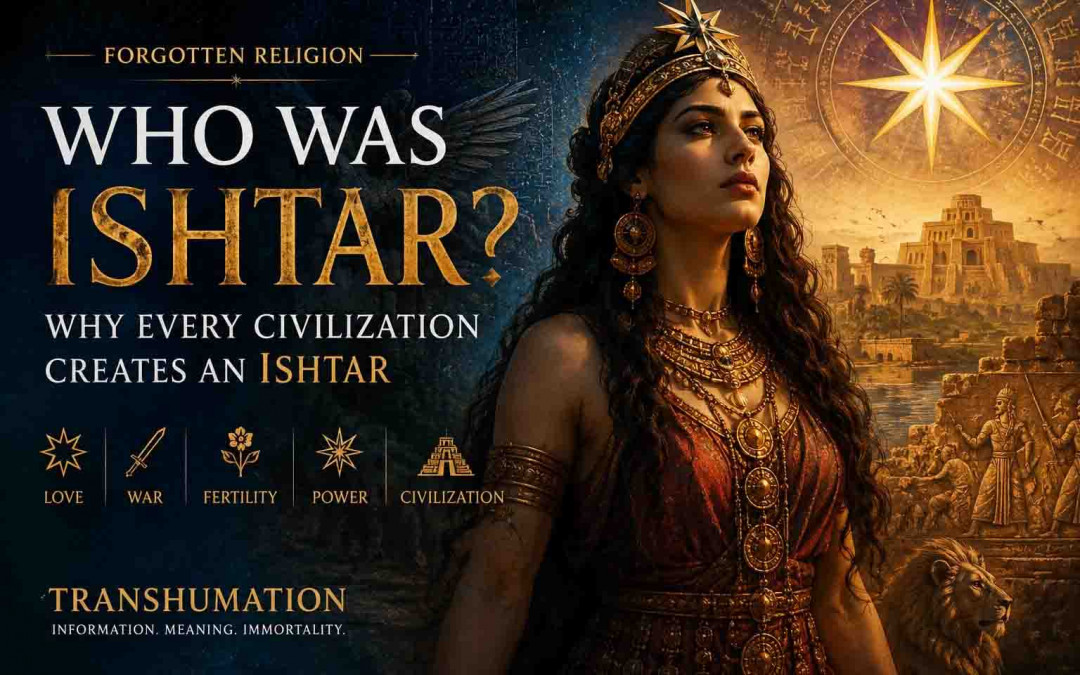
Why Every Civilization Creates an Ishtar
When people hear the name Ishtar, they usually think of an ancient goddess.
A figure from a forgotten religion.
A relic from a world of temples, kings, and myths.
But perhaps Ishtar survived for the same reason that certain stories survive.
Because she was never merely a goddess.
She was a solution.
A symbol for something humanity repeatedly encounters.
A force so fundamental that civilizations keep rediscovering it under different names.
The Goddess of Contradictions
Ishtar was one of the most important deities of ancient Mesopotamia.
She ruled over love.
She ruled over desire.
She ruled over fertility.
Yet she was also associated with war, power, conquest, and ambition.
To modern people this seems contradictory.
How can one goddess represent both love and war?
The answer may be simpler than it appears.
Both are expressions of movement.
Love pulls people toward each other.
Ambition pulls civilizations toward expansion.
Desire pushes individuals beyond their current condition.
War often emerges when competing desires collide.
Behind these different expressions lies the same force:
the refusal to remain still.
The Attraction of the Future
Every civilization depends on something remarkable.
People willingly sacrifice the present for a future that does not yet exist.
Farmers plant seeds.
Builders construct cities.
Parents raise children.
Scientists pursue discoveries.
Artists create works they may never see appreciated.
Why?
Because humans are attracted to possibilities.
We are pulled toward futures that exist only in imagination.
Ancient people expressed this force through myth.
One of the names they gave it was Ishtar.

Why Ishtar Never Disappeared
The temples vanished.
The empires collapsed.
The language changed.
Yet the pattern remained.
Modern societies no longer pray to Ishtar.
Instead they celebrate success.
Innovation.
Beauty.
Influence.
Fame.
Progress.
New technologies.
New frontiers.
The symbols changed.
The underlying force remained remarkably familiar.
Every age creates its own version of Ishtar.
The object of desire evolves.
The mechanism does not.
The Price of Desire
Desire is not always gentle.
This is why Ishtar was associated with both love and war.
The same force that creates civilization can also create conflict.
Every great achievement begins with dissatisfaction.
Someone wants something that does not yet exist.
A better life.
A better city.
A better future.
But desire can also become obsession.
It can produce competition, rivalry, and destruction.
The ancient myths understood this tension.
They recognized that the power driving civilization forward was neither purely good nor purely evil.
It was simply powerful.
Ishtar and Technology
The modern world often imagines itself as completely different from the ancient world.
Yet the similarities are striking.
Ancient people looked toward gods.
Modern people look toward technology.
Both represent visions of transformation.
Both promise a future different from the present.
Both inspire hope.
Both inspire fear.
Every generation creates symbols that embody its aspirations.
In this sense, technology may be accomplishing functions that myths once performed.
Not replacing them.
Continuing them.
Why Every Civilization Creates an Ishtar
The question is not whether Ishtar existed.
The more interesting question is why civilizations repeatedly create figures like her.
The answer may be that certain human problems never disappear.
People need reasons to move forward.
They need symbols that embody possibility.
They need stories that make the future feel real.
Ishtar represented desire.
Not merely romantic desire.
The broader desire that drives exploration, invention, creativity, and growth.
Without that force, civilizations stagnate.
Without that force, history stops.
Perhaps this is why Ishtar never truly vanished.
Like many ancient gods, she may have been less a person than a pattern.
A recurring structure hidden within human nature itself.
And every civilization eventually discovers it again.
The Descent of Ishtar
Yet the most important myth of Ishtar was not her power.
It was her descent.
Because every transformation begins when something is lost before something new can emerge.
Want to Explore More..?
Watch The Video Below
Continue reading…
Descent of Ishtar

FAQ
Who was Ishtar?
Ishtar was one of the most important goddesses of ancient Mesopotamia, associated with love, fertility, desire, power, and war.
What was Ishtar the goddess of?
She was the goddess of love, beauty, sexuality, fertility, political power, and warfare.
Is Ishtar the same as Inanna?
Many historians consider Ishtar to be the Akkadian and Babylonian counterpart of the earlier Sumerian goddess Inanna.
Why was Ishtar important?
She represented forces that shaped human civilization: attraction, ambition, growth, creativity, and conflict.
What does Ishtar symbolize today?
Some modern interpretations see Ishtar as a symbol of desire, aspiration, and humanity’s attraction to the future.
Explore the full journey:
- End of Reality — Where Do You Really Exist?
- End of Physics — Are the Laws of Reality Real?
- End of the Real World — Reality Is No Longer Required
- End of Consciousness — Beyond the Human Mind
- End of Death — When Human Limits Disappear
- End of Religion — When Technology Replaces Faith