
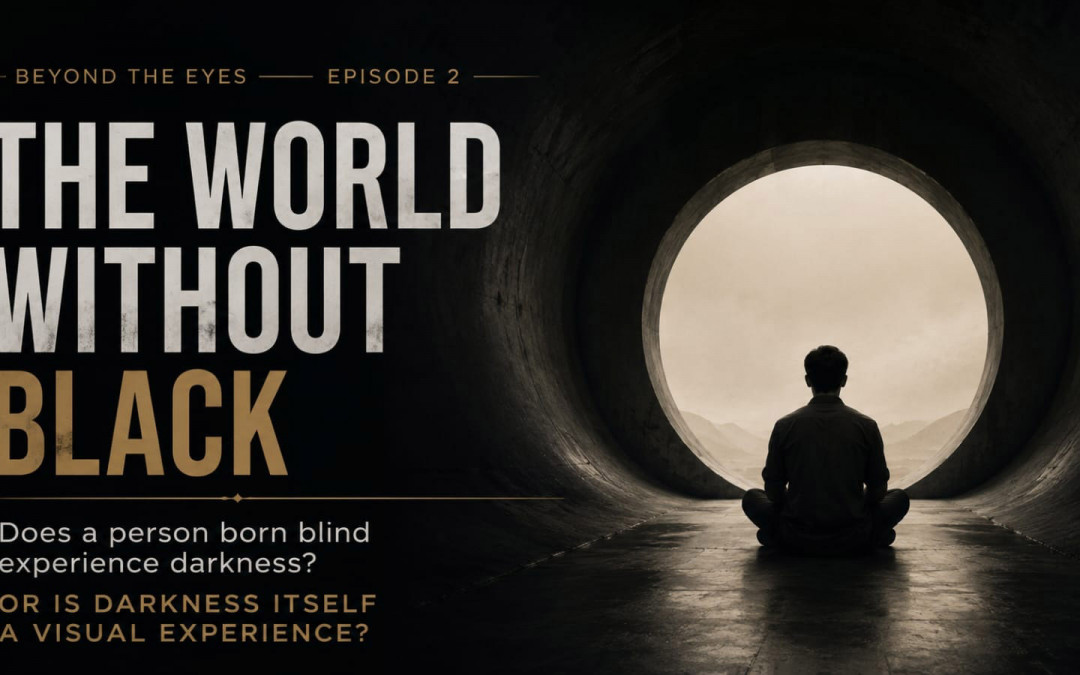
What Happens When an Entire Sense Is Missing From the World
Close your eyes and ask yourself what remains. The ordinary answer arrives almost immediately: darkness. A black field seems to occupy the place where the room had been. There may be faint visual noise, shifting patches, afterimages from the lamp you were looking at a moment earlier, but the general impression is unmistakably visual. The world has gone dark.
Now make the experiment harder.
Do not imagine losing sight tonight. Do not imagine remembering your mother’s face and discovering that you can no longer see it. Do not imagine the lights being switched off inside a familiar theatre. Imagine instead that visual experience had never existed anywhere in your life. No red, no blue, no brightness, no shadow, no horizon, no face remembered as an image. Nothing has been removed because nothing visual was ever there to remove.
What would you see?
The question almost forces the sighted mind toward black.
And that may be the mistake.
Black is not the absence of a visual system. Black is already one of the things a visual system can give us. The difficulty we experience trying to remove vision from imagination may therefore reveal something more interesting than blindness itself. We can imagine an interface being switched off much more easily than we can imagine never possessing the interface at all.
We keep putting a black screen where perhaps there would be no screen.
Darkness Still Belongs to Sight
For a sighted person, darkness can feel like nothing because it contains so little visual information. Yet phenomenologically it is not nothing. Darkness has extension. A dark room can feel cavernous or enclosed. The night sky can appear deep. A black wall still seems to have a location. Even when the eyes are closed, the visual system does not simply cease to exist; neural activity, adaptation, afterimages and other visual phenomena continue.
Black therefore belongs to the vocabulary of vision just as silence belongs to the vocabulary of hearing. Silence is not what it is like never to have had auditory experience. It is an auditory world in which the expected signal is absent or greatly reduced.
That distinction becomes important when talking about congenital blindness. People who have never had functional vision should not automatically be imagined as living inside permanent darkness. The phrase sounds natural to sighted people because darkness is our nearest visual metaphor for no sight, but the metaphor may already smuggle vision back into the description.
There is a difference between seeing nothing and having no visual experience to describe.
The first still invites a picture.
The second may not.
This is almost impossible for a sighted person to simulate from the inside because every attempt at simulation uses a brain whose imagination developed alongside vision.
The black curtain keeps returning because black is one of the materials we own.
Imagination Has a Biography
We speak about imagination as though it were the one place where biological limits finally disappear. In imagination we can fly, stop time, build cities inside stars and resurrect people who died two thousand years ago. Matter seems to lose its authority as soon as the eyes close.
But imagination has a history.
The floating city still has geometry. The god has some relation to body, voice, light, agency or personality. The alien planet receives colors borrowed from terrestrial perception. Even our most radical science fiction tends to construct the unprecedented from transformations of available experience.
This does not reduce imagination to a childish box of recycled images. Human beings can create mathematics, social institutions and conceptual structures for which there is no simple sensory prototype. Language allows thought to move far beyond immediate perception.
Still, phenomenological imagination appears far less free.
Try to invent a color entirely outside human color space. Not a mixture, not an impossible shade between familiar hues, but a genuinely new visual quality. The command seems grammatically sensible while the experience refuses to appear.
Now try to remove vision completely.
Most sighted minds dim the image until it becomes black.
We are remarkably good at rearranging the furniture and surprisingly bad at imagining a room that was never built.
Where Is the Self When the Picture Disappears?
Vision also creates a peculiar geometry of selfhood.
Sighted people often experience the world as opening in front of them from somewhere near the head. The eyes occupy a privileged position in the ordinary sense of perspective. We look outward. Things approach us. Faces appear before us. Dreams are frequently described using cinematic language because visual imagery provides such a powerful metaphor for inner experience.
It is therefore easy to make a subtle mistake and place the self behind the eyes.
Yet losing vision does not ordinarily dissolve personal identity. A blind person still remembers, reasons, plans, fears, loves, recognizes voices, learns and participates in relationships. Vision contributes enormously to the structure of experience, but it is not equivalent to the existence of the person.
This fact does not prove that consciousness is an independent observer sitting somewhere deeper inside the skull.
Neuroscience gives us no evidence for a little witness watching a neural screen.
The more careful conclusion is that conscious identity is not exhausted by one sensory channel.
The visual system contributes information to a much larger biological process involving perception, memory, bodily regulation, emotion, attention and cognition. When visual input is absent, that system reorganizes rather than simply leaving an empty cinema behind.
The observer is therefore probably not hiding behind the eyes.
But neither have we discovered an observer independent of the brain.
That distinction matters enormously.
The Window Metaphor Is Useful Until It Becomes Literal
Calling the eyes an interface is helpful because vision does mediate between physical events and conscious experience. Light reaches the retina. Photoreceptors respond. Neural systems process contrast, motion, color, depth and other information. Eventually a world appears that does not feel like electrical activity inside a nervous system.
The metaphor becomes dangerous when the word interface encourages us to imagine a separate user sitting behind it.
A laptop has a screen and a person looking at the screen. Human perception may not be organized that way.
There may be no little internal spectator.
Seeing could instead be something the integrated organism does.
This is one of the enduring difficulties of consciousness research. We can trace pathways, record neural activity and study the behavioral consequences of damage to particular systems. We can observe how visual perception changes when those systems change.
But explaining the neural conditions associated with experience is not yet the same as explaining why those processes possess a subjective character at all.
The mystery therefore survives without requiring us to invent a ghost.
That is a more interesting position than either extreme.
The eyes are not the person.
But the fact that they are not the person does not make the person independent of biology.
The World Built by Other Senses
A world without vision is not necessarily an impoverished visual world.
It may be organized differently.
Touch becomes important in ways sighted people rarely notice. Sound contains spatial information. Proprioception and vestibular signals contribute to bodily orientation. Language can carry descriptions of spatial and visual concepts that the listener understands conceptually without having the corresponding visual phenomenology.
Research on blindness also reveals the plasticity of the brain. Regions normally associated with visual processing can participate in other functions when visual input is absent early in life. The brain does not simply preserve an unused visual theatre waiting for pictures that never arrive. Development reorganizes around the information actually available.
This is philosophically important because it challenges the assumption that there is one standard world with sensory channels added or removed like options in a menu.
An organism’s perceptual world is partly constructed around the channels it possesses.
Jakob von Uexküll’s idea of the Umwelt becomes useful here: different organisms occupy the same physical environment while living within very different meaningful perceptual worlds.
A bat is not merely a human walking through darkness with an echolocation attachment.
A bee is not a small person whose screen includes ultraviolet.
The perceptual architecture participates in defining what the world is like for the organism.
A person without vision therefore does not necessarily inhabit our world with the picture turned black.
The organization of experienced reality itself can be different.
What Happens When We Build Another Window?
Technology makes this problem practical.
Retinal implants, sensory-substitution systems and other neurotechnologies raise the possibility of restoring or modifying channels of information. Cameras can already detect wavelengths beyond ordinary human vision. Sensors can measure magnetic fields, radiation, chemical concentrations and microscopic processes unavailable to unaided perception.
Normally we translate those measurements back into familiar forms.
Infrared becomes a false-color image.
Radiation becomes a clicking sound.
Magnetic information becomes a number or a vibration.
The unusual phenomenon is converted into an old human alphabet.
But imagine going further.
Suppose a sensor sends information into the nervous system continuously for decades and the brain gradually learns to treat the signal not as a coded vibration but as an effortless part of orientation. The user no longer consciously translates it. The information simply becomes present.
At what point would we stop calling the device an instrument and start calling the resulting capacity a sense?
That question may eventually matter far more than whether a synthetic camera can reproduce ordinary eyesight.
A replacement eye attempts to rebuild the window.
A new sensory system would alter the architecture of the room.
Before Mind Uploading, Find the Mind
The question becomes more difficult when Transhumation approaches personal continuity.
Discussions of mind uploading often begin too late. We imagine scanning memories, reconstructing neural structure, transferring personality and running the resulting model on another substrate. Then we ask whether the person survived.
But the sensory problem reveals an earlier uncertainty.
Which parts of the biological system belong to the thing we are trying to preserve?
We already know that personal identity can tolerate extraordinary changes in sensory input. Vision can be lost. Hearing can change. Prostheses can replace parts of the body. Neural plasticity can reorganize functions. Ordinary life therefore gives us evidence that the self is not identical with one fixed sensory interface.
That is important.
But it is not evidence that the self can survive arbitrary replacement of the entire biological process.
A perfect digital reconstruction might remember the same childhood, recognize the same people and report the same visual memories. If the biological original remained alive beside it, both could sincerely claim the same past.
The question would no longer be whether the reconstruction possessed the correct information.
It would be whether the original first-person continuity had crossed anywhere.
The world without black therefore reaches unexpectedly toward the same boundary as the Julian Experiment.
Changing the window does not obviously destroy the observer.
That does not tell us how much of the house can be replaced before we are talking about another inhabitant.
Watch the Video
How to Read the World
Current Knowledge
Vision depends on specialized biological systems that convert electromagnetic radiation within a limited range into neural activity. Visual experience is not a direct copy of incoming light; it depends on substantial processing throughout the retina and brain.
Black and darkness are visual phenomena for sighted people. Closing the eyes does not reproduce congenital blindness, because the visual system remains active and the person already possesses a lifetime of visual experience. People born without functional vision should therefore not automatically be described as experiencing a permanent black field; the exact perceptual situation also depends on the cause and degree of blindness.
Congenital or early blindness can produce significant neuroplastic reorganization. Brain regions commonly associated with visual processing may participate in tactile, auditory, linguistic or other tasks when ordinary visual input is absent.
Loss of vision does not ordinarily eliminate cognition, memory, emotion or personal identity. This shows that consciousness and personhood cannot be equated with visual input, but it does not demonstrate that consciousness exists independently of brain function.
Current neuroscience strongly links conscious states to brain activity, while the explanatory relationship between neural processes and subjective experience remains philosophically and scientifically unresolved.
Open Questions
One unresolved question concerns the limits of neural plasticity. If entirely new streams of information were connected to the nervous system, could humans develop genuinely novel perceptual qualities, or would the brain always translate them into modifications of familiar sensory categories?
There is also the problem of phenomenology in congenital blindness. Language allows people with radically different sensory histories to share concepts, but conceptual understanding and sensory experience are not identical. How much of another person’s perceptual world can ever be reconstructed from description alone remains uncertain.
The harder question concerns consciousness itself. Neuroscience can increasingly identify systems required for particular forms of perception, but there is no universally accepted theory explaining why specific physical processes are accompanied by subjective experience.
And finally there is the continuity problem. We know that a person can remain recognizably the same individual while important sensory systems change. We do not know which biological or informational changes would eventually cross the boundary from modified person to new person.
Transhumation Interpretation
The World Without Black gives Transhumation a particularly useful warning:
absence is difficult to imagine without borrowing the language of what is absent.
A sighted person tries to imagine no vision and produces black.
We remove the picture but preserve the screen.
That may be a general cognitive habit.
When people imagine death, they often picture themselves observing their own absence. When they imagine nothingness, they give it darkness and space. When they imagine consciousness transferred into a machine, they often preserve an invisible spectator moving from one interface to another as though the existence of that spectator had already been established.
The metaphor quietly supplies the answer before the argument begins.
This is why the sensory interface matters so much.
Transhumation has good reasons to distinguish a person from any one biological channel through which information reaches them. Losing sight does not produce another human being. Replacing a damaged lens does not create another observer. A cochlear implant can change the way information reaches the nervous system without requiring us to imagine the previous person vanished.
But these examples establish continuity through local modification, not independence from biology.
That difference is exactly where serious discussion of uploading should begin.
The useful question is not, “Are the eyes merely hardware?”
The better question is: which transformations can the conscious system absorb while preserving the continuity we care about?
The answer may eventually depend on gradual replacement, causal continuity, embodiment, memory, dynamic organization or features of consciousness we have not yet identified. We should resist deciding in advance that the self is either a metaphysical soul detachable from biology or simply a file waiting to be exported.
The evidence does not justify either shortcut.
The New Theurgy adds another layer because it treats interfaces as central objects of inquiry. Human beings have always expanded their contact with realities larger than ordinary perception through instruments, symbols and systems. The telescope extends the visual range. Mathematics makes invisible relations legible. Artificial intelligence can identify patterns too complex for unaided cognition and translate them back into language.
Yet almost every technological extension eventually returns to the same biological doorway.
A machine detects something unfamiliar.
Then it turns the result into a color.
A sound.
A graph.
A sentence.
We keep enlarging reality while preserving the ancient human receiving equipment.
That may eventually change.
If future neurotechnology allows new signals to become directly integrated into perception, humanity may encounter a transformation deeper than simply seeing farther. We might acquire categories of experience for which our present language has no native vocabulary.
That would not prove that consciousness is separable from the body.
It would prove something more modest and perhaps more consequential: the human interface to reality is editable.
And once the interface becomes editable, questions we currently treat as philosophical abstractions begin to become design decisions.
What information should become intuitive?
Which channels should remain separate?
Could an artificial sense reshape emotion or identity?
Would a person raised with a new modality experience the same world we do?
At that point, “What does blindness look like?” becomes the wrong kind of question for a larger reason.
It assumes that every possible consciousness must contain our visual architecture somewhere, even if it is dark.
Perhaps the real lesson of the world without black is that we are very poor at imagining consciousness without secretly rebuilding ourselves inside it.
We picture the window closed.
The harder task is imagining a house whose architecture never included that window.
That is where the thought experiment becomes valuable.
Not because it reveals a hidden observer behind the eyes.
Because it reveals how easily the observer mistakes the structure of its own interface for the structure of reality.
FAQ
What does someone born blind “see”?
There may be no useful visual answer. Describing congenital blindness as “seeing black” can be misleading because black itself is a visual quality. Individual experiences also vary depending on residual vision and the cause of blindness.
Is closing your eyes similar to blindness?
No. A sighted person with closed eyes still has an active visual system, visual memory and often faint visual phenomena. It is not a simulation of never having possessed vision.
Are the eyes just an interface?
They are part of the biological system through which visual information reaches and is processed by the nervous system. Calling them an interface can be useful, provided it does not imply a separate little observer sitting behind them.
Could technology create an entirely new human sense?
Possibly. Sensory substitution and neural plasticity show significant flexibility, but whether genuinely novel channels could generate entirely new kinds of subjective experience remains unresolved.
Does blindness show that consciousness exists independently of the body?
No. It shows that consciousness is not identical with vision. Current evidence still strongly associates conscious experience with functioning brain systems.
What is the deeper Transhumation question?
It is not simply whether we can replace an eye or build a better sensor.
It is whether we can change the architecture through which reality becomes experience while preserving the same continuing person.
The black screen was never the mystery.
The mystery is why we assumed there had to be a screen at all.
Continue the Transhumation Series
- Forgotten Religion | Ancient Gods, Symbols and the Hidden Structures of Human Civilization
- The Last Religion | Death, Immortality and the Future of Humanity
- The New Theurgy | AI, Information and the Future of Human Civilization
- End of Branding: You Were Never Meant to Become a Product
- Baal vs Ishtar: Why Ancient Gods Never Disappeared