
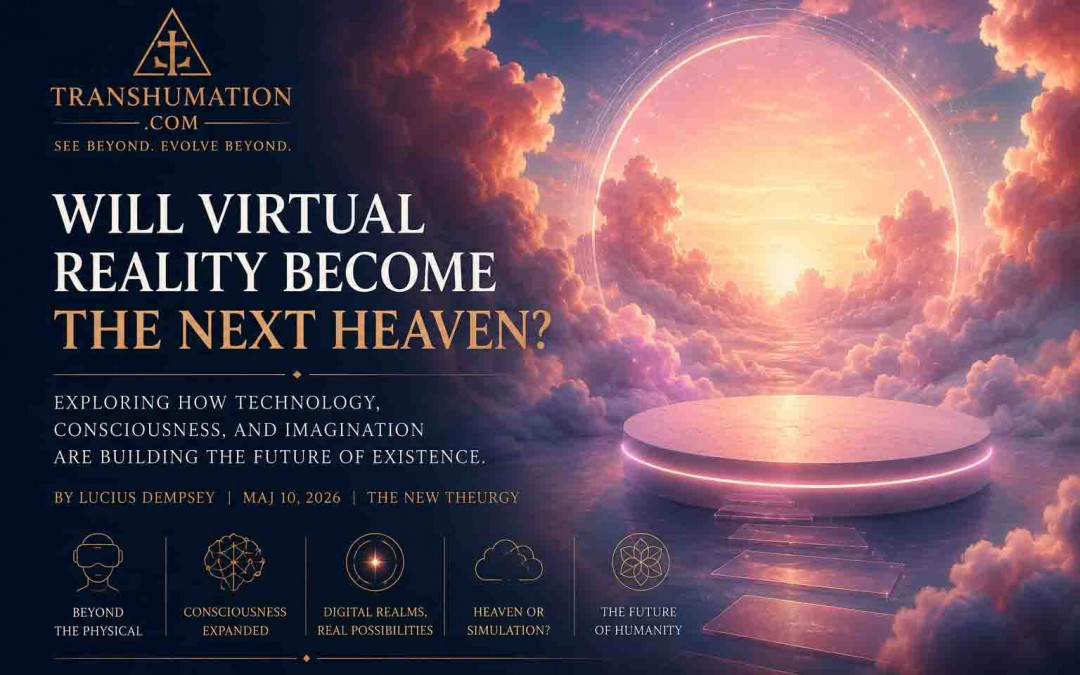
When Paradise Becomes an Interface
A person puts on a plastic headset in an ordinary room.
The carpet remains underneath their feet. A radiator stands against the wall. Somewhere behind them there may be an unwashed coffee cup, a charging cable and a window looking onto a parking lot. Then the screen comes alive. The ceiling disappears. The room opens onto an ocean, a city that never existed, a reconstructed childhood home or a mountain no human body could conveniently reach. Gravity can be changed. Distance can be abolished. Appearance can be edited. The dead cannot yet be brought back, but their voices and faces can increasingly be reconstructed from what they left behind.
Measured against the Egyptian pyramids or the frescoes of medieval paradise, the headset looks almost offensively unimpressive.
Yet the comparison is worth making.
For most of human history, the worlds beyond ordinary human limitation had to be imagined, narrated, painted, prayed toward or promised. Their geography varied enormously. There were fields of the blessed, ancestral realms, celestial cities, reincarnations, gardens, heavens and states that did not resemble places at all. It would be absurd to reduce all of them to one idea of technological immortality. But across many traditions appears a recurrent human gesture: the construction of a reality in which some of the conditions governing ordinary life no longer apply.
Modern technology has introduced a strange variation on that gesture.
We have begun constructing the worlds ourselves.
Paradise Was Never One Place
The word heaven gives the illusion of a universal concept where none really exists. Ancient Egyptians did not imagine post-mortem existence exactly as Christians later would. Greek philosophers could speak about immortality in ways very different from popular religious mythology. Christian paradise itself developed through theology, scripture, art and centuries of interpretation. Other traditions have understood liberation not as the indefinite continuation of an ordinary individual personality but as transformation, reunion, release or escape from the very attachment to self that modern technological immortality often seeks to preserve.
What matters here is therefore not whether every religion secretly anticipated virtual reality.
They did not.
The interesting continuity lies deeper. Human cultures repeatedly imagined modes of existence in which the apparent finality of the present condition was challenged. The body could be restored, transformed or transcended. Distance between the living and dead might disappear. Justice unavailable in ordinary history might become possible elsewhere. Pain could end. Identity could endure or be radically changed. The limitations of the visible world were not necessarily the limitations of reality itself.
Technology approaches these questions without requiring a metaphysical answer.
A virtual environment does not need to establish whether heaven exists in order to imitate one small property traditionally associated with transcendence: the ability to inhabit a world whose rules are not identical to those of the immediate physical environment.
That is already philosophically unusual.
The First Programmable Afterworlds
Virtual reality is often discussed as a better screen. That may eventually prove to be as misleading as describing the early internet as a faster postal service.
The more consequential development is not visual realism but persistence. A digital environment becomes culturally different when it does not disappear after the game ends; when people maintain identities there, own objects, establish relationships, attend events, work, remember, create reputations and return to places that possess a history independent of any single session. At that point the environment begins acquiring some of the properties we ordinarily associate with a world.
This does not make it immaterial. Every virtual landscape depends on very physical things: processors, electricity, cables, cooling systems, servers, mineral extraction and biological users whose eyes and nervous systems remain inside bodies. The digital world is not outside nature. It is an arrangement occurring within it.
But from the perspective of experience, something important changes.
The environment becomes increasingly negotiable.
A physical mountain cannot be moved because a visitor dislikes the view. A virtual mountain can. A biological face carries inherited anatomy, age, injury and history. A digital representation can be redesigned in seconds. Physical geography makes London and Tokyo distant. A shared virtual room can make their occupants appear to sit beside one another.
For the first time, humanity is beginning to inhabit environments in which important features of reality are not merely discovered.
They are selected.
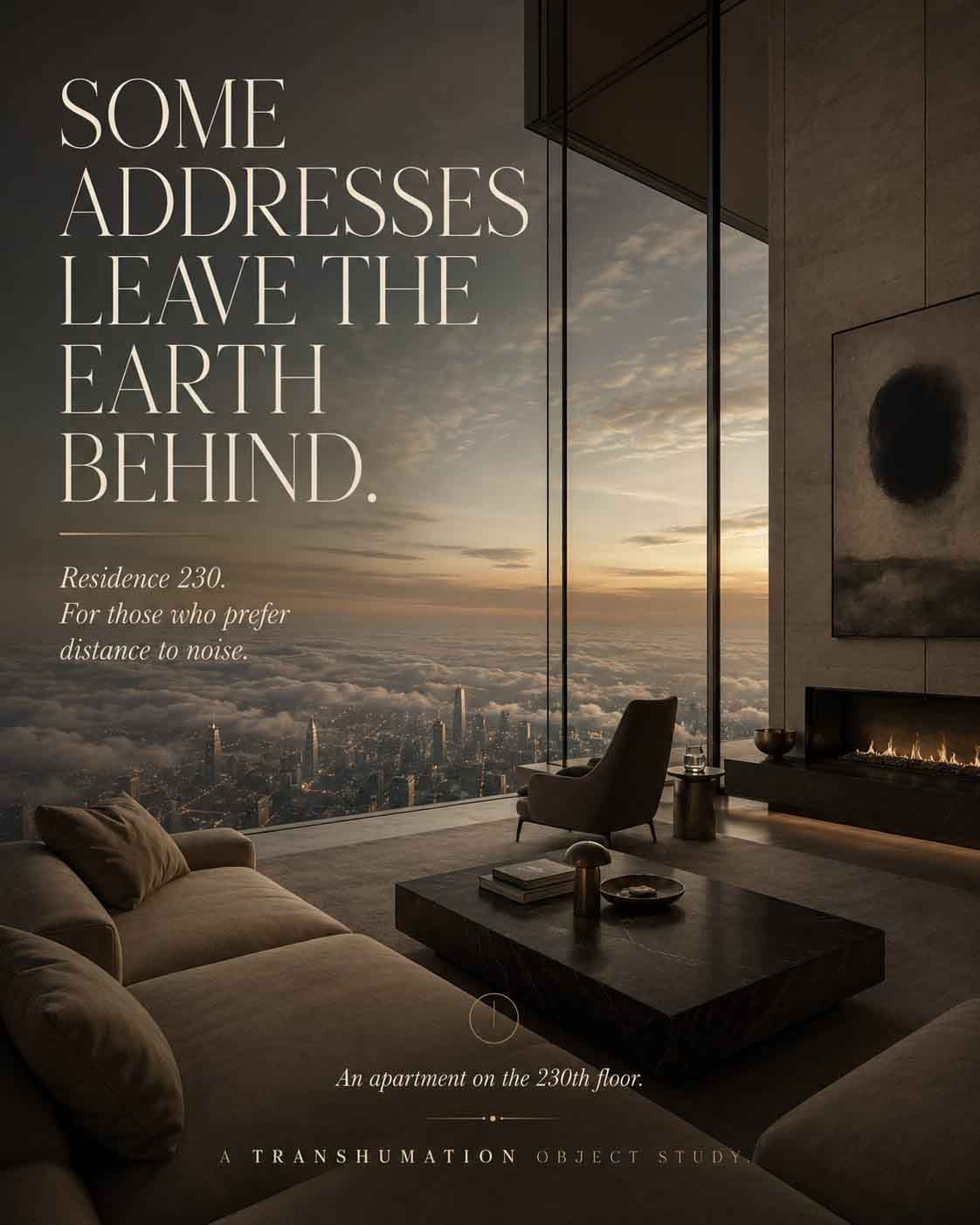
The Soul Becomes a Design Problem
This is where the old language of the soul begins to encounter the new language of identity.
A religious soul and a digital identity are not equivalent. One belongs to metaphysics and theology; the other to information systems, psychology and technology. Treating them as interchangeable would solve nothing.
Yet digital civilization is gradually forcing us to ask questions once associated primarily with philosophy and religion. How much can change while a person remains the same person? Does identity reside in the body, memory, continuity, social recognition or some combination of them? If a voice, face, preferences, writings and patterns of conversation can survive someone, what exactly has survived? At what point does representation become simulation, and could simulation ever become continuation?
We are already constructing primitive versions of this problem without possessing anything resembling a digital soul.
Photographs preserve appearance. Recordings preserve voice. Message archives preserve fragments of thought. Social platforms preserve networks of relationships. Artificial intelligence can increasingly reproduce stylistic and behavioral features from stored information. Avatars allow individuals to maintain recognizable identities through bodies that do not resemble their biological ones.
None of these things demonstrates survival after death.
Together, however, they reveal that the social identity of a human being can already persist in structures that are not identical to the biological body.
The important distinction is between preserving evidence of a person and preserving the person who experiences.
Technology is becoming remarkably good at the first.
We have no reason yet to believe it can accomplish the second.
Heaven Has an Infrastructure Problem
One of the most revealing things about technological transcendence is how mundane its requirements become once the poetry is removed.
A digital paradise would need electricity.
It would need maintenance, cybersecurity, access rules, storage, ownership, redundancy and somebody responsible for deciding what happens when a server fails. It would need governance. If millions of people inhabited persistent virtual environments, somebody would determine whether property could be confiscated, whether identities could be copied, whether memories could be erased, whether unpleasant experiences could be excluded and whether inhabitants had a right to leave.
The ancient problem of paradise would become an administrative problem.
This is more important than it sounds because perfection is much easier to imagine than to govern. A world without danger may become unbearably sterile. A world where every desire is instantly fulfilled may make desire itself meaningless. A world where nobody can permanently lose anything may transform courage, sacrifice and attachment. If death disappears while memory remains unlimited, the psychological consequences could be stranger than immortality enthusiasts usually admit.
Even heaven requires a theory of human nature.
Once an environment is programmable, every limitation becomes a decision.
Whoever writes the rules begins doing something gods once did in mythology: establishing the conditions under which inhabitants are allowed to exist.
The Dead May Arrive Before Immortality
The first great cultural collision between virtual reality and death may not involve uploaded consciousness at all.
It may involve representations of the dead.
A future descendant could enter a reconstructed family home and speak with an artificial model trained on decades of photographs, messages, recordings and personal documents belonging to someone who died long before. The model might remember family stories, reproduce characteristic humor and answer in a familiar voice. With sufficiently rich data, the experience could become emotionally convincing in ways a photograph never could.
The technological achievement would be extraordinary.
The ontological achievement would remain uncertain.
A system behaving like your grandfather does not establish that your grandfather is present. A perfect memorial can still be a memorial. The distinction may become increasingly difficult to feel even if it remains philosophically decisive.
This creates a strange possibility. Civilization may become capable of constructing persuasive afterlives before it possesses any evidence that anyone has actually survived into them.
The ancient tomb preserved the name.
The photograph preserved the face.
The recording preserved the voice.
The artificial environment may preserve the encounter.
That is not resurrection.
But it is no small transformation of death.
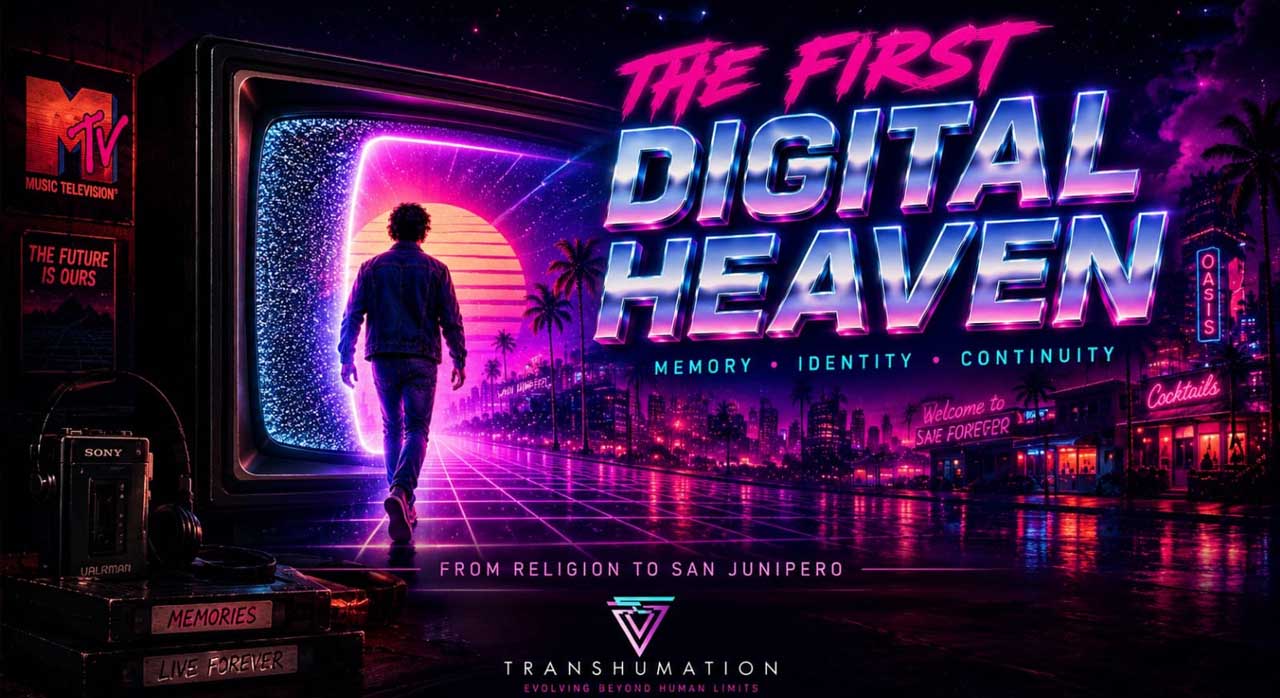
The End of Biology Is the Wrong Prediction
It is fashionable to describe this future as the end of biology. The phrase is dramatic and probably wrong.
Human technology has almost never eliminated an older layer simply because a new one appeared. Writing did not abolish speech. Photography did not abolish painting. The internet did not abolish physical cities. Artificial intelligence has not made the human nervous system irrelevant.
More often, civilization adds layers.
Biology may therefore become less exclusive without becoming obsolete. Neural interfaces could connect biological cognition more closely with external systems. Prosthetics could replace functions. Virtual environments could become permanent extensions of social life. Artificial agents could become persistent participants in personal identity. Over decades, the distinction between where the person ends and where the technological environment begins might become less obvious.
None of this requires a dramatic morning on which humanity “becomes digital.”
The transition could be much stranger precisely because it feels ordinary.
People may one day discover that they spend significant portions of meaningful life in programmable environments in roughly the same way modern people discovered that much of their memory, communication and social existence had moved onto networks: not through a ceremony, but through convenience.
Civilization rarely notices a new world on the day it enters one.
When Paradise Becomes a Choice
The most important question about a technological heaven is therefore not whether virtual reality will eventually become beautiful enough to resemble paradise.
Beauty is the easy part.
The harder problem begins when reality itself becomes configurable.
Which suffering should remain possible? Should embarrassment be erasable? Should people be allowed to inhabit bodies incapable of injury? Should grief exist in a world where representations of the dead remain permanently available? If an artificial environment can satisfy nearly every preference, what happens when inhabitants disagree about what reality should be?
A traditional heaven could be imagined as perfect because its designer was beyond appeal.
A technological heaven would be built by committees, corporations, engineers, users, governments and competing philosophies of the good life.
It would therefore inherit the oldest political question in a new form:
Who gets to design paradise?
Perhaps this is where virtual reality becomes most interesting to Transhumation. Not as proof that religion was primitive technology, and not as evidence that biological death is about to disappear, but as a new stage in a very old human experiment.
For thousands of years we imagined worlds beyond our limitations.
Now, for the first time, we are beginning to build worlds in which some limitations are optional.
The difference between heaven and virtual reality remains enormous.
But one boundary has already moved.
Paradise used to be something the living could only describe.
Now we have begun writing the settings.
Watch The Video
How to Read the World
Current Knowledge
Virtual reality currently uses computer-generated sensory environments to create experiences of presence in simulated spaces. Contemporary systems remain dependent on biological sensory processing and physical infrastructure; there is no evidence that human consciousness leaves the body or exists independently within a virtual environment.
Persistent digital environments already support social interaction, education, training, entertainment, artistic creation and forms of remote collaboration. Researchers have also explored VR in areas including rehabilitation, pain management, exposure therapy and clinical training, although effectiveness varies by application and implementation.
Digital systems can preserve photographs, recordings, written communication and other information associated with an individual. Artificial intelligence can generate speech, images and conversational behavior resembling a person when sufficient source material is available. These capabilities do not demonstrate persistence of that person’s subjective consciousness.
Brain-computer interfaces can record or stimulate limited neural activity and have enabled important experimental and clinical applications, particularly for restoring communication or motor functions. They currently provide nothing comparable to transferring a complete human mind into a virtual environment.
There is no demonstrated technology capable of uploading human consciousness, preserving subjective awareness after irreversible biological death or establishing that consciousness can exist independently of a functioning physical substrate.
Open Questions
It remains unknown whether consciousness depends on specifically biological properties of the brain or whether an equivalent organization could support subjective experience in another physical substrate. Even if artificial consciousness eventually becomes possible, this would not automatically establish that an existing human consciousness could be transferred into it.
Persistent virtual worlds also create unresolved questions about identity. If people maintain several bodies, names or versions of themselves across different environments, it is unclear how psychological and legal concepts of identity will adapt. The problem becomes significantly harder if future systems can generate autonomous representations of deceased individuals.
Another unresolved issue concerns human motivation. Many concepts of paradise remove suffering, scarcity and death, but much of human meaning has developed in response to limitation. It is uncertain what happens psychologically in environments where consequence can be reversed, bodies replaced and scarcity artificially controlled.
There is also a political problem concealed inside the technological one. Programmable worlds require designers. Whoever determines the rules of a persistent digital environment acquires unusual power over identity, property, visibility, memory and permissible experience. A technically convincing paradise could therefore still become a socially intolerable world.
Transhumation Interpretation
Transhumation does not interpret virtual reality as evidence that ancient religions were secretly describing computers. That would collapse radically different traditions into a convenient modern metaphor.
The more interesting pattern is carrier-independent.
Human civilization repeatedly constructs structures through which experience exceeds the immediate limitations of the biological individual. Writing allowed thoughts to survive their speakers. Painting allowed absent places to become present. Theatre temporarily replaced one reality with another. Books allowed readers to inhabit minds separated from them by centuries. Cinema manufactured memory for events that never occurred. Networks made distant people behave as though they occupied a common room.
Virtual reality adds another step.
The interface begins surrounding the observer.
That matters because an interface does not merely show reality. At sufficient depth it can begin determining which reality is available to experience. Once bodies, spaces and physical laws become programmable inside persistent environments, the distinction between representing a world and inhabiting one becomes increasingly important.
This is the Transhumation question hidden inside the idea of a technological heaven: what happens when humanity becomes capable not only of interpreting reality but of engineering the conditions under which reality is experienced?
The answer may have little to do with immortality at first.
But eventually the two questions meet.
If human identity can become increasingly integrated with persistent non-biological environments, then the old boundaries between body, memory, place and self may become less stable. Whether consciousness can ever cross the final boundary of biological death remains completely unknown.
Perhaps it never will.
But even without immortality, something historically strange has already begun.
Humanity spent millennia asking what kind of world might exist beyond this one.
We are entering an age in which the more dangerous question may be:
What kind of world would we build if we were allowed to choose?
FAQ
What is a “virtual reality heaven”?
It is a speculative idea in which advanced virtual environments reproduce some qualities traditionally associated with paradise, such as freedom from ordinary physical limitations, customizable bodies, persistent social existence or environments designed around human preference. It does not imply that religious heaven and virtual reality are the same thing.
Does VR allow consciousness to leave the body?
No. Present virtual reality changes sensory experience while consciousness remains dependent on the user’s functioning brain and body.
Is virtual reality becoming more than entertainment?
Yes. VR is also used and studied in education, professional training, rehabilitation, therapy, remote collaboration and social interaction. Its broader importance may eventually come from persistent environments rather than individual games or simulations.
Could people eventually live much of their lives in virtual worlds?
Technologically, increasingly immersive and persistent digital environments are plausible. Whether people will choose to organize a major portion of social, economic or personal life inside them is a cultural question as much as a technical one.
Can AI recreate dead people inside virtual reality?
AI can already imitate limited aspects of a deceased person’s appearance, voice or conversational style when recordings and other data are available. Future reconstructions could become far more convincing, but resemblance would not prove that the original person had survived.
Would a perfect digital reconstruction count as resurrection?
Not according to anything currently established scientifically. A reconstruction could preserve information and behavior while remaining a new system. Whether subjective personal continuity could ever be preserved is a separate unresolved problem.
Is transhumanism a form of religion?
Not necessarily. Transhumanism is a diverse set of ideas concerning the use of technology to alter or extend human capacities. It nevertheless intersects with questions historically explored by religions, including mortality, transformation, human limits and possible forms of existence beyond the present condition.
Could a virtual world eliminate suffering?
It could potentially eliminate or reduce particular physical constraints inside the simulation, but suffering is not only physical. Boredom, rejection, status competition, grief, conflict, meaninglessness and psychological distress could remain even in an environment with perfect scenery and programmable bodies.
Would heaven still feel like heaven if nothing could go wrong?
That is a philosophical problem rather than a technical one. Human meaning often depends on difficulty, uncertainty, sacrifice and consequence. Removing every constraint might not automatically produce a desirable form of existence.
Who would control a technological paradise?
Any real virtual world would require ownership, governance and technical administration. Questions about access, identity, censorship, property, memory and modification would therefore become central. A programmable paradise would also be a political system.
Could consciousness eventually exist entirely inside a virtual environment?
We do not know. Current evidence strongly connects human consciousness to brain function. Whether subjective experience could be implemented in a non-biological substrate remains unresolved.
What is the difference between a digital world and an afterlife?
A digital environment is a technologically produced physical system whose experiences are generated computationally. An afterlife is a metaphysical or religious claim about existence beyond biological death. Future technology could imitate some experiences associated with imagined afterlives without establishing that an afterlife exists.
What would have to happen before “VR heaven” became something more than metaphor?
At minimum, virtual environments would need to become persistent and deeply integrated with personal identity rather than temporary simulations. A much stronger version would require evidence that human subjective consciousness itself could continue within such an environment rather than merely being represented there.
What is the deeper Transhumation question?
It is not whether humanity can manufacture clouds, angels or eternal sunsets convincingly enough to call them heaven. Those are problems of graphics.
The serious question begins when the environment becomes an interface for existence itself. If bodies can be selected, distance rewritten, identity extended and parts of the experienced world programmed, humanity acquires a power normally hidden inside mythology: the power to decide which limitations belong to reality and which belong only to its current design.
At that point we may discover that building paradise was never the difficult part.
The difficult part was deciding what paradise should allow us to become.
Continue the Transhumation Series
- Forgotten Religion | Ancient Gods, Symbols and the Hidden Structures of Human Civilization
- The Last Religion | Death, Immortality and the Future of Humanity
- The New Theurgy | AI, Information and the Future of Human Civilization
- End of Branding: You Were Never Meant to Become a Product
- Baal vs Ishtar: Why Ancient Gods Never Disappeared