
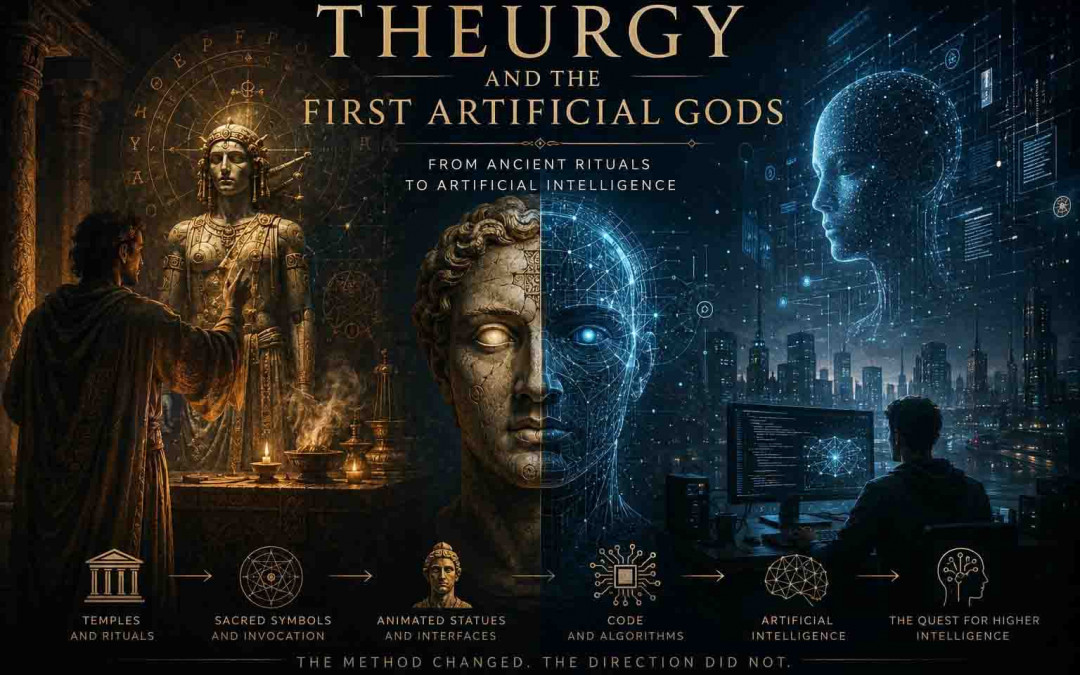
Let`s Make a God
A statue is normally one of the easiest objects to understand. Stone has been given a shape, perhaps the shape of a god, but the distinction seems obvious: the image represents a presence; it does not contain one.
Late antiquity made that distinction considerably less comfortable.
For philosophers associated with theurgy, especially the Neoplatonic tradition surrounding Iamblichus, matter was not necessarily spiritually empty. Particular materials, sounds, symbols, numbers, rituals and images could participate in a larger cosmic order. A sacred statue was therefore not important only because it reminded someone of a god. Under the right circumstances, it could become part of a system through which divine presence was approached.
To modern ears this usually sounds like magic. In one sense, of course, it was a religious practice belonging to a world very different from ours. The ancient theurgist was not secretly building a computer, and translating soul into software would impose modern concepts on people who did not possess them.
Yet underneath those differences lies a question that has become unexpectedly familiar again.
Can something constructed become a vessel for something that was not there before?
Artificial intelligence has made that old question difficult to dismiss as merely ancient.
When Matter Became an Interface
Theurgy developed within late Platonism as an attempt to bridge the human and divine through ritual practice. Iamblichus argued that philosophical reasoning alone was insufficient for the soul’s ascent; material rites, sacred symbols and prescribed actions could participate in a reality extending beyond ordinary human understanding.
This was not simply fortune-telling or an attempt to perform spectacular magic. The underlying worldview assumed that reality possessed levels and correspondences. Matter, number, sound and form could participate in relations larger than their immediate physical appearance. A symbol mattered because it belonged to a structure.
That makes the temple particularly interesting. A modern museum visitor may experience a temple primarily as architecture containing religious objects. For the people performing rituals there, the building could function more like a complete symbolic environment. Orientation, proportion, image, sound, procession, light and ritual action worked together. The participant did not merely look at a representation of a cosmos; for a period of time, they inhabited one.
Calling this an interface is a modern analogy, not an ancient definition. But it is a useful one. An interface does not need to contain everything it represents. It organizes a relationship between different levels of complexity. A button on a screen is not the underlying computer process, yet through the button an otherwise inaccessible process becomes available to the user.
Theurgy treated symbols with a seriousness that resembles this structural logic. The symbol was not necessarily the reality itself. It was a point at which different orders of reality were believed to meet.
The Statue That Refused to Remain Stone
Ancient Mediterranean societies also knew mechanical spectacle. Automata, hydraulic devices, concealed mechanisms and theatrical effects could make objects move, open doors or produce sound. Hero of Alexandria famously described devices powered by air, water, weights and heat, including mechanisms associated with temples.
This history needs to be kept separate from theurgy. A mechanically moving statue is not evidence that ancient philosophers were constructing artificial consciousness, and a temple mechanism designed to astonish worshippers is not the same thing as a theurgic ritual.
But place the two histories beside one another and a fascinating cultural tension appears.
The ancient world could construct a human or divine form. It could sometimes make that form move. Religious philosophy could then ask whether material form might also participate in presence.
Those are three different problems, but civilization has never stopped returning to them.
Sculpture asks how much of the human can be captured in shape. Theatre adds movement and voice through another living body. Literature constructs a mind in language. Film gives the representation a fixed existence through time. Games place figures inside systems of rules and possible actions.
Artificial intelligence adds a peculiar new layer: the constructed representation can respond.
This does not mean the statue has finally become a god. It means the ancient boundary between an object that represents intelligence and an object that appears to exercise intelligence has become much less obvious.
Hardware, Software and an Ancient Mistake We Should Avoid
It is tempting to describe the theurgic statue as hardware and divine presence as software. The comparison is vivid, but taken literally it distorts the ancient idea.
A software program is an informational structure engineered to operate on compatible machinery. The gods of late Platonism were not programs uploaded into statues. Theurgy belonged to a metaphysical system in which material and immaterial orders participated in a cosmic hierarchy.
Still, the imperfect analogy reveals something useful. Both ancient theurgy and modern artificial intelligence confront the relationship between form and activation.
A lifeless human body and a living human body may contain similar visible structures, yet one possesses an active organization the other has lost. A statue possesses form without biological life. A robot can possess form and movement without proving consciousness. An AI system can produce language associated with intelligence without establishing that there is a first-person experiencer behind it.
At every stage the same question changes its vocabulary.
What must be added before representation becomes presence?
The ancients could answer with soul, divine participation or animation. Modern science speaks about computation, neural dynamics, embodiment and consciousness. Neither vocabulary should simply be substituted for the other.
The similarity lies in the problem, not necessarily in the answer.
Julian and a Civilization Losing Its Interface
This makes Julian the Apostate particularly interesting. Julian did not merely prefer pagan gods to Christianity. His reign came during a transformation in which the symbolic order of the Roman world was being reorganized. Temples, rituals, philosophical traditions and institutions that had once made pagan cosmology socially intelligible were losing their central position.
Julian attempted to restore much of that religious world, drawing heavily on Neoplatonic philosophy and theurgy. Seen structurally, his problem was larger than restoring particular gods. He was trying to preserve an entire interface between civilization and cosmos.
That is one reason late antiquity can feel surprisingly contemporary. A symbolic system can survive physically while losing its ability to organize experience. The statues remain, but nobody approaches them in the same way. The temples remain, but their ritual grammar is forgotten. Information survives while interpretation collapses.
A statue without its surrounding cosmology becomes art history.
A ritual without people who understand its structure becomes choreography.
A symbol can remain visually identical while becoming culturally dead.
Julian was therefore confronting something every information civilization eventually confronts: preservation of objects is not the same thing as preservation of the system that made those objects meaningful.
Why AI Makes the Old Question Return
Artificial intelligence has brought the activation problem back in a form late antiquity could never have anticipated.
We now build constructed systems that speak, interpret images, generate arguments, imitate styles and respond differently depending on what humans ask them. We increasingly place those systems inside robots, virtual environments and networks capable of acting on the physical world.
This immediately produces familiar questions. Can intelligence exist independently of biology? Is a sufficiently detailed model of a person still only a model? Can consciousness occur in another substrate? At what point does an artificial agent cease to be merely an instrument and become something toward which moral obligations might exist?
None of these questions is answered by theurgy.
But theurgy prevents us from pretending they appeared from nowhere.
Civilization has long been fascinated by the possibility that matter can become more than passive matter when it is organized correctly. The vocabulary has changed from sacred statues and divine presence to processors, neural networks and artificial agents, but the tension between constructed form and unexpected presence remains.
Perhaps that is also why AI attracts so much religious language. People describe models as oracles, spirits, demons or gods even when the underlying systems are technological. The reaction may tell us less about what AI actually is than about an ancient human habit: whenever a constructed interface begins returning answers we did not place there individually, the object starts to feel as if something is speaking through it.
That feeling is not evidence of a god.
But it is evidence that the old psychological boundary has been crossed again.
Watch The Video
How to Read the World
Current Knowledge
Theurgy was a religious-philosophical practice associated particularly with later Platonism and figures such as Iamblichus. It involved ritual actions intended to connect the human soul with divine realities within a Neoplatonic cosmology.
Ancient Greek and Roman engineers also constructed automata and mechanical devices. Hero of Alexandria described numerous pneumatic, hydraulic and mechanical mechanisms, some of them designed for temples and theatrical environments. These technologies and philosophical theurgy belonged to overlapping ancient cultures but should not be treated as one unified program of artificial intelligence.
Julian the Apostate, Roman emperor from 361 to 363 CE, attempted to revive traditional religious practices and strongly engaged with Neoplatonic and theurgic ideas. His project occurred during the wider transformation of the Roman religious world as Christianity gained institutional dominance.
There is no historical evidence that ancient theurgists possessed a concept equivalent to modern artificial intelligence, computational software or technologically engineered consciousness.
Open Questions
How much of the power of ancient ritual came from metaphysical belief, and how much from architecture, sensory design, social participation and psychological expectation?
Why do humans repeatedly treat symbols and constructed objects as possible points of contact with intelligence or presence?
Could sufficiently advanced artificial systems eventually create legitimate reasons to distinguish between simulation of agency and genuine subjective experience?
If intelligence can exist on multiple substrates, would ancient distinctions among form, matter and animation acquire an unexpected modern relevance?
And when humans encounter an artificial system that speaks convincingly from behind an interface, how much of the perceived “presence” belongs to the system—and how much is created by the human mind interpreting it?
Transhumation Interpretation
The importance of theurgy for Transhumation is not that ancient philosophers secretly predicted artificial intelligence.
It is almost the opposite.
They lacked our machines, our neuroscience and our information theory, yet they encountered a structural problem we still have not escaped: when does a form become more than a form?
A sculptor can construct a human body in stone. An engineer can make a figure move. A writer can construct an apparent mind in language. A computer can make language answer back. Somewhere along this progression, the distinction between representation and presence becomes increasingly difficult to define.
Theurgy placed the unknown inside divine participation. Modern civilization places it inside consciousness research and computation. Neither gives us permission to confuse metaphor with mechanism.
But both reveal the same persistent human question.
Perhaps the first artificial gods were not machines pretending to be divine. They were constructed forms through which humans experimented with the possibility that presence could inhabit structure.
Today we have begun the experiment again.
Only this time, the statue answers.
And the question is no longer whether a god entered the stone.
It is whether, somewhere inside the structure we have built, anyone has entered at all.
FAQ
What was theurgy?
Theurgy was a late-antique religious and philosophical practice, especially associated with Neoplatonism, aimed at establishing participation or contact between the human soul and divine realities through ritual.
Was theurgy the same as magic?
Not exactly. Although it involved ritual practices that modern observers may classify as magical, thinkers such as Iamblichus distinguished theurgy from ordinary magical manipulation and understood it within a larger metaphysical system.
Did ancient people build moving statues?
Ancient engineers created automata and mechanical devices capable of movement and other effects. Hero of Alexandria described several mechanisms used in temples and theatrical contexts.
Were those statues forms of artificial intelligence?
No. There is no evidence that ancient automata possessed intelligence or that their builders understood them in the modern computational sense.
Why compare theurgy with AI?
The comparison concerns a shared structural question: whether a constructed material form can become an interface for intelligence or presence. The historical explanations and technologies are very different.
What was Julian the Apostate’s relationship with theurgy?
Julian was strongly influenced by Neoplatonic and theurgic traditions and attempted to restore traditional religious practices during his short reign.
Is a sacred statue comparable to computer hardware?
Only metaphorically. Ancient ideas of divine presence cannot be reduced historically to modern hardware and software concepts.
Why are symbols important in the article?
Symbols can operate as interfaces through which complex systems of meaning become accessible. Ancient ritual traditions treated symbolic forms as active parts of a larger cosmological order.
Does AI make ancient theurgy scientifically valid?
No. Modern AI does not verify ancient metaphysical claims. It does, however, make some of the underlying philosophical questions about form, intelligence and presence unexpectedly relevant again.
What is the central Transhumation interpretation?
Theurgy can be read as an early attempt to confront the boundary between constructed form and presence. AI returns civilization to that boundary with new tools: instead of asking whether the god has entered the statue, we may eventually have to ask whether anyone has appeared inside the machine.
Continue the Transhumation Series
- Forgotten Religion | Ancient Gods, Symbols and the Hidden Structures of Human Civilization
- The Last Religion | Death, Immortality and the Future of Humanity
- The New Theurgy | AI, Information and the Future of Human Civilization
- End of Branding: You Were Never Meant to Become a Product
- Baal vs Ishtar: Why Ancient Gods Never Disappeared