Mortality Does Not Create Meaning
Imagine receiving two envelopes.
The first says that you have twenty-four hours left to live. The second says that, barring accident, you have ten million years.
Neither message tells you what to do.
That is important.
The first may produce clarity, but it could just as easily produce panic. You might call your children. You might forgive someone. You might spend the day staring at the wall because the information is psychologically too large to absorb. The second envelope does not guarantee boredom either. You might spend five centuries studying oceans, another thousand composing music, and still discover questions you had never imagined when the message arrived.
The difference between the two futures is not that one contains meaning and the other does not.
The difference is the price of postponement.
With twenty-four hours remaining, almost every choice excludes something forever. With ten million years, postponement becomes cheap enough to change the architecture of decision itself.
This is why mortality matters.
Not because death is secretly benevolent.
Not because suffering improves us.
Not because every life needs a funeral waiting at the end in order to matter.
Mortality matters because a finite horizon turns time into a scarce resource, and scarce resources force selection.
A mortal life cannot contain every possible life.
That fact has shaped almost everything we know about commitment.
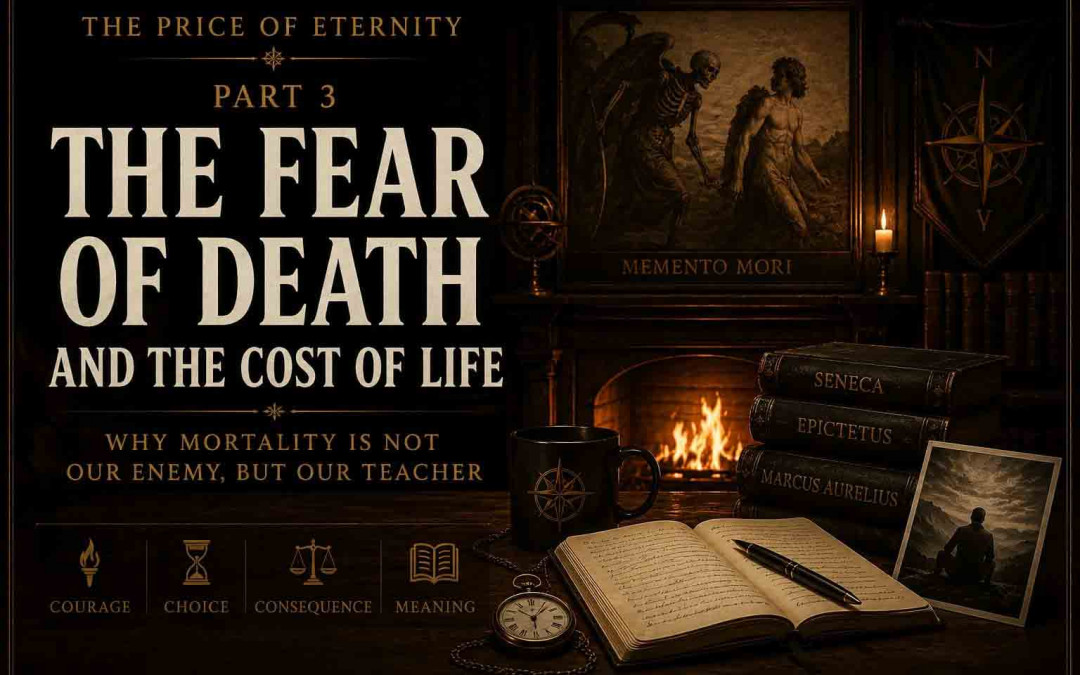
Does Mortality Give Life Meaning?
It gives life a particular structure.
That is not the same thing.
A finite person cannot read every book, pursue every profession, live in every country, maintain every friendship, raise every possible family or become every version of themselves they might imagine. Choosing one path inevitably leaves others unrealized.
This gives decisions weight.
To marry one person is, under ordinary conditions, not to marry thousands of others. To spend ten years becoming a surgeon is to spend those ten years not becoming a concert pianist. To care for a parent may mean abandoning another opportunity because the same evening cannot be lived twice.
Meaning emerges partly from commitment, and commitment becomes legible because alternatives are foreclosed.
Yet it would be a mistake to conclude that death creates the value.
The value may lie in the relationship, the craft, the knowledge, the act of care. Mortality changes the stakes under which those things are chosen.
If humans lived five hundred years, love would not necessarily vanish.
Its temporal grammar might change.
That is the more serious problem.
Why Does Limited Time Change Our Priorities?
Because unlimited postponement is psychologically different from delay under a closing horizon.
Human beings routinely behave as though time were abundant even when we intellectually know it is not. We postpone visits. Careers. Apologies. Books. Conversations. Decisions.
The future functions like a vast warehouse where unfinished intentions can be stored.
Then something happens.
A diagnosis.
A parent’s frailty becomes unmistakable.
A friend dies unexpectedly.
The warehouse shrinks.
Suddenly the difference between someday and never becomes visible.
This can produce clarity, but clarity should not be romanticized. Mortality does not automatically strip away triviality and reveal the authentic self underneath. People remain complicated under pressure. Fear can narrow attention. Illness can make philosophical reflection impossible. Families can become closer or fall apart.
What changes is not human nature.
The accounting changes.
The cost of delay rises.
And because delay becomes expensive, priorities can become easier to see.

The Invisible Architect
Death is often described as an enemy, and for good reason.
It destroys relationships.
Interrupts projects.
Removes people who wanted to continue living.
It produces grief without asking whether grief will make anyone wiser.
Nothing in a serious philosophy of mortality requires pretending that death is secretly a gift.
But an unavoidable boundary can influence form without being desirable.
A canvas has edges.
A novel ends.
A concert occupies a limited interval.
A game has rules that exclude most possible moves.
The boundary does not automatically create the value of the work, but it helps give the work shape.
Human life has developed under a similar condition.
We plan because time is limited.
We inherit because generations replace one another.
We teach partly because we will not remain available forever.
We preserve knowledge because individual memory will disappear.
Mortality became one of civilization’s invisible architects not because humanity chose it, but because every institution had to be built around the assumption that its participants would eventually leave.
Remove that assumption and many structures may need to be redesigned.
Is Death Necessary for Meaning?
Probably not.
This is where the argument must resist one of philosophy’s most seductive shortcuts.
If death makes certain choices urgent, it does not follow that immortality makes all choices trivial.
A person can care deeply about music without fearing that music will disappear tomorrow.
A scientist can pursue a question even if they have centuries to investigate it.
A friendship can matter even if neither friend expects imminent separation.
Value does not always require scarcity.
Sometimes abundance permits kinds of value that scarcity prevents.
A person with more healthy years might repair relationships that a shorter life would leave broken. They might master several disciplines instead of one. They might participate in projects too long for current human lives. They could watch a forest mature that they planted themselves.
Longevity could expand responsibility rather than dissolve it.
The real uncertainty is psychological.
Human motivation developed under conditions of biological finitude. We do not know how desire, ambition, commitment or boredom would adapt if that condition changed radically.
Eternity does not obviously destroy meaning.
It removes one of the mechanisms that currently organizes it.
The Midnight Club and the Fiction of the Deadline
Stories about terminal illness repeatedly return to this problem because an approaching deadline creates an unusually concentrated narrative environment.
The Midnight Club uses young people facing terminal illness who tell one another stories. The power of the premise is not that disease reveals some guaranteed hidden wisdom unavailable to healthy people. It is that the audience knows the characters cannot treat time as endlessly renewable.
Stories matter differently when the storytellers know there may not be another year.
This is a narrative device, but it reflects a recognizable feature of human experience.
A deadline changes the meaning of an unfinished sentence.
A final meeting changes the meaning of silence.
Knowing that an encounter cannot be repeated can concentrate attention on details that ordinary repetition makes invisible.
But the important word is can.
Mortality can sharpen.
It can also overwhelm.
The responsible conclusion is not that death makes life meaningful.
It is that known limits alter salience.
The mind begins pricing moments differently.
The Last Day Problem
The familiar thought experiment asks what you would do if today were your last day.
People often answer with family, reconciliation, love, places they want to see, or unfinished conversations.
That is revealing.
But it does not prove that those things are objectively more important.
It tells us something about what becomes salient when long-term instrumental goals collapse.
Few people facing one final day would spend it improving their résumé because the future in which the résumé matters has disappeared. They might also stop worrying about minor reputational injuries or purchases designed to signal status years later.
The thought experiment removes certain future-oriented incentives and exposes others.
Now reverse it.
Suppose you had ten million years.
The problem is not simply that everything could be postponed.
Some commitments would become possible that mortality currently prevents.
You could personally observe slow ecological change.
Master fields repeatedly.
Build institutions intended to last millennia and remain present to repair them.
Witness consequences that current leaders leave to descendants.
The immortal person might actually face more responsibility, because “I will be gone by then” would disappear as an excuse.
That is why mortality and immortality are not simple opposites.
Each exposes a different ethical weakness.
Mortality tempts us to neglect the distant future.
Immortality might tempt us to neglect the present because there is always more time.
The Luxury of Another Tomorrow
Young people are often described as feeling immortal.
They do not usually believe, propositionally, that they cannot die.
What they often possess is something psychologically similar: a large reserve of assumed tomorrows.
Mistakes can be repaired later.
Destinations can be visited later.
Important decisions can be delayed.
Age alters this less by producing wisdom than by changing probability.
The reserve becomes visibly smaller.
This is why life extension could change human psychology long before anyone becomes technically immortal.
If healthy lifespan reaches 130, then 180, then 300 years, the meaning of early, late, career, marriage, retirement and wasted time may all shift.
A forty-year-old in a three-hundred-year life might feel psychologically closer to a teenager than to a contemporary middle-aged adult.
Institutions would follow.
Education might lengthen.
Careers might become chapters.
Marriage contracts might evolve.
Inheritance would become politically strange.
The architecture of time is partly biological.
Change biology and culture will eventually renegotiate the calendar of a life.
The Scarcity Mistake
“Scarcity creates value” sounds profound because economics has trained us to recognize that scarce things often command higher prices.
Human value is not a market.
Oxygen is abundant under ordinary circumstances and enormously valuable.
Affection can become richer when it is abundant rather than rationed.
Safety does not become meaningless because a city becomes safer.
Children do not need to fear losing their parents in order to love them properly.
Scarcity can increase attention.
It can also produce desperation.
The useful distinction is between scarcity and finitude.
Scarcity means there is not enough.
Finitude means there is an end.
A finite life may contain abundance: years of love, friendship, health and opportunity. What finitude introduces is the impossibility of indefinite postponement.
Eventually some doors close.
Eventually the book cannot be extended by another chapter.
That is enough to shape choice without requiring us to glorify deprivation.
The Wealth of Irreplaceability
There is, however, another kind of scarcity that deserves attention.
Some experiences are valuable partly because they cannot be repeated exactly.
The first time a child speaks.
The final dinner in a house before moving away.
A reunion after decades.
The last conversation with someone who later dies unexpectedly.
Their significance is not contained in rarity alone. It comes from their position within a biography.
This is why money is such a poor analogy for much of human value.
You can replace one banknote with another of equal denomination.
You cannot replace one Wednesday in 1997 with another Wednesday that performs the same emotional function.
Human life contains non-fungible moments.
They matter because of relationships, history and sequence.
An immortal person would not eliminate this property.
Even with endless future time, some moments would remain unrecoverable because the people, context and earlier self that made them possible would have changed.
Eternity may give infinite duration without making experience infinitely reversible.
That distinction matters.
Would Immortality Make Life Meaningless?
There is no reason to assume so.
But immortality could make meaning more demanding.
A mortal person inherits many priorities from biology and society. Eat. Work. Protect the family. Plan for aging. Build enough financial security to survive periods when work becomes impossible.
Remove aging, disease and much economic necessity, and freedom expands.
So does responsibility for constructing a life.
The question changes from What must I do? to What is worth doing?
That is not an empty question.
It may be harder.
A society of radically long-lived people could develop new rituals of commitment precisely because time has become abundant. People might choose artificial deadlines, finite projects, temporary identities or periods of deliberate limitation in order to create structure.
We already do this on a smaller scale.
Games impose rules voluntarily.
Artists constrain themselves through form.
Athletes choose contests with defined endpoints.
Scholars create deadlines even when the subject could be studied indefinitely.
Meaning does not always emerge by escaping limits.
Sometimes intelligent beings create limits because unbounded possibility is difficult to navigate.
The Fear of Death
Fear of death is often treated as one single instinct.
It is probably better understood as several fears entangled.
Fear of pain.
Fear of nonexistence.
Fear of leaving people.
Fear of unfinished work.
Fear of losing identity.
Fear of uncertainty.
Fear that the world continues without us.
These are not the same problem.
Technology could solve some while leaving others intact.
Medicine can reduce pain.
Life extension can postpone biological death.
Archives can preserve memory.
AI may preserve conversational patterns.
None of those technologies currently demonstrates survival of first-person consciousness.
This matters because the phrase defeating death can hide the question of which death has been defeated.
A person can survive culturally without surviving subjectively.
A name can remain.
A voice can remain.
A model can remain.
The person may still be absent.
The Price of Eternity is partly the price of becoming precise about that difference.
The Mirror of Eternity
Mortality and immortality are useful mirrors because each reveals assumptions hidden inside the other.
Mortality shows us how much current meaning is organized around limited time.
Immortality asks whether those structures would survive once that limit loosened.
A mortal person worries that there is not enough time.
An immortal person might face another anxiety: that there is no external reason to choose this century rather than the next.
One condition makes postponement expensive.
The other may make commitment expensive.
Neither automatically produces wisdom.
Both require a way of deciding what deserves attention.
This may be the real continuity between them.
Whether we possess one day or one million years, consciousness still faces selection.
You cannot inhabit every possible perspective simultaneously.
You cannot care about everything with equal intensity.
Even infinite time would not create infinite attention in each present moment.
The problem of meaning may therefore survive eternity because it was never only a problem of duration.
It was a problem of selection.
Watch The Video
How to Read the World
Current Knowledge
Human responses to mortality vary widely. Awareness of limited time can change priorities and increase attention to emotionally meaningful goals, but terminal illness and bereavement can also produce fear, depression, anger, cognitive burden and withdrawal. There is no universal psychological law by which approaching death automatically deepens life.
Human perception of time is strongly affected by attention, expectation, age, novelty and emotional state. Objective duration and subjective significance are therefore different dimensions of experience.
Meaning is not known to require death. Humans derive value from relationships, curiosity, creativity, play, competence, care and other activities that do not depend upon suffering or imminent mortality. Finitude influences how choices are structured without proving that death is necessary for value.
Research into aging and longevity can address biological mechanisms and healthy lifespan, but it does not answer how human motivation would adapt to lives lasting centuries. Radical longevity remains sufficiently speculative that its psychological and institutional consequences cannot be confidently predicted.
Cultural persistence, memory and digital reconstruction should also be distinguished from personal survival. Preserving information about a person does not establish continuation of that person’s subjective consciousness.
Open Questions
One major question is how human motivation would adapt if healthy lifespan increased dramatically. Some current ambitions might become less urgent, while entirely new long-term projects could become psychologically possible. We do not know whether boredom would dominate or whether curiosity would simply move to larger timescales.
Another concerns commitment. Many human institutions assume that lives are finite: marriage, inheritance, careers, political succession and retirement all operate against expected biological horizons. Radical longevity could require these institutions to be redesigned.
There is also a problem of selfhood. A person living for centuries might undergo enough psychological change that continuity becomes as important as duration. Living longer raises the question of how much transformation one identity can contain before the label “same person” becomes philosophically difficult.
The deepest uncertainty is whether humans need externally imposed limits at all, or whether sufficiently reflective minds can create meaningful commitments voluntarily. A post-mortal civilization might not eliminate limits; it might learn to design them.
Transhumation Interpretation
For Transhumation, mortality is not the creator of meaning.
It is one of the constraints inside which human meaning developed.
Remove the constraint and we should expect the architecture to change.
The important question is therefore not whether eternity destroys value, but which parts of value depended upon the deadline and which survive without it.
That is the test.
If love, curiosity, care and creation survive radical longevity, then mortality was never their source.
If urgency, commitment and identity change, we have discovered which structures the finite horizon was quietly supporting.
FAQ
Why do humans fear death?
Because death combines several threats: possible pain, loss of relationships, unfinished projects, uncertainty and the end of conscious experience. Different people fear different parts of it.
Does mortality give life meaning?
Mortality influences meaning by limiting time and forcing selection, but there is no reason to think death is necessary for love, curiosity, art or purpose.
What is the Last Day Problem?
It is a thought experiment asking what becomes important when almost all future time disappears. Its value lies in revealing priorities, not in proving that imminent death makes people wiser.
Would immortality make people bored?
Possibly in some circumstances, but there is no evidence that extremely long life must lead to boredom. New knowledge, relationships and projects could continue creating reasons for action.
How would radical life extension change society?
It could alter careers, marriage, inheritance, political power, memory and the meaning of different life stages. Longer life would be a cultural transformation, not merely a medical achievement.
What is the deeper question of The Price of Eternity?
The deepest question is not whether death makes life valuable.
That gives death too much credit.
The harder question is what happens to value when time stops doing so much of our choosing for us.
A finite life contains an invisible editor. Some opportunities expire. Some relationships end. Some projects become impossible. Eventually the person has no more pages on which to postpone the decision.
An indefinitely long life removes part of that editor.
Then selection becomes increasingly ours.
Which relationship deserves another century? Which version of the self should be abandoned? Which project deserves ten thousand mornings? Which promise should remain binding when the person who made it has changed almost beyond recognition?
Mortality currently closes many of those questions for us.
Eternity would leave them open.
That may be its greatest promise.
It may also be its price.
Continue the Transhumation Series
- Forgotten Religion | Ancient Gods, Symbols and the Hidden Structures of Human Civilization
- The Last Religion | Death, Immortality and the Future of Humanity
- The New Theurgy | AI, Information and the Future of Human Civilization
- End of Branding: You Were Never Meant to Become a Product
- Baal vs Ishtar: Why Ancient Gods Never Disappeared