
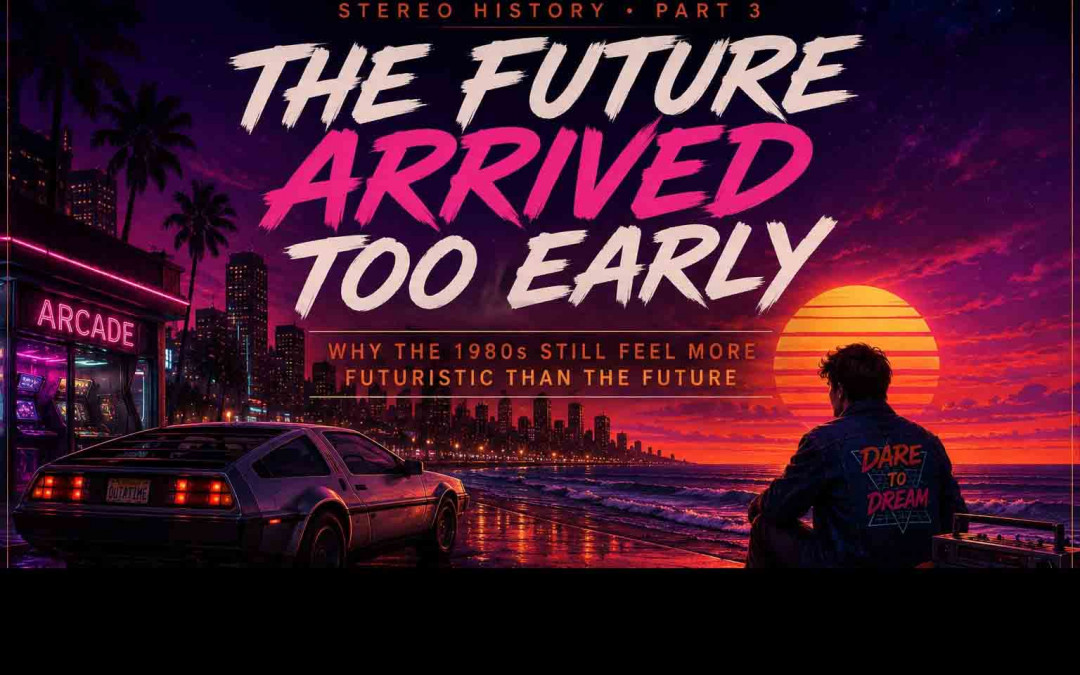
Why the 1980s Still Feel Futuristic
There is something mildly absurd about describing the 1980s as futuristic.
The computers were slow. Mobile phones were enormous. Most people had never used the internet. Television was bulky, photographs were trapped on film, and the supposedly digital future still depended on cassette tapes, floppy disks and machines that often took long enough to start that the user had time to reconsider the entire project.
And yet the decade still looks like tomorrow.
Not our literal tomorrow. Few contemporary cities resemble the neon horizons of Blade Runner, and most of us do not commute through streets filled with chrome robots. But the emotional structure of the world imagined then remains strangely familiar. Information moves everywhere. Identity becomes partly electronic. Screens mediate daily life. Machines become conversational. Public and private space begin to overlap. The body acquires technological extensions. Geography matters less to communication than it once did.
The forms were often wrong.
The functions were not.
Perhaps this is why the 1980s can feel so uncannily suspended between past and future. They are visibly obsolete and conceptually unfinished at the same time. The devices have aged. The questions have not.
The future did not arrive exactly as imagined.
It arrived wearing different clothes.
A Decade That Could See the Interface
The 1980s did not invent digital civilization. Computer networking, artificial intelligence research, electronic music, video technology and interactive computing all had substantial prehistories by the time the decade began. ARPANET existed. AI had already passed through periods of optimism and disappointment. Synthesizers had transformed experimental and popular music long before the first MTV ident appeared.
But the 1980s made many of these technologies culturally visible to a much larger public.
That distinction matters.
The future was moving out of specialist institutions and into ordinary life. Personal computers appeared on desks. Video games created electronic environments that people could enter through action rather than merely observe. Portable audio moved individualized media onto the body. Music television fused sound with visual identity. Computer graphics began appearing in films, television, advertising and design as unmistakable evidence that another visual language was arriving.
For a brief historical period, the interface was still obvious enough to feel like an event.
A computer looked technological.
A digital display looked digital.
Electronic music sounded electronic.
The machine had not yet learned to disappear behind familiarity.
Today a child can hold a device containing more computational power than entire earlier institutions and experience it not as science fiction but as an irritatingly slow phone. The technology has become more extraordinary while feeling less futuristic.
The 1980s occupied the opposite position.
The technology was relatively limited.
The sense of threshold was enormous.
Tomorrow Had a Sound
The musical futurism of the decade is especially seductive because it seems to have survived technological obsolescence better than many of the machines themselves.
Listen to the production of certain records now and the electronic environment can still feel startlingly spacious. This was not because 1980s musicians were the first to use synthesizers or artificial reverberation. They were building on decades of electronic experimentation, disco production, ambient music, progressive rock, Kraftwerk, Giorgio Moroder, Jean-Michel Jarre and many others.
What changed was the extent to which synthetic sound became an ordinary component of mainstream imagination.
A drum no longer had to sound like a drum recorded in a room.
A keyboard did not need to resemble a piano.
A voice could occupy a space larger than the studio in which it had been recorded.
Music began constructing environments that had no obvious acoustic original.
That was culturally important because the sound itself carried an idea of the future. It did not merely accompany futuristic images. Electronic production could create the sensation that ordinary physical space had become insufficient.
The room became too small.
The horizon became audible.
This is one reason some 1980s recordings can feel unexpectedly modern while later music occasionally feels less so. The issue is not technical superiority. Contemporary production is incomparably more sophisticated. The difference lies in intention and cultural position. Electronic sound was still new enough to signify elsewhere.
Today synthetic sound often signifies nothing in particular.
It is simply sound.
The future became fluent enough to lose its accent.
The Future Was Not a Prediction
One of the easiest mistakes in retrospective futurism is to ask whether a past decade “predicted” us correctly.
Did it predict smartphones?
Did it predict AI?
Did it predict virtual reality?
Usually this produces a museum of amusing hits and misses.
Flying cars: wrong.
Global communication: right.
Robot servants: partly wrong.
Artificial intelligence: perhaps.
Moon colonies: still waiting.
But prediction is not the most interesting relationship between culture and technology.
Civilizations rarely forecast exact objects.
They imagine functions.
Instant communication across distance.
Access to enormous quantities of information.
Portable private media.
Artificial agents.
Immersive synthetic environments.
Bodies augmented by machines.
Those functions can later arrive through forms nobody anticipated.
The imagined computer terminal becomes the smartphone.
The electronic library becomes search.
The videophone becomes an app.
The robot secretary becomes software.
The virtual environment becomes not one separate digital world but a permanent layer surrounding ordinary life.
The futurists were often wrong about appearance because technology does not evolve according to aesthetic logic.
Functions combine.
Devices converge.
Infrastructure becomes invisible.
That is why the future can arrive without looking futuristic.
The Black Rectangle That Ate the Future
Few objects illustrate this more clearly than the smartphone.
A 1980s vision of technological life often distributed the future across many visible machines.
Television.
Telephone.
Camera.
Computer.
Music player.
Map.
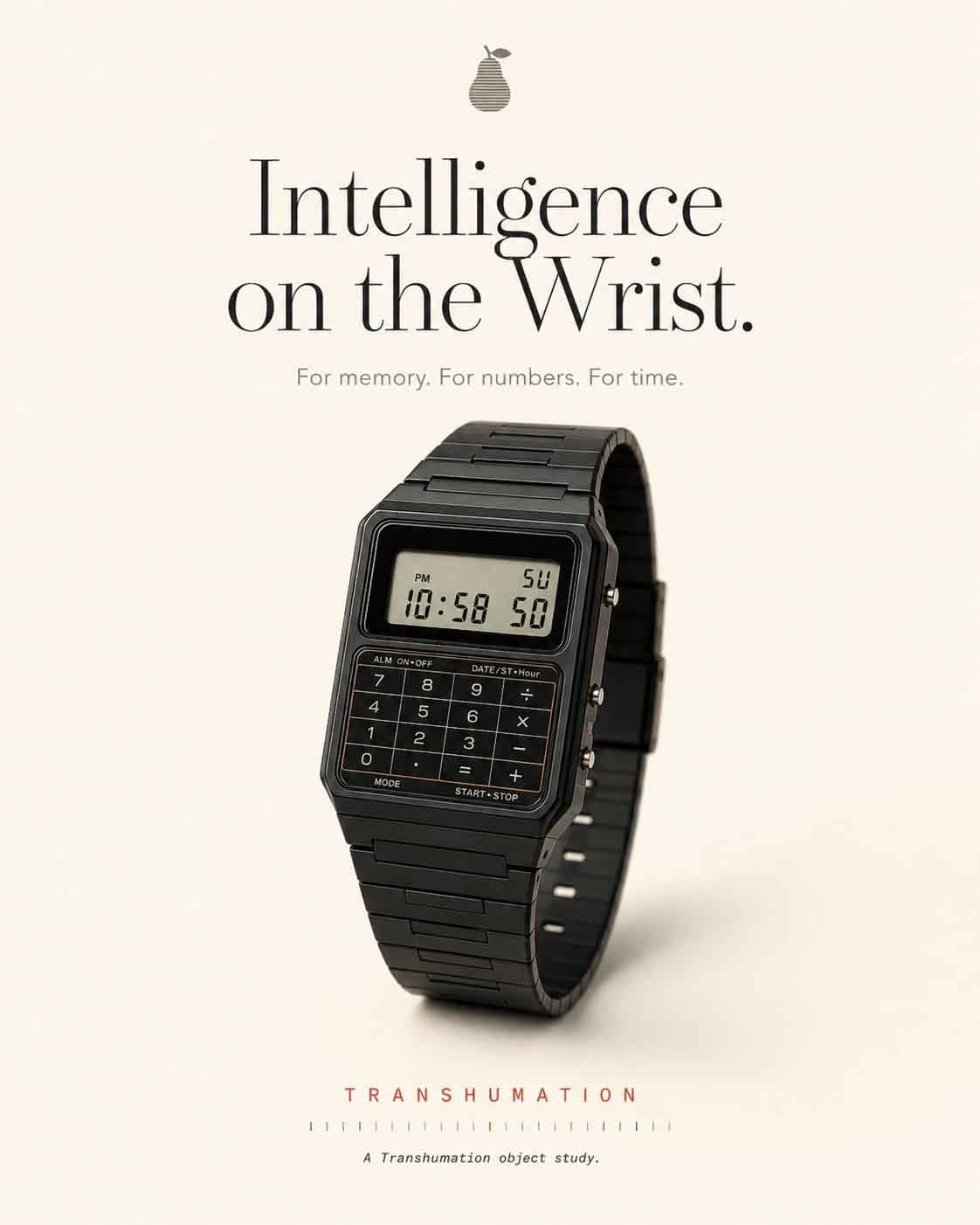
Calculator.
Video game.
Diary.
Library.
Recording device.
Communication terminal.
Each had a body and a ritual.
Each announced what it was.
The smartphone absorbed most of them.
This was an enormous technological victory and a strange aesthetic loss.
The future collapsed into a black rectangle.
The extraordinary functions survived, but their symbolic individuality disappeared. A camera no longer looks like a camera. A map no longer needs to resemble a folded landscape. Music no longer arrives through an object culturally dedicated to music.
Everything becomes software.
The device matters less.
The interface matters more.
This may be one reason retrofuturism returns obsessively to older machines. They make function visible.
The Walkman visibly means portable music.
An arcade cabinet visibly means entry into another world.
A CRT monitor visibly means computation.
Modern technology increasingly refuses to display its purpose so clearly because one object can become almost anything.
The future became more powerful by becoming less legible.
The Future Did Arrive—But It Came Without the Poster
This is the paradox at the center of the article.
Many people feel that the great technological future somehow failed to happen.
We were promised more.
Where are the lunar cities?
Where are the flying cars?
Why does the office still contain forms?
Why does a morning commute remain a morning commute?
The feeling is understandable because spectacular prediction naturally focuses on visible objects. A city on Mars looks like the future. A machine quietly routing billions of packets of information does not.
Yet measured by capabilities, contemporary civilization would have appeared astonishing to most people several decades ago.
Global video communication is ordinary.
Satellite navigation is ordinary.
Immediate access to vast cultural archives is ordinary.
Automatic translation is increasingly ordinary.
Artificial systems can write, generate images, analyze information and engage in extended dialogue.
Millions of people maintain persistent digital identities that affect relationships, careers, politics and money.
The dream arrived by moving from spectacle into infrastructure.
That is why it can be missed.
We expected the future to enter through the front door dressed like the future.
Instead it renovated the plumbing.
Optimism Was Never the Whole Story
There is another danger in looking backward.
The 1980s can easily become a lost kingdom of technological confidence: chrome, space shuttles, neon nights, new computers and a civilization convinced that progress would make everything better.
The historical decade was not remotely that simple.
Nuclear anxiety remained deeply embedded in popular culture. The AIDS epidemic devastated communities and exposed profound failures of public compassion and policy. Economic restructuring produced insecurity and unemployment. Environmental concerns were growing. Geopolitical violence remained constant.
And much of the decade’s futurism was profoundly pessimistic.
Blade Runner imagined technological magnificence alongside ecological decay, corporate dominance and uncertainty about what counts as human.
The Terminator turned intelligent machinery into extermination.
Cyberpunk frequently assumed that technological sophistication would coexist with social fragmentation and concentrated power.
This does not weaken the article.
It improves it.
The future of the 1980s was compelling precisely because it had not settled whether technology would liberate humanity or trap it inside a more sophisticated system.
The future was open enough to contain both possibilities.
We recognize that tension because it is still ours.
Why the Decade Feels More Optimistic From Here
If the historical 1980s were so anxious, why do we often remember them as optimistic about technology?
Part of the answer is selection.
Later culture preserved particular images.
The bright arcade rather than the nuclear shelter.
The sports car rather than the unemployment line.
The Walkman rather than the hospital ward.
The music video rather than the policy document.
Nostalgia performs editorial work.
But another explanation is more interesting.
Even fearful futures can feel optimistic when they remain open.
The central emotional difference may not be confidence that everything would improve.
It may be confidence that something large was still going to happen.
History appeared unfinished.
Technology seemed capable of producing radical discontinuity.
The next world might be better or worse, but it would not simply be more of the same.
That expectation is psychologically different from technological anxiety inside a mature digital system.
Today the network is already here.
The smartphone is already here.
Permanent connectivity is already here.
Many debates concern how to manage systems whose arrival is no longer in question.
The 1980s lived closer to the moment before normalization.
The future was still negotiable.
When the Prototype Becomes Reality
There is a broader civilizational pattern here.
A new technology often passes through several emotional stages.
First it appears as impossible.
Then experimental.
Then futuristic.
Then expensive.
Then desirable.
Then useful.
Then ordinary.
Finally invisible.
At the beginning, it belongs to imagination.
At the end, it belongs to infrastructure.
The transition changes more than behavior.
It changes meaning.
A computer on a desk in 1983 could represent tomorrow.
A computer inside a washing machine today represents nothing at all.
This suggests that futuristic is not a property of technology.
It is a relationship between technology and cultural expectation.
Anything advanced enough can cease to look futuristic once people learn to depend on it.
Perhaps nothing demonstrates this more clearly than artificial intelligence.
For decades, conversational machines belonged naturally to speculative fiction. Now people can use one while waiting for a taxi.
The philosophical distance collapses quickly.
If these systems become sufficiently integrated into ordinary work and communication, a generation may eventually grow up finding them no more metaphysically extraordinary than search engines.
The future will again have arrived too early for someone.
And then it will disappear into habit.
Watch The Video
How to Read the World
Current Knowledge
The 1980s were not the beginning of digital technology. Important developments in computer networking, artificial intelligence, electronic music, graphical interfaces and interactive media occurred earlier. What changed during the decade was partly their expanding visibility within consumer culture and everyday life.
Personal computing grew rapidly during the period, while video games, portable audio, music television and increasingly sophisticated electronic production contributed to a recognizable technological aesthetic. These developments did not form one unified movement, but later memory has combined them into a powerful image of 1980s futurism.
Many capabilities associated with contemporary digital civilization were imagined before they became technically practical at mass scale. Exact predictions were frequently wrong, but broader functions such as portable computing, global communication, digital environments and machine intelligence became increasingly prominent cultural expectations.
The period was neither uniformly optimistic nor uniformly pessimistic. Technological enthusiasm coexisted with nuclear anxiety, the AIDS crisis, economic disruption, geopolitical conflict and growing concern about environmental and social consequences of modernization.
Retrofuturism is itself retrospective. What contemporary audiences call the “futuristic 1980s” is partly a historical reality and partly a later cultural reconstruction produced by music, film, fashion, games and nostalgia.
Open Questions
One question is why the 1980s have become more strongly identified with futurism than many other technologically innovative periods. The answer may involve their position between analog and digital culture, the visual distinctiveness of early electronic interfaces and the ability of mass media to produce a relatively shared aesthetic vocabulary of tomorrow.
Another question concerns function and form. When a past culture imagines an accurate function but an inaccurate physical implementation, should that count as successful prediction at all? A smartphone satisfies many dreams once assigned to separate futuristic devices, but its convergence of functions would have been difficult to anticipate culturally.
There is also a question about the loss of visible futurism. As technologies become increasingly infrastructural—software, networks, algorithms, cloud systems—does technological change become harder to represent aesthetically? Perhaps contemporary society is not less futuristic; perhaps its most transformative machinery simply has fewer visible silhouettes.
Artificial intelligence adds a final uncertainty. We are currently close enough to its emergence to experience it as a threshold. If it becomes ordinary infrastructure, will future generations regard today’s excitement and fear as another historical moment when civilization could still see the machinery changing?
Transhumation Interpretation
The Future Arrived Too Early belongs to Transhumation because it exposes the difference between a structure and the form through which a generation first imagines that structure.
The 1980s often pictured the future through particular carriers.
Terminals.
Robots.
Neon cities.
Large screens.
Electronic voices.
Physical machines with obvious technological bodies.
What survived was often not the carrier.
It was the function.
Portable access to information survived.
Remote presence survived.
Synthetic environments survived.
Machine-mediated identity survived.
Artificially generated responses survived.
The physical manifestation changed drastically.
This is a familiar Transhumation problem.
When the carrier changes, what remains recognizably the same?
The answer is rarely everything.
A smartphone is not simply a Walkman with more features, nor is modern AI merely the realization of a fictional talking computer. Historical continuity exists at the level of some functions, not complete objects.
This is why the phrase the future arrived too early should not mean that civilization accidentally received technology before it was ready.
The more interesting meaning is cultural.
Some structures of the future became imaginable before their eventual carriers existed.
Humanity learned to desire functions before engineering discovered their durable forms.
That process happens constantly.
We imagine remote presence before building videoconferencing.
We imagine artificial servants before discovering that software agents may be more practical than humanoid robots.
We imagine giant libraries before search makes physical scale irrelevant.
We imagine virtual worlds as separate spaces and later discover that digital mediation may work more powerfully by layering itself continuously onto ordinary life.
The model appears first.
Reality negotiates with it.
Then reality returns something stranger.
This also explains why the future so often disappoints even when technological progress exceeds prediction.
Imagination remembers the form.
Reality delivers the function.
We wanted the flying car because it looked unmistakably futuristic.
Instead navigation became almost perfect, transport became algorithmically coordinated and communication made many journeys unnecessary.
The capability improved.
The spectacle declined.
This is one of the great misunderstandings of progress.
Humans judge the arrival of the future aesthetically.
Infrastructure does not care.
Stereo History becomes useful here because two accounts can be true simultaneously.
On one channel, the 1980s got the future wrong.
There are no widespread moon colonies, no everyday humanoid robot servants, and the visual world of late-twentieth-century science fiction did not become the standard architecture of ordinary life.
On the other channel, the decade lived close to the emergence of capabilities that would reorganize civilization more deeply than many spectacular predictions.
Both histories matter.
The mistake would be choosing only one.
If we listen only to technological capability, contemporary life looks astonishingly futuristic.
If we listen only to cultural expectation, the future can feel strangely absent.
The dissonance between those channels produces the nostalgia.
This is also why modern AI is worth watching without mythologizing it.
We should not assume it is consciousness.
We should not assume it completes ancient dreams of artificial life.
We should not assume today’s interfaces tell us what its mature form will look like.
The 1980s teach the opposite lesson.
Early forms can be culturally loud and historically temporary.
The eventual technology may become most powerful precisely when its original form disappears.
Future generations may not encounter AI as a glowing intelligence on a screen.
They may encounter it diffused through medicine, education, design, archives, transportation and everyday decision-making until asking where “the AI” is becomes as strange as asking where “the electricity” is inside a modern city.
That would be another case of the future arriving by ceasing to look futuristic.
Perhaps this is the deepest reason the 1980s still appear to belong to tomorrow.
They caught digital civilization before it became fluent.
The pixels were visible.
The electronic drums sounded synthetic.
The machines exposed their interfaces.
The future had an accent.
We live in a more advanced version of that world now, but much of the accent has disappeared.
Technology became ordinary enough to stop announcing its arrival.
The future did not fail to appear.
It succeeded so thoroughly in certain domains that we stopped recognizing it.
And perhaps every successful future eventually suffers the same fate.
It begins as a destination.
It ends as the background.
FAQ
Why do the 1980s still look futuristic?
Because emerging digital technologies were visible enough to feel unfamiliar while already entering mass culture. Later media strengthened that association by turning certain sounds, colors and machines into symbols of the decade.
Did the 1980s predict smartphones and AI?
Not precisely. Earlier culture imagined many similar functions, such as portable computing, intelligent machines and global communication, but the final forms often differed radically from those predictions.
Why does 1980s music still sound futuristic?
Partly because electronic production was culturally prominent while synthetic sound still carried a strong association with technological novelty. Today many of those techniques are ordinary production tools.
Was the decade really optimistic?
Not simply. Technological enthusiasm existed alongside nuclear fear, AIDS, political conflict and dystopian visions of technology. Its future was powerful because it contained both promise and danger.
What does “the future arrived too early” actually mean?
It means some of the functions associated with later digital civilization became culturally imaginable before society possessed the technological forms through which they would eventually become ordinary.
What is the deeper Transhumation idea?
A generation often mistakes the imagined form of the future for the future itself.
History is less obedient.
The form changes. The carrier changes. Several predictions fail completely. Yet some underlying functions survive and reappear through technologies nobody originally pictured.
Perhaps that is why the 1980s still resemble tomorrow.
They were not looking at our machines.
They were beginning to recognize some of the structures our machines would eventually carry.
Continue the Transhumation Series
- Forgotten Religion | Ancient Gods, Symbols and the Hidden Structures of Human Civilization
- The Last Religion | Death, Immortality and the Future of Humanity
- The New Theurgy | AI, Information and the Future of Human Civilization
- End of Branding: You Were Never Meant to Become a Product
- Baal vs Ishtar: Why Ancient Gods Never Disappeared