
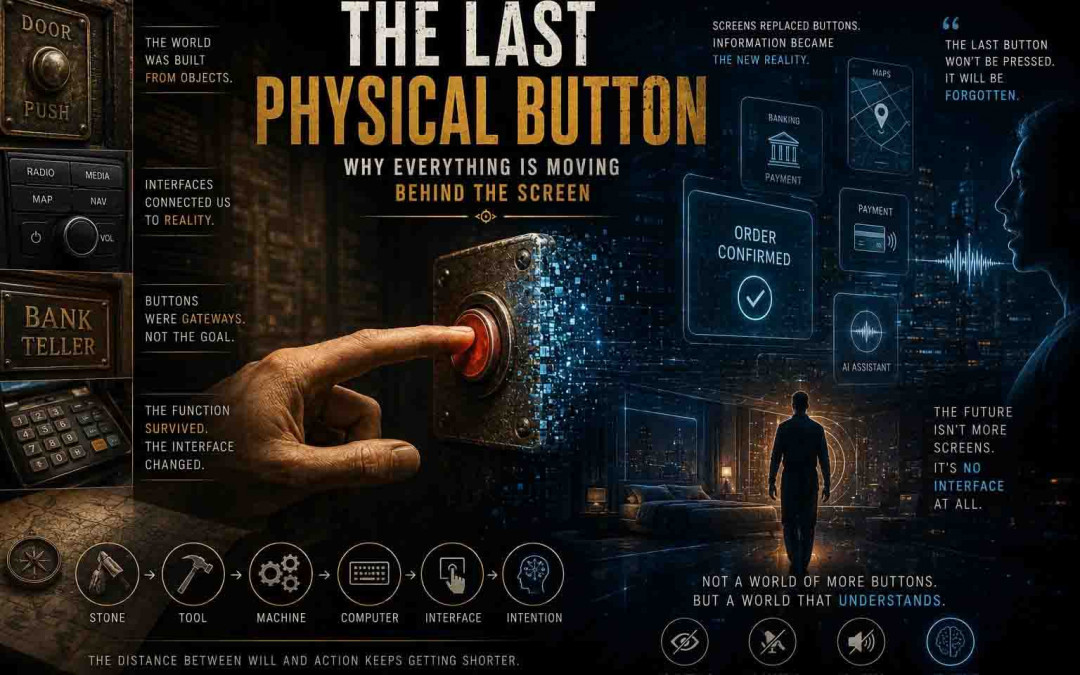
The Last Physical Button
There is a peculiar moment in a modern car when your hand reaches for something that no longer exists.
You want to adjust the temperature. Twenty years ago, your fingers would have found a dial almost without help from your eyes. The control had shape, resistance and position. You knew where it was because your body remembered.
Now the function may be three layers deep inside a touchscreen.
The car is more advanced. The interface is arguably less physical. Whether it is better depends on what the driver needs at that moment.
That small irritation reveals something much larger.
Modern technology does not simply replace old objects with new ones. It often separates function from fixed physical form. A button once had to exist as its own object because the function was permanently attached to the mechanism. Software changes that relationship. The same surface can become climate control, navigation, music, camera, payment terminal or communication system depending on what the software decides to display.
The physical world has not disappeared.
The function has become portable.
That is why the disappearing button matters.
It is not really a story about buttons.
It is a story about what happens when one interface can become many things.
Why Are Physical Buttons Disappearing?
A traditional button is beautifully honest.
It tells you, through its body, what it is for.
Push.
Turn.
Slide.
Flip.
The relationship between form and function is stable enough that the user can learn it once and rely on muscle memory afterward.
That stability is also the button’s limitation.
A physical button occupies space whether the function is used every minute or once a year. If engineers want to add a new function, they need a new control, a new symbol, another place on the dashboard or another compromise in industrial design.
A screen behaves differently.
It can reorganize itself.
One area becomes music, then navigation, then seat heating. New functions can appear through software updates without drilling new holes into the dashboard.
This is why screens became attractive in systems where functionality multiplied faster than physical surfaces could reasonably accommodate it.
The button did not lose because it was old.
It lost whenever adaptability became more valuable than permanence.
That is an important distinction because it immediately explains why buttons do not disappear everywhere.
When tactile certainty matters more than flexibility, the physical control can remain superior.
The future is not a war between glass and plastic.
It is a negotiation between two kinds of intelligence: the intelligence of programmable surfaces and the intelligence of the body.
Are Touchscreens Better Than Buttons?
Not universally.
A touchscreen is astonishingly efficient as a general-purpose interface. It can represent thousands of possible states without physically changing shape.
But that same flexibility removes tactile landmarks.
A driver looking at the road can identify a physical knob by feel. A flat display often requires visual confirmation. The user must look, locate, interpret and then touch the correct virtual control.
For low-risk tasks, this may be trivial.
Under high cognitive load, it matters.
This is why certain environments continue to value dedicated physical controls. Cockpits, industrial machinery and medical devices often preserve buttons, switches or knobs where immediate tactile certainty is important.
The interesting pattern is therefore not that matter is losing.
It is that function is migrating to software wherever software can absorb complexity without creating too much new friction.
Sometimes it succeeds.
Sometimes designers discover that they compressed the interface too aggressively and have to put the knob back.
A mature technological civilization may not eliminate physical controls.
It may become better at knowing which controls deserve bodies.

The Car That Became a Software Environment
The modern automobile makes this transformation unusually visible.
Cars were always complex machines, but much of their complexity used to be mechanically legible. A lever connected to a function. A needle moved across a dial. A key turned in an ignition.
Now the driver sits inside a layered computational environment.
Navigation responds to live traffic.
The vehicle may update software remotely.
Sensors monitor surrounding objects.
Driver-assistance systems interpret lanes.
Settings can be remembered by user profile.
The dashboard becomes less like an instrument panel and more like an operating system.
It is tempting to say the car has become “software wrapped in metal.”
That is rhetorically attractive but physically misleading.
The tires still grip asphalt.
The brakes still convert motion into heat.
The chassis still has to survive impact.
The battery or fuel system still obeys physical constraints.
Software has not replaced the car.
It has become a new control layer over the car.
That difference matters because digital interfaces can create the illusion that the physical system has become secondary.
Then reality intervenes.
A software menu can decide when to brake.
It cannot negotiate with ice after traction has already disappeared.
Why Are Self-Service Kiosks Everywhere?
Walk into a fast-food restaurant and another version of the same transition appears.
The cashier once functioned as interface.
You spoke.
The employee translated your request into the restaurant’s internal ordering system.
Money changed hands.
Questions were resolved conversationally.
The self-service kiosk moves part of that translation onto the customer.
The menu becomes software.
Customization becomes explicit.
Upselling can be standardized.
Payment integrates directly into the order.
The restaurant gains consistency and scalability, while the customer performs some of the work previously performed by an employee.
This is why the kiosk is more interesting than a simple story of automation.
It changes who carries the complexity.
The old interface hid the restaurant’s internal system behind a human conversation.
The new one exposes selected parts of the system directly to the user.
Both are interfaces.
One is social.
The other computational.
And both reveal the same deeper rule:
civilization becomes more efficient when complexity can be reorganized behind a surface simple enough for ordinary people to use.
The danger begins when the surface becomes easier while the system behind it becomes harder to inspect.
The Button Was Never the Function
This is the central idea.
The switch is not electricity.
The key is not access.
The cashier is not banking.
The steering wheel is not direction.
The keyboard is not writing.
These are interfaces connecting intention to system.
Technology often advances not by replacing the function but by changing the layer through which the function is accessed.
A paper map gives way to digital navigation.
The road remains.
A boarding pass becomes a QR code.
The aircraft remains.
A bank counter becomes an app.
Money remains embedded in institutions, accounts, laws and networks.
What disappears is the need for one dedicated physical route to the function.
The function becomes less dependent on a specific interface.
That is why the disappearance of the button belongs to a much larger history.
Writing separated language from the speaker.
Printing separated text from one manuscript.
Software separates function from one physical control.
AI may separate intention from the procedural steps that once had to be learned explicitly.
Each transition moves the user one level farther from implementation.
The Fingerprint Paradox
Biometrics reveals another side of the same story.
For years, fingerprint scanners and facial recognition were framed primarily as technologies of surveillance and control. Those concerns remain legitimate, especially when biometric data is collected without meaningful consent or used across large institutional systems.
But consumer biometrics succeeded for another reason.
Passwords became exhausting.
Users accumulated dozens of accounts. Security rules demanded length, uniqueness, symbols, rotation and two-factor authentication. The cognitive load grew until people began relying on password managers, biometric unlocks and device-based authentication.
The fingerprint did not win because humanity suddenly stopped caring about privacy.
It won because authentication complexity exceeded what ordinary memory could comfortably manage.
This pattern recurs across technology.
A new interface often becomes normal when the old one demands too much cognitive labor.
The calculator reduced arithmetic friction.
Search engines reduced retrieval friction.
GPS reduced navigational friction.
AI may reduce procedural friction.
The question is always the same:
What ability did we outsource, and what did we gain by outsourcing it?
The Disappearing Object
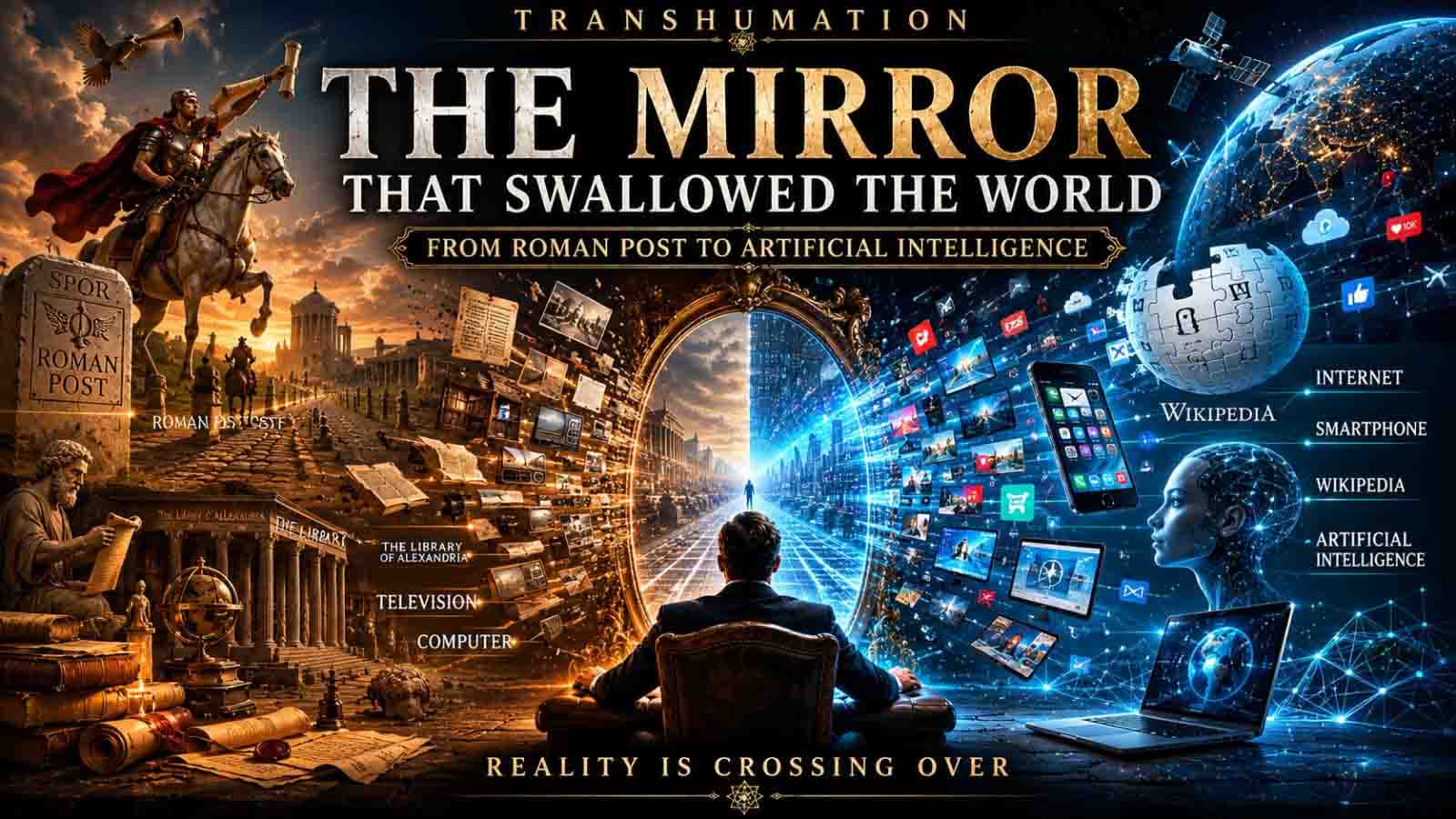
Digitalization can make it look as though entire classes of objects are vanishing.
The map becomes an app.
The ticket becomes a barcode.
The photograph becomes a file.
The encyclopedia becomes a website.
The music collection becomes a subscription.
But nothing becomes immaterial.
The physical infrastructure often grows in the background.
A digital photograph still occupies physical states somewhere.
Streaming music requires storage, networks, processing, energy and devices.
Online banking relies on data centers, payment infrastructure, legal systems and security systems vastly more complicated than the counter the customer no longer visits.
The visible object shrinks.
The hidden system expands.
This is one of the defining illusions of contemporary technology.
Our individual environment looks cleaner while civilization behind it becomes more complicated.
The desk loses paper.
The cloud gains data centers.
The dashboard loses switches.
The vehicle gains millions of lines of software.
The customer loses the cashier.
The restaurant gains a networked ordering system.
Complexity does not disappear. It changes address.
What Comes After the Screen?
The obvious answer is not a larger screen.
The deeper trend is toward reducing the distance between intention and result.
The command line required the user to know syntax.
The graphical interface replaced much of that syntax with icons and menus.
Touchscreens removed some of the distance between pointing and action.
Voice removed the need to touch.
Generative AI goes further because the user can often describe the desired outcome rather than specify every operation.
This is a profound shift.
Traditional interfaces ask:
Which button do you want to press?
Conversational interfaces increasingly ask:
What are you trying to do?
That sounds subtle, but it changes the architecture of interaction.
The user no longer necessarily needs to understand how the system is organized.
The system increasingly interprets intention and translates it into procedure.
If this continues, the screen may not disappear physically.
It may disappear conceptually.
We will stop thinking about the interface because the interface will increasingly resemble conversation.
Will AI Make Interfaces Disappear?
Partly.
Visual interfaces will remain excellent for many tasks. A map is easier to understand visually than through a long spoken description. A spreadsheet allows relationships to be inspected spatially. Cameras require framing. Timelines, diagrams and dashboards benefit from visible structure.
But AI can become a layer above these interfaces.
Instead of opening five applications, locating settings and moving information manually between them, a person may describe an objective to one system that coordinates the underlying tools.
This makes AI less like another app and more like an interpreter standing between intention and infrastructure.
That role is powerful.
It is also dangerous.
The more the intermediary handles automatically, the less the user sees which choices were available, which sources were consulted and which assumptions were made.
The interface becomes easier.
The system becomes less transparent.
This is the paradox of invisible technology.
The better it works, the harder it becomes to notice that it is shaping the path.
The Last Physical Button
There will probably never be a literal last physical button.
That is not the point.
The metaphor works because buttons belong to an era in which one function often had one visible physical entrance.
The future increasingly breaks that relationship.
One surface performs many tasks.
One voice command reaches many systems.
One AI assistant may coordinate services that used to require dozens of separate interfaces.
Yet physical controls will survive where their physicality contains useful information.
Emergency stop buttons exist for a reason.
A tactile switch can be found in darkness.
A camera shutter can communicate pressure.
A volume knob can be adjusted continuously without visual attention.
The physical button is not obsolete because matter is primitive.
It remains valuable whenever the body is the fastest interface available.
This may be the deeper lesson.
Civilization is not moving from physical to digital.
It is becoming more selective about where physicality still earns its place.
Watch The Video
How to Read the World
Current Knowledge
Digital interfaces have increasingly replaced dedicated physical controls in consumer electronics, vehicles, retail and services because software allows one programmable surface to support many functions. This can reduce hardware complexity and make updates or feature changes easier.
Physical controls still offer important advantages in contexts requiring tactile feedback, rapid operation without visual attention or high reliability under pressure. The optimal interface depends on task, safety requirements and human factors rather than on technological fashion alone.
Self-service kiosks and digital workflows can standardize transactions, reduce staffing requirements in some roles, support customization and integrate payment and ordering systems. They also transfer portions of interaction and decision-making from employees to customers.
Biometric authentication reduces the cognitive burden of managing repeated credentials, but it also raises security and privacy questions because biometric characteristics are difficult or impossible to replace in the same way as passwords.
AI and natural-language interfaces may reduce the number of explicit procedural steps users need to perform, but they do not remove the underlying software, infrastructure or decision logic. They move more of that complexity behind an interpretive layer.
Open Questions
One unresolved question is where software abstraction becomes counterproductive. A single screen can replace dozens of controls, but excessive consolidation may increase distraction, reduce tactile certainty or make critical functions harder to access quickly.
Another problem concerns skill and dependency. Navigation, memory, calculation and information retrieval can increasingly be outsourced to external systems. The resulting convenience is real, but we still do not fully understand which cognitive abilities become less practiced when interfaces consistently perform them for us.
AI introduces a deeper transparency problem. If an intelligent intermediary coordinates travel, banking, information, shopping and communication on behalf of the user, the interface may begin selecting rather than merely displaying options. At that point, convenience and agency become harder to separate.
The most serious question may therefore concern invisibility. Human beings are usually aware that a button mediates action because the button is physically present. When the interface disappears into software or conversation, do users remain equally aware that something is still mediating what they see and what they are allowed to do?
Transhumation Interpretation
For Transhumation, the disappearing button illustrates a broader transition from fixed interface to adaptable interface.
The function remains while the carrier changes.
A dial becomes a screen. A screen becomes a voice. A voice may become an AI mediator capable of interpreting intention rather than waiting for explicit commands.
But the Transhumation boundary remains clear: interface simplification must not be confused with disappearance of underlying structure.
A good interface makes complexity usable.
A dangerous interface makes complexity invisible enough that the user forgets someone designed the path.
Perhaps the last physical button is not important because it disappears.
It is important because it reminds us what an interface used to look like when we could still see it.
FAQ
Why are physical buttons disappearing?
Because software allows many different functions to share one programmable interface, reducing the need for every function to have a separate physical control.
Are touchscreens better than physical buttons?
Not always. Touchscreens offer flexibility, while physical buttons can provide better tactile feedback and faster operation without visual attention.
Why are self-service kiosks becoming common?
They can standardize ordering, support customization, integrate payment and reduce some forms of labor, while shifting part of the transaction process directly to the customer.
What comes after the screen?
Likely a mixture of voice, AI, augmented interfaces and ambient computing rather than one universal replacement. The main trend is toward reducing the number of explicit steps between intention and action.
Will AI eliminate traditional interfaces?
Probably not completely. Visual and physical controls remain superior for many tasks, but AI may increasingly coordinate several interfaces from one conversational layer.
What is the deeper Transhumation question?
The interesting question is not when humanity will press the last physical button.
It is what happens when the interface becomes so effective that we stop noticing it exists.
A button makes mediation visible. You press something, and something happens. A conversational AI may hide dozens of selections, permissions, rankings and systems behind one natural sentence.
That is progress in convenience.
It can also become a loss of legibility.
The future may not be defined by the disappearance of matter, nor even by the disappearance of the screen. It may be defined by something subtler: the disappearance of the moment in which the user can still clearly see where intention ends and the system begins.
And that is why the last physical button may deserve more respect than nostalgia alone can give it.
Continue the Transhumation Series
- Forgotten Religion | Ancient Gods, Symbols and the Hidden Structures of Human Civilization
- The Last Religion | Death, Immortality and the Future of Humanity
- The New Theurgy | AI, Information and the Future of Human Civilization
- End of Branding: You Were Never Meant to Become a Product
- Baal vs Ishtar: Why Ancient Gods Never Disappeared