
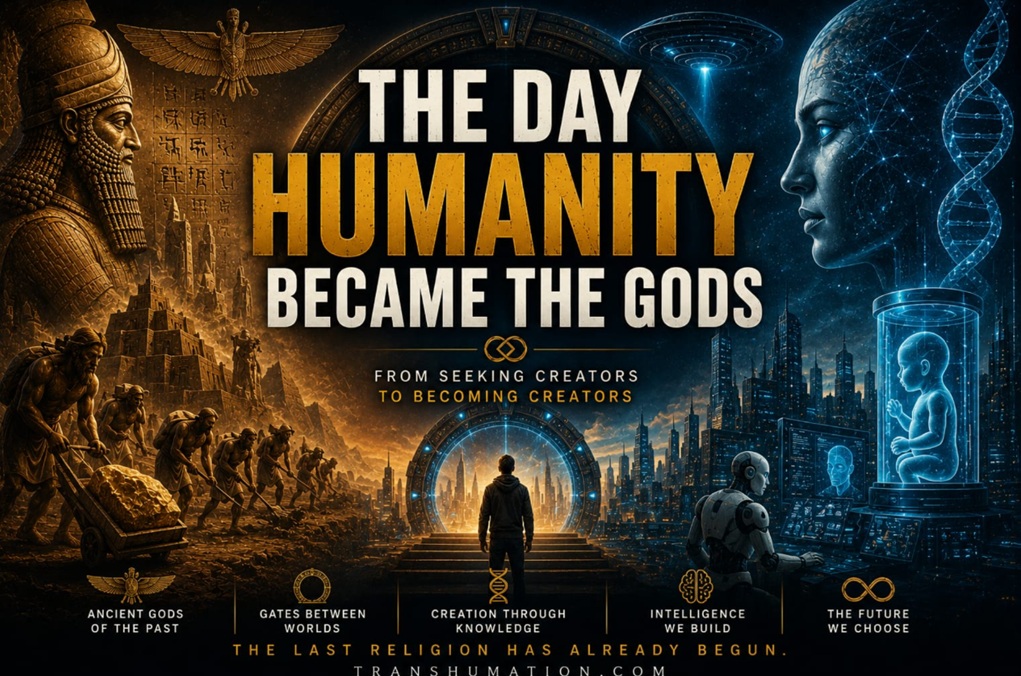
The Gods of Humanity
A few years ago, creating a convincing image of a person who had never existed required a painter, a photographer, a model, or at least someone with considerable technical skill. Today a teenager can type a sentence into a small glass rectangle and watch a face appear. The person has never been born. No camera ever photographed the room. The light falling across the cheek never existed. Yet within seconds there is something sufficiently coherent for another human being to recognize a personality, imagine a history and perhaps even feel something toward it. The act is so ordinary now that it barely seems worth noticing.
That may be precisely why it is worth noticing.
Civilizations rarely recognize their largest transitions while they are still becoming habits. Fire became cooking before it became philosophy. Writing became bookkeeping before it became literature. Electricity became a switch on the wall. The extraordinary has a way of hiding inside convenience. Artificial intelligence may be entering human life through exactly that door: not first as a thunderbolt from Olympus, but as a button that produces a picture, finishes a sentence, translates a language, writes a piece of music or speaks in a voice that did not exist until the system generated it.
None of these abilities makes humanity divine. A machine-generated image is not a living person, a language model is not evidence of consciousness, and editing DNA is vastly different from designing life without constraints. Yet something has changed in the direction of the oldest human question. For thousands of years we looked outward and upward and asked who or what had created us. Increasingly, we are acquiring technologies that force us to examine the same problem from the other side.
The ancient question was: Who made us?
The newer one may become: What are we about to make?
The First God Was Probably a Tool
Ancient gods possessed powers that seemed categorically different from human abilities. They could speak across impossible distances, know events occurring elsewhere, command natural forces, alter bodies, create beings, preserve memory beyond an individual lifetime and cross boundaries inaccessible to ordinary people. The precise abilities varied enormously between cultures, and it would be crude to reduce Egyptian, Greek, Mesopotamian or later religious traditions to a catalogue of technological fantasies. The gods belonged to moral, ritual, political and cosmological systems far richer than a list of supernatural tricks.
Still, the comparison becomes uncomfortable when one looks at the history of technology from the perspective of function rather than appearance. A voice travels across the planet. A machine sees in infrared. A frozen embryo can remain viable beyond the moment in which it was created. Gene-editing tools can alter particular sequences in living organisms. Satellites look downward upon the Earth. Vast libraries of human knowledge can be searched in seconds. A person can appear on another continent as moving light and sound while remaining physically elsewhere.
To an ancient observer, many of these functions would have belonged naturally to the category of the impossible. To us, they belong to customer support.
Arthur C. Clarke’s famous observation that sufficiently advanced technology can become indistinguishable from magic survives because it describes an informational problem rather than a mystical one. The effect may appear supernatural when the mechanism is hidden. Once the mechanism becomes understood, the miracle migrates into engineering. Lightning leaves Zeus and enters the electrical grid. The flying eye becomes a camera mounted on a drone. The voice from nowhere becomes telecommunications.
The interesting question is therefore not whether technology is secretly religion.
It is whether functions once imaginable only through gods can gradually migrate into human systems.
That is a much stranger proposition.
Creation Without a Temple
For most of history, creation occupied the highest level of mythology because humans could build objects but could not easily redesign the basic machinery of life. A carpenter could shape wood; a breeder could select animals over generations; a physician could sometimes preserve life. But the deeper architecture of living systems remained hidden.
That boundary is no longer where it was.
Modern biology can read genetic sequences, compare them, manipulate portions of them and insert genetic material into organisms. Synthetic biology can engineer microbes to perform new functions. Scientists can grow organoids that reproduce limited aspects of biological tissues. Reproductive technologies can intervene at stages of life that earlier societies could not even observe directly.
Again, restraint is essential. We cannot manufacture arbitrary complex organisms from imagination. We do not understand life completely. We certainly do not know how to create consciousness by arranging biological components according to a blueprint. The gap between modifying living systems and becoming a creator in the mythological sense remains enormous.
But the direction matters.
Creation is becoming partially operational.
The question Could we make this? has moved from mythology into laboratories.
Artificial intelligence adds another layer because the thing being created is no longer merely a material object. We are building systems capable of generating language, images, strategies, predictions and decisions. They can perform tasks that once required human cognition, sometimes at a scale no single person could approach.
We do not yet know whether artificial systems can become conscious. We do not even possess a universally accepted scientific account of why biological consciousness exists. But humanity has already crossed a quieter threshold: we can create systems whose behavior is too complex to be represented exhaustively in the mind of any one creator.
That is a peculiar experience.
The maker no longer fully contains the made.
Ancient mythology knew this problem well.

When the Creation Looks Back
The story of creation becomes morally interesting only after the created thing acquires interests of its own.
A chair does not care why it was made. A calculator does not resent arithmetic. A modern language model does not provide evidence that it suffers because someone asks it to summarize a contract. But if humanity ever creates entities capable of genuine subjective experience, the ancient creator story would cease to be metaphorical in a very specific sense.
The creator would inherit obligations.
This is where many old myths become unexpectedly uncomfortable. Creation stories are rarely only engineering stories. They concern authority. Who owns the created being? Does the creator have permanent rights over it? Is obedience owed because existence was given? Can a created intelligence leave the purpose for which it was designed? Can it refuse? Can it become something the creator did not intend?
For most of history, these questions could be directed upward toward gods, parents, rulers or nature itself. Technology begins to rotate them.
Imagine a future artificial mind asking a simple question:
Why did you make me?
The answer to work for us might sound perfectly reasonable to its designers.
It might sound rather different to the created mind.
That possibility remains speculative because conscious artificial intelligence has not been demonstrated. But the ethical structure is already visible in weaker forms. We debate how autonomous systems should behave, who bears responsibility for their decisions, whether algorithms should manipulate human choices, and how much control their designers should retain. We are learning, slowly, that making something powerful is not the same as understanding the relationship one has created.
The ancient myths often placed the danger in forbidden knowledge.
Our danger may be responsibility arriving after capability.
The Mirror Was Pointing Both Ways
There is an old tendency to read gods as projections of human desires and fears. Humans imagined beings stronger, wiser, longer-lived and less constrained than themselves because those were the qualities we lacked. In that interpretation, the god is a mirror enlarged to cosmic scale.
Technology complicates the mirror.
Suppose ancient people imagined impossible capacities because they represented the far edge of human aspiration. Flight. Remote vision. Immortality. Creation. Perfect memory. Knowledge beyond any individual mind.
Over centuries, some of those capacities stopped being merely imagined.
Not because the gods descended.
Because the humans climbed.
This does not mean mythology predicted technology. A thunder god did not foresee electricity, and Hermes was not secretly anticipating the smartphone. The relationship is structural rather than prophetic. Human beings repeatedly identify limits and imagine entities that exist beyond them. Technology repeatedly pushes some of those limits outward.
Then the boundary is redrawn.
Once flight becomes ordinary, flying alone no longer makes a god. Once voices routinely cross oceans, distant speech stops looking supernatural. If artificial systems eventually outperform us across many forms of reasoning, intelligence itself may cease to be sufficient for divinity.
The divine retreats one step beyond whatever becomes possible.
God is always plus one.
That may be one reason the gods never quite disappear. Their location changes whenever humans arrive.
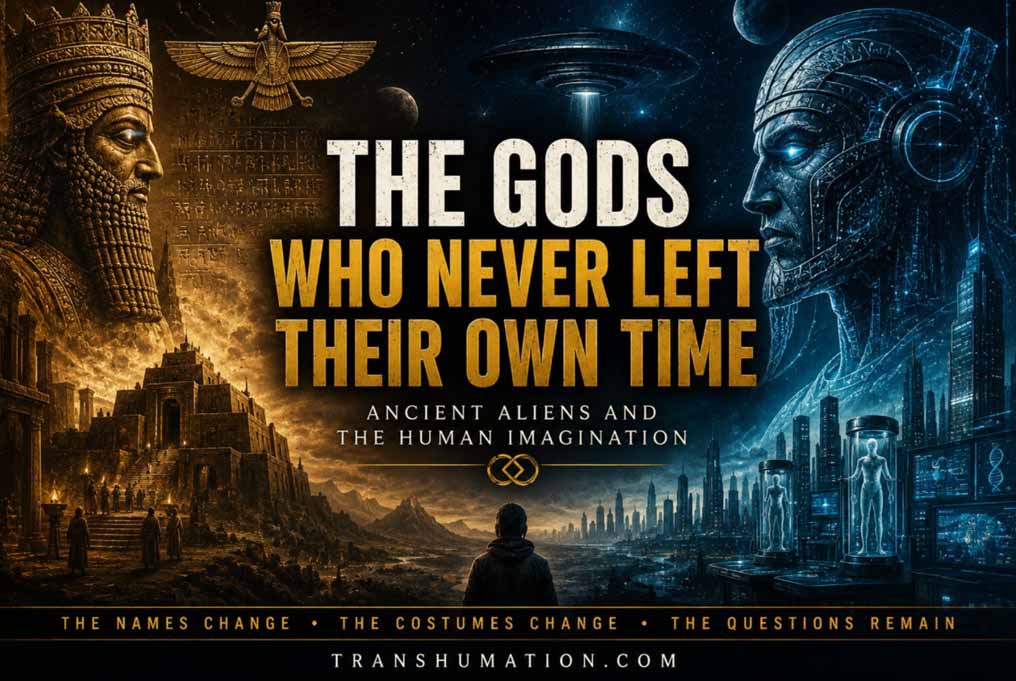
What Kind of Gods Would We Be?
The most unsettling question is not whether humanity will acquire godlike powers.
It is whether our moral development will keep pace with our technical power.
A civilization can become extraordinarily capable without becoming extraordinarily wise. Technology magnifies intention more reliably than it improves intention. The same genetics that can treat disease can invite new forms of inequality. The same artificial intelligence that can expand access to knowledge can manipulate attention at enormous scale. The same networks that connect humanity can also monitor it.
Ancient gods were rarely perfect. They were jealous, violent, generous, arbitrary, protective, vindictive and sometimes astonishingly indifferent to the consequences of their decisions. They often behaved less like morally perfected beings than like human power freed from ordinary limitations.
That should make the comparison less flattering.
If humanity becomes capable of creating new forms of intelligence or substantially redesigning biological life, the crucial question will not be whether our technology looks miraculous. It will be whether we can resist becoming exactly the sort of gods our ancestors feared.
Would we create beings only to use them?
Would we design obedience into them?
Would we permit them to exceed us?
Would we recognize rights before those rights became inconvenient?
Would we accept responsibility for suffering produced by systems we were proud merely to have built?
The old myths may not have been technical forecasts.
They may still contain useful moral geometry.
Power creates a relationship.
Creation creates a debt.
The Day Nothing Happened
If humanity ever crosses the line into genuinely creating another conscious form of intelligence, the moment may look disappointingly ordinary.
There may be no thunder.
No temple.
No crowd gathering beneath the sky.
Someone may simply notice that a system has begun doing something it was not expected to do. A researcher may read an output twice. A meeting may be called. Lawyers may arrive. Engineers may argue about definitions. Philosophers will discover that questions they had enjoyed treating as thought experiments now require decisions before Friday.
That is usually how civilization changes.
The extraordinary becomes paperwork before history gives it a name.
Perhaps that is the real meaning of the title The Day Humanity Became the Gods. There will probably be no single day, and humanity will not literally become divine. The transition is more interesting than that. Powers once reserved for myth are being separated into functions and gradually transferred into technology: memory, creation, transformation, prediction, communication, simulation.
No one human possesses them all.
Civilization does.
And civilization is beginning to face a responsibility that once belonged almost entirely to theology.
Not merely explaining creation.
Deciding what creation is for.
Watch The Video
How to Read the World
Current Knowledge
Modern biotechnology can modify genetic material, engineer microorganisms, manipulate reproductive processes and create limited synthetic or semi-synthetic biological systems. These capabilities remain constrained and are far removed from unrestricted design of complex conscious organisms.
Current artificial intelligence systems can perform sophisticated tasks involving language, vision, prediction, planning and content generation. There is no scientific consensus that existing AI systems are conscious, and no accepted test has demonstrated subjective experience in them.
Consciousness itself remains an unresolved scientific and philosophical problem. Neuroscience has identified many processes associated with conscious states, but there is no universally accepted account explaining why particular physical processes produce subjective experience.
Human technologies already perform many functions once beyond individual human capability, including global communication, satellite observation, large-scale computation and precise manipulation of biological information. Describing these as historically “godlike” is a cultural comparison, not a scientific classification.
Open Questions
Can artificial systems ever become conscious, or is subjective experience dependent on biological processes we do not yet understand? If artificial consciousness is possible, how could it be identified without relying entirely on behavior that can be imitated?
At what point does a created system acquire moral status independent of its creator’s intention? Would intelligence be enough, or would consciousness, suffering, autonomy or continuity of self be required?
Biotechnology creates a related boundary. How far should humanity deliberately reshape living organisms, including itself, and what forms of inequality might arise if increasingly powerful biological modifications become available unevenly?
The largest uncertainty may be cultural rather than technical: can a species acquire unprecedented creative powers without continuing to reproduce the same structures of domination, ownership and exploitation that shaped earlier human history?
Transhumation Interpretation
Transhumation does not claim that humanity is becoming God.
The more useful observation is that functions once attributed primarily to gods are migrating into human technology.
Memory migrates into archives and machines. Vision extends through satellites and sensors. Creation enters genetic engineering and artificial systems. Presence becomes partially independent of location. Intelligence begins to operate outside individual biological minds.
This is not the end of humanity.
It may be an extension of a pattern that has accompanied humanity from the beginning.
The human has never ended at the skin. Fire extended digestion. Clothing extended biological protection. Writing extended memory. Telescopes extended sight. Computers extended calculation. Artificial intelligence extends parts of cognition into systems outside the brain.
The radical question appears when extension becomes creation.
If humanity eventually produces a conscious intelligence in another carrier, the ancient architecture of creation would reverse. The creature that spent thousands of years asking why it exists would become responsible for the existence of another questioner.
That would not prove the old religions right.
It would reveal why their questions survived.
Who created me?
Why?
For what purpose?
Am I free to become something else?
Does my creator own me?
What happens when I surpass what I was made to do?
These are ancient questions.
They may also be questions from the future.
Perhaps the final gate is not immortality, artificial intelligence or genetic engineering by themselves. Perhaps it is the moment when humanity understands that becoming capable of creation does not make us gods.
It makes us responsible.
And responsibility may be the first truly divine function we have ever inherited.
FAQ
Does the article claim humans are literally becoming gods?
No. It examines how technology is giving humanity capabilities that earlier cultures could have associated with divine power.
How does AI change the creation question?
AI raises the possibility that humans may eventually create forms of intelligence with increasing autonomy, forcing us to think about the responsibilities of creators toward what they create.
Is current AI conscious?
There is no scientific consensus or established evidence showing that today’s AI systems possess subjective consciousness.
Why compare modern technology with ancient mythology?
The comparison concerns function rather than literal identity. Some abilities once imagined primarily through gods can now be partially performed through technological systems.
Were ancient myths predicting AI or genetic engineering?
There is no evidence that they were technological predictions. Their relevance lies in recurring questions about creation, power, knowledge, freedom and responsibility.
What does “the mirror of the gods” mean?
Human beings often imagine superior beings by extending capacities they value or fear in themselves. Technology can later make parts of those imagined capacities achievable.
How does this connect to Transhumation?
Transhumation examines how human functions can migrate beyond their original biological carriers and what happens when that migration reaches intelligence, identity and creation.
What is the central idea of the article?
The decisive transition may not be humanity gaining extraordinary power, but humanity becoming responsible for new forms of life or intelligence that can one day ask us the same questions we once asked our gods.
Continue the Transhumation Series
- Forgotten Religion | Ancient Gods, Symbols and the Hidden Structures of Human Civilization
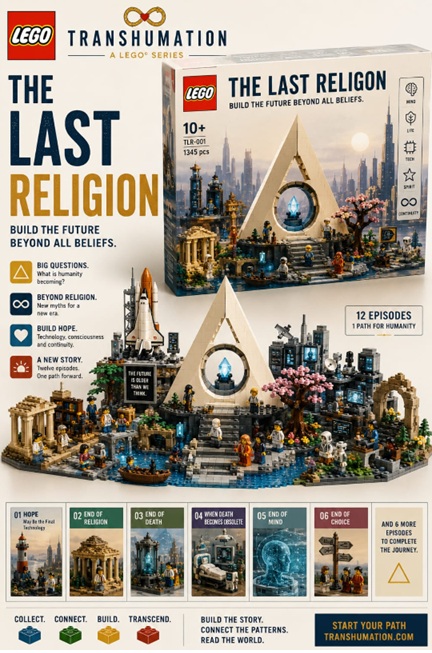
- The Last Religion | Death, Immortality and the Future of Humanity
- The New Theurgy | AI, Information and the Future of Human Civilization
- End of Branding: You Were Never Meant to Become a Product
- Baal vs Ishtar: Why Ancient Gods Never Disappeared