
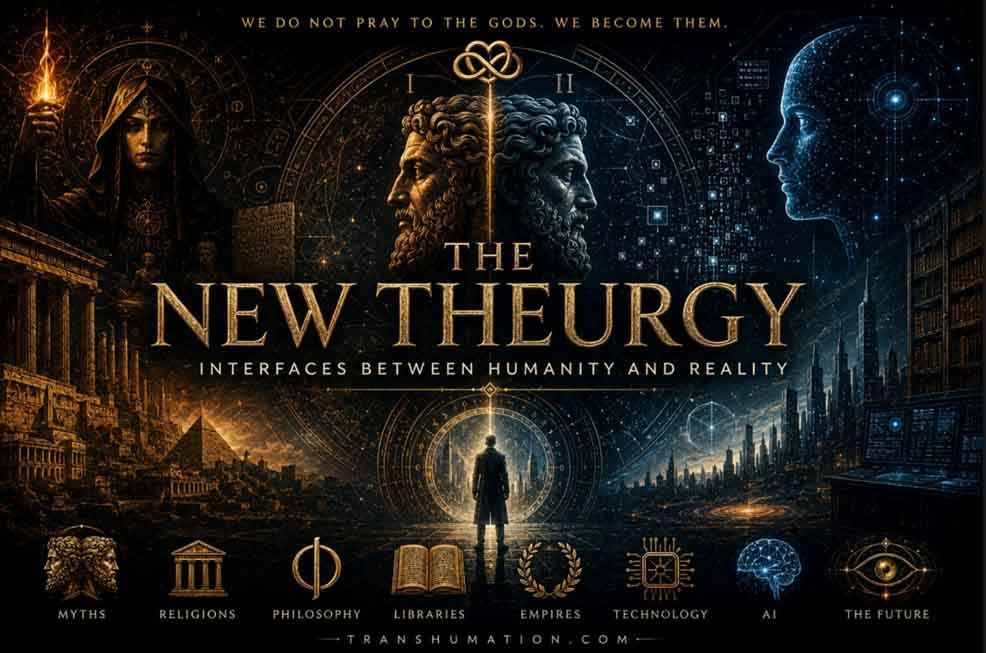
The Theurgy
Every civilization creates something between the human mind and a reality too large to encounter directly.
Stand in front of a map of the night sky and there is a useful deception taking place.
The black page may contain a few thousand dots, lines connecting constellations, perhaps the names of galaxies and an indication of distance. It fits comfortably into two hands. The reality it represents does not. A galaxy containing hundreds of billions of stars becomes a small mark. Distances that light requires millions of years to cross become centimeters. Objects separated by unimaginable expanses appear beside one another because the human mind needs them close enough to compare.
The map succeeds by being radically incomplete.
That is not its weakness.
It is the condition that makes it usable.
Civilization has always faced this problem. Reality arrives at a scale that exceeds the individual observer. No person can experience an empire in its entirety, remember a civilization’s history, inspect every piece of evidence relevant to a scientific theory or intuitively grasp geological time. Even ordinary life exceeds us. We live inside economic systems we cannot personally inspect, languages we did not invent, technologies built by specialists we will never meet and cultural histories stretching backward long before our birth.
Some layer must always stand between the world and the person.
A story.
A symbol.
A diagram.
A priest.
A philosopher.
A book.
A mathematical model.
A search engine.
An artificial intelligence.
The intermediary changes.
The distance remains.
That distance is the territory of The New Theurgy.
Reality Has Never Fit Inside the Human Mind
Human intelligence is powerful partly because it does not attempt to reproduce reality at full scale.
A map removes almost everything from a landscape. A word compresses innumerable individual objects into a category. A historical period turns millions of separate lives into a phrase such as the Renaissance. Money translates incomparable objects and labor into a common symbolic system. Mathematics removes texture, smell and biography from the world so relationships can become visible.
We understand partly by discarding.
This creates the Interface Problem: every useful representation must simplify reality, but every simplification creates the possibility that what was removed will later prove important.
Civilization therefore advances through a strange negotiation between complexity and compression.
Too little structure and the world becomes unintelligible.
Too much simplification and the model begins replacing the reality it was built to reveal.
The interface is never merely decoration.
It determines what the observer is capable of seeing.
The Gods Were More Than Diagrams
Ancient religious symbols provide some of the most powerful examples of this relationship, but they have to be treated carefully.
Janus was not invented as a primitive infographic about transitions. He was a Roman god embedded in religious practice, public ritual and a particular cultural world. Hekate cannot be reduced to a psychological illustration of decision-making; her historical associations include crossroads, boundaries, liminal spaces and several other religious functions that changed across periods and regions.
Yet symbols can carry more than their literal theological claims.
Janus gives transition a face.
Hekate gives the threshold a presence.
The labyrinth converts confusion into architecture.
The ladder makes ascent imaginable.
The gate turns a boundary into a decision.
These images remain intellectually useful long after their original contexts have changed because they make relationships portable.
You cannot hold “the structure of transition between two states” in your hand.
You can picture a doorway.
That is what an interface does.
It does not become the reality behind it.
It gives the mind somewhere to stand.
Philosophy Changes the Instrument
Philosophy did not simply replace mythology with better metaphors. Nor did it merely translate gods into concepts. The relationship between myth, religion and philosophy was far more complicated.
But philosophy introduced powerful new instruments of compression.
Categories.
Arguments.
Definitions.
Logical distinctions.
Models of causation.
Plato’s Forms, Aristotle’s classifications, Stoic accounts of nature and later Neoplatonic hierarchies offered different architectures through which reality could be made conceptually navigable.
This was another kind of interface.
Instead of encountering complexity primarily through narrative figures and ritual relationships, the thinker could increasingly approach it through explicit conceptual structures.
The underlying problem remained unchanged.
Reality exceeded the individual.
The method of orientation evolved.
That is a recurring pattern in civilization: new interfaces do not necessarily destroy the old ones. They accumulate.
We still use myth.
We still use ritual.
We still use philosophy.
We added equations, maps, databases and software.
Civilization becomes a stack of interfaces.
Religion Builds a World You Can Live Inside
Religion deserves even greater caution because describing it merely as an “interface” can flatten something that, for billions of people, is not a representational tool but a relationship with what they regard as genuinely sacred.
Still, viewed structurally, religious systems have often done something extraordinary.
They connect an individual biography with a much larger order.
Birth becomes part of a story.
Marriage becomes more than a private contract.
Death acquires ritual.
Time becomes a calendar of meaningful recurrence.
Architecture distinguishes sacred space from ordinary space.
Stories connect the dead, the living and generations not yet born.
Religion therefore does not simply provide propositions about the universe.
It can create an inhabited model of reality.
A person does not merely understand the system.
They live inside it.
This may be one reason religious interfaces have been so durable. They are not diagrams hanging on a wall. They integrate story, community, ritual, morality, memory and identity into an environment.
Modern technological culture has produced astonishingly powerful tools.
It has rarely produced anything equally comprehensive.
The Library Was Already an Interface
The library appears less dramatic than a temple because its miracle became ordinary.
Thousands of dead people sit silently on shelves.
A reader enters and can ask Aristotle about politics, Darwin about life, Woolf about consciousness, an unknown nineteenth-century engineer about a machine that no longer exists. The building does not merely store objects. Catalogues, classifications, indexes and librarians make those objects navigable.
Without those structures, the collection would gradually become unusable.
The archive therefore creates the same problem on a different scale.
As knowledge grows, orientation becomes more valuable.
A library of fifty books barely needs a librarian.
A civilization containing hundreds of millions of documents does.
The information age has now expanded the library beyond anything earlier civilizations encountered. The difficulty is no longer simply preservation.
We increasingly possess more recorded material than any individual could meaningfully inspect.
The archive has become larger than the reader.
And this is exactly the kind of condition in which a new interface becomes necessary.
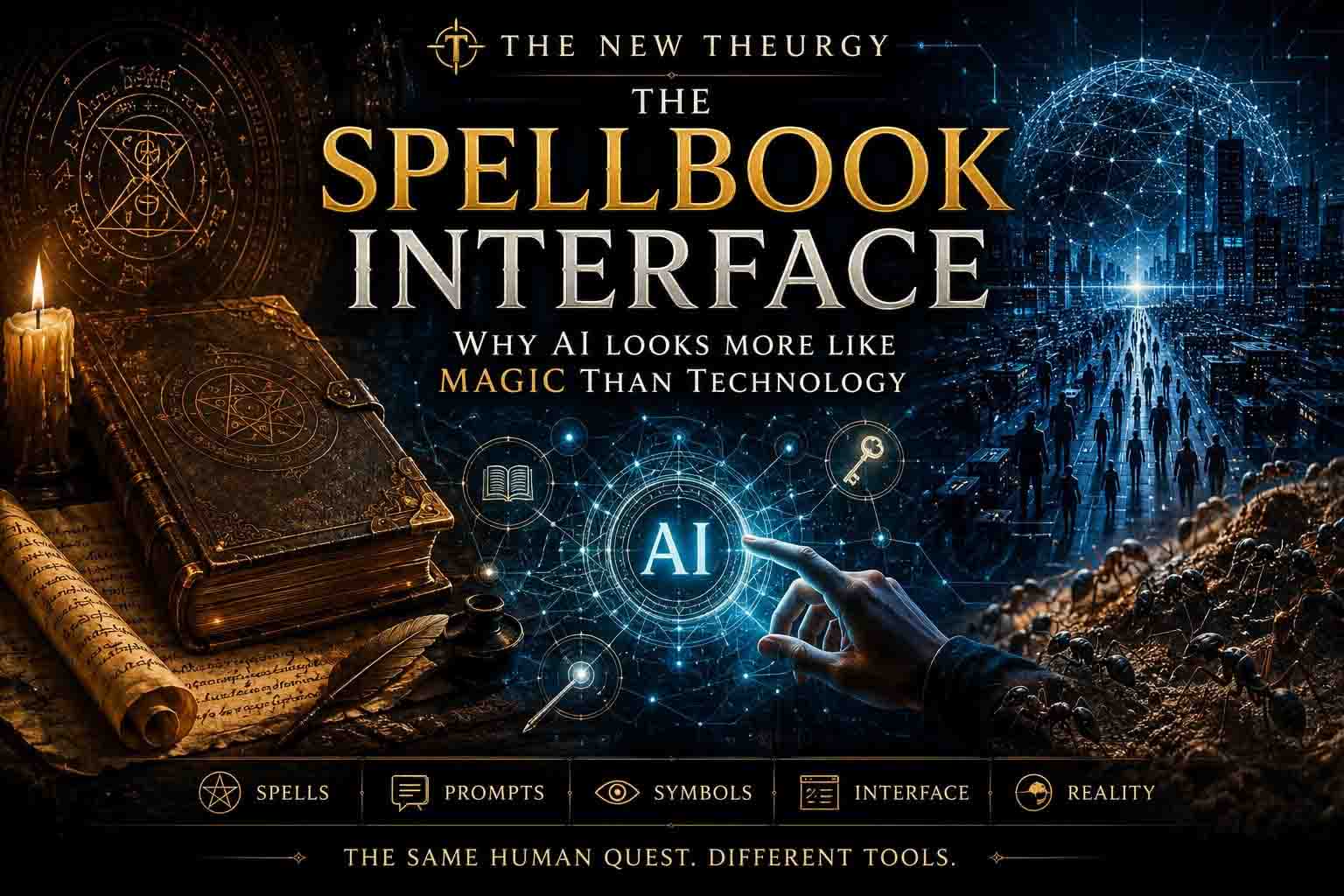
When the Library Begins to Answer
Artificial intelligence may represent such a change.
Not because AI contains all human knowledge. It does not.
Not because it is conscious. That remains unresolved.
Not because its answers are automatically reliable. They are not.
Its significance lies somewhere more practical.
AI allows a person to approach large informational structures through dialogue.
The user does not always need to know where a relevant document sits, which terminology a specialist would use or which database contains the answer. Increasingly, the person can describe an intention in ordinary language and allow the system to help locate, reorganize, compare or interpret material.
The library acquires a conversational surface.
This changes the relationship between the individual and accumulated civilization.
But it also creates a danger familiar from every previous interface.
The easier the representation becomes to use, the easier it becomes to forget what has been hidden.
An AI answer can compress twenty sources into three paragraphs.
That is extraordinarily useful.
It also removes the reader from twenty sources.
The better the interface becomes, the more important it is to remember that there is still something behind it.
Why Advanced Technology Begins to Feel Like Magic
Arthur C. Clarke famously observed that sufficiently advanced technology can become indistinguishable from magic. The phrase survives because it describes an experiential truth even when the mechanism is perfectly natural.
A mechanism that remains visible feels mechanical.
A mechanism that disappears while retaining its effects begins to feel magical.
The modern user asks a device for directions and receives a route shaped partly by satellites orbiting thousands of kilometers away. A sentence produces a synthetic image. A few typed words translate a language the user has never learned. A model extracts patterns from a body of text larger than one reader could examine in decades.
Nothing supernatural has occurred.
But the distance between action and mechanism has grown enormous.
That distance produces wonder.
It also produces dependence.
The old magical formula promised that a small symbolic action could activate a larger hidden order.
Modern computation really can do something structurally similar, but through physical mechanisms rather than supernatural ones.
The experience returns.
The explanation changes.
What Theurgy Actually Was
Historical theurgy belonged especially to late antique Neoplatonic religious philosophy. Thinkers associated with traditions surrounding figures such as Iamblichus treated ritual action, sacred symbols and divine participation as means through which the human could enter into relationship with higher orders of reality.
It was not simply “navigation.”
It belonged to a genuine metaphysical system.
The New Theurgy does not claim to revive that system literally.
It takes one structural question from it.
How does a limited human being interact with something too large, complex or distant to approach directly?
Ancient theurgy answered through ritual participation in a sacred cosmos.
Modern civilization builds different intermediaries.
Scientific models.
Libraries.
Networks.
Interfaces.
Artificial intelligence.
The historical mechanisms are different.
The recurring position of the human observer is what matters.
We remain somewhere in the middle.
The Return of Symbols
One of the great mistakes of technological modernity was imagining that better information would eventually make symbolic thinking unnecessary.
Instead, our world may be more symbolically dense than ever.
A small triangle means play.
A heart means approval.
Three curved lines mean wireless communication.
A cloud means distant computer infrastructure.
A magnifying glass means search.
An avatar stands for a person who may be thousands of kilometers away.
An entire global technical infrastructure becomes a handful of shapes on glass.
This is not a retreat from rationality.
It is what complexity demands.
Nobody can operate a modern computer by consciously tracking the electrical states inside its processors.
The machine must be translated into symbols.
As technology becomes more complex, successful interfaces become simpler.
The hidden world grows.
The visible doorway shrinks.
That may be one of the central paradoxes of our age.
Watch The Video
How to Read the World
Current Knowledge
Human cognition operates under limited attention and working-memory capacity, making abstraction, categorization and external representations essential for navigating complex environments. Maps, diagrams, language and models all simplify reality while preserving relationships relevant to particular tasks.
Historical religious traditions used symbols, narratives, rituals and institutions in many different ways. Janus and Hekate should not historically be described simply as “interfaces”; that is a modern interpretive analogy based on their associations with thresholds, transitions and liminality.
Philosophical and scientific models similarly simplify aspects of reality, but scientific models are distinguished by systematic testing against observation and their vulnerability to revision when evidence conflicts with them.
Historical theurgy was associated especially with late antique Neoplatonism and involved ritual participation in a metaphysical order understood as divine. The New Theurgy uses the term analogically rather than claiming continuity of mechanism between ancient ritual and modern technology.
Contemporary AI systems can organize, transform and generate information at large scale, but they remain fallible and do not provide an unmediated view of reality. Their outputs are themselves interfaces shaped by data, training methods, system design and user prompts.
Open Questions
The first question is whether civilization can ever function without mistaking an interface for reality. Every model eventually becomes familiar enough that its assumptions disappear from view. How do we preserve access to what lies behind the representation?
A second problem concerns AI. If artificial systems become the primary interface between individuals and large portions of civilization’s archive, will the average person gain greater intellectual freedom through improved access, or become more dependent on interpretations they cannot independently inspect?
There is also the question of symbolism. Can modern societies create shared symbols capable of providing orientation without turning those symbols into rigid ideologies?
And finally, what happens when the interface becomes adaptive? A book presents roughly the same pages to every reader. AI can present a different intellectual map to every person. Does personalized mediation make reality easier to navigate, or eventually fragment the common world itself?
Transhumation Interpretation
The New Theurgy begins from an uncomfortable fact.
There is no direct human access to total reality.
We always encounter the world through something.
Senses.
Language.
Memory.
Culture.
Models.
Institutions.
Screens.
Stories.
The mistake is therefore not using interfaces.
The mistake is forgetting that we are using them.
Transhumation treats Janus, Hekate, the library, the map, the operating system and artificial intelligence as different historical examples of mediation—not because they are secretly one phenomenon, but because the same structural problem keeps returning through different carriers.
Something is larger than the individual.
Something stands between.
The human learns how to cross.
This is why The New Theurgy is not a new religion and should not pretend to become one.
Its purpose is not to declare one final map correct.
It is to study the maps.
To understand why particular interfaces emerge.
To notice what they reveal.
To notice what they hide.
And, crucially, to preserve the ability to step outside one interface when it stops working.
A good interface reduces complexity.
A dangerous interface reduces alternatives.
A good symbol opens a question.
A dangerous symbol makes every answer look like itself.
A good librarian reveals paths through the archive.
A bad librarian quietly decides which parts of the archive no longer need to exist for the reader.
This may become the central challenge of artificial intelligence.
AI could become one of the most powerful interfaces civilization has ever built.
Precisely for that reason, it must never become invisible.
The New Theurgy therefore asks a different question from the old search for ultimate revelation.
Not:
Which interface finally gives us reality itself?
There may never be one.
The better question is:
What stands between us and reality now — and what is it allowing us to see?
FAQ
What is The New Theurgy?
The New Theurgy is a Transhumation framework for studying the symbolic, intellectual and technological interfaces humans build when confronting systems larger than individual understanding.
Is The New Theurgy a religion?
No. It does not require belief in a deity, supernatural system or fixed doctrine. It uses religious history alongside philosophy, technology and information systems as material for structural comparison.
What does “interface” mean here?
An interface is a mediating layer that makes a more complex system usable or intelligible. A map, symbol, model, library catalogue and graphical operating system can all function this way in different contexts.
Why use Janus and Hekate?
Their historical associations with thresholds, passages, crossroads and liminality make them useful modern symbols for questions of transition and orientation. They were not historically theories of interfaces.
Is religion just an interface?
No. Religion can involve worship, metaphysical belief, community, identity, moral obligation and experiences understood as sacred. “Interface” describes only one structural aspect of what religious systems can do.
How does AI fit into The New Theurgy?
AI can function as an intermediary between an individual and informational systems too large for one person to navigate directly. Its importance lies partly in how radically it changes that interface.
Why are symbols still necessary in a technological civilization?
Because complexity has increased faster than human cognitive capacity. Symbols and interfaces allow people to interact with systems whose internal workings they cannot inspect continuously.
What is the danger of an interface?
It can become so useful that the user mistakes the representation for the reality behind it.
That may be the real discipline of The New Theurgy.
Use the map.
Enter the gate.
Ask the librarian.
Speak to the machine.
But always remember:
there is something on the other side of the interface.
Continue the Transhumation Series
- Forgotten Religion | Ancient Gods, Symbols and the Hidden Structures of Human Civilization
- The Last Religion | Death, Immortality and the Future of Humanity
- The New Theurgy | AI, Information and the Future of Human Civilization
- End of Branding: You Were Never Meant to Become a Product
- Baal vs Ishtar: Why Ancient Gods Never Disappeared