
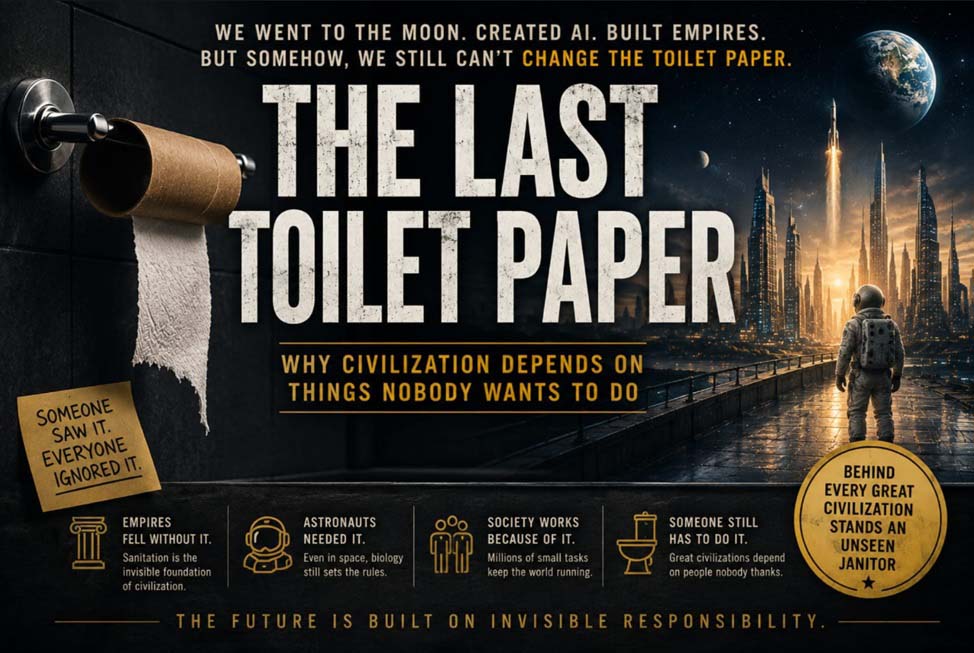
The Last Sheet of Paper
At sixty thousand feet, somewhere over the Atlantic, a passenger aboard Concorde could drink champagne while outrunning the rotation of the Earth.
The aircraft was one of the most extraordinary machines ever placed into commercial service. Its nose moved. Its fuselage expanded with heat. Four Olympus engines pushed it beyond twice the speed of sound. A passenger could leave Europe and arrive in New York at a local time that made the clock appear almost negotiable.
And somewhere inside that masterpiece of aerospace engineering was a lavatory.
Someone had cleaned it.
Someone had stocked it.
Someone had made certain that one of the fastest civilian machines in history did not contain an empty toilet-paper holder.
This is not a joke at the expense of civilization.
It may be civilization in miniature.
Human history prefers the spectacular. We remember the aircraft, the astronaut, the architect, the king, the inventor and the machine. Maintenance usually disappears from the story because successful maintenance is almost invisible by definition. When the lights turn on, nobody applauds the electrical grid. When clean water arrives, nobody photographs the pipe. When the bathroom contains what it should contain, there is nothing to discuss.
Then the roll is empty.
Suddenly an entire hidden system becomes visible.
Why Does Civilization Depend on Invisible Work?
Civilization is usually described through what it builds.
Roads.
Cities.
Satellites.
Libraries.
Computers.
But every structure creates a second problem immediately after the first has been solved.
It must continue working.
A road needs repair. A hospital needs cleaning. A library requires cataloguing. Software needs updates. Food must be delivered. Waste must leave. A machine that performs perfectly today can still fail tomorrow because material systems accumulate wear.
This is why maintenance occupies such an odd position in human imagination.
Creation has a moment.
Maintenance has a schedule.
We cut ribbons when a bridge opens. Nobody holds a ceremony for the thousandth inspection that prevented the bridge from becoming dangerous.
The new object receives the photograph.
The caretaker receives the keys.
Yet the second role may ultimately determine whether the achievement survives the first.
Civilization is not only the ability to construct complexity.
It is the willingness to return tomorrow morning and check whether complexity is still functioning.
Why Do We Notice Infrastructure Only When It Fails?
Because a good interface hides effort.
Turn a tap and water appears.
Touch a switch and a room becomes bright.
Press a button and an elevator arrives.
Place an order and a parcel materializes at the door two days later.
The better the system becomes, the less of the system the user needs to understand.
This is one of civilization’s great achievements.
It is also one of its great illusions.
The water did not come from the tap.
The electricity did not originate in the switch.
The parcel did not begin at the front door.
The interface compresses a complicated chain into one manageable point of contact.
That compression changes psychology. We begin treating outcomes as though they were properties of interfaces themselves.
The hotel guest experiences fresh towels as a feature of the room.
The passenger experiences fuel, navigation and maintenance as a property of the ticket.
The smartphone user experiences instant information as a property of glass.
Then something fails.
The water stops.
The server goes down.
The toilet blocks.
The delivery does not arrive.
For a moment, the world behind the interface reappears.
Failure is often infrastructure becoming visible.

The Last Physical Button
The button gives us a beautiful miniature history of this disappearance.
A traditional button was mechanical.
Press it and something physically moved. Contacts closed. A mechanism responded. The relationship between gesture and machine was comparatively legible.
Then came the first artificial button.
A shape drawn on glass.
It looked like a button because humans already understood buttons. It sometimes even cast a little artificial shadow, as if software needed to reassure us that the object still possessed depth.
Nothing underneath the fingertip physically moved.
The button had become an image of a button.
Then interfaces changed again.
Gestures replaced some buttons.
Voice replaced some gestures.
Artificial intelligence now begins to remove parts of the interface altogether. Instead of finding the correct control, the user states an intention.
“Book the trip.”
“Find the photograph.”
“Summarize the document.”
“Turn the heating down.”
The system translates purpose into procedure.
The physical button became a synthetic button.
The synthetic button can now disappear too.
But the heating system still contains pipes.
The aircraft still requires fuel.
The hotel still has laundry.
The passenger still has a body.
Interface can become almost immaterial to experience while infrastructure becomes more material underneath it.
Complexity has not vanished.
It has changed address.
The Last Physical Thing
This is where the toilet-roll joke becomes unexpectedly serious.
Modern civilization has spent decades converting physical objects into symbols.
The ticket becomes a QR code.
Cash becomes a number.
The map becomes a screen.
A key becomes authentication.
A letter becomes a message.
A switch becomes an icon.
Even the icon may eventually become unnecessary when intention itself becomes the interface.
But the human organism remains stubbornly physical.
It requires water.
Calories.
Temperature regulation.
Sleep.
Waste removal.
No software update can convert metabolism into a graphical preference.
You may replace a physical button with an icon of a button.
You may replace the icon with a spoken request.
But you cannot replace physical waste with the 💩 emoji.
One is representation.
The other still has to go somewhere.
Perhaps this is the last great joke matter plays on the digital age.
At the precise moment civilization begins feeling as though everything has become information, the body quietly reminds us that information still lives inside a world with plumbing.
Apollo Had a Bathroom Problem Too
Nothing exposes this better than spaceflight.
The heroic image of Apollo is one of engineering transcendence: the Saturn V leaving Earth, human beings crossing the distance to the Moon, astronauts stepping onto another world.
The biological reality traveled with them.
Apollo spacecraft did not contain a comfortable modern toilet. Urine and fecal waste required collection systems that were awkward, physical and decidedly less glamorous than lunar navigation.
This is not a trivial footnote to the Moon landing.
It reveals something fundamental.
Technology can change the environment enormously without abolishing the organism entering it.
The astronaut became a creature capable of standing on another celestial body.
He did not cease having a digestive system.
Every dream of becoming multiplanetary eventually reaches the same border.
Mars needs life-support systems.
Life support produces waste streams.
Waste streams require recycling, storage, transport or disposal.
The greater the ambition becomes, the more seriously civilization must take the ordinary.
A space colony will not fail because nobody wrote enough poetry about Mars.
It may fail because a pump stopped working.
The Secret History of the Caretaker
History favors founders because founders provide narrative.
Caesar crosses the Rubicon.
Brunelleschi raises the dome.
Armstrong steps onto the Moon.
Jobs presents the iPhone.
The moment is clean enough to remember.
Maintenance belongs to thousands of people whose names rarely become symbols.
The sanitation worker.
The cleaner.
The mechanic.
The person checking the pressure gauge.
The technician replacing a seal before anyone notices that it has begun deteriorating.
The archivist discovering that a storage format is becoming obsolete.
The employee who sees the empty roll and replaces it without announcing the achievement.
These acts are individually unimpressive.
Collectively they form the difference between a civilization and a ruin.
Rome is useful precisely because its extraordinary scale depended not only upon emperors and armies but upon transportation, water supply, food distribution, waste management, administration and endless repair. Monumental civilization sat on top of repetitive work.
The same remains true of the digital world.
Data centers need electricity and cooling.
Networks require cables.
Devices require minerals.
Software requires maintenance.
AI systems require physical computation.
The more magical the surface becomes, the easier it is to forget the industrial structure underneath it.
Does Automation Eliminate Maintenance?
It eliminates some forms and creates others.
A robot vacuum can remove one repetitive household task.
It introduces batteries, sensors, software, replacement parts and a new object that can itself fail.
An automated warehouse reduces certain forms of human handling while increasing dependency on robotics, control systems and technical maintenance.
An AI assistant can perform administrative work while creating new responsibilities involving data quality, security, monitoring and verification.
This does not mean automation is pointless.
The washing machine is better than hand-washing clothes simply because the washing machine occasionally requires repair.
The important distinction is that automation relocates work more often than it abolishes the category of maintenance.
Tomorrow’s invisible worker may sometimes be another machine.
Then the human responsibility moves one level upward.
Who repairs the repair system?
Who notices that automation has misunderstood the exception?
Who decides which failure is acceptable?
Who remains responsible when nobody touched the process directly?
An intelligent civilization therefore does not ask only whether a task can be automated.
It asks where responsibility goes after automation.
The Toilet-Paper Test
There may be a useful test hidden in the joke.
Walk into any complicated system and look for the task everyone assumes someone else will perform.
That task tells you something important about the system.
In a family it may be cleaning.
In a company it may be documentation.
In a city it may be preventive infrastructure.
In software it may be maintenance of unglamorous legacy systems.
In politics it may be the long-term consequence that falls outside an election cycle.
The empty roll is simply the domestic version.
Nobody experiences replacing it as a heroic act because heroism is not the point.
The point is shared continuity.
The person replacing the roll performs a tiny service for someone who will arrive later.
There is almost no prestige.
The benefit is mostly external.
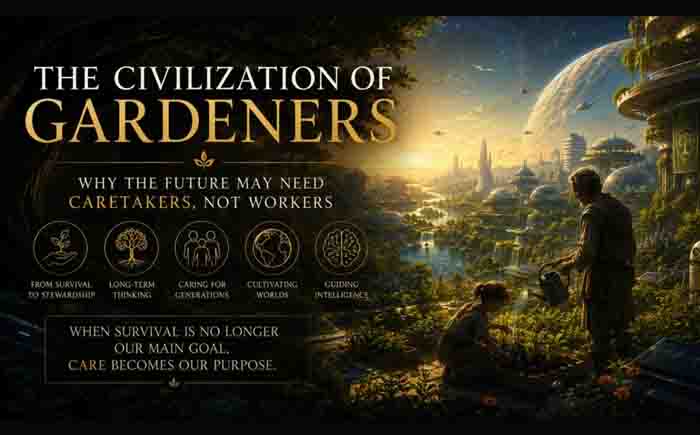
That makes it a surprisingly pure form of stewardship.
You found the system in a usable state.
You leave it in a usable state.
Civilization at its smallest scale may be nothing more mysterious than that.
The First Artificial Caretaker
Artificial intelligence changes this question because, for the first time, we are building systems that may not merely perform maintenance but notice when maintenance is required.
A machine can already detect falling pressure.
Software can predict equipment failure.
Sensors can notice dwindling supplies.
A sufficiently integrated household system could eventually order the replacement roll before anyone discovers that it is missing.
At first glance, the problem has vanished.
But the more interesting transformation has happened behind the scenes.
Responsibility has become anticipatory.
The system does not wait for the human to press the physical button.
It does not even wait for the human to press the artificial button drawn on glass.
It observes the condition and acts.
This may be the first genuinely post-button interface.
The instruction is no longer “do this.”
It becomes something closer to “keep this condition within acceptable boundaries.”
That is a profound change.
It moves civilization from controlling individual actions toward specifying desired states.
Keep the house warm.
Keep the car safe.
Keep the medicine stocked.
Keep the network running.
Keep the bathroom usable.
The machine can increasingly handle the verbs.
Humans inherit the nouns and values.
What counts as safe?
How much redundancy is enough?
What should be preserved?
What level of waste is acceptable?
Which condition deserves maintenance in the first place?
The disappearing button does not eliminate responsibility.
It exposes its next layer.
The Dignity of the Unseen Task
There is also a social problem hidden in invisible work.
Societies routinely assign less prestige to maintenance than to creation even when failure of maintenance would be catastrophic.
The architect is celebrated.
The cleaner is unnoticed.
The surgeon receives symbolic status.
The sanitation worker becomes visible mainly during a strike.
The inventor is remembered.
The technician who kept the invention operating for thirty years often disappears from history.
Some of this reflects genuine differences in expertise or responsibility.
But some of it is simply narrative bias.
Creation produces beginnings, and beginnings make excellent stories.
Maintenance produces continuity, which is much harder to dramatize.
The future may need to become better at honoring continuity.
A civilization capable of extraordinary creation but poor maintenance does not become advanced.
It becomes an impressive archaeological site waiting to happen.
Why Civilization Will Never Become Fully Digital
Because the digital world is physical all the way down.
Every bit requires implementation.
Every model runs on hardware.
Every network uses energy.
Every screen contains materials extracted, processed and transported through physical systems.
Every human user returns eventually to food, temperature, sleep, shelter and sanitation.
This does not make digital civilization less extraordinary.
It makes its achievement more interesting.
Human beings have built a layer in which functions can move between carriers with astonishing flexibility.
A physical button can become software.
A software button can become language.
Language can become an instruction to an autonomous system.
But the disappearance of the visible object should never be confused with disappearance of the physical world.
The interface grows lighter.
The infrastructure underneath can become heavier.
The future may therefore look almost magical from the passenger seat while becoming increasingly industrial behind the wall.
That is not a contradiction.
That is the architecture.
Watch The Video
How to Read the World
Current Knowledge
Modern societies depend upon large infrastructures for water, sanitation, energy, food distribution, transportation, communication and waste removal. These systems typically require continuous maintenance even when users encounter them only through simple interfaces.
Maintenance and care work are often less culturally visible than creation or innovation, partly because successful maintenance prevents events rather than producing dramatic new ones. A repaired system looks much like the system looked before failure.
Digital technology does not eliminate physical infrastructure. Computing depends upon hardware, electrical energy, cooling, communications networks and material supply chains. Artificial intelligence adds computational capability while remaining dependent upon these systems.
Automation can reduce the human effort required for particular tasks, but it commonly introduces new forms of monitoring, repair, software maintenance, security and governance. The location and character of labor change even when the user experiences the process as effortless.
Human biological requirements remain physical. Technology can improve sanitation, automate cleaning and manage waste more efficiently, but representation should not be confused with the material process represented.
Open Questions
One major question is how far maintenance itself can be automated. Predictive systems can already detect many failures before they occur, but increasingly autonomous maintenance creates new dependencies on sensors, software and systems capable of failing in less visible ways.
Another concerns social value. If automation removes much repetitive physical labor, will societies finally recognize care and stewardship more clearly, or will invisible technical systems make maintenance even easier to overlook?
There is also a governance problem. As interfaces disappear and AI acts directly on stated goals, users may become less aware of the decisions taking place beneath the surface. Convenience can therefore increase while transparency decreases.
The deeper question is whether an advanced civilization can preserve a culture of responsibility when fewer citizens personally encounter the physical systems keeping them alive. The more seamless the interface becomes, the easier it may be to mistake dependence for independence.
Transhumation Interpretation
For Transhumation, the empty toilet roll belongs to the same history as the disappearing button.
Both reveal the difference between interface and underlying reality.
The button can disappear because its function moves to another carrier.
The physical need underneath the system does not disappear so easily.
That is why the future caretaker matters.
As civilization becomes more intelligent, the question may shift from Who performs the task? to Who remains responsible for the condition?
And that responsibility survives even when no human hand ever touches the button.
FAQ
Why use toilet paper as a symbol of civilization?
Because it represents the small maintenance tasks that become visible only when they are neglected. Large systems depend upon thousands of similarly ordinary actions.
What is the “last physical button”?
It is a metaphor for the migration of fixed mechanical controls into software. A physical button can become a digital representation and eventually disappear into voice or AI-based interaction.
What is the “first artificial button”?
The on-screen button is a useful example: software imitates the form of a mechanical control even though nothing physically moves beneath the finger. It preserves the familiar interface while changing the carrier.
Does automation eliminate invisible work?
It can eliminate particular tasks, but it often creates new requirements for monitoring, repair, technical maintenance and governance. Complexity usually moves rather than simply vanishes.
Why can’t civilization become completely digital?
Because digital systems still depend upon matter, energy and physical infrastructure, while human bodies continue having biological needs. Digitalization can hide physical processes without abolishing them.
What is the deeper Transhumation question?
The deeper question is not who will replace the final roll of toilet paper.
A sufficiently advanced machine can probably solve that.
The interesting question begins the morning after the machine solves it.
When the physical button has disappeared, when the artificial button on the screen has disappeared, when an intelligent system quietly orders supplies, checks the pipes and handles the work before a human notices anything was required, civilization will appear to have removed the problem.
But it will only have removed the visible act.
Something still measures the supply.
Something still transports matter.
Something still uses energy.
Something still deals with waste.
Someone still decided what condition the system should preserve.
This is the lesson hidden behind the bathroom door.
Humanity may become extraordinarily good at making responsibility invisible.
The danger is confusing invisible responsibility with no responsibility at all.
Perhaps the final step from animal to god is not escaping the embarrassing material facts of existence. Perhaps it is becoming sophisticated enough to maintain them without pretending they ceased to exist.
The last physical thing may remain stubbornly physical.
And that may be useful.
It reminds us that no matter how elegant the interface becomes, reality is still somewhere underneath it, waiting for someone—or something—to take care of it.
Continue the Transhumation Series
- Forgotten Religion | Ancient Gods, Symbols and the Hidden Structures of Human Civilization
- The Last Religion | Death, Immortality and the Future of Humanity
- The New Theurgy | AI, Information and the Future of Human Civilization
- End of Branding: You Were Never Meant to Become a Product
- Baal vs Ishtar: Why Ancient Gods Never Disappeared