
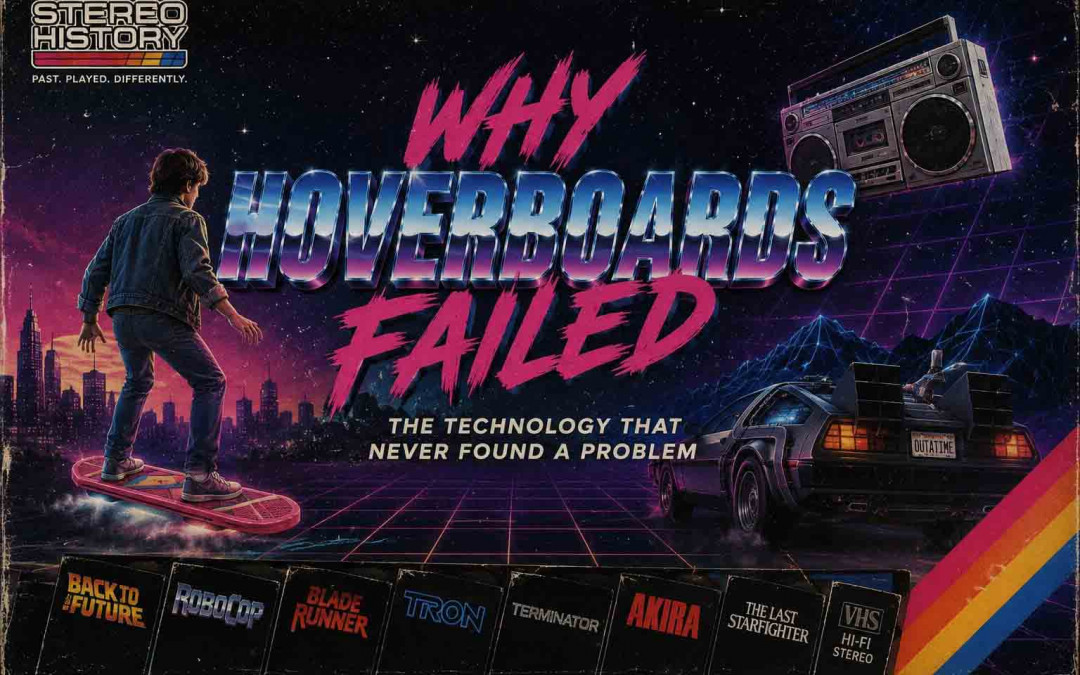
Why Hoverboards Failed
There is a scene in Back to the Future Part II that has survived longer than many of the film’s actual predictions.
Marty McFly steps onto what appears to be a skateboard without wheels. The board floats above the pavement, responds almost intuitively to his movement and turns ordinary transportation into something halfway between technology and magic. The image lasts only a few minutes, but it became one of the most durable visual promises of the future.
For decades, the hoverboard occupied a privileged place in popular imagination because it appeared to solve a problem nobody had formally described. It was faster than walking, more elegant than a bicycle, more personal than public transport and more miraculous than anything with wheels. It seemed to abolish friction itself.
Then the future arrived.
People received smartphones, GPS navigation, streaming media, cloud computing, electric scooters, generative AI and pocket-sized cameras capable of recording better video than professional equipment once could.
The hovering board never became ordinary.
What makes the failure interesting is not that engineers lacked imagination. It is that technological history repeatedly reminds us of a distinction futurism prefers to ignore: a device can be culturally irresistible as an image and still be structurally weak as a solution.
The hoverboard looked like tomorrow.
Tomorrow found other priorities.
Why Don’t Real Hoverboards Exist?
The popular answer is usually technological limitation.
Levitation is difficult. A board capable of hovering over arbitrary surfaces would require some combination of magnetic infrastructure, aerodynamic lift, propulsion, superconducting systems or another method of generating sufficient upward force. Each solution brings requirements involving energy, stability, control, weight, noise, safety and cost.
But technical difficulty alone does not explain the hoverboard’s absence.
Humanity regularly solves technically difficult problems when the reward is sufficiently valuable. Commercial aviation is complicated. Modern surgery is complicated. Semiconductor fabrication is almost absurdly complicated. Global telecommunications require layers of infrastructure no user sees.
The deeper question is whether true hoverboard-like mobility offers enough advantage to justify the complexity.
For short distances, walking is astonishingly efficient. Bicycles convert modest human effort into useful transportation with minimal infrastructure. Skateboards are inexpensive. Electric scooters provide powered micro-mobility using wheels, batteries and streets that already exist. Cars, trains and aircraft cover increasingly large distances.
A genuine hoverboard would therefore enter a crowded technological space.
It would not compete against an empty world waiting to be improved.
It would compete against the wheel.
That is a formidable opponent.
The Wheel Has No Interest in Looking Futuristic
One of the great mistakes of futurism is assuming that old technologies must eventually disappear.
They often do not.
The wheel survives because it remains exceptionally useful. Doors survive. Chairs survive. Printed books survive beside digital libraries. Mechanical bicycles survive beside electric vehicles. A spoon does not become obsolete merely because civilization invents advanced robotics.
Technological progress does not reward novelty for its own sake.
It rewards relationships between cost, reliability, convenience and function.
The hoverboard suffers because many of the problems it appears to solve have already been solved cheaply by unfashionable objects.
A bicycle lacks cinematic glamour, but it performs its function with remarkable efficiency. It requires no levitation system, no active stabilization and very little energy beyond the rider. An electric scooter is less magical, but it can be manufactured at scale and used immediately on existing streets.
This creates an uncomfortable lesson for futurism.
Sometimes the future encounters an old solution and decides there is nothing embarrassing about keeping it.

Did Back to the Future Predict Hoverboards?
Not in the serious technological sense.
The film used the hoverboard as part of a visual vocabulary designed to make 2015 recognizable as the future. It needed objects whose difference could be understood immediately by an audience in 1989. Floating vehicles, self-lacing shoes and other exaggerated technologies performed that job beautifully.
The hoverboard therefore belongs first to storytelling.
It communicates future before anyone needs to explain it.
That distinction matters because science fiction frequently becomes trapped by its own visual success. An image becomes so persuasive that later audiences begin treating it as a prediction rather than a dramatic device.
The classic science-fiction future tends to make progress conspicuous.
Cars fly.
Buildings grow upward.
Robots become humanoid.
Displays become enormous.
The future advertises itself.
Actual technological transformation often behaves differently. A familiar object quietly absorbs dozens of capabilities while looking almost unchanged.
The smartphone did not need wings.
It merely had to make entire categories of older objects unnecessary.
That turned out to be much more consequential.
What Problem Would a Hoverboard Actually Solve?
This is the question technological fantasy often asks too late.
A hoverboard promises effortless personal movement, but the underlying desire contains several different problems: reducing travel time, avoiding obstacles, improving convenience, creating pleasure and perhaps expressing status or freedom.
Those functions do not require hovering.
A subway can reduce travel time.
A bicycle provides personal movement.
An electric scooter reduces physical effort.
A pedestrian bridge avoids an obstacle.
A smartphone can remove the journey completely by turning some physical errands into informational ones.
The underlying need is therefore broader than the imagined machine.
This is precisely why predictions based on specific devices are fragile.
A technology can lose even when the need it represents remains powerful because another carrier solves the same need more efficiently.
People wanted easier access to music.
The winner was not a larger record collection.
It was streaming.
People wanted instant maps.
The winner was not a more elaborate paper atlas.
It was GPS navigation.
People wanted to communicate across distance.
The winner was not necessarily faster transportation.
Sometimes it was video calling.
The hoverboard mistake is therefore not imagining a foolish desire.
It is mistaking one beautiful implementation of the desire for the desire itself.
The Fantasy of Frictionless Motion
There is nevertheless a deeper reason hovering remains emotionally attractive.
Human imagination repeatedly dreams about escaping friction, weight and terrain.
Flying carpets cross landscapes without roads. Magic brooms ignore conventional transport. Levitation appears in religious imagery, mythology and fantasy because gravity is one of the most obvious conditions of embodiment. Human bodies are permanently negotiated with surfaces.
The hoverboard translates that ancient desire into technological language.
You do not defeat gravity entirely.
You negotiate a special exemption.
That is why wheels feel disappointing beside it.
The wheel accepts the ground and becomes extraordinarily good at using it.
The hoverboard appears to reject the ground.
Symbolically, that is much more powerful.
Technologically, it can be much worse.
This reveals an important difference between symbolic efficiency and engineering efficiency.
A flying carpet is an almost perfect symbol because nobody needs to explain what freedom it represents.
A bicycle is a better transport device precisely because it accepts constraints the fantasy wants to abolish.
Reality often rewards compromise more than purity.
Why Did Smartphones Succeed Where Hoverboards Didn’t?
The comparison seems unfair because the devices solve different problems, yet it exposes something important about technological adoption.
The smartphone did not become indispensable because civilization had been waiting for one specific black rectangle. Its success came from convergence. Communication, photography, maps, music, payment, search, messaging and computing became accessible through one portable interface.
The device reduced friction across many existing behaviors simultaneously.
That is very different from solving one narrow problem spectacularly.
The hoverboard offers one highly visible capability.
The smartphone offers dozens of mostly invisible ones.
This difference helps explain why earlier futurists often underestimated informational technology.
Mechanical transformations are easy to draw.
Information systems are harder to illustrate.
A flying object announces technological progress through appearance.
A software protocol can reorganize civilization without possessing any memorable physical form.
The twentieth century imagined the future as new objects.
The twenty-first century often delivers new relationships among existing objects.
That is a much quieter revolution.
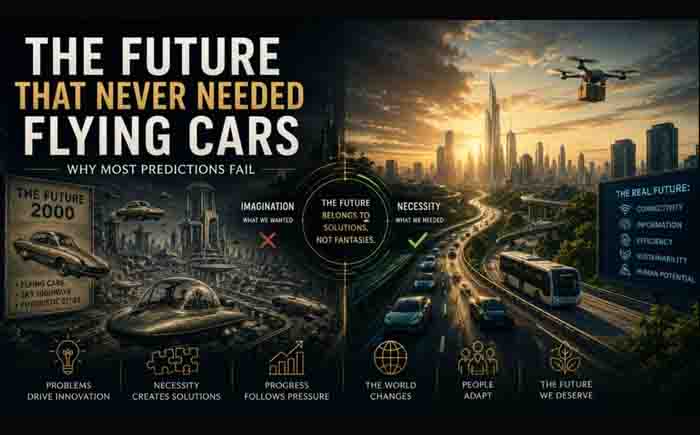
The Future Did Not Become Less Physical
There is an easy mistake hiding here as well.
It would be tempting to conclude that the physical future failed and the informational future won.
Reality is more complicated.
Cloud computing requires data centers. Smartphones require mines, factories, shipping and energy networks. Artificial intelligence depends on enormous physical computational infrastructure. Streaming music appears immaterial only because the material system carrying it has been moved outside the listener’s field of vision.
The future did not dematerialize.
Its machinery became less visible at the interface.
This is an important Transhumation distinction.
The carrier never disappears.
Dependence on one particular carrier can decrease.
A song no longer needs one vinyl disc.
A map no longer needs one paper sheet.
A library no longer needs one building at the moment of access.
But every informational pattern still requires matter somewhere.
The hoverboard represented visible technological magic.
The smartphone represents invisible technological dependency.
The second turned out to be easier to normalize.
Does Technology Need a Problem to Survive?
Not necessarily.
Humans adopt technology for pleasure, fashion, curiosity, play and status as well as necessity. Video games do not need to solve hunger. Musical instruments need not improve survival. Cameras became ubiquitous partly because humans like creating and sharing images, not because photography answered an unavoidable biological problem.
The stronger rule is subtler.
A technology that demands major changes in infrastructure, behavior or cost usually needs to offer correspondingly substantial value.
The more expensive the ecosystem required, the more serious the advantage must be.
This is where the hoverboard becomes weak.
If a toy floats beautifully inside a controlled environment, entertainment alone may justify it.
If a society must redesign streets, energy systems and safety rules so millions of people can float to work, the burden of proof becomes much higher.
The hoverboard is therefore not defeated by frivolity.
It is defeated by insufficient advantage relative to complexity.
That is a much more useful principle because it explains both serious and playful technologies without pretending civilization is governed by necessity alone.
The Technology That Lost to Infrastructure
Technological prediction tends to focus on devices because devices are visible.
History frequently turns on infrastructure.
A car becomes useful because roads, fuel stations, repair networks, licensing systems and manufacturers surround it. A smartphone becomes useful because wireless networks, software ecosystems, payment infrastructure and cloud services make the rectangle operational.
A hoverboard has no comparable world waiting for it.
To operate over arbitrary terrain, it would require either onboard mechanisms capable of continuous lift or surfaces designed to interact with it. The first makes the device demanding. The second transfers complexity into the environment.
Either way, the magical simplicity of the film version hides a complicated system.
This is a recurring feature of futuristic imagery.
The device looks effortless because the infrastructure has been removed from the frame.
Science fiction shows the flying car.
It rarely shows the air-traffic bureaucracy.
It shows the humanoid robot.
It rarely shows the supply chain maintaining millions of actuators.
It shows the hoverboard floating.
It does not show the energy budget.
The future becomes easier to imagine when somebody else handles the engineering.
Why Futuristic Technologies Fail
A technology can fail for many reasons without being technically impossible.
Its cost can remain too high.
A competing system may become cheaper.
Regulation can slow adoption.
Infrastructure can favor older alternatives.
The physical benefit may be too small.
Users may decide the novelty is not worth the inconvenience.
A technology can even solve a genuine problem while losing because another technology solves that problem at a different level.
This last possibility is especially important.
Suppose the underlying goal is faster movement through a city.
One future improves the vehicle.
Another improves public transit.
Another changes urban design.
Another reduces the need for movement by moving information instead of bodies.
Each solution attacks the same friction from a different scale.
The hoverboard is only one candidate.
The future is not obligated to choose the most cinematic one.
Watch The Video
How to Read the World
Current Knowledge
True free-hovering personal boards remain technically difficult because stable levitation over arbitrary surfaces requires active lift or specialized environmental infrastructure. Experimental systems using magnetic levitation, aerodynamic propulsion and other approaches have demonstrated limited versions of the concept, but these differ substantially from the effortless universal hoverboards of popular culture.
Commercial devices sold under the name hoverboard are generally self-balancing wheeled vehicles rather than levitating boards. They succeeded temporarily as consumer products because they delivered novelty using comparatively conventional components, but they did not fulfill the science-fiction concept.
Technological adoption depends upon more than feasibility. Cost, infrastructure, safety, reliability, regulation, energy use, user convenience and competition with existing alternatives all influence whether a device can move from demonstration to widespread infrastructure.
Entertainment and novelty can create successful technologies even when no serious practical necessity exists. The stronger historical pattern is therefore not that only necessary inventions succeed, but that technologies demanding major systemic change generally need to provide significant enough value to justify the transition.
Digital technologies have transformed many activities without making physical infrastructure disappear. Their apparent invisibility results partly from moving complexity behind interfaces rather than eliminating it.
Open Questions
One open question is whether improvements in materials, control systems or energy storage could eventually make practical hovering personal vehicles viable in specialized environments. Airports, warehouses, industrial sites or controlled recreational spaces may support technologies that would remain impractical as universal street transportation.
Another concerns the cultural value of fantasy itself. Technologies imagined in fiction can inspire engineers, shape expectations and influence what societies choose to research even when the literal fictional device never becomes practical. Failure of the object does not necessarily mean failure of the imagination that produced it.
There is also a forecasting problem. If functions are more durable than predicted forms, should futurists focus less on individual devices and more on persistent human constraints such as distance, attention, energy, coordination and access? That may improve prediction, but even underlying needs can change once new technologies alter behavior.
Artificial intelligence creates a related uncertainty. Contemporary culture often imagines AI through visible forms such as humanoid robots, companions and autonomous machines. History suggests that its most consequential effects may instead arrive through less theatrical integration into existing systems.
Transhumation Interpretation
The hoverboard belongs to Transhumation because it provides an almost perfect demonstration of the difference between structure and carrier.
The visible carrier is the board.
The deeper structure is the desire to reduce the friction of movement.
Once those two things are separated, technological possibility expands.
A hoverboard is one answer.
A bicycle is another.
A train answers a different scale of the same problem.
Remote communication sometimes removes the requirement for physical movement entirely.
No single carrier owns the function.
This is why futurism repeatedly becomes trapped.
It sees the current object and projects its descendants.
Car becomes flying car.
Screen becomes larger screen.
Robot becomes more human-looking robot.
Building becomes taller building.
The prediction preserves the carrier and exaggerates its features.
Technological history often does the opposite.
It preserves the function while replacing the carrier.
This is structurally similar to what Transhumation observes in language, media and information.
A text can move from clay to parchment to paper to electronic display.
The material changes dramatically while enough linguistic structure survives.
A melody can move from human voice to notation to vinyl to streaming.
The carrier changes.
The pattern remains recognizable.
The hoverboard teaches the inverse lesson.
Sometimes the carrier we expect never arrives because another carrier satisfies enough of the same structure.
The failed device can therefore still reveal the correct question.
What did people actually want?
Not necessarily a floating board.
Perhaps they wanted movement to feel effortless, individual, playful and unconstrained.
Once the question is framed that way, scooters, e-bikes, ride-hailing, lightweight electric vehicles and even remote services become part of the same broader space without pretending they are descendants of the hoverboard.
This is exactly where the Test of Unnecessary Choice becomes useful.
Remove the board.
Does the underlying problem remain?
Yes.
Remove levitation.
Does the desire for reduced friction remain?
Yes.
Remove the futuristic aesthetic.
Does the function still matter?
If it does, we may have found the deeper structure.
That is a better way to read technological prophecy.
The wrong machine can contain a correct intuition.
This also explains why some science-fiction predictions look foolish only when inspected too literally.
A wall-sized video telephone may be technologically awkward while correctly anticipating routine visual communication across distance.
A robot servant may misunderstand the physical form automation takes while correctly anticipating that machines will absorb more routine work.
The hoverboard may fail as transportation while accurately capturing a persistent desire for frictionless mobility.
The prophecy misses the carrier.
The structure survives.
Artificial intelligence will almost certainly expose us to the same mistake.
We may currently be over-attached to the chatbot, humanoid robot or agent interface because those are the visible forms available now.
The deeper transformation could occur elsewhere.
Perhaps AI changes education because explanation becomes constantly available.
Perhaps it changes software because users increasingly specify intentions instead of operations.
Perhaps it changes libraries because navigation through knowledge becomes conversational.
Perhaps it becomes so embedded in infrastructure that future users stop recognizing particular systems as AI at all.
The hoverboard offers a warning before we make the next set of predictions.
Do not ask only what futuristic object will appear.
Ask which limitation is becoming negotiable.
Then ask how many different carriers could solve it.
This is also where the article turns back toward the physical world.
Not every limit should be treated as an enemy.
The wheel succeeds partly because it collaborates with the ground.
The bicycle succeeds because it accepts gravity, friction and human anatomy rather than attempting to abolish them.
Some of the most elegant technologies are not those that defeat constraints but those that use constraints intelligently.
That is a different vision of progress from the fantasy of effortless transcendence.
It may also be a more mature one.
Transhumation does not require humanity to reject matter.
It asks which structures remain meaningful when their carriers change.
Sometimes the answer is surprising because the old carrier turns out never to have been essential.
Sometimes the opposite happens.
Reality reveals that the supposedly boring constraint was doing important work all along.
The hoverboard lost partly because the ground was more useful than futurism wanted to admit.
That may be its most elegant lesson.
The future did not fail to arrive.
It simply discovered that wheels were not embarrassed to come with it.
FAQ
Why don’t we have real hoverboards like in Back to the Future?
Because stable hovering over ordinary surfaces requires substantial energy, control or specialized infrastructure, while simpler wheeled systems already solve most short-distance transport needs very efficiently.
Did Back to the Future Part II predict hoverboards?
The film popularized hoverboards as a visual symbol of its imagined 2015, but it was storytelling rather than a technical forecast. Its importance lies in how strongly it shaped the cultural image of the future.
Were hoverboards technically impossible?
No. Experimental levitating systems exist, and some specialized approaches can work under controlled conditions. The difficulty is making such systems practical, safe, affordable and useful enough for everyday mass transportation.
Does every successful technology need to solve an important problem?
No. Entertainment, fashion and pleasure can support successful technologies. The stronger rule is that a technology requiring major infrastructure or behavior change must usually provide enough value to justify that complexity.
Why did smartphones succeed while hoverboards did not?
Smartphones combined many useful functions inside one portable interface and could operate through expanding digital infrastructure. The hoverboard offered a narrower advantage while demanding much more difficult physical engineering.
What is the deeper Transhumation question?
The hoverboard asks us to separate the visible invention from the function we hoped it would perform.
The useful prediction is rarely which machine will survive.
It is which relationship humanity keeps trying to change.
Hoverboards may remain fantasy, but the desire behind them—the wish to make distance, effort and physical constraint matter less—will keep looking for other carriers. And the future may recognize that desire perfectly while looking nothing like the machine we drew for it.
Continue the Transhumation Series
- Forgotten Religion | Ancient Gods, Symbols and the Hidden Structures of Human Civilization
- The Last Religion | Death, Immortality and the Future of Humanity
- The New Theurgy | AI, Information and the Future of Human Civilization
- End of Branding: You Were Never Meant to Become a Product
- Baal vs Ishtar: Why Ancient Gods Never Disappeared