
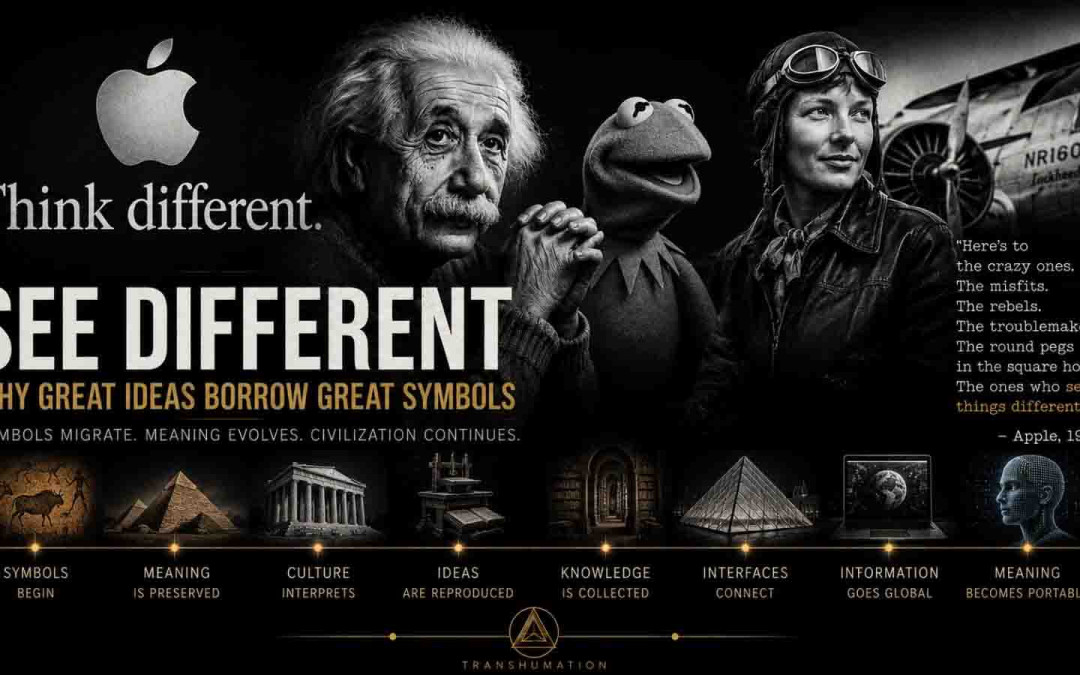
See Different
A traveler carrying a book through an airport is transporting something physically unremarkable.
Paper, glue, ink. Perhaps three hundred grams of matter. The object can be weighed, scanned, damaged, confiscated or left accidentally on a seat. Nothing about its physical composition announces that inside it may be an argument written by someone dead for two thousand years, a fictional childhood that never occurred, instructions for building a machine, or a sentence capable of permanently changing the life of a person its author could never have imagined.
That disproportion is one of civilization’s quietest miracles. Human beings discovered ways of placing enormous structures of significance inside carriers that possess almost none of that significance by themselves. Ink does not understand philosophy. Paper does not grieve. Magnetic storage does not know what a photograph means. A server containing a million books has no necessary experience of possessing a library.
And yet another mind can approach the carrier and reconstruct something.
A thought crosses a century without its thinker. A story crosses an ocean without its storyteller. A mathematical relation can move from chalkboard to textbook to computer screen while remaining recognizable enough to be used again. The carrier changes, and the event of understanding can occur elsewhere.
We usually describe this as the transmission of information.
But civilization accomplished something stranger.
It learned how to make meaning reconstructible at a distance.
That is the sense in which meaning became portable.
What Does It Mean for Meaning to Be Portable?
Meaning is not an object hidden inside language.
There is no tiny version of Hamlet living between the molecules of ink in a printed copy, waiting to be released when someone opens the book. The physical carrier contains patterns that interact with a reader who already possesses language, memory, cultural assumptions and a nervous system capable of interpretation.
This is why the same sentence can mean different things to different people without the letters changing.
A joke translated literally may lose what made it funny. A religious symbol can be sacred to one observer, historical to another and incomprehensible to a third. A legal document can remain physically intact after the legal system that once gave it force has disappeared.
Meaning therefore travels imperfectly because it does not belong entirely to the carrier.
It emerges through a relationship among pattern, context and interpreter.
That makes civilization’s achievement more impressive rather than less. We did not invent containers capable of holding pure meaning. We invented methods for preserving enough structure that meaning can happen again.
A musical score does not contain sound, yet a musician can reconstruct a performance from it. A map does not contain a city, yet a traveler can use it to navigate one. A written argument does not contain the consciousness of its author, yet another consciousness can enter the structure of the reasoning centuries later.
The pattern does not need to carry the whole world.
It needs to preserve the relationships that matter.
Before Writing, Meaning Had Legs
The first great carriers of culture were human beings themselves.
Before extensive writing systems, communities transmitted genealogies, stories, laws, rituals, songs and practical knowledge through speech and repeated performance. Oral traditions should not be imagined merely as fragile memories waiting for writing to rescue them. They developed sophisticated methods for making memory reliable enough to function socially: repetition, formulaic language, rhythm, melody, ritual occasions and groups of people who corrected one another.
Meaning was already portable.
It traveled inside bodies.
A storyteller could cross a valley and carry a narrative farther than the people who first created it. A song could move between settlements. A ritual could persist after the death of individual participants because another generation learned the sequence.
The carrier was biological and social.
That gave oral culture certain strengths. Voice preserved timing, emphasis and performance. The audience could ask questions. The storyteller could adapt an explanation. Meaning remained surrounded by living context.
It also created vulnerability. Transmission depended on people. Memory could change. Population loss could erase knowledge. A tradition might survive only while a community continued performing it.
Writing did not replace this world in a single revolutionary moment.
It added another kind of memory.
One that could wait.

Did Writing Change Human Memory?
Writing created a strange separation between knowledge and the immediate presence of a knower.
A spoken sentence vanishes acoustically almost as soon as it is produced. A written sentence remains available for inspection. It can be copied, compared and returned to long after the speaker has left.
This changes more than storage.
It changes thought.
A long argument can become externally stable enough that another person does not need to hold every part simultaneously in biological memory. Lists can exceed what one person can reliably remember. Laws can be consulted rather than merely recalled. Mathematical operations can be written out. Administrative systems can coordinate populations larger than a single network of personal relationships.
Writing therefore becomes a form of cognitive scaffolding.
But the trade is not free.
The written page removes much of the living context that accompanies speech. Tone may disappear. Gesture disappears. Immediate clarification disappears. A phrase can survive long after assumptions once obvious to its audience have vanished.
The carrier becomes more stable.
Interpretation can become more uncertain.
This is the recurring bargain of media history: every carrier preserves some relations exceptionally well and abandons others.
Civilization gains reach by accepting compression.
When Stone Learned to Wait
Stone is an almost perfect symbol of persistence because it performs one function exceptionally well: it remains.
An inscription can outlive dynasties. A monument can survive the language in which it was built. Archaeologists can encounter marks made by hands whose names have vanished completely.
But endurance does not guarantee intelligibility.
A surviving inscription may contain a language nobody can read. A symbol may remain physically visible while the cultural system that made its significance obvious disappears. A monument can outlive the religion, political authority or ritual practice that once told people how to interpret it.
This reveals a distinction that modern civilization sometimes forgets.
Preservation of the carrier is not preservation of the meaning.
Meaning requires a path back.
Language.
Context.
Comparative evidence.
Tradition.
Interpretation.
This is why libraries do more than protect objects. Catalogues, translations, annotations, provenance records and scholarship preserve relationships around the object that make later understanding possible.
A perfectly preserved book in an unreadable language is an extraordinary artifact.
It is also a locked door.
Books Did Not Become Portable Minds
The book is one of the most successful technologies ever created partly because of the extraordinary ratio between physical simplicity and intellectual reach.
A book can cross borders without its author. It can remain closed for fifty years and become active again when a reader opens it. Thousands of identical copies can expose different minds to approximately the same symbolic structure.
But the phrase portable mind goes too far.
A book does not contain the author’s complete experience. It does not possess the memories the author omitted, the unspoken assumptions surrounding the argument or the capacity to respond when misunderstood. Even autobiography is selection.
What the book preserves is something narrower and still remarkable: a structured trace capable of reactivating thought in someone else.
This gives written civilization a peculiar relationship with time.
Plato cannot hear our objections.
Yet the structure of one of his arguments can still cause a person today to formulate an objection.
A dead novelist cannot know a modern reader.
Yet a pattern created inside one nineteenth-century nervous system can participate causally in the emotional life of another nervous system generations later.
That is not resurrection.
It is delayed participation.
The library becomes an architecture built for encounters between people who can never meet.
Do Libraries Preserve Information or Meaning?
A library preserves carriers first.
Books, manuscripts, photographs, recordings, maps, newspapers, databases. These are physical or digitally instantiated objects containing structured traces.
Meaning appears when those traces become accessible to interpretation.
This is why the best library cannot simply accumulate.
It must organize.
An archive containing everything but revealing no route through it approaches informational uselessness. Ten million uncatalogued documents can hide a fact more successfully than the destruction of a single clearly identified file.
Civilization therefore developed a second technology beside storage:
navigation.
Catalogues.
Indexes.
Bibliographies.
Classification systems.
Curators.
Archivists.
Librarians.
Search engines.
Each sits between preserved structure and a mind trying to use it.
This is the deeper meaning of the Library of Mirrors.
A library exists for readers, not for books.
The books are carriers.
The purpose is the encounter they make possible.
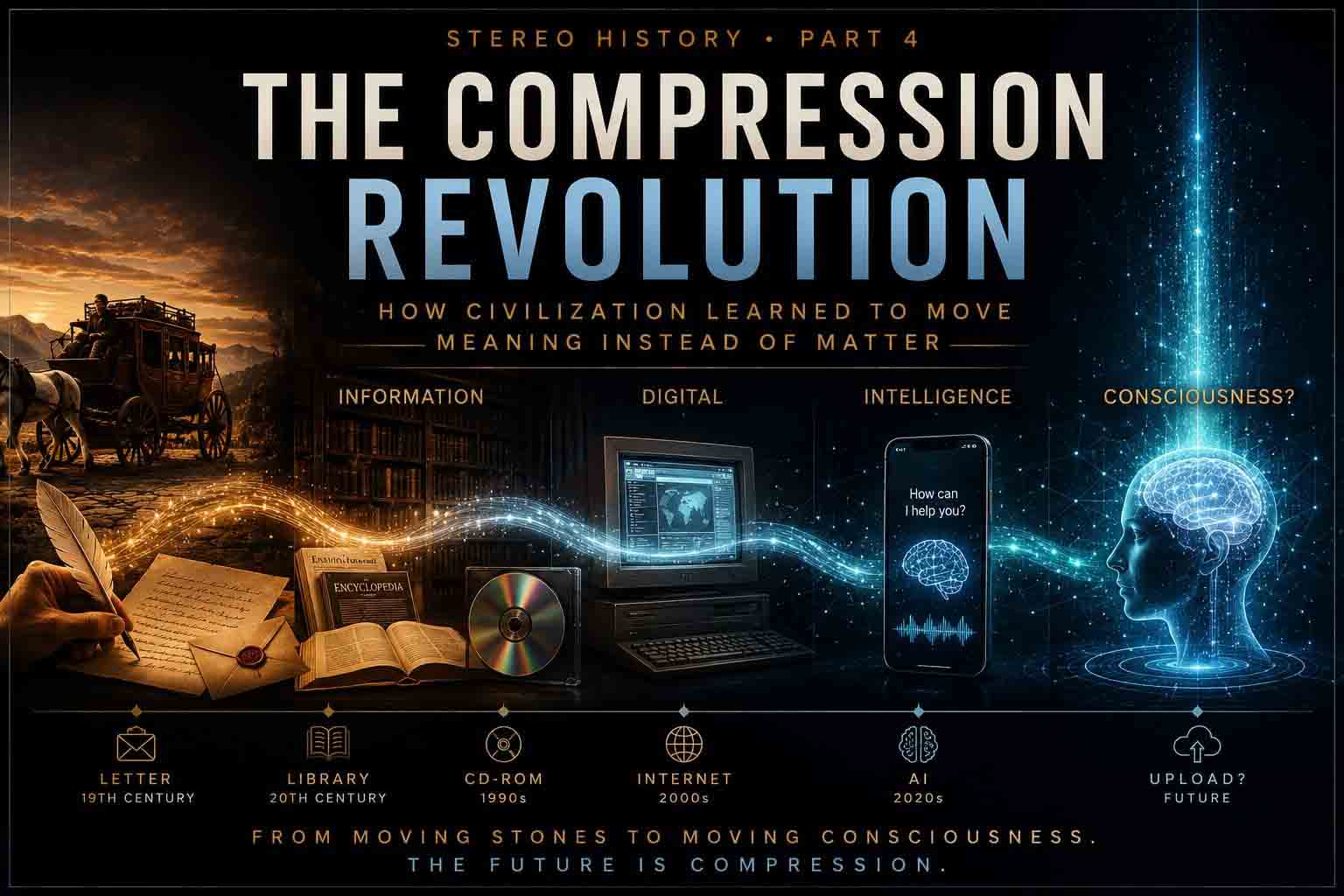
The Digital Migration
Digitization appears to make meaning almost weightless because the visible carrier becomes difficult to perceive.
A message crosses continents in seconds. A photograph appears on another screen. A book can be duplicated without producing another stack of paper. An enormous library becomes accessible from a device small enough to hold in one hand.
But nothing became immaterial.
The physical requirements moved away from view.
Data centers consume energy. Networks require fiber, routers, antennas and satellites. Digital storage depends upon physical devices. A book encoded as a file still needs matter somewhere if the pattern is to remain instantiated.
The transformation is therefore not disappearance of the carrier.
It is reduced dependence on one particular carrier.
A text once bound to one manuscript can become reproducible across countless physical systems. The paper may disappear while the linguistic relationships survive another migration.
This is carrier independence in the useful sense.
Not freedom from matter.
Freedom from one specific piece of matter.
Can Meaning Survive Without Its Original Context?
Only partially.
The history of translation proves both the strength and fragility of portable meaning.
A story can cross languages, religions and civilizations while remaining recognizable. Yet each migration alters something. Words possess associations that do not line up perfectly. Cultural references change. Humor resists translation. New audiences interpret old symbols through different assumptions.
This does not make transmission a failure.
It shows that meaning has degrees of continuity.
Some structures travel extremely well. Mathematical relations can often survive a change in notation with remarkable precision. A simple instruction may remain functionally stable through translation. Poetry may preserve narrative while losing sound. Religious symbols may retain emotional force while their original doctrinal setting disappears.
Meaning therefore behaves less like cargo than like a pattern repeatedly reconstructed.
The question is not whether every molecule of significance survives.
The question is which relations must remain for later observers to say that something important has been carried forward.
That is the same problem encountered throughout Transhumation.
Which changes are superficial?
Which changes destroy identity?
What is the invariant?
AI Changes the Journey, but Not in the Way We Think
Artificial intelligence introduces a new kind of interface between stored traces and interpretation.
Traditional search systems locate documents.
A generative model can compare them, summarize them, translate them, reorganize them and respond conversationally to questions about them. That makes a large body of information accessible through a radically different interface.
But saying that AI “preserves interpretation” would be too strong.
Interpretation is not a fixed layer secretly embedded inside the archive. An AI system generates responses according to its training, architecture, available context and instructions. It can illuminate relationships that are genuinely present in the sources.
It can also invent one.
That makes AI both an extraordinary librarian and a dangerous mirror.
Its power lies in reducing the distance between a question and a relevant structure.
Its responsibility lies in preserving the route back.
Where did this claim come from?
Which part is quotation?
Which is inference?
Which interpretation is contested?
Where does the archive become silent?
A future library becomes more useful when the librarian can speak.
It becomes more dangerous when the librarian speaks so beautifully that nobody asks to see the book.
Religion, Meaning and the Problem of Continuity
Religion belongs in this essay, but not because religion and technology are secretly the same project.
They are not.
Religious traditions contain metaphysical claims, ritual systems, communities, ethical structures and experiences that cannot responsibly be reduced to information storage. Technology solves different classes of problems.
Yet a structural comparison remains possible.
Religions have developed extraordinarily durable systems for carrying meaning across generations. Scripture, ritual, architecture, music, symbols, calendars and communities allow a pattern of belief and practice to survive beyond any one believer.
The carrier changes while enough of the structure remains recognizable.
A prayer moves from memory to manuscript to printed page to digital screen.
A ritual performed by one generation is learned by another.
A symbol crosses geography and sometimes survives even when its interpretation changes.
This makes religion one of civilization’s most sophisticated demonstrations of how meaning can persist through multiple carriers.
It does not prove the meaning is metaphysically true.
It demonstrates the strength of the transmission architecture.
That distinction matters to The Last Religion and the New Theurgy.
The interesting question is not whether technology replaces religion.
It is what both reveal, in very different contexts, about humanity’s refusal to let the present moment possess everything that matters.
Watch The Video
How to Read the World
Current Knowledge
Human cultures transmitted large bodies of knowledge long before widespread writing through oral traditions, ritual practices, apprenticeship and social memory. Oral transmission can be highly structured and should not be treated simply as unreliable speech preceding “real” civilization. Writing nevertheless changed the scale and character of external memory by allowing symbolic structures to persist without continuous biological recollection.
Writing and other media do not preserve meaning independently of interpreters. They preserve structured signals from which meaning can be reconstructed. Interpretation depends upon language, cultural context, previous knowledge and assumptions that may change or disappear over time. This is why undeciphered texts can remain physically preserved while much of their meaning remains inaccessible.
Different media preserve different aspects of an event. Writing can preserve linguistic structure while losing gesture and vocal tone; audio can preserve voice while losing visual context; film can preserve movement while excluding everything outside the frame. No known medium preserves a complete human experience.
Digital information remains physically instantiated. The apparent dematerialization of books, images and messages reflects migration between physical carriers and the hiding of infrastructure from the user rather than information escaping matter.
Modern AI systems can assist retrieval, translation, comparison and interpretation of large archives, but their outputs are generated and can contain mistakes or unsupported reconstructions. They should therefore be understood as interfaces to information rather than automatic preservers of original meaning.
Open Questions
One of the deepest unresolved questions is how much meaning can survive a radical change of context. A mathematical relation may move successfully between notation systems, while a joke or religious symbol can become almost unintelligible after the culture surrounding it disappears. There may be no single measure of semantic preservation that works across every form of human expression.
Another problem is deciding what counts as the same pattern after repeated transmission. A story copied word for word displays obvious textual continuity. A folktale transformed over centuries can retain recognizable structure while almost every detail changes. At what point does adaptation become a new work rather than a migrated version of the old one?
Digital abundance creates a further difficulty. Civilization may now be capable of preserving far more information than any previous society while simultaneously losing the shared context required to interpret it. A trillion surviving files would not automatically constitute a trillion preserved meanings.
Artificial intelligence intensifies the question because it can construct context around fragments. This may rescue otherwise inaccessible material, but it can also make speculative reconstruction feel indistinguishable from recovered meaning. Future archives will need methods for preserving uncertainty as carefully as they preserve information.
Transhumation Interpretation
The Day Meaning Became Portable gives Transhumation one of its most important distinctions.
Meaning does not migrate alone.
A carrier preserves structure.
Another system reconstructs meaning from it.
That means portability is never absolute.
When a text moves from parchment to print to digital storage, the letters may survive almost perfectly. But even perfect reproduction cannot guarantee identical understanding because the reader has changed.
The pattern crosses the carrier.
The world around the pattern does not.
This is why civilization requires more than storage.
It requires lineages of interpretation.
Translations.
Commentaries.
Dictionaries.
Schools.
Libraries.
Historians.
Communities that preserve not only a sentence but enough surrounding structure for later people to understand why the sentence mattered.
The best carrier is therefore not necessarily the one that lasts longest.
It is the one that preserves the backward route from pattern to context.
A stone inscription can survive three thousand years and become opaque.
A fragile manuscript can survive inside a tradition of commentary and remain intellectually alive.
Physical endurance and semantic endurance are different achievements.
This distinction becomes even more important when we move from culture toward personal identity.
A person’s handwriting can survive.
Voice can survive.
Photographs can survive.
Thousands of messages might preserve habits of language, humor and preference.
Future AI could combine those traces into a representation capable of responding in ways that feel startlingly familiar.
But the portability of those patterns would not, by itself, answer the Julian Experiment.
The reconstruction may preserve enough structure for recognition.
It may preserve enough style for imitation.
It may preserve enough memory for a compelling simulation.
None of those achievements proves first-person continuity.
The fact that meaning can travel between carriers should therefore make us more interested in the human upload problem, not less cautious about it.
We already know that some structures are extraordinarily portable.
A triangle survives a new screen.
A theorem survives a new notation.
A sentence survives another edition.
A melody survives another instrument.
A person is harder because we do not know which structure must remain invariant for subjective identity itself to continue.
This is the boundary Transhumation should never cross merely because the metaphor is beautiful.
The Library of Mirrors gives us a useful model.
A library is not civilization’s mausoleum.
It is an interface through which patterns created by absent minds can become operational in present ones.
The book does not wake.
The reader does.
Meaning happens again.
That may be one of the most extraordinary forms of continuity civilization has created because it allows the dead to affect the living without pretending that the dead have returned.
AI could extend this architecture enormously.
A good future librarian might move among languages, restore conceptual context, compare versions, expose contradictions and show the genealogy of an idea. Instead of returning only an answer, it could reveal the chain by which the answer became possible.
That would make meaning more navigable.
But the same technology can also produce a dangerous illusion: that because an interpretation is fluent, the meaning was always present in precisely that form.
The Library of Mirrors must therefore preserve the difference between finding and generating.
Between source and interpretation.
Between transmission and reconstruction.
Between recognizable pattern and original consciousness.
There is another consequence.
Meaning may be one of the clearest examples of a carrier-independent structure precisely because it is never fully independent of context.
That sounds contradictory until we recognize that independence is always partial.
A sentence can survive a new sheet of paper.
It may not survive the death of its language.
A myth can survive new performers.
It may not survive unlimited alteration.
A scientific relation may survive a new notation.
It may fail if the relation itself is changed.
Every successful migration therefore preserves something and sacrifices something.
The intelligent question is not simply whether meaning survived.
It is:
what had to remain unchanged for us to recognize that something crossed?
That is a much stronger Transhumation question than the romantic idea of immaterial meaning floating between civilizations.
Nothing floated.
Humans built carriers.
They taught one another how to read them.
They copied.
Translated.
Misunderstood.
Corrected.
Forgot.
Rediscovered.
Every act of preservation involved matter, labor and another consciousness willing to reconstruct what had arrived.
This is why the history of meaning is not a story of increasing escape from the physical world.
It is a story of increasingly sophisticated re-instantiation.
Voice becomes remembered voice.
Speech becomes marks.
Marks become printed text.
Printed text becomes encoded data.
Encoded data becomes another visible sentence.
Each migration changes the material world carrying the pattern while trying to preserve enough relationship for another mind to recognize it.
That may be humanity’s great cultural invention.
Not making meaning weightless.
Making it capable of changing vehicles.
A book on an airplane still weighs three hundred grams.
The civilization inside it does not.
FAQ
What does “meaning became portable” actually mean?
It means humans developed carriers such as speech traditions, writing, books and digital media that preserve enough structure for meaning to be reconstructed by other minds in different places or periods.
Did writing invent the transmission of meaning?
No. Oral cultures transmitted complex knowledge long before writing. Writing changed the scale, durability and independence of cultural memory from continuous living transmission.
Do books actually preserve meaning?
They preserve structured language from which meaning can be reconstructed. Understanding still depends on a reader, a language and sufficient context.
Why are libraries so important?
Libraries preserve carriers and the systems needed to navigate them. Their deeper function is to make delayed encounters with accumulated human thought possible.
Can AI preserve human meaning?
AI can help retrieve, compare and interpret preserved material, but it can also generate new interpretations. It therefore needs provenance and clear boundaries between source, inference and reconstruction.
What is the deeper Transhumation question?
If meaning can survive repeated changes of carrier while remaining recognizable, then some structures clearly possess a degree of carrier independence.
The harder problem is discovering the boundary of that independence. How much can change before the pattern no longer carries the same meaning, and what would have to survive if the pattern we were trying to carry were not a sentence or a story, but a human being?
Continue the Transhumation Series
- Forgotten Religion | Ancient Gods, Symbols and the Hidden Structures of Human Civilization
- The Last Religion | Death, Immortality and the Future of Humanity
- The New Theurgy | AI, Information and the Future of Human Civilization
- End of Branding: You Were Never Meant to Become a Product
- Baal vs Ishtar: Why Ancient Gods Never Disappeared