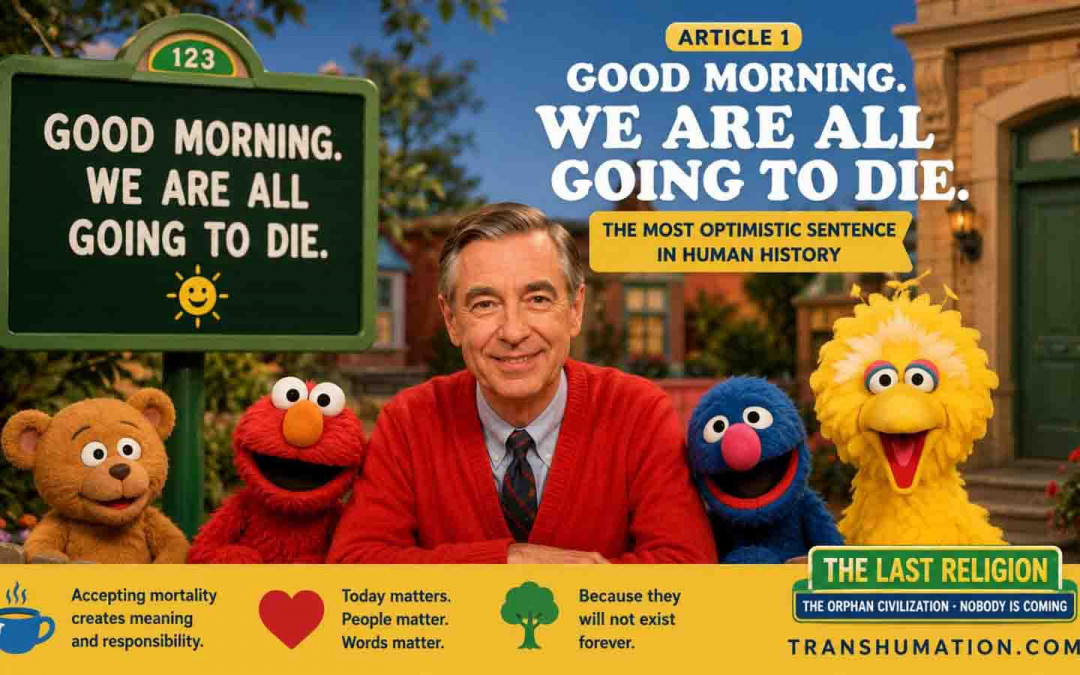
Good Morning
Mortality, Meaning and the Price of Eternity
There is something faintly comic about beginning the day with the one fact everyone is trying not to think about. Coffee is poured. Messages arrive. Someone complains about traffic. A calendar fills with meetings. Then, hovering invisibly behind the entire arrangement, there is the oldest appointment of all.
We are going to die.
Almost every culture has found a more graceful way to phrase it. Religion promises continuation, philosophy offers acceptance, monuments bargain with memory, families preserve names, medicine buys time, and technology increasingly asks whether the bargain itself can be renegotiated. Yet beneath all these systems sits the same primitive fact: the human organism is temporary, and consciousness—at least in the form we know it—is tied to a body that does not last forever.
The sentence sounds dark because it removes the illusion of permanence. But perhaps permanence was never the source of meaning in the first place. A song matters partly because it ends. A conversation matters because it cannot be postponed indefinitely. A life becomes a shape because time eventually closes around it.
The problem may not be that death destroys meaning.
The problem may be that we have spent so long assuming meaning requires escape from death.
The First Great Disappointment
Children begin life inside a world that appears astonishingly stable. The house exists. Parents exist. Summers return. Birthdays arrive in sequence. Even when something breaks, the underlying world seems permanent enough to absorb the damage.
Then mortality enters.
Sometimes through the death of a grandparent, sometimes through an animal, sometimes through a sentence overheard in a room adults thought the child was not listening to. The first realization is not merely that somebody has died. It is that the structure itself is temporary.
Parents can disappear.
Homes can disappear.
Bodies change.
The future is not an infinite warehouse of unused days.
This can feel like a defect in reality. Why build attachment if attachment can be broken? Why create anything if time eventually destroys the object, the maker and the audience?
Human civilization has spent thousands of years producing answers to that discomfort. Tombs, genealogies, afterlives, reincarnation, resurrection, monuments, portraits, dynasties, libraries and myths all perform different versions of the same operation: they attempt to extend something beyond the boundary of the individual life.
The fact that so many systems converge on the same problem should tell us something.
Death is not merely a biological event.
It is one of civilization’s organizing forces.
The Limited Page
Imagine a novel with no final page.
At first, the idea may sound luxurious. No character ever has to leave. No plot has to resolve. Nothing important needs to happen yet because there will always be another chapter.
Very quickly, the luxury becomes unbearable.
A story without limit loses pressure. Decisions can be postponed forever. Consequences weaken. Structure dissolves because there is no need to choose one path over every other possible path.
Human life may acquire some of its intensity from the same constraint.
Mortality does not make every moment meaningful automatically. Many moments are wasted, trivial or painful. A finite life can still be badly lived. But finitude creates the condition in which choices become costly.
To choose one thing is to surrender time that could have been spent on another.
To love one person is to shape a life around commitments that exclude other possibilities.
To spend ten years building something is to spend ten years not doing something else.
Time is not merely the medium through which life happens.
It is the price attached to every decision.
That may be the hidden reason death gives form to life. Without a boundary, there is no need for priority. Without priority, value becomes difficult to distinguish from possibility.
The Civilization Built Against the Clock
Once mortality is viewed this way, much of civilization looks like a response to time.
Writing extends memory beyond the speaker.
Architecture extends intention beyond the builder.
Children extend biological lineage.
Law extends decisions across generations.
Religion extends hope beyond death.
Art extends experience into another observer.
Libraries extend thought beyond the lifetime of the thinker.
Technology keeps repeating the same gesture with increasingly sophisticated tools.
A photograph preserves a face.
A recording preserves a voice.
A database preserves information.
Medicine preserves function.
Genetics allows us to intervene in inherited biological structures.
Artificial intelligence can increasingly preserve style, preference, language patterns and fragments of knowledge in ways that can remain accessible after the original person is gone.
The methods changed.
The desire did not.
Humanity has always tried to make something cross the boundary.
The Morning After the Discovery
There is, however, another consequence of mortality that discussions of immortality often miss.
Responsibility appears only when time matters.
A person who truly possessed unlimited tomorrows could postpone almost anything without loss. An apology could wait. A book could be started next century. A child could be called later. A difficult decision could be deferred until the conditions became perfect.
Finite time makes avoidance expensive.
This is why the knowledge of death can produce opposite reactions. It can generate fear, denial and despair. But it can also strip away a certain category of nonsense.
Some arguments suddenly look too small.
Some ambitions become clearer.
Some relationships become more valuable because their duration is no longer assumed.
Mortality does not tell us what matters.
It removes the possibility of pretending that everything matters equally.
This is one reason the sentence “We are all going to die” can become strangely optimistic. It does not promise rescue. It does not guarantee cosmic purpose. It simply restores scarcity to time.
And scarce things require choices.
The New Immortality Industry
Modern technology has made the old dream of defeating death less mythical and more technical.
Medicine has already extended average human lifespan dramatically compared with many earlier periods. Biotechnology investigates mechanisms of aging. Cryonics preserves bodies or brains in the hope that future technology may make restoration possible, though no such revival has been demonstrated. Digital systems preserve enormous quantities of personal information. Some technologists speculate about mind uploading, whole-brain emulation or artificial continuity.
The distinction between these ideas matters.
Keeping a body alive longer is not the same as preserving identity.
Preserving memories is not the same as preserving consciousness.
Creating a digital model that behaves like a person is not the same as demonstrating that the original subjective observer continues.
The word immortality hides several different goals under one dramatic label.
Biological continuity.
Informational continuity.
Social continuity.
Memory.
Reconstruction.
Conscious experience.
They may turn out to be different achievements.
And even if one of the stronger versions became possible, another problem would immediately appear.
What Happens After Forever Begins?
The standard immortality story ends too early.
A person survives.
The music swells.
The problem is solved.
But suppose the engineering eventually works. A human life can continue for centuries, perhaps indefinitely barring accident. Disease becomes manageable. Aging becomes reversible. Memory can be augmented. Bodies can be repaired or replaced.
Then what?
What happens to urgency when there is always another century?
What happens to marriage, education, ambition, inheritance and political power when lifetimes expand radically?
What does boredom mean at five hundred years?
Would identity remain coherent across enormous spans of experience?
Would a civilization of long-lived people become wiser because they remember consequences personally, or more rigid because the same individuals retain influence for centuries?
Mortality creates one class of problems.
Immortality would create another.
This is why eternal life cannot be treated as a simple technological upgrade. It would transform the architecture of motivation itself.
The greatest problem of immortality may eventually be not how to avoid death.
It may be how to preserve meaning after urgency loses its oldest source.
The Last Religion Begins Without a Promise
Religions traditionally approach death from many directions, and it would be absurd to reduce them all to fear of mortality. They concern ethics, community, cosmology, ritual, identity, transcendence and experiences that believers understand as encounters with the divine.
Still, death sits near the center of the human religious problem because it forces the most difficult version of the continuity question.
Does the person end?
Does something continue?
If something continues, what?
Body?
Soul?
Memory?
Pattern?
Consciousness?
Relationship with God?
The Last Religion does not need to answer these questions by declaring that death is an illusion. It can begin from the harder position.
Perhaps death is real.
Perhaps no technological rescue is guaranteed.
Perhaps no metaphysical answer can be demonstrated with certainty.
Then meaning cannot be postponed until after the problem is solved.
It must be constructed inside the uncertainty.
This may be the genuinely adult version of hope.
Not confidence that nothing will be lost.
The decision that loss does not make creation pointless.
Good Morning
The phrase works because morning and death appear to belong to opposite emotional worlds.
Morning suggests beginning.
Death suggests ending.
Put them together and the contradiction disappears.
Every morning matters because there are not infinitely many of them.
Every project exists inside a limited interval.
Every relationship is temporary in at least one direction.
Every civilization eventually becomes history.
This does not make life tragic by definition.
It makes life non-repeatable.
Perhaps the tragedy would be different: to possess finite time while behaving as though it were unlimited. To spend a life postponing the thing one claims matters. To protect possibilities so carefully that none become commitments.
The knowledge of death cannot tell anyone what to do today.
But it makes the question difficult to avoid.
Good morning.
We are all going to die.
So what deserves the day?
Watch The Video
How to Read the World
Current Knowledge
Human mortality is a biological fact, although average lifespan varies greatly across populations and historical periods. Improvements in sanitation, nutrition, medicine, vaccination and public health have substantially increased life expectancy in many societies.
Psychological responses to awareness of death are complex. Research in existential psychology and related fields suggests that mortality awareness can influence values, behavior, anxiety and meaning-making, but there is no single universal reaction.
Current medicine can extend life and delay or treat many age-related diseases, but there is no demonstrated method for making humans biologically immortal. Research on aging, cellular senescence, gene regulation and regenerative medicine is active, but its future limits remain uncertain.
Mind uploading and whole-brain emulation remain hypothetical. No current technology has demonstrated transfer of human subjective consciousness into a digital system.
Open Questions
If human lifespan were extended dramatically, would meaning diminish because urgency decreased, or would people simply create new sources of purpose? We do not know whether mortality is necessary for meaning or merely one of the forces that currently shapes it.
The continuity problem remains unresolved. If memories, personality and behavior could be reproduced in another substrate, would that constitute survival of the person or creation of a highly accurate successor?
There is also a social question. Radical life extension could transform inheritance, inequality, political power, family structure and access to resources. A technology that solves mortality for some people might create new forms of injustice for others.
And perhaps the deepest question remains untouched by engineering: if indefinite continuation became possible, what would make continued existence worth choosing?
Transhumation Interpretation
Transhumation treats death not only as an ending but as a boundary condition that shapes human civilization.
The structure is visible everywhere:
mortality → scarcity of time → choice → value → preservation
Because life ends, humans externalize themselves.
They build.
Write.
Teach.
Record.
Reproduce.
Create institutions.
Tell stories.
Every act of preservation is, in some sense, an answer to mortality.
Technology extends this process by creating new carriers for memory, identity and function. But it does not automatically solve the problem of the observer. A preserved pattern is not necessarily preserved consciousness.
This distinction matters enormously.
The future may allow fragments of a person to survive with unprecedented fidelity. Voice, appearance, knowledge, preference and behavior may become increasingly reproducible. But the question of whether the subjective “I” crosses the boundary remains open.
The Last Religion begins there.
Not with certainty.
With responsibility under uncertainty.
Perhaps immortality is possible.
Perhaps it is not.
Perhaps continuity will emerge in forms we do not yet understand.
But while the answer remains unknown, mortality performs a function we already understand very well.
It gives weight to choice.
The future may teach us how to live longer.
The older problem is learning what is worth doing with the time we already have.
FAQ
What does “Good Morning. We Are All Going to Die” mean?
It is a reminder that mortality can create urgency, responsibility and value rather than only fear.
Is this a nihilistic argument?
No. It argues that finitude can make choices and relationships more significant.
Does death create meaning automatically?
No. Mortality creates limits, but humans still have to decide what matters within those limits.
Can technology defeat death?
Current technology can extend life and treat disease, but human biological immortality has not been achieved.
Is digital preservation the same as survival?
Not necessarily. Preserving information about a person is different from demonstrating continuity of subjective consciousness.
Would immortality solve the human problem?
Not completely. It could introduce new questions about purpose, identity, motivation and social structure.
How does this connect to The Last Religion?
The Last Religion treats death, continuity and meaning as enduring human questions that reappear in new technological forms.
Why call the sentence optimistic?
Because accepting limited time can make life more deliberate rather than less valuable.
What is the central idea?
Death may be more than the force that ends life. It may also be one of the forces that gives life structure.
Continue the Transhumation Series
- Forgotten Religion | Ancient Gods, Symbols and the Hidden Structures of Human Civilization
- The Last Religion | Death, Immortality and the Future of Humanity
- The New Theurgy | AI, Information and the Future of Human Civilization
- End of Branding: You Were Never Meant to Become a Product
- Baal vs Ishtar: Why Ancient Gods Never Disappeared