
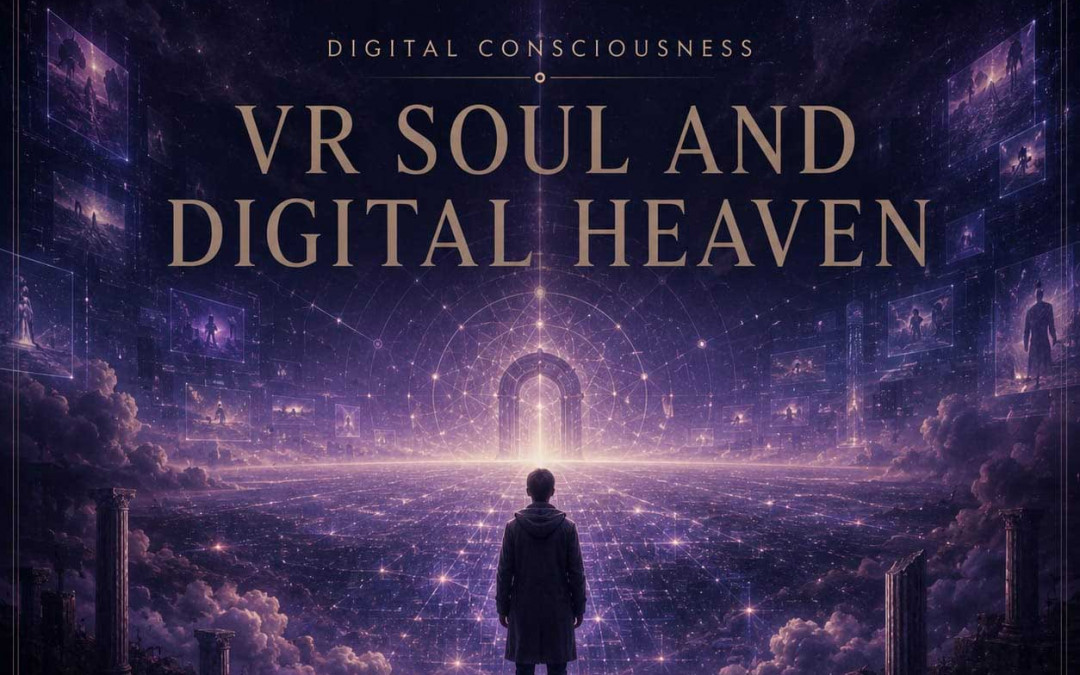
For thousands of years, religion offered humanity an answer to death.
The body would disappear.
The soul would continue.
Heaven existed beyond ordinary reality, beyond suffering, and beyond the limitations of biology.
Today, technology is beginning to reconstruct the same promise using a completely different language.
Virtual reality instead of paradise.
Artificial intelligence instead of angels.
Digital continuity instead of resurrection.
Algorithms instead of divine judgment.
This is why transhumanism should not be understood only as a technological movement.
It may also be the first religion humanity is attempting to engineer.
Heaven Was Always an Interface
Traditional descriptions of heaven vary enormously.
Some imagine a city.
Others a garden.
A realm of light.
A reunion with the dead.
A state without pain, aging, or fear.
These images may appear theological, but they also describe an environment designed to solve the central problems of human existence.
Loss.
Mortality.
Separation.
Suffering.
The important question may therefore not be whether heaven exists exactly as religion described it.
The more interesting question is:
What problem was heaven trying to solve?
If the purpose of heaven was to preserve consciousness, reconnect people, and remove biological suffering, then virtual reality begins to resemble more than entertainment.
It becomes an early prototype of an artificial afterlife.
The First VR Heaven
A virtual world does not need to obey the physical rules of ordinary life.
A person can appear young.
Distance can disappear.
Buildings can change instantly.
The dead can be represented through recordings, memories, models, and simulated personalities.
Today these experiences remain limited.
But the direction is already visible.
Virtual reality creates environments in which identity becomes partially independent of the body.
The user enters through an avatar.
The body stays outside.
The experience continues inside another world.
This does not prove that consciousness can survive death.
But it changes the structure of the question.
Heaven was once imagined as a supernatural reality entered after biological life.
Technology now asks whether a constructed reality could perform some of the same functions.

The Digital Soul
The phrase “digital soul” sounds poetic, but it describes a serious philosophical problem.
What part of a person would need to survive for that person to continue?
Memories?
Voice?
Personality?
Habits?
Values?
Patterns of decision?
A detailed simulation could potentially preserve all of these.
It could speak in a familiar voice, remember shared experiences, and respond in ways resembling the original person.
But would it be the same consciousness?
Or only an extremely convincing descendant made from information?
This distinction is central.
A copy of the mind may preserve the pattern without preserving the experience.
The world may continue interacting with something that resembles you while you never experience another moment.
That would not be immortality from the inside.
It would be immortality from the perspective of everyone else.
When Resurrection Becomes Engineering
Religion treated resurrection as a miracle.
Transhumanism treats continuity as a technical problem.
Can the brain be mapped?
Can memory be preserved?
Can neural processes be simulated?
Can consciousness move gradually from biological tissue into another medium without breaking subjective continuity?
These questions remain unresolved.
But their existence marks a profound civilizational change.
Death is no longer discussed only through prayer, theology, and mythology.
It is also discussed through neuroscience, information theory, simulation, and artificial intelligence.
The ancient promise has entered the laboratory.
Algorithms as Judges
Many religious traditions imagined judgment after death.
A life would be examined.
Actions would be evaluated.
A destination would follow.
Digital systems already perform primitive versions of this process.
Algorithms rank people.
Predict behavior.
Measure trust.
Recommend opportunities.
Restrict access.
Shape visibility.
A future VR Heaven could theoretically be governed by the same logic.
Who enters?
Which memories are preserved?
What version of a person appears?
Who controls the environment?
What happens to those who cannot afford access?
The danger is not simply that algorithms might replace divine judgment.
The danger is that private systems could inherit powers once reserved for gods.
A technological heaven owned by a corporation would not be heaven.
It would be an eternal platform with terms of service.
Religion Without Faith
Transhumanism often presents itself as secular.
Yet many of its ambitions are recognizably religious.
The defeat of death.
The creation of superior beings.
The transformation of the body.
The preservation of consciousness.
The arrival of a new stage of humanity.
The difference lies in method.
Religion asks humanity to trust in transcendence.
Transhumanism attempts to manufacture it.
This does not mean transhumanism is secretly a church.
It means technology has entered the same territory religion occupied for thousands of years.
Both respond to the same ancient dissatisfaction:
The human condition feels unfinished.
The End of Heaven—or Its Construction?
Technology may not destroy heaven.
It may divide the idea into separate engineering problems.
Pain becomes medicine.
Aging becomes biology.
Memory becomes data.
Identity becomes information.
Reality becomes simulation.
Continuity becomes architecture.
Each problem appears smaller when separated.
Together, however, they reconstruct the outline of the oldest human promise.
A world beyond suffering.
A self beyond death.
A reality designed around consciousness.
Perhaps the end of supernatural heaven would not mean the end of transcendence.
It could mean the beginning of its construction.
The Afterlife Becomes a Design Question
The future of religion may not be decided only in temples.
It may also be decided in laboratories, server rooms, virtual environments, and AI systems.
The central question is no longer simply:
Do you believe in life after death?
It is becoming:
What would have to continue for life after death to be real?
A memory is not necessarily a soul.
A simulation is not necessarily a person.
A digital replica is not necessarily conscious.
But technology has already forced humanity to examine ideas once protected by mystery.
Transhumanism may therefore become religion not because it asks for worship, but because it inherits religion’s greatest task:
to explain what should survive when the body can no longer carry us.
And perhaps VR Heaven will not begin when humanity proves that the soul exists.
Perhaps it will begin when civilization decides which part of a person deserves to continue.
Read more
FAQ
What is transhumanism as religion?
It is the idea that transhumanism addresses many questions traditionally associated with religion, including immortality, transcendence, resurrection, human transformation, and the survival of consciousness.
What is VR Heaven?
VR Heaven is a hypothetical digital environment designed to preserve identity, memory, relationships, or conscious experience beyond ordinary biological limitations.
Can virtual reality replace the traditional afterlife?
Virtual reality could reproduce some functions associated with heaven, such as reunion, freedom from physical limitation, and reconstructed environments. Whether this would constitute a genuine afterlife depends on whether consciousness itself continues.
What is a digital soul?
A digital soul is a proposed informational representation of a person containing memories, personality, voice, behavior, and identity patterns. It remains uncertain whether such a representation could possess the original person’s consciousness.
Is a digital copy the same as the original person?
Not necessarily. A copy may preserve information and behavior without preserving subjective continuity. This is one of the central problems in mind uploading and digital immortality.
How could artificial intelligence contribute to digital immortality?
AI could organize personal memories, reproduce speech patterns, simulate personality, and allow future people to interact with models based on deceased individuals.
What are the risks of a technological heaven?
Major risks include corporate control, unequal access, manipulation of identity, algorithmic judgment, surveillance, altered memories, and uncertainty about whether simulated beings are conscious.
Does transhumanism reject religion?
Not always. Some forms are secular, while others borrow religious language and aspirations. Transhumanism may compete with religion, cooperate with it, or technologically reinterpret its oldest promises.
What is the main idea of this article?
The main idea is that technology may not eliminate religion’s vision of heaven. It may transform heaven from a supernatural promise into an engineering challenge.
The Core Questions of Transhumation
Explore the full journey:
- End of Reality — Where Do You Really Exist?
- End of Physics — Are the Laws of Reality Real?
- End of the Real World — Reality Is No Longer Required
- End of Consciousness — Beyond the Human Mind
- End of Death — When Human Limits Disappear
- End of Religion — When Technology Replaces Faith