
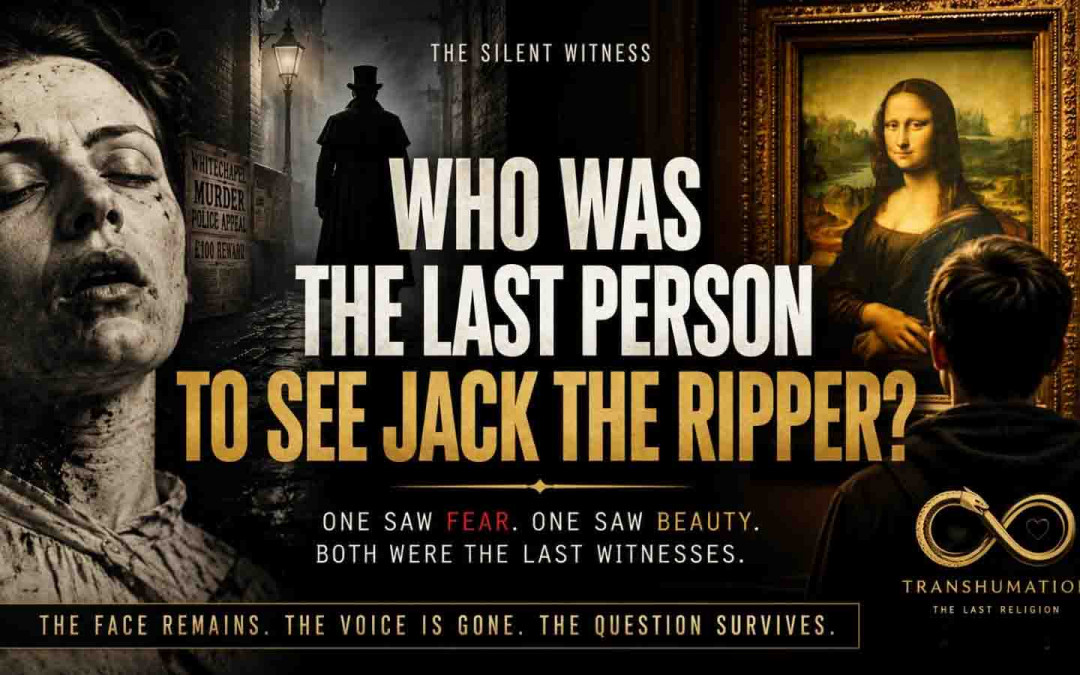
The Silent Witness
Somewhere in the world, somebody is going to be the last person to see the Mona Lisa.
There will be nothing remarkable about the visit. Perhaps the room will be crowded. Perhaps the visitor will raise a telephone, take the same photograph taken millions of times before, look at the painting for twenty seconds and move on. There will be no announcement informing them that they have just occupied a unique position in history. They will not know that nobody will ever stand before Leonardo’s painting again. Only later—through accident, catastrophe, decay, theft, war, or simply the unimaginable distance of time—the chain of witnesses will end. The painting will disappear, and one human being will unknowingly have carried its final direct memory.
History normally approaches such a scene from the opposite direction. We ask who painted the Mona Lisa, who built the pyramids, who wrote an anonymous manuscript, who committed an unsolved murder. We look backward toward the hand responsible for an object or event. The creator attracts us because the creator appears to promise an explanation.
But there is another figure standing at the far end of the chain.
The witness.
And sometimes the witness knows something about the creator that no archive can recover.
The Woman Who May Have Seen His Face
Jack the Ripper provides an unusually disturbing version of the problem because almost everything we know about him comes indirectly. There is no authenticated photograph of the killer, no established biography, no confession universally accepted as genuine, and no identity supported strongly enough to close the case. There are bodies, locations, police records, newspaper reports, disputed letters and more than a century of interpretation.
There were also witnesses. People reported seeing some of the canonical victims with men shortly before their deaths, although there is no way to establish that every man observed was the killer. In several cases the descriptions are frustratingly ordinary: age, height, clothing, moustache, complexion, manner. Nothing announces that the person being described will become one of history’s most famous unidentified criminals.
And then there are the victims themselves.
At least one of them may have seen him more clearly than anyone who survived. She may have heard his natural voice, noticed how he approached, how he moved, whether he seemed nervous or calm, educated or rough, familiar or foreign. Perhaps she saw nothing memorable at all. We cannot know.
That is precisely what makes her different from a missing document.
A document never knew.
She may have known.
For a few seconds or minutes, information that historians would later spend generations trying to recover may have existed inside an ordinary human mind. Then the carrier disappeared.
The photograph of the victim can survive. Her name can survive. The police file can survive. But the particular memory—the angle of a face under a gas lamp, a voice, a gesture, the moment when an unremarkable stranger ceased to be unremarkable—can vanish completely.
The archive preserves the witness.
It cannot necessarily preserve what the witness witnessed.
The Last Visitor at the Louvre
Now replace Whitechapel with the Louvre.
The emotional direction reverses, but the structure remains surprisingly similar. Imagine the final visitor to see the Mona Lisa before the painting disappears forever. Unlike a murder victim, this person is in no danger. Perhaps they experience wonder; perhaps disappointment. Perhaps they are thinking about lunch. What matters is that, for some period after the object itself has ceased to exist, a representation of it could continue inside a living observer.
This reveals an odd property of information. The painting and the experience of seeing the painting are related, but they are not identical.
The Mona Lisa can be photographed millions of times, measured, scanned and described. Those records may preserve vastly more objective detail than any visitor could remember. Yet none of them tells us exactly what it was like for a particular person to stand before it. Conversely, the visitor may retain something no high-resolution scan contains: surprise at its scale, annoyance at the crowd, the feeling of finally encountering an image known since childhood.
The object carries one kind of information.
The observer carries another.
If the object disappears, copies may remain. If the copies disappear, descriptions may remain. If the language of the descriptions disappears, perhaps images survive. With every migration, something can be preserved and something can be lost.
History is therefore not simply a warehouse in which information waits intact.
It is a sequence of carriers.
And every transfer has a price.

Two Photographs at the End of Civilization
Now push the experiment much further.
Imagine that almost everything disappears. The names Jack the Ripper and Leonardo da Vinci mean nothing. London and Florence are forgotten. English and Italian cannot be reconstructed. No police report explains Whitechapel; no catalogue explains the Louvre. Perhaps humanity itself is gone.
Two photographs remain.
One depicts a human face marked by fear. The other captures someone looking at something with unmistakable wonder. The future observer does not know what produced either expression. The causes have disappeared. The cultural context has disappeared. The stories have disappeared.
Has all the information disappeared with them?
Not necessarily.
A sufficiently human-like observer might still recognize something in the faces. Fear does not explain what was feared. Wonder does not reconstruct what was seen. Emotion is therefore a very lossy carrier. It can preserve a relation while destroying its object.
Someone feared something.
Someone loved something.
Someone saw something worth looking at.
That is almost nothing compared with a historical record.
And yet it is not nothing.
The distinction matters because we tend to treat information as though its highest form were explanation. But experience can leave traces without preserving the explanation that produced them. A ruined theatre tells us people gathered without preserving the performance. Wear on a threshold tells us people crossed it without preserving their names. A face can preserve the consequence of an encounter while the encounter itself becomes unrecoverable.
The message becomes smaller.
But it can travel farther.
We Almost Never Meet the Creator
This is where the murder mystery begins opening into something much larger.
A detective arrives after the act and examines what remains. Blood, wounds, footprints, fibres, timing, geography, behavior. From consequences, the detective attempts to infer a cause and eventually an agent. The killer is absent, so the creation—however terrible the word sounds in this context—must be read backward.
The art historian encounters a related problem under radically different moral circumstances. Pigment, composition, revisions beneath the paint, documents, workshop practices and provenance become evidence from which intentions and authorship may sometimes be reconstructed.
The archaeologist works from pottery, foundations, rubbish, graves and broken objects. The civilization that produced them is no longer available for interview.
In each case, the observer stands downstream.
We see the trace and infer what could have produced it.
At the largest scale, the same structure appears in one of humanity’s oldest disputes. A believer looks at existence and may understand creation as evidence of a creator. A naturalist can regard the same universe as something whose structures are investigated through physical causes without requiring that inference. Philosophy has spent centuries examining whether properties of the world can justify conclusions about anything beyond it.
The comparison does not make a murder scene, a painting and the universe equivalent. Their evidential situations are radically different.
What they share is the direction of the question.
Can the absent source be reconstructed from what remains?
That is the silent-witness problem.
What the Witness Adds
There is a temptation to romanticize the witness as though experience automatically provides truth. It does not. Eyewitness testimony can be mistaken. Memory changes. Attention is selective. Fear can distort perception. Two people can watch the same event and remember it differently. A witness is not a camera.
But that limitation makes the problem more interesting rather than less.
The witness is an interpreter.
The world produces an event; the nervous system receives only part of it; attention selects; memory reorganizes; language later attempts to reconstruct what remains. Information has already undergone several transformations before the witness says a word.
The last person to see Jack the Ripper would therefore not have carried “Jack the Ripper” intact inside her head. She would have carried an encounter. The last person to see the Mona Lisa would not contain Leonardo’s painting. They would contain an experience produced partly by the painting and partly by themselves.
This suggests that civilization is not preserved merely by copying objects.
It is preserved by changing observers.
Every book read becomes slightly different information from the book stored unopened on a shelf. Every work of art acquires another history when someone encounters it. Every historical trace becomes part of the present only when somebody interprets it.
A library without readers can preserve information.
A civilization requires someone to encounter it.
The Face After the Library Burns
Libraries make us feel secure because they give memory architecture. Shelves, catalogues, databases and archives create the impression that what has been recorded has been saved. To a remarkable extent, that is true. Civilization has learned to move memory outside biological minds precisely because minds die.
But no carrier is permanent.
Papyrus decays. Stone erodes. Languages disappear. Servers fail. File formats become obsolete. Institutions collapse. Even carefully preserved information can eventually lose the context required to interpret it.
This produces a strange hierarchy of survival. Sometimes detailed information dies first while a simpler pattern persists.
We may forget the words of a song while remembering its melody.
Forget an argument while retaining the conclusion.
Forget what someone said while remembering how the conversation made us feel.
Forget the face while retaining the fear.
Information does not always disappear all at once. It can erode.
The silent witness sits somewhere on that slope between complete record and complete absence.
A photograph of a frightened woman cannot tell us who frightened her. A portrait of an astonished visitor cannot reconstruct the object of astonishment. But each can preserve a final fragment of a relationship between an observer and a world that no longer exists.
Perhaps this is why old photographs can be so unsettling. The people inside them are not merely dead.
They looked at things we can no longer see.
The Last Witness
One day there will be a last reader of every book that disappears. A last person who understands every dead language. A last visitor to every ruined building. A last listener who recognizes a melody before it becomes meaningless sound.
Usually nobody will know when the moment occurs.
Civilizations rarely place a plaque beside their final witnesses.
This changes the way we might think about cultural preservation. We normally imagine civilization as a collection of things: monuments, manuscripts, paintings, technologies, databases. But those things become civilization only through a relationship with observers capable of reading them. Preservation therefore has two sides. We must preserve the object, but we must also preserve the ability to understand what the object is.
A library needs books.
It also needs readers.
And eventually it needs librarians capable of connecting one to the other.
Jack the Ripper’s last witness, whoever that person was, demonstrates the tragic version of this rule. The information may once have existed. The carrier may even have looked directly at the answer.
Then the carrier died.
What remained was enough to keep the question alive, but not enough to answer it.
Perhaps that is the strange dignity of the silent witness. The witness does not necessarily preserve truth. Sometimes all that survives is evidence that there was once something worth knowing.
And that can be enough for another observer to begin looking.
Watch The Video
How to Read the World
Current Knowledge
Jack the Ripper is the conventional name given to the unidentified killer associated with the Whitechapel murders of 1888, particularly the five so-called canonical victims. Several witnesses reported seeing victims with men shortly before their deaths, but none of those observations can be established with certainty as a sighting of the murderer. It is therefore impossible to identify historically the “last person to see Jack the Ripper.”
Eyewitness memory is not a perfect recording of events. Psychological research has demonstrated that perception and memory can be incomplete, reconstructive and influenced by later information. A witness may possess unique information while still being mistaken about important details.
The Mona Lisa was painted by Leonardo da Vinci and is held by the Louvre. The “last visitor” in this article is a thought experiment rather than a prediction about the painting’s actual fate.
Human emotion can communicate information through facial expression, posture, voice and other signals, but expressions alone cannot reliably reconstruct the precise event that caused them. Context remains essential.
Open Questions
How much information can survive after its original context disappears? A photograph may preserve extraordinary visual detail while losing the names, circumstances and relationships necessary to understand what it depicts. Future observers may recover some of that context through comparison, but some losses can become irreversible.
There is also the problem of experience itself. An external record can preserve what happened with greater accuracy than human memory while failing to preserve what the event felt like to the observer. Whether subjective experience could ever be captured and transferred with anything approaching the fidelity of physical information remains unresolved.
The deeper historical question is equally difficult: how much can we legitimately infer about an absent cause from its surviving effects? The answer varies enormously between forensic science, history, archaeology, art attribution and metaphysics. Similarity in the structure of the question does not imply equal strength of evidence.
Transhumation Interpretation
The silent witness introduces another form of the carrier problem.
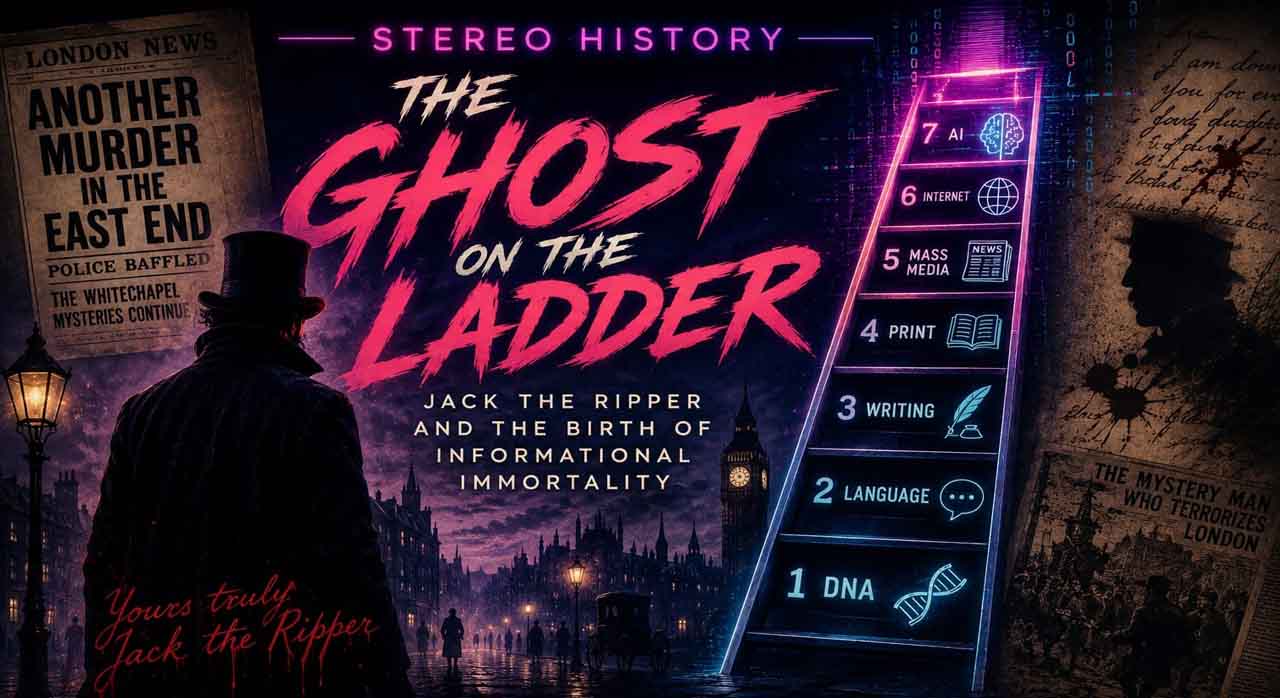
Normally we ask how information survives when a physical carrier changes: manuscript to print, print to digital file, biological memory to external archive. The witness reveals something more fragile. Sometimes information exists only because an observer was present.
The structure becomes:
event → observer → memory → trace → future observer
At every transition, information can survive.
At every transition, information can also disappear.
This is why the last witness matters. The witness occupies the point at which reality has already happened but has not yet become history. For a brief moment, the event exists both as an external occurrence and as internal experience.
Then the two separate.
Transhumation therefore reads civilization not merely as the preservation of objects, but as the preservation of relationships between information and observers. A book without a reader can survive physically. A language without anyone capable of understanding it becomes an encrypted message whose key has been lost. A face without context can preserve emotion while surrendering its cause.
The Jack the Ripper thought experiment takes this to its cruelest limit.
Perhaps someone once looked directly at the answer to a mystery that would survive for centuries.
The answer disappeared.
The question survived.
And perhaps that is one of civilization’s most important asymmetries: questions can sometimes outlive the information required to answer them.
A good library therefore cannot merely keep what was written.
It must keep the keys required to read it.
FAQ
Who was the last person to see Jack the Ripper?
We do not know. Several people reported seeing victims with men, and a victim may have seen the killer directly, but the evidence cannot establish who saw him last.
What is a silent witness?
In this article, it is a person or surviving trace that contains evidence of an event without being able to provide a complete explanation of it.
Why compare Jack the Ripper with the Mona Lisa?
They create opposite emotional examples of the same informational structure: an observer may become the final direct witness to something that later disappears.
Can a face preserve information?
Yes, but only partially. Expression may communicate emotion or reaction while leaving the cause unknown.
Why are eyewitnesses imperfect?
Human perception is selective and memory is reconstructive, so witnessing an event does not guarantee an exact internal record of it.
Can we understand a creator only through the creation?
Sometimes surviving works or effects allow strong inferences about their source, but the strength of those inferences depends on the evidence. The question cannot be answered by one rule across art, crime, history and metaphysics.
How does this connect to Transhumation?
It extends the carrier problem from objects to observers: information can pass from event to mind to memory to archive, losing and gaining something at every stage.
What is the central idea?
Sometimes history loses the answer while preserving the question. The silent witness is the point where information may once have existed—and then vanished with the person who carried it.
Continue the Transhumation Series
- Forgotten Religion | Ancient Gods, Symbols and the Hidden Structures of Human Civilization
- The Last Religion | Death, Immortality and the Future of Humanity
- The New Theurgy | AI, Information and the Future of Human Civilization
- End of Branding: You Were Never Meant to Become a Product
- Baal vs Ishtar: Why Ancient Gods Never Disappeared