
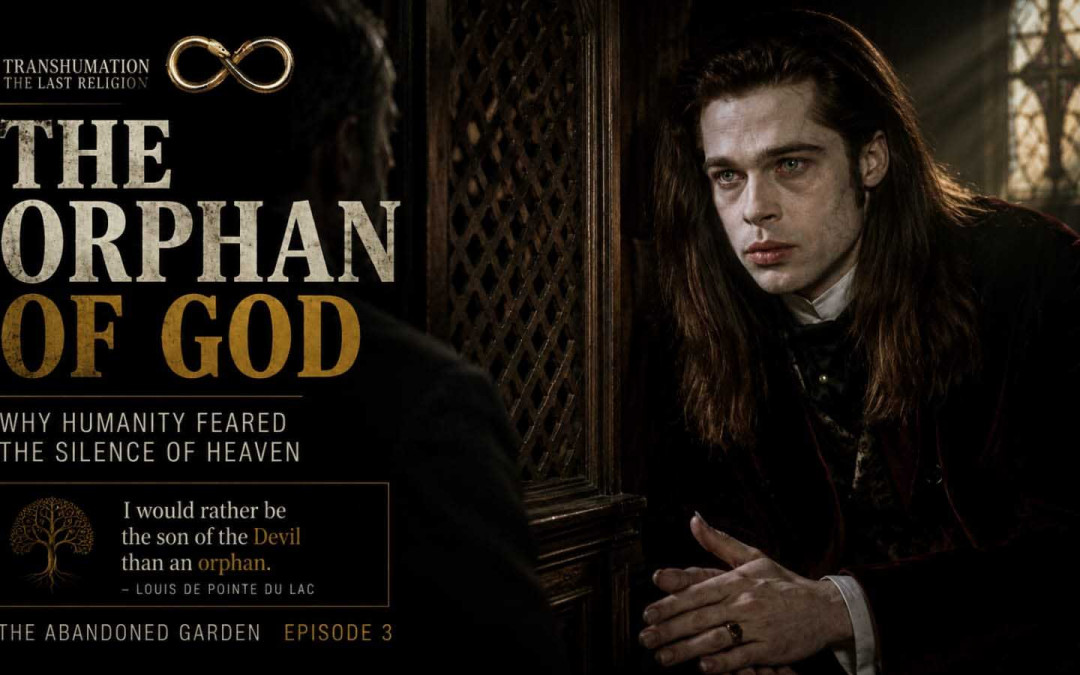
The Orphan of God
A child does not begin by asking whether the world has meaning. The child begins by assuming that someone nearby knows what is going on. There is a hand to hold, a voice to answer, a room prepared by someone else. Even fear has a structure because fear can be carried to an adult who knows more.
Then, gradually, the arrangement changes.
Parents become fallible. Explanations contradict one another. The world turns out to contain accidents, losses and silences no one can repair. At some point, every person discovers that the adults were never standing outside reality with a complete map.
Humanity may have gone through a similar transition on a civilizational scale.
For thousands of years, religion did more than explain gods, rituals and afterlives. It often supplied something more intimate: the conviction that existence belonged inside a larger order. Someone—or something—knew why the world existed, what a human being was for, and what would happen when the visible story ended.
The promise was not only rescue.
It was orientation.
And that may be why the silence of heaven has always been so difficult to bear.
The Comfort of Having a Father, Even a Terrible One
There is a line spoken by Louis de Pointe du Lac that captures the problem with unusual cruelty: he would rather be the son of the Devil than an orphan.
The power of the sentence lies in the hierarchy it creates. Evil is terrifying, but absence can be worse because evil at least preserves a relationship. A cruel father still answers the question of origin. An absent father leaves the child with uncertainty.
Who made me?
Why?
What am I to them?
Was I wanted?
The orphan does not merely lose protection. The orphan loses the obvious source of narrative.
This distinction helps explain why human beings sometimes prefer harsh cosmologies to no cosmology at all. A universe governed by severe gods may still be psychologically easier to inhabit than one that appears indifferent. Punishment, however frightening, can imply that the world is watching. Silence offers no such reassurance.
The deepest fear is not always that something terrible is in control.
Sometimes it is that nobody is.
The Day the Parent Stopped Answering
Nietzsche’s famous declaration that “God is dead” is often reduced to a slogan about atheism. That misses much of its force. The deeper problem was civilizational: what happens when a culture loses confidence in the highest framework through which its values had been justified?
If the old authority disappears, the laws do not immediately vanish. People still marry, trade, raise children, build institutions and punish crimes. The world keeps working.
But the final appeal changes.
Who decides what is good?
Who decides what a human being is for?
What makes a sacrifice meaningful?
What makes one future preferable to another?
These questions become heavier when they can no longer be referred upward.
The experience resembles adulthood less because religion is childish and more because dependency has a structure. A child can ask, “What should I do?” and expect that somewhere above them sits a more authoritative answer. An adult eventually discovers that some decisions cannot be outsourced without losing something essential.
A civilization can make the same discovery.
The sky does not fall.
The burden moves.

Origin as Identity
Human beings care intensely about origin because origin is one of the easiest ways to stabilize identity.
Family history does this. Nations do it. Religions do it. Scientific cosmology does it in a different way. To know where something came from is to place it inside a sequence.
Origins explain relationships.
They tell us what came before.
What belongs with what.
Which inheritance matters.
This is why creation myths have such enormous cultural power. They do not merely answer the technical question of how the world began. They often answer the social and existential question of what kind of world this is and what kind of creature the human being is inside it.
Remove the creator and the second question becomes unstable.
If there is no assigned place, perhaps place must be chosen.
If there is no inherited purpose, perhaps purpose must be constructed.
If there is no cosmic parent, perhaps identity can no longer be derived entirely from origin.
That sounds liberating from a distance.
From inside the transition, it can feel like bereavement.
The Orphan Civilization
Modernity created something historically unusual: large numbers of people capable of imagining a universe with no personal creator, no final cosmic judge and no predetermined human purpose.
This does not mean earlier civilizations were incapable of skepticism, nor that modernity is uniformly secular. Religious belief remains powerful across the world, and the relationship between religion, science and modern life is far more complicated than a simple story of disappearance.
But the cultural possibility of cosmic orphanhood is real.
A person can now coherently imagine that the universe exists without intending anything toward us.
Stars form.
Species evolve.
Civilizations rise.
People love.
People die.
No external voice explains what the whole sequence means.
That possibility can be frightening because it removes the guarantee that meaning has already been prepared.
But it also produces a new responsibility.
If no final meaning is assigned, then human choices matter differently.
Not less.
More.
The Difference Between Abandonment and Freedom
There is an obvious theological temptation here: perhaps divine silence is actually evidence that the creator trusts the creation.
That idea is philosophically attractive, but it cannot be smuggled in as knowledge. Silence alone does not tell us whether a creator is absent, hidden, indifferent, testing, transcendent or simply nonexistent.
The ambiguity must remain.
Still, the parent analogy reveals something useful about freedom.
A parent who never lets go prevents independence.
A teacher who gives every answer prevents judgment.
A creator who controls every action leaves little room for agency.
This does not prove anything about God. It does show that visible intervention and successful creation are not always the same thing.
Sometimes guidance culminates in withdrawal.
Sometimes withdrawal is abandonment.
From inside the system, the two can look identical.
The difference lies in what the system has been prepared to do next.
The Child on the Other Side of the Door
Humanity is beginning to encounter this problem from the opposite direction.
For most of history, creation was imagined upward. Gods made humans. Nature made life. Parents made children. Artists made works.
Now humans increasingly occupy the creator’s position in new domains. We modify genomes, build artificial agents, construct digital environments, train systems whose outputs cannot be predicted line by line, and create institutions that may outlive their founders.
This changes the old theological question.
Instead of only asking, “Why did the creator leave us?”, we may have to ask, “When should we leave what we create?”
How much control is too much?
How much independence is too little?
What obligations remain when a creation becomes capable of operating beyond direct supervision?
The orphan problem is therefore not merely about humanity losing God.
It may be about humanity inheriting the problem of creation.
The Silence That Forces a Decision
The orphan civilization is not a civilization without memory, religion or tradition.
It is a civilization in which inherited answers can no longer be treated as self-executing.
That is a different condition.
The old stories remain.
The scriptures remain.
The philosophies remain.
The laws remain.
But each generation has to decide how much authority to give them.
This is where silence becomes productive in an uncomfortable way.
If no voice settles the argument, the participants must learn to reason, compare, doubt, preserve, revise and take responsibility for consequences.
The absence of a final answer creates work.
That work is civilization.
The Orphan Does Not Begin at Zero
There is a danger in romanticizing the orphan.
Actual orphans do not become freer simply because someone is gone. Loss can damage, isolate and destabilize. Likewise, a civilization that loses a shared metaphysical framework does not automatically become wiser. It can become fragmented, cynical, authoritarian or desperate for substitute gods.
The vacuum does not stay empty for long.
Politics can become religion.
Technology can become religion.
Markets can become religion.
Identity can become religion.
A society that rejects one absolute may simply construct another.
This is why the mature orphan cannot be defined merely by the absence of a parent.
Maturity requires learning which inheritances deserve to be kept even after the authority that once guaranteed them has weakened.
The orphan carries more than loss.
The orphan carries an estate.
The Birth of Responsibility
Perhaps the strongest version of the idea is also the least dramatic.
The sky remains silent.
The universe offers no universally accepted commentary.
People disagree.
Nothing descends to settle the dispute.
So we act anyway.
We choose institutions.
Raise children.
Build technologies.
Decide whom to protect.
Decide what kinds of intelligence we are willing to create.
Decide which parts of humanity should be preserved and which should be changed.
In other words, the question of the creator slowly becomes a question about the creation.
What does the creation do when nobody guarantees the answer?
That may be where adulthood begins.
Not when the parent disappears.
When the child stops waiting for the parent to return before taking responsibility for the room.
Watch The Video
How to Read the World
Current Knowledge
Nietzsche’s phrase “God is dead” appears most famously in The Gay Science and later in Thus Spoke Zarathustra. It was not simply a declaration of atheism but part of a broader diagnosis of what happens when traditional religious and moral frameworks lose authority.
The psychological importance of attachment, belonging and narrative identity is well established, although human responses to religious belief or nonbelief vary enormously. There is no single universal reaction to the loss of religious certainty.
Religious traditions differ greatly in how they understand divine silence, hiddenness, providence and human freedom. Some interpret apparent absence as a theological problem; others understand divine action as indirect, non-coercive or fundamentally unlike ordinary human intervention.
Modern secular societies have not eliminated religion, and global religious belief remains widespread. It would therefore be inaccurate to describe contemporary humanity as uniformly “orphaned” in any literal sociological sense.
Open Questions
Can a civilization sustain durable moral commitments without appeal to a transcendent authority, or do secular systems inevitably recreate equivalent absolutes in political, cultural or technological form?
If divine hiddenness is real, what should we infer from it? Does silence support atheism, non-interventionist theism, spiritual maturity or none of these conclusions strongly enough to decide?
There is also a psychological question. How much human meaning depends on origin? Can identity be built primarily from chosen commitments rather than inherited narratives?
AI and synthetic biology add another problem: if humans create increasingly autonomous systems, what responsibilities do creators retain after direct control becomes limited or intentionally reduced?
Transhumation Interpretation
The Orphan of God is not an argument that God is dead.
It is a model of what happens when certainty of the parent disappears.
The structure can be written simply:
origin → authority → silence → uncertainty → responsibility
This pattern appears in religion, parenthood, education, politics and technology.
The important transition is not silence itself.
It is what happens after silence.
A dependent system waits for instructions.
A mature system develops judgment.
That does not mean it forgets the creator, rejects tradition or declares itself all-powerful. It means that inherited structure becomes something to interpret rather than merely obey.
This is where the Orphan Civilization begins.
Not in emptiness.
In inheritance without guaranteed instruction.
The old question was:
Who created us?
The next question may be:
What are we responsible for now that we are here?
That shift matters because humanity is slowly moving from creation as a theological problem toward creation as a technological responsibility.
We may build new forms of intelligence.
Modify life.
Extend identity into new carriers.
Construct systems that continue after their designers are gone.
At that point, the orphan and the parent meet inside the same species.
Humanity becomes both.
The child that once asked why the creator was silent may one day face a creation asking the same question.
And perhaps that is the real threshold.
Not the death of God.
The birth of responsibility.
FAQ
What does “The Orphan of God” mean?
It describes the human experience of losing certainty that a divine authority provides final answers about meaning, purpose and morality.
Is this article arguing that God does not exist?
No. It explores the consequences of divine silence and uncertainty without claiming to resolve the metaphysical question.
Why is Nietzsche important here?
Because his “death of God” describes a cultural crisis that follows when traditional religious authority loses its ability to organize meaning.
Why use the image of an orphan?
Because losing a parent represents not only loneliness but also the loss of an obvious source of identity, authority and explanation.
Is divine silence the same as abandonment?
Not necessarily. Different philosophical and religious traditions interpret hiddenness or silence in different ways.
What is the Orphan Civilization?
A Transhumation concept for a civilization that understands it may have to make final decisions without guaranteed external instruction.
How does AI connect to this idea?
Humanity is increasingly becoming a creator itself, raising questions about what responsibilities we have toward systems that may eventually operate with greater autonomy.
Does maturity mean rejecting religion?
No. Maturity here means accepting responsibility for judgment even when certainty is unavailable.
What is the central idea?
The most important consequence of the creator’s silence may not be emptiness. It may be the moment when the creation realizes that responsibility can no longer be postponed.
Continue the Transhumation Series
- Forgotten Religion | Ancient Gods, Symbols and the Hidden Structures of Human Civilization
- The Last Religion | Death, Immortality and the Future of Humanity
- The New Theurgy | AI, Information and the Future of Human Civilization
- End of Branding: You Were Never Meant to Become a Product
- Baal vs Ishtar: Why Ancient Gods Never Disappeared