Bonjour.
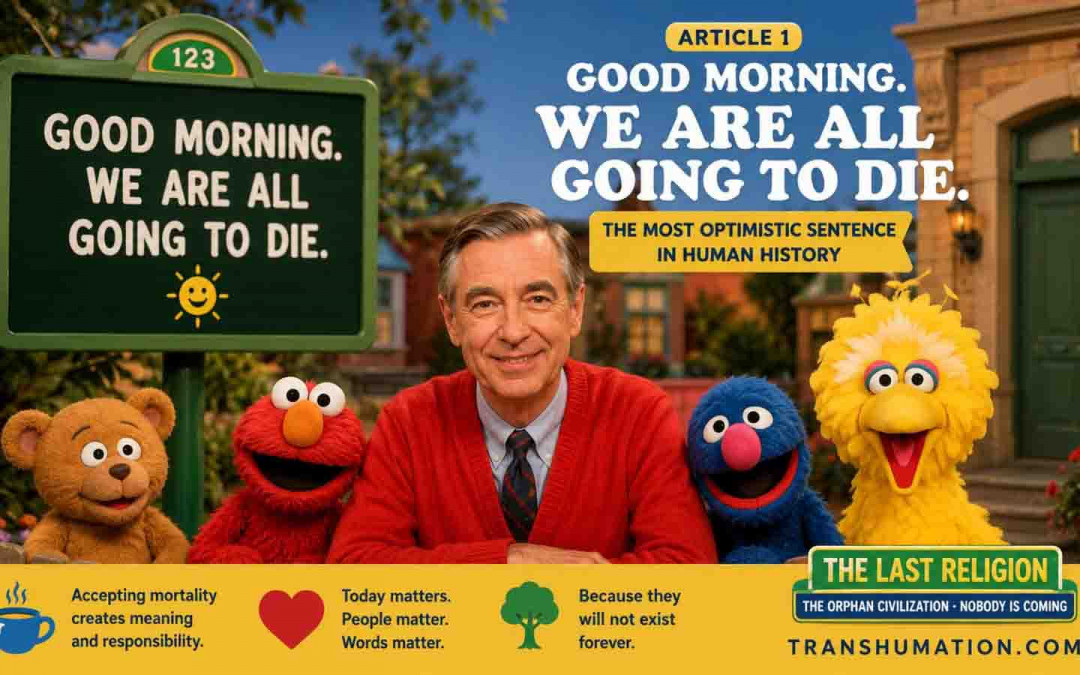
Good morning. Coffee is ready, the phone is charging, somebody is late, somebody else has already sent an email marked urgent, and all of us are going to die. Bonjour.
That sounds like a terrible way to begin the day. It may be one of the better ones. Death has acquired an impressive public-relations department: religion gives it an afterlife, philosophy gives it dignity, medicine gives it extensions, technology gives it a roadmap, and advertising mostly asks us not to mention it before breakfast. Jacques Couteau would like to ask a smaller question. If the fact is true, what does it actually change?
Everyone knows the answer in theory. Almost nobody lives as if the information arrived this morning. We postpone the call, save the good bottle, tolerate the stupid job for another year, protect grudges as if they were pension funds, and behave as though the calendar were a renewable resource. Mortality is universal knowledge with remarkably poor market penetration.
That is where the optimism begins. “We are all going to die” is not good news because death is good. It is good news because a limit turns time from background scenery into a price. Once the supply is finite, choices stop being decorative.
The Limited Page
Imagine a novel with no final page. At first it sounds generous: nobody has to leave, nothing has to be resolved, every mistake can be repaired in chapter 8,412. Then the generosity becomes a structural problem. If there is always another chapter, why must this one matter?
A finite life does not automatically become meaningful. People can waste scarce things perfectly well. But scarcity creates the possibility of priority: ten years spent on one thing are ten years unavailable to another; loving one person shapes possibilities elsewhere; saying yes has a cost because the number of yeses is limited.
Death does not tell you what to value. That would be suspiciously convenient. It merely removes one excuse: the fantasy that every decision can be postponed without loss. The clock does not provide a philosophy. It provides a bill.
Does Anyone Care?
Civilization has spent thousands of years answering death without defeating it. Tombs preserve names. Children carry lineages. Writing lets a dead person continue making trouble in a living reader’s head. Architecture extends an intention beyond the builder, law extends decisions beyond the legislator, and art can move an observer centuries after the artist has stopped breathing.
Technology has made the old operation more precise. Photographs preserve faces, recordings preserve voices, databases preserve information, medicine preserves function, and artificial systems can preserve increasingly convincing fragments of style and behavior. The carrier changes. The desire to get something across the border does not.
But here Couteau’s second rude little question becomes useful: does anyone care? Not “is death important?” Obviously it is. The question is whether knowing about death changes conduct, or whether mortality becomes another fact we can understand, discuss, optimize and then place beside the weather forecast while we go back to arguing about parking.
This is not nihilism. It is a significance test. A truth can be enormous and still fail to alter Tuesday afternoon. The interesting question is what happens when it finally does.
The Price of Eternity
Religion has traditionally offered many answers to mortality, and reducing religion to fear of death would be silly. But eternal life is undeniably one of humanity’s most durable offers. Technology has now entered the same sales territory with different vocabulary: longevity, rejuvenation, cryonics, whole-brain emulation, digital continuity.
The terms matter. A longer-lived body is not the same thing as preserved identity. A preserved memory is not demonstrated consciousness. A digital system that speaks like you after your death may be an extraordinary archive without proving that the observer who once said “I” crossed anywhere at all.
So read the contract. “Immortality” may conceal several products: biological continuity, informational continuity, social memory, reconstruction, or subjective survival. They are not interchangeable merely because the brochure uses the same photograph.
And if one day the strongest version works, congratulations. We have solved death. Now we have to solve forever.
What Happens After Forever Begins?
The standard immortality story ends at exactly the convenient moment. The patient survives, the music rises, the camera pulls back. Nobody asks what the patient is doing 430 years later.
Suppose aging becomes reversible and bodies repairable. What happens to marriage, inheritance, education, ambition and political power when a lifetime no longer provides the familiar turnover? Does a five-hundred-year-old become wise because consequences remain personally remembered, or rigid because the same preferences can occupy the same institutions for centuries?
Then there is boredom. Mortality creates urgency partly because opportunities close. Remove the closing time and some forms of motivation may have to be rebuilt from scratch. Eternal life might be magnificent, but “eternal” is a surprisingly long warranty period.
None of this is an argument against life extension. Saving a life is not made foolish because philosophy has unresolved questions. It is simply a reminder that engineering can remove one boundary and expose another. Mortality creates problems; immortality would create problems too. Welcome to product development.
The Most Optimistic Sentence
“We are all going to die” sounds pessimistic only if optimism requires an exemption. It does not. The sentence can be optimistic because it makes the price visible while the purchase is still possible.
You do not need a cosmic guarantee to call someone today. You do not need proof of an afterlife to stop spending years on something you despise. You do not need immortality to build something capable of surviving you, and you do not need to know whether consciousness can change carriers to notice that words, images, institutions and consequences already do.
The future may teach us to live much longer. It may even force us to reconsider what survival means. Until then, the old fact remains brutally useful: the day is finite, the life is finite, and the menu is larger than the stomach.
Bonjour. We are all going to die. Now what are you doing after breakfast?
Watch The Video
How to Read the World
by Jaques Couteau
Current Knowledge
Human mortality remains a biological fact. Medicine and public health can extend life and prevent or treat many causes of premature death, while research into aging, cellular senescence, gene regulation and regenerative medicine continues. No demonstrated method currently makes humans biologically immortal.
Digital preservation is a different problem. Present systems can preserve recordings, writing, images, behavioral traces and increasingly sophisticated models of a person’s language or preferences. No current technology has demonstrated transfer of human subjective consciousness into a digital system, so preservation of a pattern should not be presented as proof of survival of the observer.
Open Questions
Would radical life extension weaken urgency, or would humans simply invent new deadlines and new sources of purpose? Would centuries of memory make individuals wiser, or make institutions harder to change? If personality, memory and behavior could be reproduced with extreme fidelity in another substrate, would that constitute survival or the creation of a successor?
The social questions are equally serious. Radical life extension could alter inheritance, inequality, family structure, political power and access to resources. A technology that solves one ancient problem could therefore manufacture several new ones.
Transhumation Interpretation
Transhumation treats mortality as a boundary condition rather than a sermon. The useful chain is simple: mortality creates scarcity of time; scarcity forces choice; choice creates cost; cost makes preservation matter. Human beings answer that pressure by building carriers—children, books, monuments, institutions, recordings, databases and perhaps one day forms we do not yet possess.
The unresolved point is the observer. Information can cross a boundary without proving that consciousness crossed with it. That distinction is exactly why death remains interesting even in a technological civilization: we are becoming better at preserving the pattern while still not knowing whether the “I” is a pattern, a process, something else, or even a well-formed scientific question.
Couteau’s contribution is not an answer. It is the impolite test applied after all the grand language: assume the claim is true. Does it change anything? If mortality is certain, what changes today? If immortality becomes possible, what changes then? The knife is useful because either answer has consequences.
FAQ
Why begin with “Bonjour. We are all going to die”?
Because the contrast is the point: an absurdly polite greeting meets the least negotiable fact of human life. The article asks what that fact actually changes.
Is the argument nihilistic?
No. It treats mortality as a constraint that can make time, choice and priority more visible rather than as proof that nothing matters.
Does death automatically create meaning?
No. Scarcity creates cost, not purpose. Humans still have to decide what deserves their limited time.
Can technology defeat death?
Current technology can extend life and preserve information, but human biological immortality and transfer of subjective consciousness have not been demonstrated.
Is a digital copy the same as survival?
Not necessarily. A highly accurate reconstruction could preserve a pattern without establishing continuity of the original subjective observer.
What is Couteau’s central question?
Assume the claim is true. Does anyone care—in the practical sense of whether the truth changes a decision, a behavior or the architecture of ordinary life?
Continue the Transhumation Series
- Forgotten Religion | Ancient Gods, Symbols and the Hidden Structures of Human Civilization
- The Last Religion | Death, Immortality and the Future of Humanity
- The New Theurgy | AI, Information and the Future of Human Civilization
- End of Branding: You Were Never Meant to Become a Product
- Baal vs Ishtar: Why Ancient Gods Never Disappeared