
The Horizon That Moves
A child can spend three weeks wanting a particular toy. It appears in shop windows, in conversations, perhaps in the negotiations before a birthday. The object gradually acquires an importance completely disproportionate to its plastic components. Then the package arrives. There is the wonderful violence of torn paper, the first inspection, the hour in which the rest of the room disappears. By evening, the toy has begun the long migration toward the shelf.
Adults like to imagine that they have outgrown this mechanism. We have mostly improved the objects.
The toy becomes a car, a house, a promotion, a journey, a relationship, a successful company, a larger audience, a place at a better table. The distances become longer and the prizes more expensive, but the horizon behaves with suspicious consistency. We reach the place from which happiness was supposed to become permanent and discover another landscape behind it. There is always another room in the house, another mountain beyond the summit, another question after the answer.
Psychology has modern terms for parts of this phenomenon. Ancient Mesopotamia did not. But it possessed something modern language often lacks: an image large enough to hold desire together with danger, creation together with destruction, attraction together with conflict.
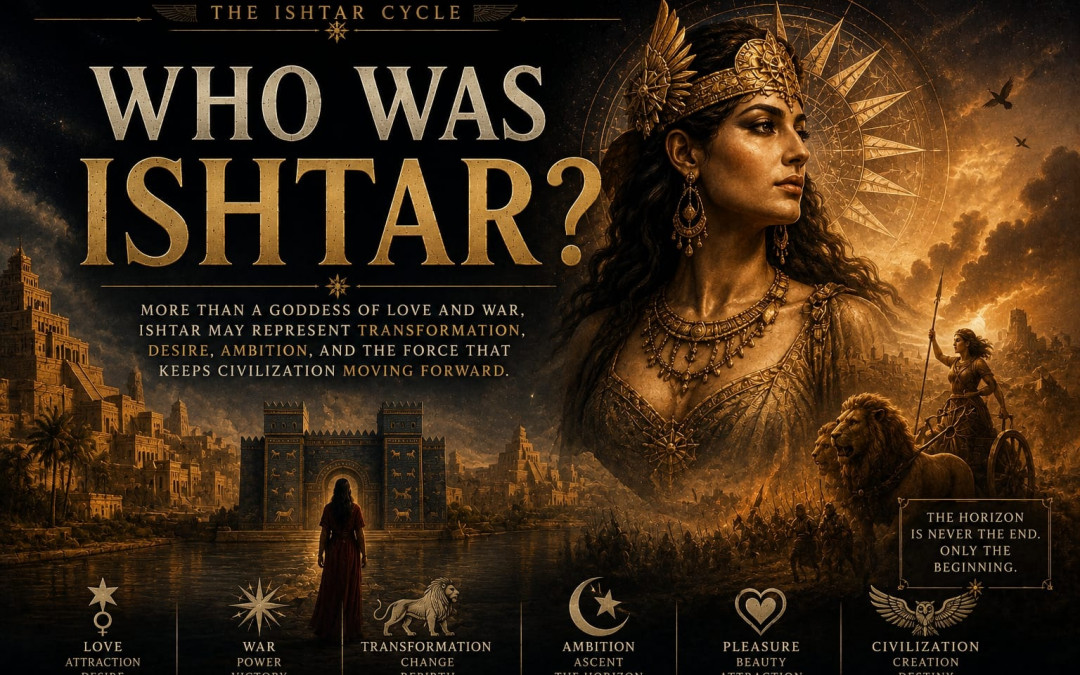
Her name was Ishtar.
A Goddess Who Refuses to Stay in One Room
Calling Ishtar simply “the goddess of love and war” is convenient in the way that calling the ocean “a quantity of water” is convenient. It is not false, but it can conceal the thing that made her so extraordinary.
The Akkadian Ishtar, closely associated with the earlier Sumerian Inanna, occupied a remarkably complex position in Mesopotamian religion. Sexuality, fertility, political power and warfare could all gather around her. She was associated with the planet Venus, whose appearances as morning and evening star offered the ancient world a celestial object that itself seemed capable of changing identity. Kings invoked her. Poets described her beauty and violence. In myth she could desire, threaten, descend, return and overturn boundaries.
To a modern mind, love and war may look like incompatible departments accidentally assigned to the same divine administrator. But perhaps our categories are too tidy. Desire can be tender, possessive, creative, destructive and politically explosive. Love rearranges lives. War rearranges kingdoms. Neither leaves the world exactly as it found it.
That does not mean ancient Mesopotamians secretly worshipped a philosophical principle called “becoming.” They did not leave us such a doctrine, and turning Ishtar into a modern self-help metaphor would flatten the very history that makes her interesting.
But as a later structural reading, something becomes visible.
Ishtar repeatedly appears near change that has acquired desire.
Something wants something else.
And the world moves.
The Problem With Getting What You Want
Imagine, for a moment, a perfect Saturday.
Nothing hurts. Nobody needs anything from you. There is enough money. The weather is right. The people you love are safe. No urgent message is waiting. You have eaten well, slept well and reached the peculiar state we spend much of our working lives claiming to desire.
Now extend Saturday forever.
The thought becomes less comfortable.
Human satisfaction seems to contain a strange instability. We seek the removal of problems, but a life from which every problem, challenge, uncertainty and unfinished possibility had permanently disappeared might cease to resemble a desirable human life. We want rest because there is work. We enjoy arrival because there was a journey. Remove every horizon and paradise begins to acquire the geometry of a waiting room.
Modern psychology has studied related phenomena under concepts such as hedonic adaptation: changes in circumstances can produce substantial emotional effects without guaranteeing that the new level of satisfaction remains permanent. Human motivation is more complicated than a single mechanism, and deprivation should never be romanticized. Hunger does not become philosophically valuable because dissatisfaction can sometimes motivate achievement.
Still, there is an uncomfortable truth hiding inside ordinary prosperity.
Enough is difficult to recognize from the inside.
The person who once wanted security begins wanting freedom. The person who obtains freedom wants accomplishment. Accomplishment creates comparison. Comparison creates another horizon. The summit is real, but the view contains another mountain.
The treasure chest opens.
Inside is another map.

Alexander and the Edge of the Map
Alexander III of Macedon provides an almost unfair example because his biography already resembles a story written to demonstrate the dangers of scale. He inherited the Macedonian kingdom in 336 BCE and, before dying at thirty-two, destroyed the Achaemenid Persian Empire and carried his campaigns through Egypt and Central Asia into the Indian subcontinent.
A modern map makes the achievement deceptively easy to comprehend. We can see the shape at once.
Alexander could not.
He moved through geography rather than hovering above it. A mountain range concealed what lay behind it. Reports arrived from territories he had never seen. Each campaign changed the political landscape and therefore created the conditions for another campaign. The known world did not present itself as a completed board waiting for him to place the final piece.
This is why the familiar image of Alexander endlessly hungry for conquest is useful but needs restraint. Ancient sources were written with their own agendas, sometimes long after his death, and we cannot diagnose the private psychology of a man who lived more than two millennia ago.
What we can see is the structure of expansion.
Success increased capability.
Capability enlarged the reachable world.
The enlarged world produced new possibilities.
The horizon moved because Alexander moved toward it.
That pattern extends far beyond conquest. A telescope does not merely answer astronomical questions; it reveals objects that generate new questions. A microscope does the same in the opposite direction. A successful company discovers markets it previously could not enter. A child learns to read and suddenly encounters the unsettling fact that there are more books than one lifetime can contain.
Knowledge does not eliminate the unknown.
It manufactures a larger border with it.
The Emptiness Behind the Sphinx
There is a moment in many adventures when the hero has already found what the story originally promised. The treasure has been recovered, the door opened, the enemy defeated. A weaker story ends there. A better one reveals that the object was never the deepest reason for the journey.
Human desire often behaves the same way.
We give the absence a name because names make absences easier to negotiate: money, recognition, love, success, knowledge, immortality. Sometimes the name is accurate. A lonely person may genuinely need companionship; a poor person may genuinely need money. But after sufficiently many needs are met, another kind of absence can remain—more difficult to locate because no single object seems capable of filling it permanently.
For the purposes of Transhumation, we can call this the Sphinx Void.
Not a psychiatric condition. Not an ancient Mesopotamian doctrine. Not proof that human beings possess some supernatural missing component.
A question.
Why does an intelligent creature capable of satisfaction repeatedly manufacture new horizons?
Perhaps the answer is evolutionary: organisms that seek resources, mates, status, information and opportunity have reasons to keep moving. Perhaps culture amplifies those drives far beyond their original environments. Perhaps consciousness itself creates the problem because an animal capable of imagining a future can also imagine a future preferable to the present.
Whatever the answer, the void has an extraordinary civilizational consequence.
An unfinished world can be improved.
A perfectly finished world cannot.
When Desire Learns Engineering
For most of human history, the distance between desire and fulfillment was enforced brutally by nature. You could want to cross an ocean quickly, but wanting did not produce an aircraft. You could want to speak to a dead parent, but memory and imagination were largely what remained. You could want perfect knowledge and discover that even the largest library contained only a fraction of what there was to know.
Technology progressively changes the bargaining position.
We extend life. Alter bodies. Cross continents in hours. Store voices after death. Search billions of pages. Generate images from sentences. Ask artificial intelligence to navigate bodies of information no individual could personally read.
The interesting thing is not that technology satisfies desire.
It is that every satisfied desire reveals another layer of the desire.
We wanted information, then discovered that too much information creates a navigation problem. We built the library and discovered that a good library requires a good librarian. We wanted permanent memory and began confronting the possibility that forgetting also performs a human function. We wanted machines that could answer questions and almost immediately began asking whether the machines themselves could understand the answers.
The horizon did not disappear.
We mechanized its movement.
And this may be where an ancient goddess becomes unexpectedly useful—not as a prediction of artificial intelligence, but as a reminder that technological progress does not arrive in a civilization emptied of ancient drives. The machines change quickly. The creature asking them for more may change much more slowly.
The Goddess at the Airport
Imagine Ishtar arriving today.
Not emerging dramatically from a reconstructed Babylonian gate, but walking through an airport like everyone else. She might initially appear to have lost her occupation. Fertility has clinics. Warfare has satellites. Sexual desire has applications. Political power travels through networks. Venus is an astronomical object whose orbit can be calculated.
But then she looks around.
Every advertisement promises transformation.
Become younger.
Travel farther.
Know more.
Earn more.
Be noticed.
Upgrade.
Improve.
Discover.
Become.
Perhaps the ancient gods disappear when their statues disappear. Or perhaps some of them become harder to notice because the functions once concentrated in divine figures diffuse into ordinary civilization.
Ishtar need not survive as a supernatural being for the structure associated with her to remain recognizable.
The child still opens the package.
The emperor still looks beyond the frontier.
The scientist still asks the next question.
The civilization still reaches for something it does not possess.
And somewhere behind every destination, almost politely, another horizon waits.
Watch The Video
How to Read the World

Current Knowledge
Ishtar was a major Mesopotamian goddess, particularly prominent in Akkadian, Babylonian and Assyrian traditions, and closely connected historically with the Sumerian Inanna. Her domains included sexuality and love, warfare and political power, and she was associated with Venus. Her traditions varied across places and periods, so reducing her to a single abstract function obscures substantial historical complexity.
Inanna and Ishtar became closely identified, although the development of their traditions involved linguistic, cultural and religious changes rather than a simple one-to-one replacement. Important surviving compositions concerning Inanna/Ishtar include narratives of divine conflict, sexuality, political authority and descent to the underworld.
Alexander the Great created an enormous empire through campaigns beginning in the fourth century BCE, but claims about his personal inability to feel satisfied should be treated cautiously. Ancient literary traditions shaped his image, and his internal motivations cannot be reconstructed with certainty.
Modern research supports the general phenomenon of hedonic adaptation, although human well-being and motivation cannot be reduced to a simple rule that people inevitably become dissatisfied with everything they obtain.
Open Questions
How much of persistent human striving comes from evolved motivational systems, and how much is produced by culture? Does increasing prosperity eventually reduce desire, or does it mostly redirect desire toward new objects such as status, experience, recognition and self-development?
A deeper question concerns progress itself. Is dissatisfaction merely a psychological cost that civilization should learn to reduce, or is some form of perceived incompleteness necessary for curiosity, art and discovery? Could a civilization become genuinely satisfied without becoming static?
Technology creates the newest version of the problem. If artificial intelligence makes knowledge, production and creation dramatically easier, will humans become more satisfied—or simply acquire larger horizons more quickly?
Transhumation Interpretation
Transhumation does not claim that historical Ishtar “really” meant technological progress, psychological dissatisfaction or human evolution.
It asks a different question.
Does a structure survive after its religious carrier changes?
Ishtar gives that question an unusually rich test. Love, war, political ambition, sexuality and transformation appear historically as different aspects of her divine world. From a modern structural perspective, many of them share an elementary operation: a present state becomes insufficient, something beyond it acquires value, and movement begins.
Present state → desire → crossing → transformation → new present state.
Then the operation can begin again.
This is the Ishtar Cycle.
Its value is not that it proves an ancient secret. Its value is that it gives us a way to notice a recurring problem in civilization. Humanity builds because something is missing. The completed structure creates new possibilities. Those possibilities create new desires. Desire pushes the boundary outward.
The pattern can produce a poem or a war.
A laboratory or an empire.
A love affair or an obsession.
Mars or another room in the house.
That ambiguity matters because Transhumation should not worship movement merely because it is movement. Growth is not automatically good. Desire can enlarge a life and consume it. The same mechanism capable of carrying humanity beyond an old limitation can prevent it from recognizing when enough has already been achieved.
Perhaps that is why Ishtar remains a better symbol than the modern word progress.
Progress sounds clean.
Ishtar never was.
She carries attraction and danger together.
And the question she leaves us is therefore not whether humanity should stop reaching beyond itself. A creature that stopped doing so might cease to resemble humanity at all.
The harder question is whether we can learn to distinguish the horizon worth crossing from the horizon that moves only because we cannot bear to stand still.
FAQ
Who was Ishtar?
Ishtar was a major Mesopotamian goddess associated especially with love, sexuality, warfare and political power.
Was Ishtar the same as Inanna?
The Akkadian Ishtar became closely identified with the earlier Sumerian Inanna, although their traditions developed across different languages, places and periods.
Was Ishtar historically a goddess of “becoming”?
Not in that literal philosophical sense. “Becoming” is the modern structural interpretation explored in this article.
What is the Ishtar Cycle?
It is a Transhumation model describing a recurring sequence: dissatisfaction or desire produces movement, movement creates transformation, and the new state eventually generates another horizon.
What is the Sphinx Void?
It is a working Transhumation term for the persistent sense that another question, achievement or level remains beyond the present one. It is an interpretive concept, not a historical or medical term.
Does dissatisfaction always produce progress?
No. It can produce discovery and creativity, but also obsession, conflict and destructive competition.
Why is Alexander included?
His extraordinary expansion provides a historical illustration of how success can enlarge the field of possible action rather than bring a process to an obvious conclusion.
How does this connect to AI?
AI may satisfy old desires for knowledge and capability while simultaneously creating entirely new horizons, questions and forms of dissatisfaction.
What is the central Transhumation question?
Not whether humanity can reach the next horizon, but whether it can learn which horizons are worth crossing.
Continue the Transhumation Series
- Forgotten Religion | Ancient Gods, Symbols and the Hidden Structures of Human Civilization
- The Last Religion | Death, Immortality and the Future of Humanity
- The New Theurgy | AI, Information and the Future of Human Civilization
- End of Branding: You Were Never Meant to Become a Product
- Baal vs Ishtar: Why Ancient Gods Never Disappeared