
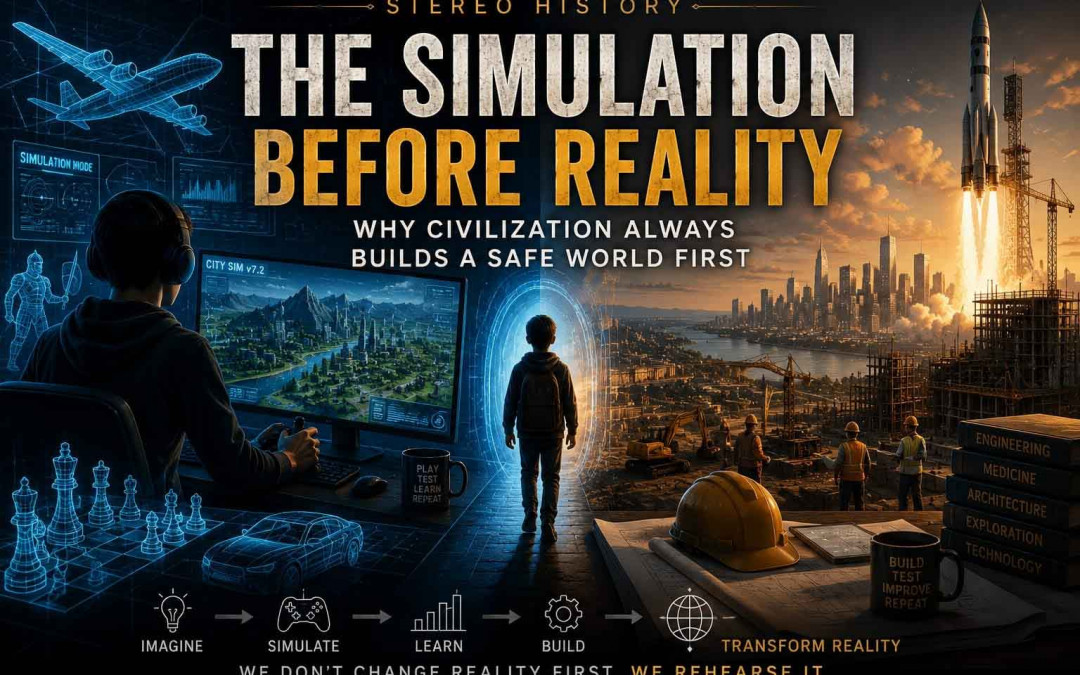
Humanity rarely changes the real world immediately.
First…
It builds a simulation.
Long before engineers launched rockets into space, they built models.
Before pilots carried passengers across oceans, they trained inside simulators.
Before surgeons operated on real patients, they practiced on models.
Before autonomous cars entered our streets, they drove billions of virtual kilometers.
Civilization does not gamble with reality.
It rehearses it.
The Playground Before the World
Children understand this instinctively.
A child builds a city from blocks.
Invents rules.
Destroys everything.
Builds it again.
Nothing important is lost.
Only knowledge is gained.
Play is civilization’s safest laboratory.
It allows impossible ideas to fail without destroying the future.
Every Great Technology Begins as a Simulation
History repeats the same pattern.
Maps simulated geography before exploration.
Military exercises simulated war before battle.
Chess simulated strategy.
Flight simulators prepared pilots.
Video games simulate economies, societies, logistics, and cooperation.
Artificial intelligence now simulates conversations, decisions, creativity, and reasoning.
The simulation becomes increasingly realistic.
But its purpose remains the same.
Reduce the cost of failure.
Reality Is Expensive
Every mistake in reality has consequences.
A bridge collapses.
A spacecraft explodes.
A medical error costs a life.
A financial decision destroys a company.
Simulations allow civilization to make thousands of mistakes before making one correct decision.
Progress depends less on intelligence than on the ability to fail safely.
The Digital Laboratory
Today humanity is creating the largest simulation in history.
Digital worlds.
Virtual reality.
Artificial intelligence.
Digital twins of cities.
Climate models.
Economic simulations.
These are not escapes from reality.
They are preparations for it.
The future is increasingly tested before it exists.
Why Games Matter
Many people see games as entertainment.
History may remember them differently.
Games teach systems thinking.
Resource management.
Cooperation.
Adaptation.
Long-term planning.
Modern civilization trains billions of people inside simulated environments every day.
The classroom has expanded.
The playground became planetary.
AI Is Another Simulation
Artificial intelligence does something fascinating.
It allows us to simulate ideas before acting on them.
We ask questions.
Test arguments.
Explore possibilities.
Generate designs.
Write code.
Imagine futures.
Instead of experimenting directly on reality, we experiment with information.
The simulation becomes intellectual.
The Pattern Behind Civilization
The pattern appears everywhere.
Imagine.
Simulate.
Learn.
Build.
Reality is always the final step.
Never the first.
This may explain why humanity advances faster than any previous civilization.
Our simulations become increasingly accurate.
Each generation inherits larger playgrounds than the one before.
Transhumation
Perhaps civilization has always followed a hidden rule.
Never change reality before you understand it.
Never build the future before rehearsing it.
Never cross a bridge before imagining it.
Simulation is not the opposite of reality.
It is reality’s preparation.
Every great civilization first creates a safe world where failure costs almost nothing.
Only then does it transform the real one.
The future is rarely built in the real world first.
It is rehearsed long before anyone notices.
Want to Explore More..?
Watch The Video Below
Continue Reading…
End of the Real World

FAQ
What is „The Simulation Before Reality”?
It is the idea that civilization first creates safe models, games, and simulations before applying new ideas to the real world.
Why are simulations important?
They reduce the cost of failure, allowing people to experiment, learn, and improve without catastrophic real-world consequences.
Are video games examples of simulations?
Yes. Many games simulate economics, strategy, engineering, cooperation, logistics, and decision-making, making them valuable learning environments.
How does AI fit into this concept?
AI allows humanity to simulate conversations, designs, decisions, and solutions before implementing them in reality.
Why compare children to civilization?
Children naturally learn through play and experimentation. Civilization often follows the same pattern on a larger scale.
How do flight simulators illustrate this idea?
Pilots master dangerous situations in virtual environments before encountering them in real life, demonstrating how simulations prepare us for reality.
Does this connect to The Ladder of Information?
Yes. Each new generation builds increasingly sophisticated simulations, allowing civilization to accumulate knowledge more efficiently.
Why is this part of Stereo History?
Because Stereo History explores how seemingly ordinary tools—games, toys, simulations, and digital worlds—become the hidden foundations of future technological revolutions.
What is the central message?
Civilization does not invent the future by risking reality first. It invents safe worlds where the future can be tested, improved, and understood before becoming real.

The Core Questions of Transhumation
Explore the full journey:
- End of Reality — Where Do You Really Exist?
- End of Physics — Are the Laws of Reality Real?
- End of the Real World — Reality Is No Longer Required
- End of Consciousness — Beyond the Human Mind
- End of Death — When Human Limits Disappear
- End of Religion — When Technology Replaces Faith