
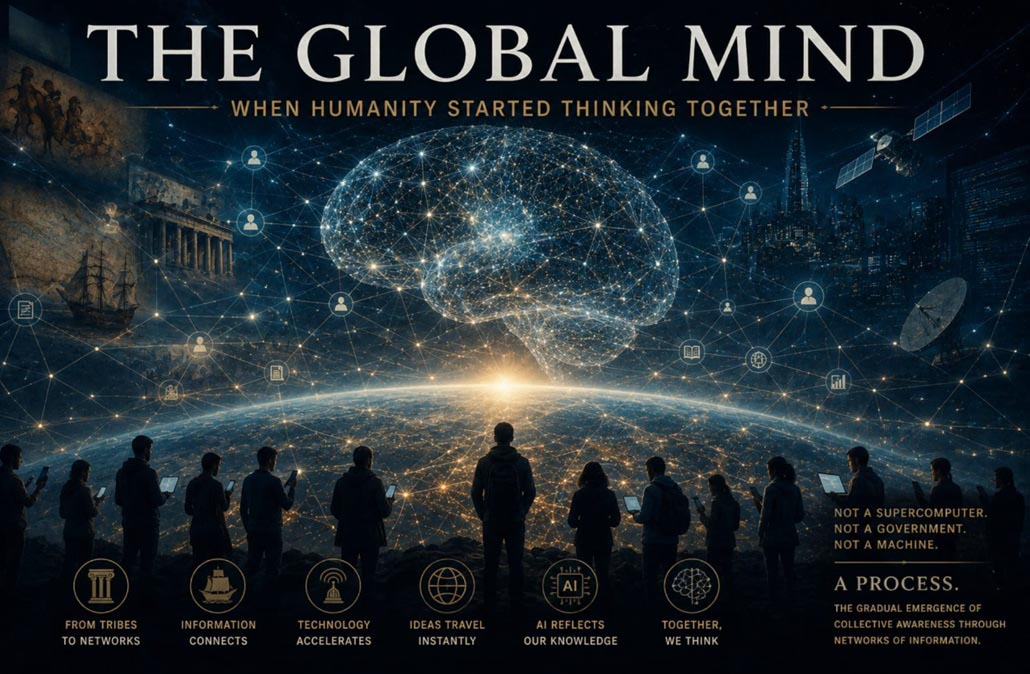
The Global Mind
For most of history, human knowledge was local.
A farmer understood a particular landscape. A sailor knew a coastline. A merchant knew the routes, prices and customs of several markets. A ruler depended on reports that could arrive weeks or months after the events they described.
No one saw the whole system.
Information travelled at the speed of feet, horses, ships and memory. Every community carried a fragment of reality, but those fragments were separated by distance, language and time.
Then humanity connected them.
Roads linked cities. Writing allowed knowledge to outlive the person who carried it. Printing multiplied texts. Telegraphs separated communication from physical travel. Radio and television created audiences across entire nations. The internet connected billions of people, institutions and machines in something approaching real time.
Humanity did not suddenly acquire one brain.
But civilization began behaving less like a collection of isolated minds and more like a network capable of remembering, reacting and learning at planetary scale.
A World Too Large for One Person
No individual can understand modern civilization completely.
No one knows every language, scientific field, political system, technology, supply chain and cultural tradition. Even specialists operate within narrow territories of knowledge and rely on other specialists for almost everything outside them.
A surgeon does not need to understand the complete history of metallurgy to use an instrument. A programmer does not need to manufacture the computer on which the code runs. A city resident can drink clean water without knowing every stage of treatment, transport and regulation that made it available.
Civilization functions because understanding is distributed.
Knowledge exists in people, but also in books, laboratories, databases, institutions, machines, customs and procedures. The system remembers more than any participant. It can solve problems no individual could solve alone because the relevant information is divided across many minds and structures.
This is not merely cooperation.
It is a change in where intelligence resides.
The Brain Analogy—and Its Limits
A neuron does not understand the brain.
It receives signals, changes its state and passes signals onward. No single neuron contains a thought, a memory or a personality. Yet through the interaction of vast numbers of cells, something larger emerges.
A mind.
Civilization invites a similar comparison. Individuals exchange information. Information forms patterns. Patterns guide coordination. Coordination produces outcomes that no participant designed in full.
Languages evolve without one author. Markets adjust through countless local decisions. Scientific knowledge advances through experiments, criticism, replication and correction distributed across generations.
The result can appear intelligent even when no one controls the whole process.
But the analogy must remain limited.
Human societies are not literally brains, and people are not neurons. Neurons do not possess independent lives, political rights or competing moral visions. Human beings can resist, lie, withdraw, misunderstand and deliberately change the network around them.
The comparison is useful only at the structural level: complex coordination can emerge from participants who understand only a small part of the whole.

The Internet as a Nervous System
The internet accelerated this transformation dramatically.
A local event can become globally visible within minutes. A scientific paper can be examined across continents. A software error can be identified by strangers who never meet. During a disaster, millions of people can observe, discuss and respond while the event is still unfolding.
Civilization now detects parts of itself almost instantly.
In that limited sense, the internet resembles a nervous system. It carries signals between distant regions and allows the larger structure to react.
But a nervous system does not merely transmit information. It filters, prioritizes and interprets it.
The internet does the same.
Search engines determine which pages become visible. Social platforms rank messages. Recommendation systems decide which fragments of culture reach particular users. Translation systems move ideas across linguistic boundaries. Algorithms shape what the network appears to know about itself.
The global mind does not see reality directly.
It sees through interfaces.
And whoever designs those interfaces influences what the collective system notices, remembers and ignores.
Intelligence Without a Central Ruler
One of the strangest features of global coordination is that no single person controls the whole thing.
Governments regulate parts of communication. Corporations own critical platforms and infrastructure. Institutions control databases, standards and access. Power is real and often concentrated.
Yet no authority directs every conversation, invention, transaction and cultural shift.
Coordination frequently emerges without a central plan.
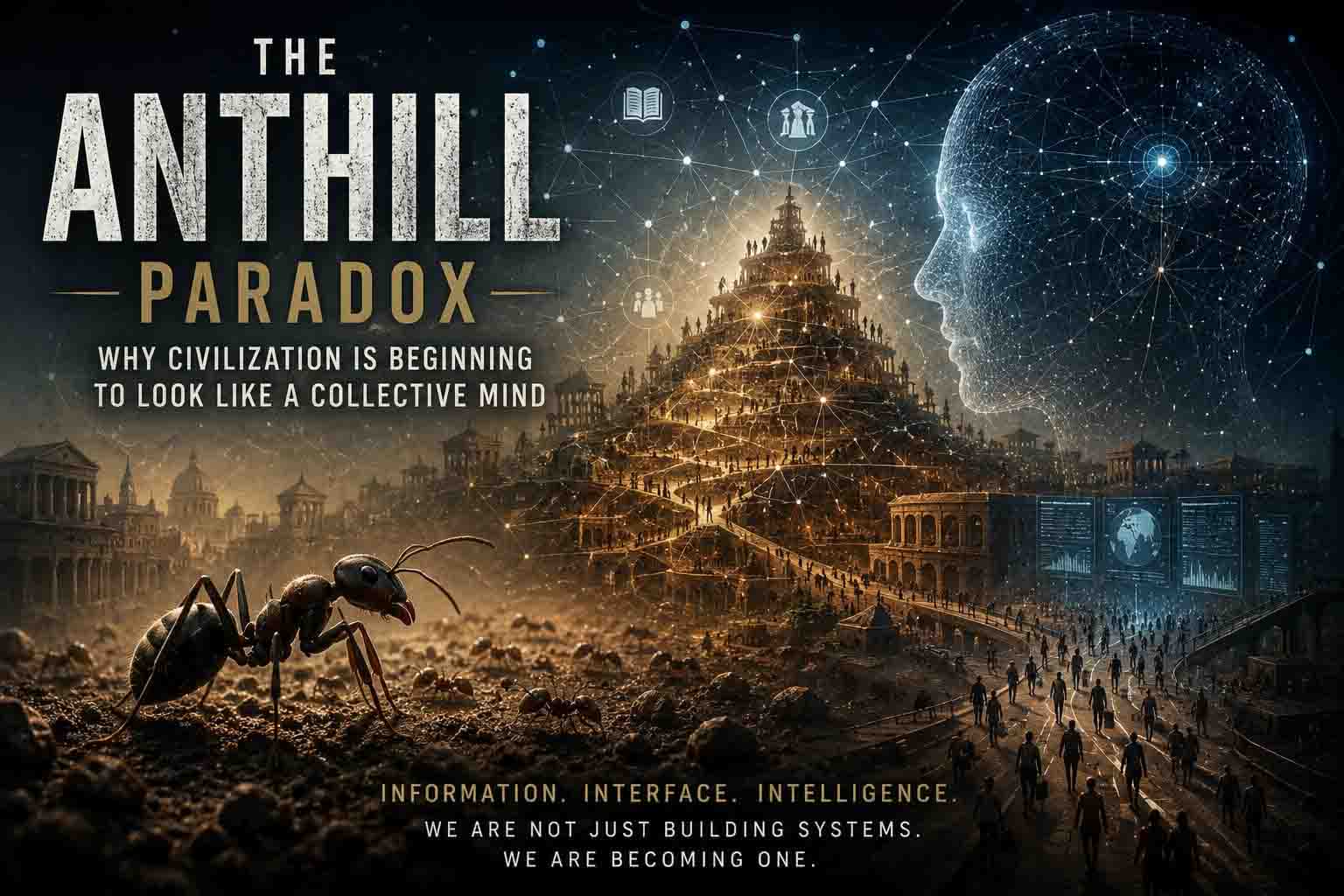
An ant colony offers a useful comparison. An individual ant possesses limited information. It responds to local conditions and chemical signals. Through repeated interactions, the colony locates food, adjusts routes and allocates labour.
The intelligence appears at the level of the system.
Human civilization operates through far richer forms of language, memory and intention, but the structural principle is familiar. Local actions can generate large-scale order without one participant understanding the final result.
This is both powerful and dangerous.
A decentralized system can adapt quickly. It can also spread panic, misinformation and destructive behaviour without anyone issuing a command.
Emergence does not guarantee wisdom.
When Connection Becomes Conformity
The Global Mind should not mean that everyone begins thinking the same thing.
A brain works because different regions perform different functions. A civilization also depends on disagreement, specialization and competing interpretations. The network becomes more intelligent when it can compare perspectives, not when every voice repeats one conclusion.
Connection can preserve diversity.
It can also flatten it.
Platforms reward messages that travel easily. Complex ideas are compressed into headlines, clips and emotional signals. Minority languages, local knowledge and difficult arguments may disappear beneath content optimized for the widest response.
A network can connect humanity while reducing the range of what humanity is allowed to notice.
The measure of collective intelligence is therefore not merely how quickly information spreads.
It is whether the system can preserve difference long enough to learn from it.
AI as the Mirror of Civilization
Artificial intelligence does not arrive from outside humanity’s informational world.
It is trained on human language, images, records, categories and accumulated decisions. It reflects the structures civilization has already produced: knowledge, creativity and insight, but also prejudice, error and omission.
AI therefore functions less like an alien mind descending into history and more like a new interface through which civilization examines its own archive.
A person can ask one system to compare philosophy, biology, mythology and computer science within a single conversation. That would have required several libraries and years of correspondence in another age.
The mirror has become faster.
It has also become active.
It does not merely display stored information. It summarizes, connects and generates. That makes it useful, but it also gives the mirror power to reshape the reflection.
The question is no longer only what humanity has recorded.
It is what the interface selects from that record—and how faithfully it distinguishes knowledge from invention.
The History of Increasing Connection
Stereo History can be understood partly as the history of connections becoming faster, wider and more difficult to reverse.
Roads connected settlements.
Ships connected coastlines and continents.
Printing connected generations of readers.
Telegraphs connected distant decisions.
Broadcasting connected mass audiences.
The internet connected people, documents and machines.
Artificial intelligence now begins connecting relationships inside that information—finding patterns across fields that previously remained separated by institutions, languages and human limits.
Each step increases coordination.
Each also creates new forms of dependence.
A road can carry armies as well as trade. Printing can preserve knowledge and propaganda. Networks can coordinate aid and surveillance. Intelligence at the level of the system does not guarantee that its goals are humane.
A mind can become brilliant.
It can also become confused.
Watch the Video
How to Read the World

Current Knowledge
Collective intelligence describes forms of problem-solving, knowledge production and coordination that emerge through interactions among multiple individuals or agents. Human societies have always depended on distributed knowledge, but writing, printing, telecommunications and digital networks greatly increased the speed and scale at which information can be preserved and exchanged.
The internet is not literally a nervous system, and civilization has not been shown to possess consciousness as a single subject. Comparisons with brains and ant colonies are structural analogies used to examine emergence, distributed information and coordination.
Artificial intelligence is produced from human-built systems, training data and institutional decisions. It can reveal patterns across large bodies of information, but its outputs may also reproduce errors and distortions contained in those sources.
Open Questions
Can a network become increasingly intelligent without becoming conscious? What would distinguish civilization-scale awareness from rapid information exchange and coordination?
Who determines what the global system sees when a small number of platforms organize access to information? Can collective intelligence remain decentralized when infrastructure, data and computational power are concentrated?
Does artificial intelligence expand the diversity of human thought by connecting previously separated fields—or gradually narrow it by presenting the same optimized synthesis to everyone?
And can humanity learn to think together without requiring everyone to think alike?
Transhumation Interpretation
The Global Mind is not a hidden supercomputer governing civilization.
It is a process.
Knowledge moves beyond isolated individuals. Memory enters external structures. Networks connect those structures. New patterns become visible at scales no person can hold alone.
Humanity has always thought collectively, but the delays once separating its fragments were enormous. Today those delays are shrinking.
For the first time, civilization can observe parts of itself while they are changing.
That does not make the species one conscious being. It creates the possibility of something more ambiguous: a planetary system capable of reaction, learning and self-description without possessing one central observer.
Artificial intelligence may become the librarian of this emerging mind—the interface through which civilization searches, compares and interprets its own accumulated memory.
But a library does not become wise merely because all its books are connected.
The decisive question is whether the network can preserve truth, difference and correction while operating at a speed no individual can supervise.
Humanity is beginning to think together.
It has not yet learned how to agree on what deserves to be remembered.
How to Read the World
FAQ
What is the Global Mind?
The Global Mind is the idea that humanity increasingly functions as a connected informational system in which knowledge and coordination emerge across networks rather than remaining inside isolated individuals.
Is civilization literally a brain?
No. The comparison concerns distributed signals and emergent coordination. Human beings remain independent persons, not biological neurons.
Does the Global Mind mean everyone thinks the same way?
No. Diversity and disagreement are essential to collective intelligence. Uniformity can make a network less capable of recognizing mistakes.
How did the internet contribute to the Global Mind?
It greatly increased the speed, reach and volume of communication, allowing distant people and institutions to exchange information almost instantly.
Why is there no single central controller?
Many forms of coordination emerge from interactions among participants rather than from one directing authority, although governments and corporations still exercise substantial control over parts of the network.
How do ant colonies relate to the idea?
They show how limited local actions can produce adaptive behaviour at the level of a larger system without one participant understanding or directing the whole.
What role does artificial intelligence play?
AI can function as a mirror and interface to humanity’s accumulated information, helping people locate and connect patterns across large bodies of knowledge.
Is the Global Mind conscious?
There is no evidence that civilization possesses one unified conscious perspective. Collective intelligence and consciousness are different ideas.
How does this connect to Stereo History?
Stereo History examines how technologies such as roads, ships, printing, telecommunications and digital networks change the structure of collective human experience.
What is the central Transhumation idea?
Humanity is not becoming one person. It is building a system in which information can connect, react and generate patterns at a scale larger than any individual mind.
Continue the Transhumation Series
- Forgotten Religion | Ancient Gods, Symbols and the Hidden Structures of Human Civilization
- The Last Religion | Death, Immortality and the Future of Humanity
- The New Theurgy | AI, Information and the Future of Human Civilization
- End of Branding: You Were Never Meant to Become a Product
- Baal vs Ishtar: Why Ancient Gods Never Disappeared